
Avoiding Retirement Account Prohibited Transaction Penalties
- Authority
- Internal Revenue Service
- Rule type
- statute
- Jurisdiction scope
- US federal
- Source text
- Read primary rule text ↗
Prohibited transactions trigger 15% excise tax, 100% failure-to-correct tax, and IRA disqualification; correction may prevent escalation but not disqualification
A prohibited transaction is not an ordinary retirement tax mistake with a clean “fix it and move on” sequence. Once the transaction occurs, counsel has to place the matter on two tracks at the same time: the excise-tax track under IRC Section 4975 and, for an IRA, the status-collapse track under IRC Section 408(e)(2).
The penalty ladder starts with a 15% excise tax on the “amount involved” in the prohibited transaction. If the transaction is not corrected within the statutory correction period, the tax can escalate to 100% of that amount. For an IRA, a prohibited transaction also causes the account to lose IRA status as of the first day of the taxable year in which the transaction occurred, with all assets treated as distributed at fair market value on that date.[1]
That is the controlling warning for any effort to avoid retirement tax mistake legal penalties in this area: statutory correction may prevent the 100% excise tax from attaching, but it does not, by itself, undo IRA disqualification.
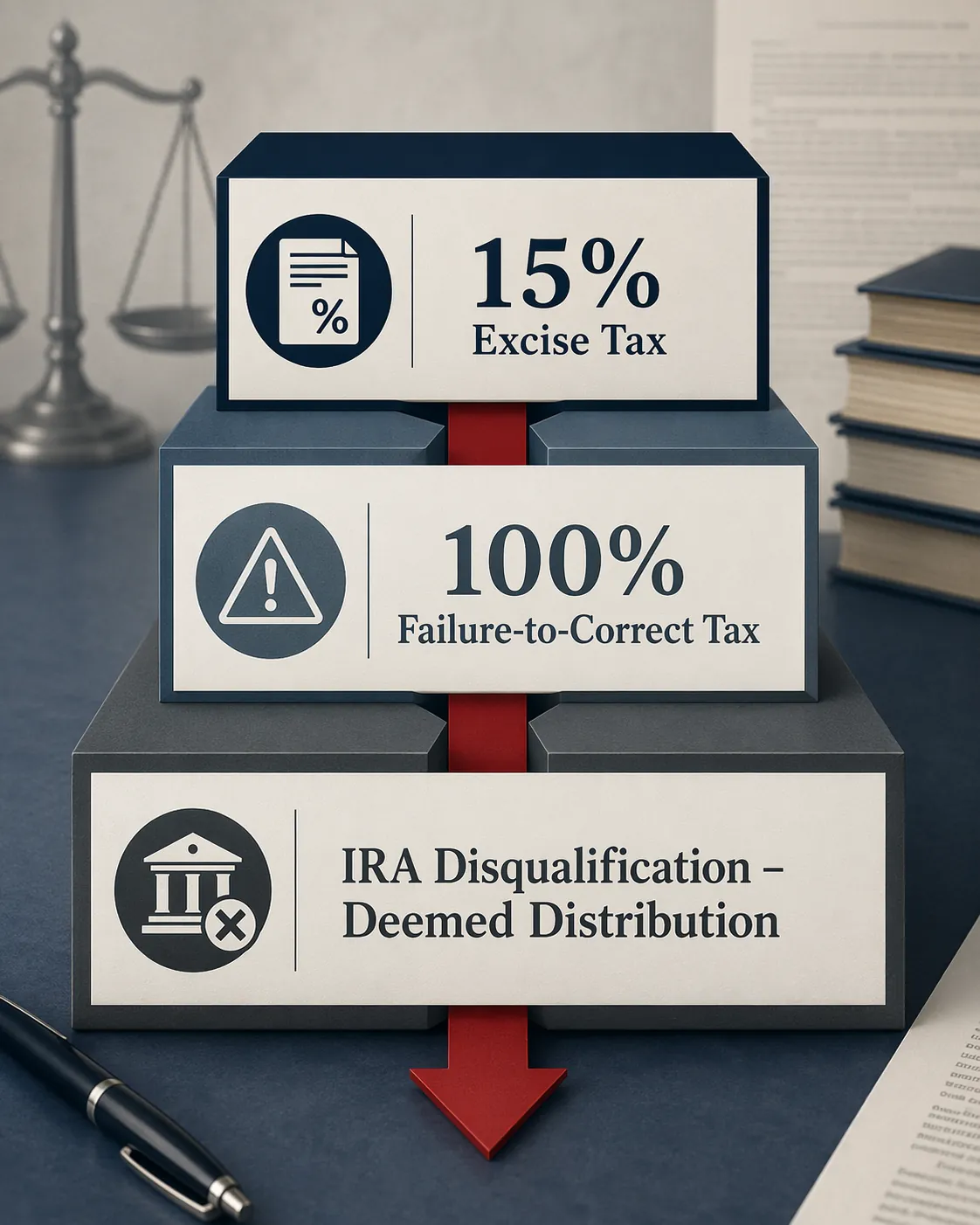
The Penalty Ladder Starts Before Anyone Talks About Cure
Section 4975 defines prohibited transactions between a plan, including an IRA, and a disqualified person. The disqualified-person category reaches fiduciaries, plan sponsors, certain family members, and entities owned 50% or more by disqualified persons. The prohibited-transaction list includes sales, exchanges, leases, loans, extensions of credit, transfers of plan assets, use of plan assets for the benefit of a disqualified person, and fiduciary self-dealing.[1]
The first tax is mechanical. Section 4975(a) imposes a 15% excise tax on the amount involved for each year, or part of a year, in the taxable period. The “amount involved” is generally tied to the consideration given or received in the transaction, not the full value of the account unless the transaction itself supports that measure.[1]
The second tax is the escalation point. Section 4975(b) imposes a 100% tax on the amount involved if the prohibited transaction is not corrected within the taxable period. The correction period typically runs until 90 days after IRS notice, subject to extension by agreement.[1]
The third consequence is different in kind. For an IRA, Section 408(e)(2) does not merely add another percentage. It says the account ceases to be an IRA as of January 1 of the year in which the prohibited transaction occurs, and the account is treated as distributing all assets at fair market value as of that first day of the year.[1]
| Consequence | Trigger | What It Measures | Why Correction Is Not Enough |
|---|---|---|---|
| 15% excise tax | A prohibited transaction between the plan or IRA and a disqualified person | The amount involved in the transaction | Correction may affect escalation, but the initial exposure has already attached |
| 100% failure-to-correct tax | Failure to correct within the statutory correction period | The amount involved in the transaction | Timely correction is aimed at avoiding this tier |
| IRA disqualification | A prohibited transaction involving the IRA owner or beneficiary | All IRA assets treated as distributed at fair market value as of January 1 of the transaction year | Section 408(e)(2) operates as a status rule, not just an excise-tax rule |
The practical consequence is that a lawyer assessing exposure should resist the client-facing shorthand that treats “correction” as a universal solvent. It may matter a great deal for the 100% tax. It does not answer whether the IRA has already ceased to be an IRA.
Two Clocks, Two Bodies of Consequence
Section 4975 and Section 408(e)(2) are often discussed together because they are triggered by the same prohibited-transaction concept. They should not be collapsed into one remedial sequence. Section 4975 asks whether an excise tax applies to a disqualified person and whether correction prevents the tax from escalating. Section 408(e)(2) asks whether the IRA kept its tax-favored status at all.
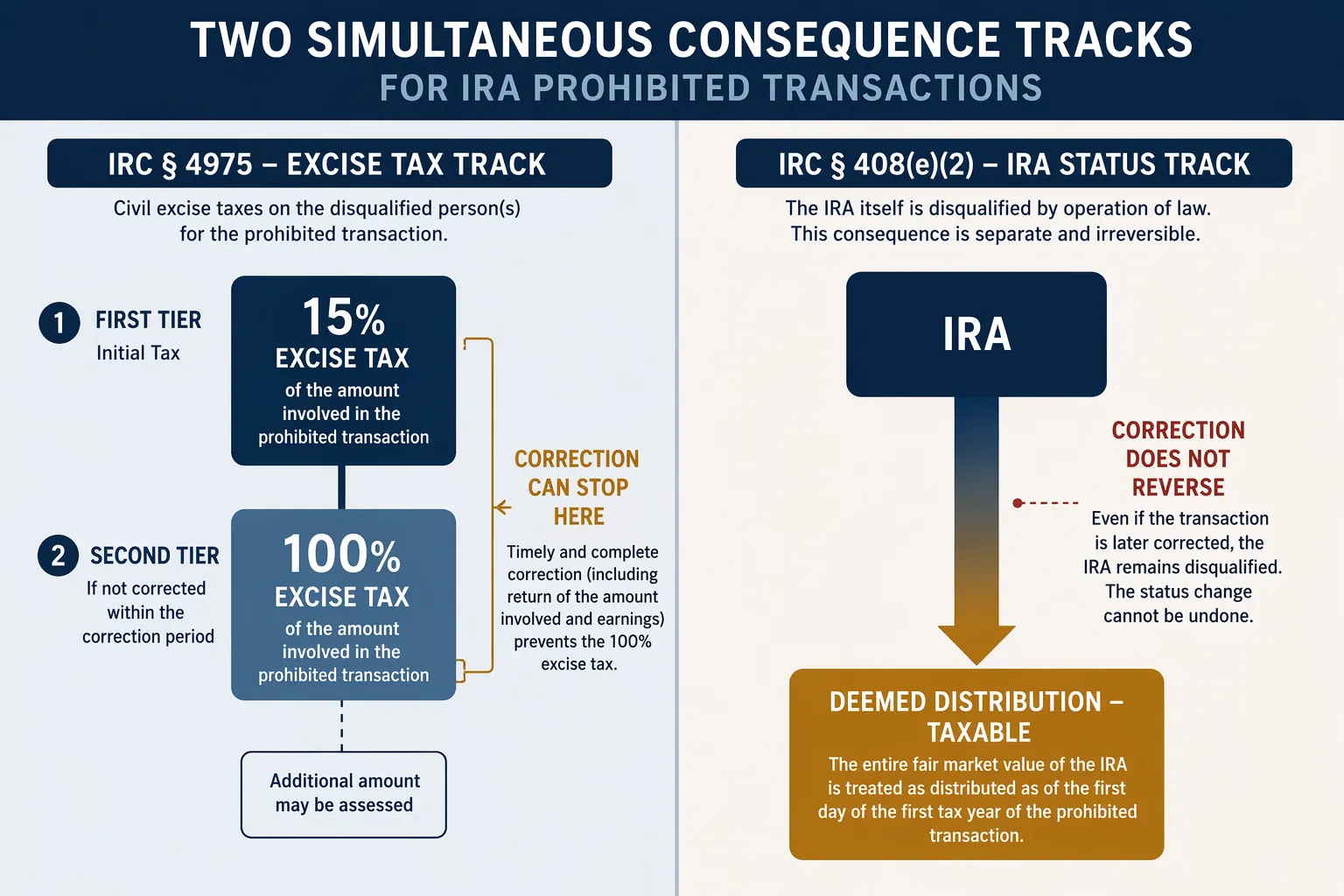
This is where many prohibited-transaction assessments go wrong. A corrective step that returns property, unwinds a loan, or restores value may be relevant to the statutory correction period. But the IRA-status rule looks back to the first day of the year in which the prohibited transaction occurred. If disqualification applies, the tax problem is no longer confined to the transaction. It reaches the entire account.
The IRS has taken the position that an IRA owner may face both the Section 4975 excise-tax regime and the Section 408(e)(2) deemed-distribution income tax consequences. That position has been contested, and Swanson is the important caution against treating the government’s broadest prohibited-transaction theory as automatically correct. In Swanson v. Commissioner, the Tax Court rejected the IRS’s argument that an IRA’s purchase of newly issued stock of a corporation whose director was the IRA owner was per se prohibited on those facts, and it awarded litigation costs after finding the IRS position unreasonable.[2]
Swanson does not supply a blanket safe harbor for closely held structures, and it does not resolve every cumulative-penalty question outside its facts. Its more useful boundary is narrower: proximity to a disqualified person is not always enough. The prohibited-transaction analysis still needs a transaction, a disqualified person, and a direct or indirect benefit or dealing of the kind the statute reaches.[2]
The scale of the issue explains why this is not a boutique drafting problem. In 2017, the GAO estimated the self-directed IRA marketplace at approximately $50 billion across roughly 500,000 accounts and concluded that the IRS could better manage risks associated with alternative investments in IRAs.[3] That is not a current market-size figure. It is still enough to explain why alternative-asset IRAs invite compliance attention, especially where the asset is controlled, financed, managed, or personally supported by the account owner.
The Case Boundaries That Matter in Practice
The Tax Court cases are most useful as boundary markers, not morality plays. They show where formal separation stopped working: a new corporation, an IRA-owned LLC, or a separate investment vehicle did not save the taxpayer once the court found a guarantee, salary, loan, co-investment, or indirect personal benefit.
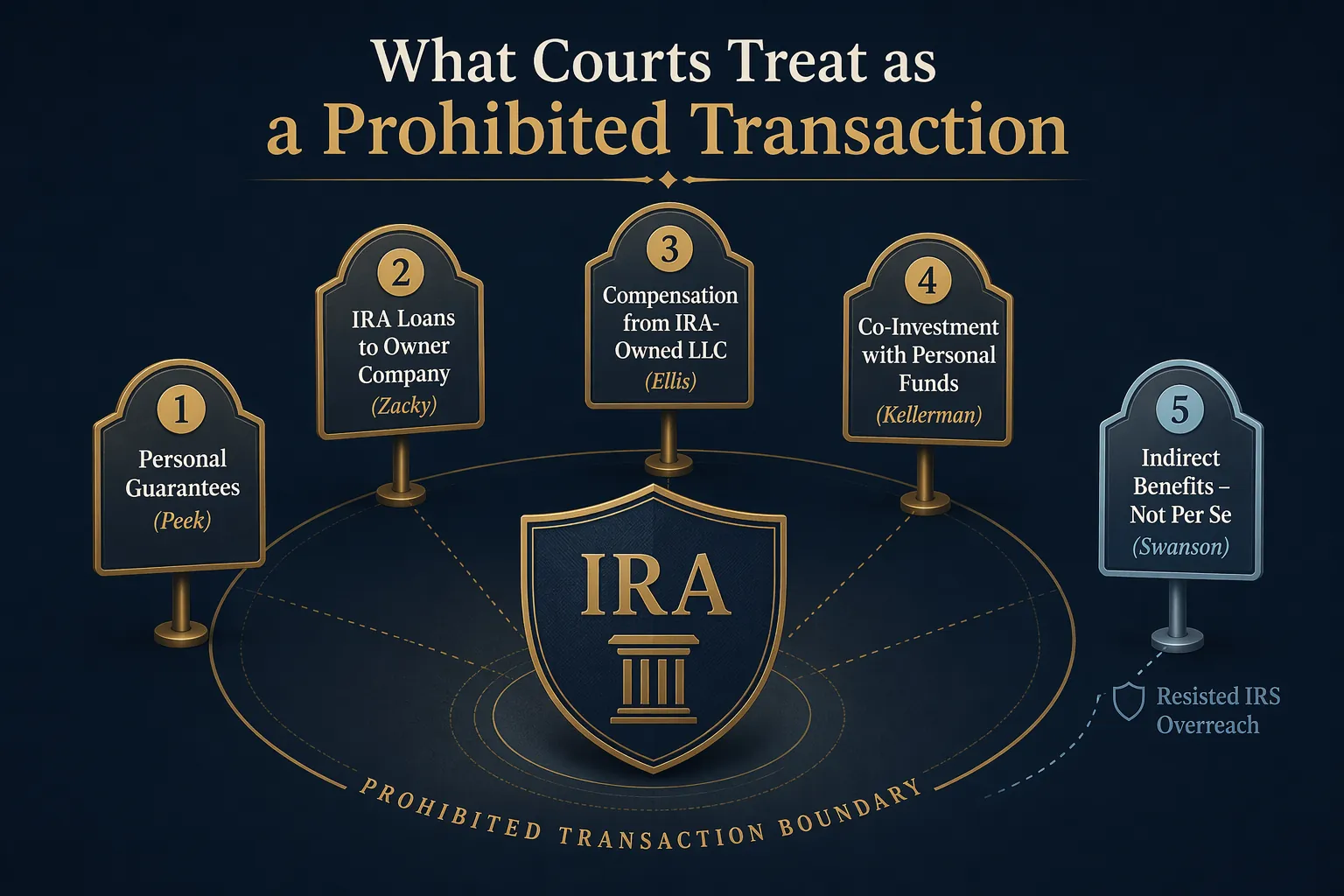
Swanson: No Per Se Violation on Those Facts
Swanson is the taxpayer-favorable boundary. The IRA bought newly issued stock in a corporation, and the IRA owner served as a director. The court rejected the IRS’s automatic prohibited-transaction theory on those facts.[2] For counsel, the case is useful when the government’s theory skips too quickly from relationship to violation.
Its value is also easy to overstate. Swanson is not a general endorsement of checkbook IRA structures, newly formed entities, or owner-adjacent investments. It says the statutory analysis must still be done. It does not say later personal support, compensation, loans, or personal benefit can be routed through an entity without consequence.
Peek: Personal Guarantees Cross the Credit Line
Peek v. Commissioner supplies one of the cleanest operational warnings. The IRA owners personally guaranteed a loan to an entity owned by their IRAs. The Tax Court held that the guarantees were indirect extensions of credit between disqualified persons and the plans, triggering prohibited-transaction consequences.[4]
The structure mattered less than the support. If an IRA-owned company needs the owner’s personal balance sheet to obtain credit, the guarantee is not just paperwork outside the IRA. It is the owner putting personal credit behind the IRA investment, and the prohibited-transaction regime treats that as a credit transaction with a disqualified person.
Zacky and Ellis: Owner-Controlled Companies Do Not Absorb Self-Dealing
Zacky v. Commissioner involved loans from an IRA to a company wholly owned by the IRA owner. The Tax Court treated the loans as self-dealing and found prohibited transactions.[5] The lesson is direct: a company controlled by the IRA owner cannot be treated as a neutral borrower merely because the funds originate in the IRA.
Ellis v. Commissioner addressed a different form of benefit. The IRA owned an LLC, and the IRA owner received salary from that IRA-owned LLC. The court held the salary arrangement was a prohibited transaction.[6] Compensation is often where the “separate entity” story collapses, because the economic benefit to the owner is no longer abstract or remote.
Kellerman: Co-Investment Can Create the Benefit
Kellerman v. Commissioner shows the risk in putting IRA money and personal money into the same transaction. The Tax Court held that co-investing an IRA alongside personal funds produced an indirect benefit and resulted in a prohibited transaction.[7]
The boundary is not simply whether the IRA paid the owner. The question is whether the owner’s personal investment, personal credit, or personal economics were advanced by the IRA’s participation. That is why co-investment deserves separate review rather than being filed under ordinary diversification or deal-sourcing.
DOL Opinion Letters Reinforce the Bright Lines
Department of Labor opinion letters point in the same direction on credit support and indirect use. ERISA Opinion Letter 2009-03A treats pledging personal assets to secure an IRA-owned entity’s loan as a prohibited transaction.[8] ERISA Opinion Letter 2006-01A treats indirect leasing of property between a disqualified person and a plan as a prohibited transaction.[9]
Those letters should not be made to carry more than they say. They are most useful as bright-line reinforcement: personal collateral and indirect leasing are not made harmless by inserting an entity between the IRA and the disqualified person.
Correction Paths After the Transaction Has Already Happened
Correction belongs after classification. The first question is not “How do we fix it?” but “What has already been triggered?” A correction plan aimed at the wrong tier can leave the client with a solved paperwork problem and an unresolved deemed-distribution problem.
Statutory correction under Section 4975(f)(5) generally requires undoing the prohibited transaction to the extent possible and placing the plan in a financial position no worse than it would have occupied if the disqualified person had acted under the highest fiduciary standards. If completed within the correction period, correction can prevent the 100% tax under Section 4975(b).[1]
That correction is not the same as reinstatement of IRA status. IRS plan-correction materials distinguish correction programs for retirement plan errors from the consequences of plan disqualification, and prohibited transactions are generally outside the Self-Correction Program for operational errors.[10][11]
- SCP: useful for certain operational failures, but generally not the path for prohibited transactions.
- VCP: a possible submission route for eligible retirement plan correction issues, but not a guarantee that an IRA prohibited transaction will be unwound for all tax purposes.
- Closing agreement: a negotiated resolution path in more serious or exposed matters, with outcome dependent on the facts and the government’s position.
- Section 4975 statutory correction: the key route for avoiding the 100% failure-to-correct tax, but not a standalone answer to Section 408(e)(2).
The absence of a broad good-faith defense is part of the severity. Prohibited-transaction exposure is not treated like a missed required minimum distribution where reasonable-cause relief may be central to the analysis. If the prohibited transaction occurred, ignorance of the rule does not supply the missing statutory exception.
A Counsel’s Exposure Sequence
A defensible assessment starts with the transaction, not the account wrapper. Identify the sale, loan, lease, guarantee, salary payment, co-investment, collateral pledge, or other transfer of value. Then identify the disqualified person and the benefit. Only after that does the penalty ladder become usable.
| Assessment Question | Reason It Matters |
|---|---|
| What transaction occurred? | Section 4975 requires a prohibited transaction, not merely an uncomfortable relationship. |
| Who is the disqualified person? | The statute turns on dealings between the plan or IRA and a disqualified person. |
| Was there a direct or indirect benefit, credit support, compensation, loan, lease, or self-dealing? | The cases treat indirect economics as enough in several recurring structures. |
| What is the amount involved? | That amount anchors the 15% and potential 100% excise taxes. |
| Is the correction period still open? | Timely correction may prevent escalation to the 100% tax. |
| Does Section 408(e)(2) apply to the IRA? | If so, the account-status consequence must be evaluated separately from excise-tax correction. |
A self-directed IRA LLC, a newly formed corporation, or formal separation between the owner and the investment entity may be relevant to the facts. None of those features answers the statutory question by itself. Swanson prevents the analysis from becoming automatic against the taxpayer. Peek, Zacky, Ellis, Kellerman, and the DOL letters prevent it from becoming automatic for the taxpayer.
The final assessment is therefore not one calculation. It is a sequence: classify the transaction, test the disqualified-person relationship, measure the amount involved, determine whether correction can still prevent the 100% excise tax, and separately decide whether the IRA has already lost its status as of January 1 of the transaction year. In prohibited-transaction work, the account’s status can be the penalty.
References
- Retirement topics — Prohibited transactions, IRS, irs.gov/retirement-plans/plan-participant-employee/retirement-topics-prohibited-transactions
- Swanson v. Commissioner, 106 T.C. 76, 1996
- IRAs: IRS Could Better Manage Risks Associated with Alternative Investments, GAO, 2017, GAO-17-102
- Peek v. Commissioner, 140 T.C. 12, 2013
- Zacky v. Commissioner, T.C. Memo 2020-108
- Ellis v. Commissioner, T.C. Memo 2011-63
- Kellerman v. Commissioner, T.C. Memo 2022-107
- ERISA Op. 2009-03A
- ERISA Op. 2006-01A
- Correct your retirement plan errors, IRS, irs.gov/retirement-plans/correct-your-retirement-plan-errors
- Tax consequences of plan disqualification, IRS, irs.gov/retirement-plans/tax-consequences-of-plan-disqualification
Operationalizing workflow
No workflow has been explicitly linked to this obligation yet. See Workflows generally.
Illustrative cases
No illustrative case is currently tracked for this obligation. See Risk Digest for documented incidents generally.
← Back to RegulationReport a correction or tip
Spotted an outdated figure, a misstated fact, or a ruling this regulation entry should reflect? Public comments are disabled for this content given the professional cost of a misreported case outcome, penalty amount, or rule text — use the structured correction channel instead.
Report a correction or tip for this record →