
Constitutional Hurdles for the Russia Sanctions Tariff Bill
- Authority
- U.S. Congress
- Rule type
- statute
- Jurisdiction scope
- US federal
- Source text
- Read primary rule text ↗
As of July 30, 2026, S.5025—the Russia sanctions bill proposed by Blumenthal and Graham in the shorthand used by many practitioners—is still proposed legislation, not enacted law. The Senate took a first procedural vote on July 28, with an 86-12 margin, but additional Senate action, House consideration, and final statutory text remain unsettled.[1][2] That status point belongs at the front because the legal analysis turns on exact words: who must make the finding, when, what happens if the finding is made, and how much discretion remains after Congress sets the machinery in motion.
The same caution applies to the Supreme Court’s 2026 IEEPA tariff ruling. TIME has described the ruling as holding that IEEPA alone did not authorize sweeping presidential tariffs, while leaving open what Congress could do through a more specific delegation.[3] That is the distinction on which this analysis depends. Before the bill is treated as a litigation-ready test case, the official opinion—not a news summary of it—has to be checked for the holding, reasoning, limiting language, and any separate opinions.
The 90-day finding is the first provision to read
The most exposed part of S.5025 is not the tariff rate. It is the mandatory determination cycle: after a specified period, the president would have to determine whether Russia has negotiated in good faith before the secondary tariff mechanism turns on. Bill summaries describe that period as 90 days.[4] For counsel, that is the first operational alarm. A tariff delegation asks whether Congress supplied enough standards for executive action. A mandatory foreign-policy determination asks a different question: whether Congress may require the president to make a specified diplomatic judgment on a fixed timetable, with trade consequences attached.
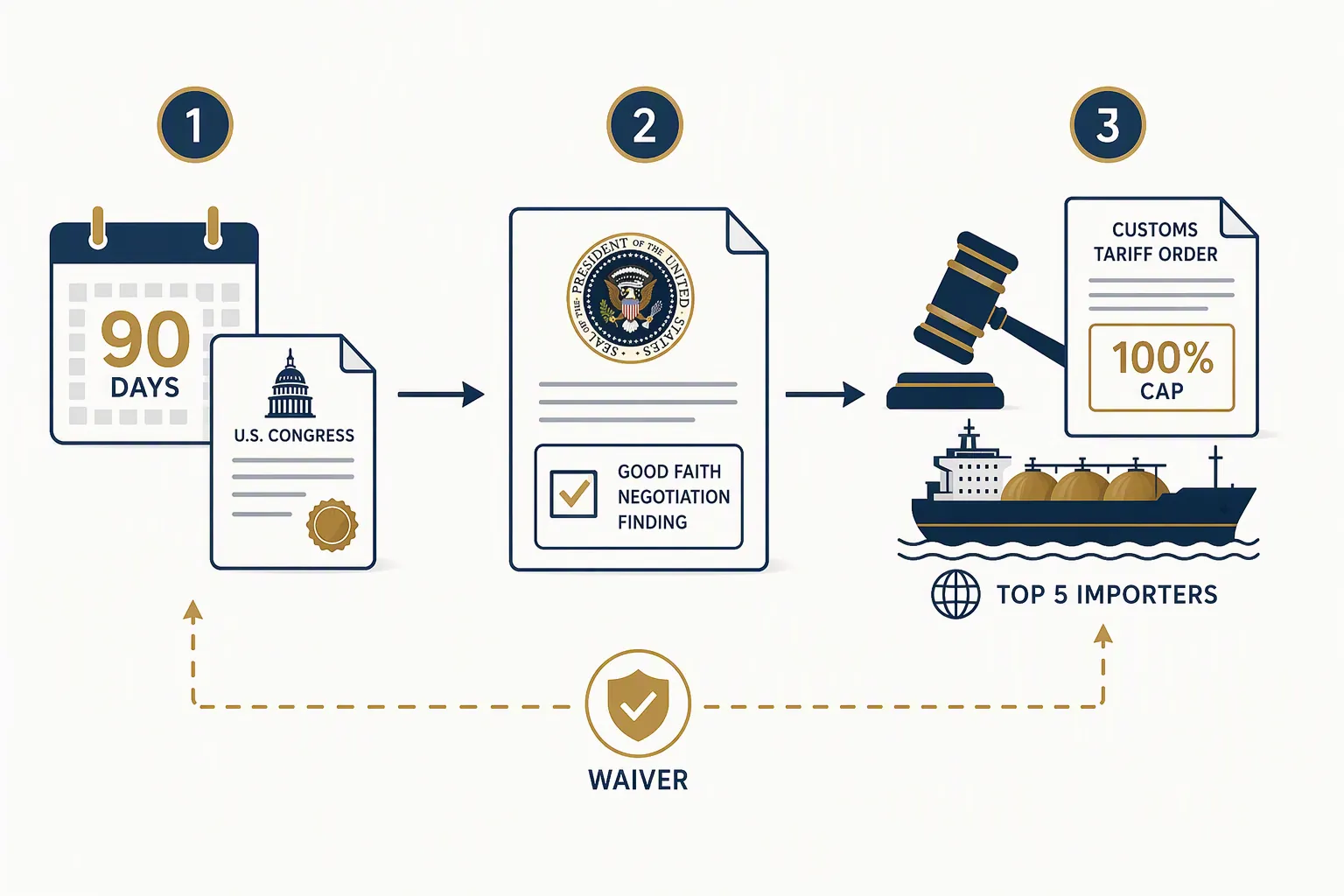
That difference matters because a court can uphold a tariff statute and still scrutinize the trigger. Congress has long written trade statutes that depend on executive findings. But S.5025’s vulnerable feature is the compression of timing, substance, and consequence into a sanctions trigger: the president must assess Russia’s negotiating posture; the assessment must occur on the statutory clock; and an adverse finding would expose certain import channels to secondary tariffs. The legal fight would likely be less theatrical than the public debate suggests. It would turn on whether this is a permissible condition Congress attached to a sanctions program, or an impermissible command to render a core foreign-policy judgment.
| Mechanism | Why it matters legally |
|---|---|
| 90-day good-faith negotiation determination | Creates the most direct separation-of-powers issue because Congress is not merely authorizing a tool; it is prescribing the timing and subject of a foreign-policy judgment.[4] |
| Secondary tariffs capped at 100% | Gives the delegation a defined ceiling, which makes the nondelegation challenge harder than it would be under an open-ended tariff grant.[1] |
| Application to top-five importers of Russian oil and gas | Narrows the class of affected countries but leaves implementation questions about ranking methodology.[1][5] |
| 15% natural-gas exemption | Shows statutory tailoring, especially for gas-dependent economies, though exact application would depend on final text and implementing rules.[4] |
| 180-day reassessment cycle | Builds in periodic review rather than leaving the tariff consequence frozen indefinitely.[4] |
| Single national-security waiver framework | Preserves executive flexibility, but also becomes a focal point for challenges alleging arbitrary or uneven implementation.[4] |
Why the tariff delegation may be more durable than the headlines imply
The nondelegation argument is the obvious headline issue after the IEEPA ruling, but it is not necessarily the bill’s weakest point. If the Court’s 2026 decision is read as a statutory-authority ruling—IEEPA itself did not authorize broad tariffs—then S.5025 is Congress trying to supply the missing authority directly. That is not the same as saying Congress cannot delegate tariff power at all for a foreign-policy sanctions objective.[3]
The bill’s narrowing is legally significant. Earlier versions of the sanctions proposal were publicly discussed around a much higher tariff figure; S.5025, as described in current materials, uses a 100% ceiling.[1][3] It also limits the affected universe to the top-five importers of Russian oil and gas, recognizes a 15% natural-gas exemption, requires reassessment every 180 days, and uses a waiver structure rather than leaving implementation wholly unguided.[1][4] Those are not minor drafting choices. They give a reviewing court concrete limiting principles to identify.
A serious nondelegation challenge would still be available. A challenger could argue that Congress has authorized tariffs for a foreign-policy objective without sufficiently defining the economic, diplomatic, or national-security criteria that determine when and how the tariffs should apply. But the best answer for the government would be straightforward: Congress selected the target conduct, defined the covered importers, capped the sanction, required periodic reassessment, and preserved waiver authority for national-security reasons. Under the ordinary intelligible-principle analysis, that is a much stronger record than a bare instruction to impose whatever tariff the president considers useful.
That is why the post-IEEPA question should be framed carefully. The Court’s reported ruling did not eliminate Congress’s tariff power. Nor, on the materials available, did it decide that tariff delegations tied to foreign policy are categorically unconstitutional.[3] S.5025 instead tests how much specificity Congress must provide when it converts a sanctions judgment into a customs consequence.
The separation-of-powers problem is narrower and sharper
The 90-day trigger is harder to defend with the same limiting-principle answer. A tariff cap helps answer “how much.” A top-five-importer rule helps answer “who.” A reassessment cycle helps answer “for how long.” None of those features fully answers whether Congress may force the president to make a good-faith-negotiation determination about Russia on Congress’s clock.
The constitutional difficulty is not that Congress is legislating in foreign affairs. It plainly can legislate sanctions, trade restrictions, customs duties, appropriations limits, reporting obligations, and waiver conditions. The difficulty is that S.5025 appears to connect a mandatory presidential diplomatic judgment to a tariff consequence. That creates a cleaner target for separation-of-powers litigation than the broader claim that sanctions tariffs are inherently unconstitutional.
A government defense would likely characterize the determination as a statutory factfinding condition. Congress often requires executive officials to make findings before legal consequences follow. A challenger would answer that this finding is not an ordinary administrative fact. “Russia has not negotiated in good faith” is a judgment about diplomacy, leverage, timing, negotiating posture, and presidential assessment of an adversary’s conduct. If Congress can require that judgment by a fixed date, the challenger would argue, it has moved beyond setting sanctions policy into commanding the president’s conduct of negotiations.
The procedural posture would matter. An importer challenging a tariff bill may not be the cleanest party to litigate presidential autonomy. But importers are likely to be the parties with money at stake, entries at Customs, and incentives to sue. Their strongest constitutional theory may therefore be a mixed one: the tariff was imposed under a statutory trigger that depended on an unconstitutional command to the president, and the importer is now paying the consequence.
That claim would not require a court to announce that Congress lacks sanctions authority. It would require the court to decide whether this particular trigger respects the line between Congress prescribing legal consequences and Congress compelling a foreign-policy determination. The absence of a clean precedent does not make the issue unknowable; it means litigants will spend their time on statutory structure, historical practice, and the practical degree of presidential discretion left by the final text.
Implementation risk starts with the importer lists
The top-five-importer structure is a limiting principle for constitutional purposes, but it is also an implementation problem. Atlantic Council analysis identifies likely oil importers as China, India, Slovakia, Hungary, and Azerbaijan, and likely gas importers as China, France, Belgium, Japan, and Hungary. The same analysis notes methodological ambiguity, including whether Turkey may rank third for oil depending on the data source and measurement approach.[5]
That ambiguity is not a side issue for affected companies. A top-five rule requires someone in the executive branch to decide what counts, over what measurement period, using what data, and how to treat blended products, transshipment, indirect purchases, pipeline volumes, LNG cargoes, and revised trade statistics. The statute can be narrow on paper and still generate litigation if the implementing methodology moves a country into or out of the covered group.
Counsel should separate two questions that political coverage often collapses. The first is whether Congress supplied a sufficiently definite category: top-five importers of Russian oil and gas. The second is whether the executive branch applies that category in a reasoned and reviewable way. The first question belongs mostly to constitutional delegation analysis. The second will look more like administrative law, customs classification, and record review.
Due process will be practical before it is theoretical
The due-process challenge most likely to reach a lawyer’s desk first is not abstract unfairness. It is cargo already moving. If secondary tariffs apply quickly after a presidential determination, importers may argue that goods purchased, financed, insured, shipped, or entered under one legal regime were exposed to a new and severe tariff consequence before they had a meaningful chance to adjust.
That does not automatically make the statute unconstitutional. Tariff changes often affect commercial expectations, and courts are not usually eager to convert disappointed pricing assumptions into due-process violations. The more credible challenge would focus on retroactive or near-retroactive application: the date used for coverage, whether Customs applies the tariff to goods already in transit, whether liquidation is suspended, whether protest rights exist, and whether importers receive administrable guidance before liability attaches.
For a company with exposure, the immediate triage is documentary. Purchase orders, bills of lading, financing documents, country-of-origin records, product composition, Russian-content certifications, and shipment dates will matter more than broad constitutional commentary. A facial challenge to S.5025 may be difficult. An as-applied challenge tied to a specific entry, date, and agency instruction may be more concrete.
The waiver provision cuts both ways
The waiver framework helps the government in a nondelegation fight because it prevents the statute from operating as a wholly mechanical trap in every circumstance. Brownstein describes S.5025 as using a single national-security waiver structure and notes a prohibition on waivers for state sponsors of terrorism.[4] That gives the executive branch room to address allied-country energy dependence, intelligence equities, or negotiations that are not captured by the tariff trigger alone.
But waiver discretion also creates the record that challengers will study. If similarly situated import channels are treated differently, or if waiver denials rest on unexplained methodology, the litigation may move away from nondelegation and toward arbitrary-and-capricious review, equal treatment arguments, or claims that the executive branch failed to follow the statutory criteria Congress actually enacted. The waiver is therefore both a constitutional safety valve and an administrative-law exposure point.
Bipartisan momentum is not legal durability
The 86-12 procedural vote matters for enactment odds and for government-relations planning.[2] It does not answer the constitutional questions. Nor does the political bargain around the bill, including the reported deal-making that helped move it forward, supply a litigation defense if the final statute contains an infirm trigger.[6]
That distinction is easy to lose because sanctions bills often arrive wrapped in urgency and bipartisan moral consensus. Courts may credit Congress’s national-security purpose, but they will still ask what Congress enacted. A strong vote can make a bill real. It cannot make a mandatory presidential finding immune from review.
The WTO issue is real, but it should not displace the domestic question
Affected trading partners would have an obvious reason to consider WTO claims if the United States imposes tariffs on goods from countries selected because of their Russian energy imports. The most likely frame would involve most-favored-nation treatment and the national-security exception under GATT Article XXI. That litigation would raise hard questions about sanctions, security, and trade discrimination.
For U.S. counsel advising importers, however, WTO exposure is usually an external pressure point rather than the first domestic remedy. A WTO dispute may shape diplomacy or retaliation risk. It will not, by itself, tell Customs how to treat a shipment tomorrow or tell a U.S. court whether Congress lawfully required the president to make the 90-day good-faith finding.
What to monitor before treating the bill as a live compliance obligation
The watch point is not whether S.5025 is tough on Russia. It is whether the final statute keeps, revises, or softens the mandatory 90-day determination. Counsel should track four items: the final text of the trigger; any change to the 100% ceiling, top-five-importer structure, natural-gas exemption, reassessment cycle, or waiver language; the executive-branch methodology for ranking covered importers; and the first litigation testing whether Congress crossed from authorizing sanctions policy into commanding the president’s foreign-policy judgment.
References
- S.5025 — Lindsey O. Graham Sanctioning Russia Act of 2026, Congress.gov
- US Senate vote on Russia sanctions bill, tribute to Graham, Reuters, July 28, 2026
- Russia Sanctions Bill Championed by Graham Would Give Trump New Tariff Powers, TIME, July 14, 2026
- Congress Threatens Putin with Sanctions Bill, Brownstein Hyatt Farber Schreck
- What the latest US sanctions bill means for Russia — and for China, India, and Iran, Atlantic Council
- Inside the deal to clinch Lindsey Graham’s sanctions bill from hell, The Washington Post, July 29, 2026
Operationalizing workflow
No workflow has been explicitly linked to this obligation yet. See Workflows generally.
Illustrative cases
No illustrative case is currently tracked for this obligation. See Risk Digest for documented incidents generally.
← Back to RegulationReport a correction or tip
Spotted an outdated figure, a misstated fact, or a ruling this regulation entry should reflect? Public comments are disabled for this content given the professional cost of a misreported case outcome, penalty amount, or rule text — use the structured correction channel instead.
Report a correction or tip for this record →