
Who Can Sue Over Satellite Reentry Pollution?
- Authority
- Federal Communications Commission
- Rule type
- regulation
- Jurisdiction scope
- US federal
- Effective date
- Aug 21, 2025
- Source text
- Read primary rule text ↗
Proposes classifying space-based operations as extraterritorial, exempting them from NEPA environmental review.
The legal problem with satellite reentry pollution is not that the sky has suddenly become litigable. It is that the scientific record has begun to describe a repeatable industrial emission pathway while the federal regulatory system still treats much of that pathway as if it happens somewhere outside environmental law. For counsel tracking the environmental impact and legal regulation of SpaceX satellites, the hard question is no longer whether reentering satellites leave material behind. It is who, if anyone, can turn that material into a claim.
The numbers now have enough shape to matter. A 2024 Geophysical Research Letters study reported that a single 250-kilogram Starlink satellite can generate about 30 kilograms of aluminum oxide nanoparticles during reentry; satellite reentries in 2022 added an estimated 17 tons of aluminum oxides to the stratosphere, roughly 30% above natural levels; and full megaconstellation replacement cycles could push that figure toward 360 tons per year.[1] Those figures do not, by themselves, prove a courtroom injury. They do, however, change the character of the dispute. This is no longer only a licensing controversy about orbital congestion or astronomy. It is a disposal process with a receiving environment.
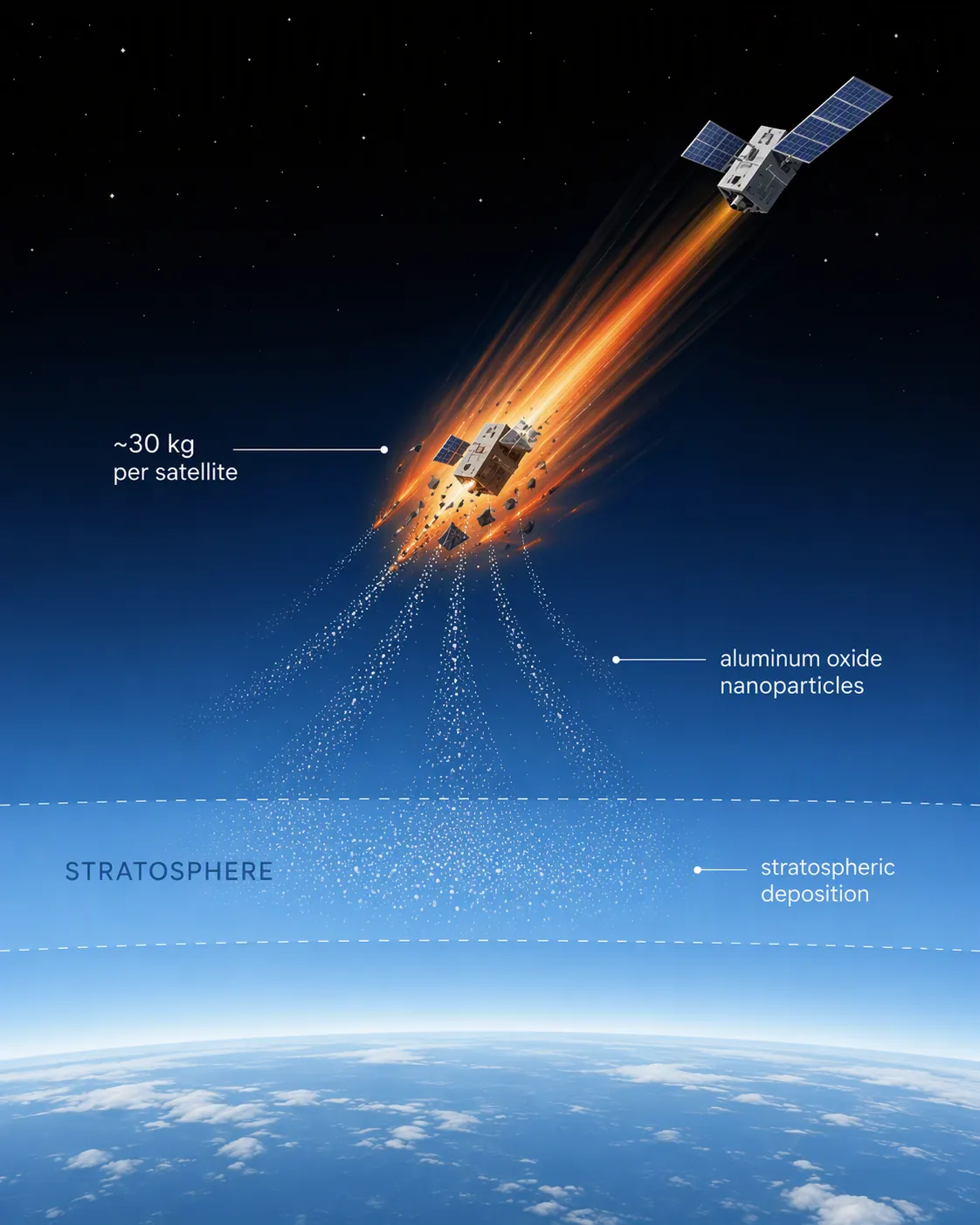
The science is still narrower than some advocacy language suggests. NOAA-led research published in 2023 confirmed satellite-derived metals in the stratosphere, but did not quantify resulting ozone impacts.[1] The aluminum oxide-to-ozone pathway remains supported by modeling rather than by a mature record of large-scale stratospheric sampling tied to legally cognizable harm. That distinction is not academic. It is the space between an alarming atmospheric finding and a complaint that survives standing, causation, and remedy challenges.
The sharper institutional contradiction arrived from the regulatory side. In August 2025, the Federal Communications Commission issued a notice of proposed rulemaking that would classify “space-based operations” as categorically extraterritorial for National Environmental Policy Act purposes, moving satellite operations further outside ordinary NEPA review.[2] The comment period closed in October 2025, and no final rule had been published as of Q3 2026.[3] If finalized in that form, the rule would not make reentry emissions harmless. It would make the main federal environmental review pathway harder to use.
That is why the September 2025 opposition from a 17-state-attorney-general coalition matters more than the most dramatic adjectives in the public debate.[3] A coalition letter is not a lawsuit and does not bind a court. But it shows that public enforcement offices are already studying the jurisdictional gap. In environmental litigation, that is often the moment before a theory becomes pleadable.
What Is Being Emitted, And Why Volume Changes The Legal Posture
A single reentry can be dismissed as a rare terminal event. A constellation replacement cycle cannot be treated the same way. The legal significance of the 30-kilogram estimate is not only the mass assigned to one satellite; it is that each satellite becomes a unit in a recurring disposal workflow. Once the operator’s business model depends on continuous launch, operation, deorbit, and replacement, the emissions argument begins to resemble an industrial-process argument rather than an accident argument.
SpaceX’s own July 2026 FCC filing makes that operational point concrete. The company reported deorbiting 260 Starlink satellites between December 2025 and May 2026 and claimed a disposal success rate above 99%.[4] From a space-debris perspective, controlled disposal is a compliance virtue. From a pollution-law perspective, it also confirms scale, regularity, and foreseeability. The same evidence that shows responsible orbital cleanup can help future plaintiffs describe a predictable atmospheric deposition stream.
That does not mean a court will accept aluminum oxide deposition as actionable contamination. Plaintiffs would still need to identify the injured interest: a state’s sovereign or quasi-sovereign interest in atmospheric resources, a public-health interest, damage to environmental systems, interference with public rights, or a more localized invasion after deposition. The stratosphere is measurable. It is not yet a familiar plaintiff’s exhibit.
NEPA Is The Obvious Door, Which Is Why The FCC Fight Matters
NEPA is where many lawyers will look first because it asks agencies to consider environmental consequences before acting. But NEPA is procedural, not a direct emissions-control statute. It does not set an aluminum oxide limit, create a permit condition by itself, or provide damages for atmospheric deposition. Its value would be forcing an agency to take a hard look before approving satellite systems or licensing activity connected to them.
The current record is not favorable to anyone relying on the FCC’s existing categorical treatment as a carefully reasoned environmental judgment. The Government Accountability Office found that the FCC had not documented its rationale for applying a 1986 categorical exclusion to large satellite constellations, and three GAO recommendations remained open as of July 2025.[5] That is not a holding that the FCC violated NEPA in any particular licensing decision. It is a documented weakness in the administrative record behind the agency’s long-running approach.
The FCC’s August 2025 proposal would move in the opposite direction from a more searching environmental review. By treating space-based operations as extraterritorial, the agency would give operators a threshold argument that NEPA does not reach the activity at all.[2] A challenger could still bring an Administrative Procedure Act claim against a final rule, or challenge a later license approval, but the fight would be about agency authority, statutory interpretation, and the adequacy of the record before anyone reached the merits of aluminum oxide risk.
| Potential federal pathway | What it could do | Why it is weak for reentry emissions |
|---|---|---|
| NEPA | Force environmental analysis before agency action | FCC categorical treatment and proposed extraterritorial exclusion may block or narrow review |
| Clean Air Act | Regulate covered air pollutants through statutory programs | Current fit is poor for stratospheric aluminum oxide deposition from reentry |
| Clean Water Act | Address discharges to regulated waters | Useful context for terrestrial enforcement history, but not a direct stratospheric-deposition tool |
A NEPA case could still matter even if it does not produce direct emissions limits. Courts reviewing agency action can require explanation, supplementation, or reconsideration. For a developing litigation theory, that can be valuable. A better agency record can generate admissions, sharpen causation questions, and identify mitigation measures. But NEPA remains a review statute. It is a poor substitute for a rule that says how much aluminum oxide is too much, who must measure it, and what happens when the threshold is crossed.
The Clean Air Act Does Not Easily Reach The Stratosphere
The Clean Air Act sounds like the natural home for emissions. It is not an easy fit here. The satellite-reentry concern described in the scientific literature centers on stratospheric aluminum oxide nanoparticles, not a conventional facility stack, vehicle tailpipe, or tropospheric ambient-air problem. The Act’s existing programs were not built around commercial spacecraft that ablate outside ordinary territorial emissions inventories.
That mismatch should not be overstated into impossibility. Congress can amend statutes. EPA can sometimes interpret existing authorities more aggressively than regulated parties expect. But under the current framework identified in the available record, there is no direct Clean Air Act rule regulating aluminum oxide emissions from satellite reentry. A plaintiff trying to plead around that absence would need to explain why the statute reaches the relevant conduct, pollutant, location, and responsible entity.
The Clean Water Act is even less central to the reentry theory. SpaceX has faced terrestrial water-enforcement scrutiny connected to Starbase deluge-system discharges, including a reported $148,000 penalty tied to Texas and federal findings.[6] That history may matter to lawyers assessing a company’s broader regulatory posture. It does not convert stratospheric aluminum oxide deposition into a water-discharge case.
Why State Attorneys General Are Better Positioned For The First Test
If the federal environmental statutes do not provide a clean cause of action, the first serious complaint is more likely to come through state common law than through a private citizen suit. That points toward public nuisance, and toward state attorneys general as the most plausible first movers.
Public nuisance gives public lawyers a doctrinal vocabulary for diffuse environmental interference. It can be used to allege unreasonable interference with a right held by the public, without requiring every resident to prove the same individualized injury at the outset. That structure is why state-led environmental nuisance suits have often preceded comprehensive federal regulation in other contamination contexts. The analogy to PFAS is useful in that limited sense: not because satellite plaintiffs are destined to win, but because scientific documentation, persistent deposition, regulatory delay, and public enforcement authority can mature together before a legislature or agency writes a specific rule.
State attorneys general also have institutional advantages individual plaintiffs lack. They can plead sovereign and quasi-sovereign interests. They can frame the injury as harm to public resources or public health rather than only as damage to one parcel or one person. They can coordinate across jurisdictions, as the 17-state FCC opposition already suggests.[3] And they can survive the early optics problem that will face any private plaintiff alleging harm from particles dispersed in an atmospheric layer most people will never physically encounter.
The weaknesses are just as important. Operators would argue that FCC licensing occupies the field or otherwise preempts state-law claims that interfere with federally authorized satellite operations. They would challenge causation, pointing to the mixed global sources of atmospheric particles and the modeled nature of ozone effects. They would contest remedy, especially any injunction that effectively regulates launch, constellation size, satellite design, or deorbit practices. A court may be willing to hear that dispute before it is willing to manage it.
Private Plaintiffs Have Narrower Theories, And Harder Injuries
Private plaintiffs are not irrelevant. They are just less likely to carry the first broad atmospheric case. Trespass and products-liability theories require a more concrete injury path than public nuisance. A trespass plaintiff usually needs to plead some form of physical invasion of property. A products plaintiff needs a defect theory, causation, and injury traceable to the product or its disposal. Stratospheric dispersal makes both tasks difficult.
A hypothetical trespass complaint might allege that satellite-derived particles eventually deposited onto land or water. That pleading would need more than a general model showing global atmospheric loading. It would need a way to connect the operator’s reentries to a plaintiff’s property at a legally meaningful level. Without that bridge, the operator’s motion to dismiss writes itself: no particularized invasion, no traceability, no remedy a court can administer without overriding federal space licensing.
Products liability has a different shape. Plaintiffs could argue that satellites are designed for disposal through atmospheric burnup despite foreseeable emissions, or that warnings and mitigation were inadequate. The defense would answer that controlled reentry is the federally preferred alternative to persistent orbital debris, that the satellites were licensed, and that any risk-balancing belongs to regulators rather than juries. The claim would force a court to compare two environmental harms: leaving objects in orbit versus burning them into the upper atmosphere.
That comparison is uncomfortable but unavoidable. A legal theory that punishes deorbiting without addressing orbital debris can create perverse incentives. A viable complaint would need to target emissions, design choices, disclosure, or mitigation—not simply the fact of disposal. Otherwise the requested remedy may make the space-debris problem worse.
Standing After Dark-Sky
The D.C. Circuit’s 2024 Starlink decision is useful, but it should not be made to carry more than it held. In the Dish Network and International Dark-Sky Association challenge to the FCC’s approval of SpaceX’s Gen2 Starlink system, the court found that the Dark-Sky Association had standing, but upheld the FCC’s NEPA determination on the merits.[7] That combination matters: standing was possible, but it did not decide the environmental claim.
For reentry-pollution plaintiffs, Dark-Sky offers a procedural lesson rather than a merits shortcut. Courts may recognize concrete interests affected by satellite systems when plaintiffs plead them carefully. But atmospheric aluminum oxide deposition presents a different injury chain than night-sky interference. A plaintiff still needs an injury that is concrete, particularized where required, fairly traceable to the defendant, and redressable by the court.
That is the evidentiary bridge the current record has not fully built. Ferreira-style quantification helps with foreseeability and scale. NOAA’s stratospheric metals findings help show that spacecraft material is present in the relevant environment. Marais and UCL’s 2026 work intensifies the governance concern, including the public characterization of megaconstellation reentries as an “unregulated geoengineering experiment.”[8] A complaint still must translate those materials into a legally recognized injury, not merely a policy concern.
The Space-Law Boundary Markers Do Not Supply The Missing Tort Case
International space law and orbital-debris legislation help define the governance gap, but they are not likely to be the main vehicle for a near-term aluminum oxide lawsuit. The proposed ORBITS Act, reintroduced in the 119th Congress and reported by the Senate Commerce Committee in February 2026, would move toward uniform debris standards, but it had not been enacted according to the available record.[9] Aspirational debris standards do not give a plaintiff a damages remedy for stratospheric deposition.
The 1972 Liability Convention is also a poor fit for this particular problem. Stanford Law’s 2025 review noted that the convention has been invoked exactly once, after Cosmos 954 in 1978, and has not been used by a private party against another private party; its fault-based Article III standard remains untested for commercial-on-commercial collisions.[10] That history is instructive because it shows how little adjudicated law exists even for more intuitive space-damage scenarios. Stratospheric nanoparticle deposition is a harder case, not an easier one.
Nor should collision liability be confused with reentry-pollution liability. A collision case asks who was at fault for damaging an object or creating debris. A reentry-pollution case asks whether a licensed disposal practice creates actionable environmental interference after the spacecraft’s useful life ends. The first has sparse precedent. The second has essentially none.
Licensing Is Not Environmental Absolution
Satellite operators will reasonably say they are not acting in secret. They obtain licenses, file reports, comply with orbital-debris rules, and deorbit spacecraft rather than abandoning them indefinitely. Those facts matter. They will be central to preemption, primary-jurisdiction, and reasonableness defenses.
But a license to operate is not the same thing as an emissions standard. The current federal posture appears to leave aluminum oxide reentry emissions without a direct regulatory home. The GAO record undermines any casual assumption that the FCC’s old categorical exclusion was designed with megaconstellation replacement cycles in mind.[5] The pending FCC proposal, if finalized, may make the review gap more explicit rather than less.
That is where litigation risk begins: not with certainty of liability, but with documented emissions, institutional inaction, and a plaintiff capable of pleading around diffuseness. The absence of a direct federal rule should be treated as pre-enforcement risk, not permission.
The first credible courthouse door is therefore not the Outer Space Treaty, not the Clean Water Act, and probably not a freestanding Clean Air Act claim. It is a state-led nuisance case built on peer-reviewed atmospheric science, the FCC’s NEPA record, and a carefully pleaded public injury. The complaint still has to cross the bridge from modeled stratospheric harm to legally cognizable injury. That bridge is not finished. It is, however, now visible.
References
- Burned-up satellites are polluting the atmosphere, Science.org
- FCC Releases Adopted NPRM Proposing Updates to NEPA, TLP Law, August 21, 2025
- Satellite Operators Urge FCC to Exempt Them From NEPA Review, Broadband Breakfast
- SpaceX Controlled Deorbit Report Discloses Decommissioning of 260 Starlink Satellites Over Six Months, SatNews, July 5, 2026
- FCC Should Reexamine Its Environmental Review Process for Large Constellations of Satellites, U.S. Government Accountability Office
- SpaceX repeatedly polluted waters in Texas this year, regulators found, CNBC, August 12, 2024
- DC Circuit upholds FCC approval of Gen2 Starlink satellite system, Courthouse News Service
- SpaceX Starlink and other satellite megaconstellations are creating an 'unregulated geoengineering experiment,' scientists say, Space.com
- Hickenlooper, Cantwell, Lummis, Wicker Reintroduce Bill to Clear Space Junk, Protect Space Exploration, Office of U.S. Senator John Hickenlooper
- Who Takes Out the Trash in Space?, Stanford Law School, August 22, 2025
Operationalizing workflow
No workflow has been explicitly linked to this obligation yet. See Workflows generally.
Illustrative cases
No illustrative case is currently tracked for this obligation. See Risk Digest for documented incidents generally.
← Back to RegulationReport a correction or tip
Spotted an outdated figure, a misstated fact, or a ruling this regulation entry should reflect? Public comments are disabled for this content given the professional cost of a misreported case outcome, penalty amount, or rule text — use the structured correction channel instead.
Report a correction or tip for this record →