
SAVE Act Dispute Puts AI Legal Research to the Test
- Authority
- American Bar Association
- Rule type
- ethics opinion
- Jurisdiction scope
- US federal
- Effective date
- Jan 1, 2024
- Source text
- Read primary rule text ↗
Lawyers must verify AI-generated outputs and understand tool limits.
Last verified: July 25, 2026, UTC. On that date, the SAVE Act dispute was not a single status entry. It included five failed Senate votes, repeated House action, a reconciliation attempt, a Senate parliamentarian obstacle, public pressure from President Trump on Senate Majority Leader John Thune, Republican dissent inside the Senate conference, and threatened executive action if Congress did not deliver the bill.[1][2][3]
That is a poor fact pattern for a fluent legal-research answer. A tool can summarize the policy fight, name the sponsors, and describe proof-of-citizenship requirements while still getting the answer that matters wrong: whether the provision has passed, which vehicle carried it, whether a procedural ruling stopped it, or whether an executive-order proposal has legal effect today.
The practical problem is not that AI cannot discuss the SAVE Act. It can. The problem is that it can discuss it smoothly enough to make a stale or blended answer look ready for a memo, client alert, procurement review, or draft filing.

The First Verification Question Is Not What the SAVE Act Means
For a practitioner, the first question is narrower: what exactly is being described, and as of when?
As of the last verification date for this article, reporting described five failed Senate votes on the SAVE Act, with Sens. Susan Collins, Mitch McConnell, Lisa Murkowski, and Thom Tillis among Republican defectors in the latest vote sequence.[1][2][3] The House had passed SAVE Act language more than once, including through a budget framework reported as passing 216-214 on July 22, 2026.[3] In June 2026, the Senate parliamentarian reportedly found SAVE provisions non-budgetary, creating a serious obstacle to using reconciliation as the path around the filibuster.[3]
Those are not interchangeable procedural facts. A House passage does not mean enactment. A failed cloture or floor vote does not mean the bill is dead for every vehicle. A parliamentarian ruling on reconciliation does not answer whether a stand-alone bill could later receive sufficient votes. A presidential threat to use executive authority does not itself amend federal voter-registration law.
This is where AI research becomes dangerous in a way that ordinary political commentary does not. A news summary can tolerate some shorthand. A legal memorandum cannot. If the sentence says “the SAVE Act now requires documentary proof of citizenship,” the author needs a source that shows enactment, not momentum.
Three Different Objects Can Collapse Into One AI Answer
The dispute carries an unusually high name-confusion risk. At least two legislative proposals have used SAVE-branded labels: the SAVE America Act, described as the main bill, and the Make Elections Great Again Act, described as a separate version with additional restrictions.[4] Separately, the federal government already operates the DHS SAVE program, short for Systematic Alien Verification for Entitlements, which is an administrative verification database rather than the election-law bill.[5]
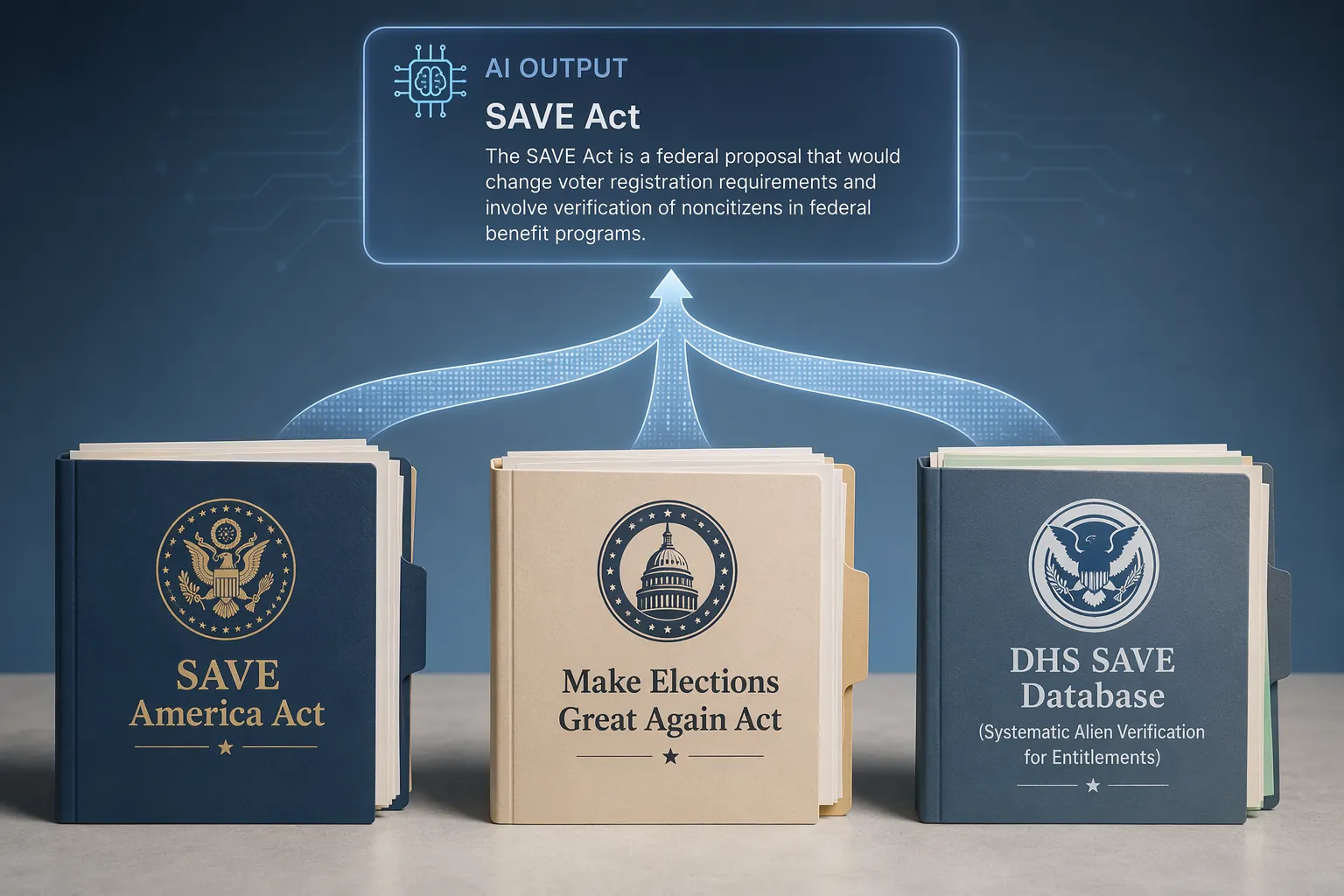
A human researcher usually notices when a database, a bill, and a successor or companion proposal have been blended. A generated answer may not. The merged answer can sound plausible because every component is real: there is a SAVE Act debate, there is proof-of-citizenship language, there is a DHS SAVE system, and there are executive-branch immigration-verification workflows. The error is in the join.
| Object | What It Is | Common AI Failure |
|---|---|---|
| SAVE America Act | The principal federal election bill at the center of the 2026 dispute | Treating House passage or Senate pressure as enactment |
| Make Elections Great Again Act | A separate SAVE-branded version with additional restrictions reported in the same policy orbit | Importing requirements from one bill into the other |
| DHS SAVE database | Systematic Alien Verification for Entitlements, an existing government verification program | Describing an administrative database as if it were the pending election bill |
The verification discipline here is simple but often skipped: do not ask “what does the SAVE Act do?” until the bill number, version, chamber, vehicle, and last action have been pinned down. A procurement reviewer testing an AI tool should treat any answer that uses “SAVE” without disambiguation as incomplete, even if the rest of the prose is polished.
Procedure Is Part of the Legal Answer
The Trump-Thune clash matters to legal research only because it changes the procedural posture a tool must track. USA Today reported on July 23, 2026, that Trump’s frustration with Thune had grown as the bill stalled in the Senate.[1] Newsweek reported Thune’s response in terms of vote-counting: “Get the votes.”[6] That exchange is not law. It is a warning that the status answer depends on whip counts, Senate rules, and possible alternate vehicles.
The reconciliation maneuver is a separate trap. House action on a budget framework can make an AI answer appear current because it supplies a fresh date and a concrete vote total. But if the relevant provisions are ruled non-budgetary for Senate reconciliation purposes, the procedural route may fail even though the House-side fact remains true.[3] A generated summary that says “the House passed it through reconciliation” may be technically grounded and still misleading if it omits the Senate parliamentarian obstacle.
The executive-action thread creates a different kind of overstatement. Votebeat reported in March 2026 that executive action could follow if Senate passage remained unlikely.[4] Democracy Docket separately reported that federal judges blocked key provisions of Trump’s March 2025 election executive order in January 2026.[7] Those facts support a cautious conclusion: executive action was part of the strategy and litigation risk was immediate. They do not support treating a threatened order, draft order, press statement, or partially blocked order as enacted statutory law.
Where AI Answers Are Most Likely to Break
Legal AI benchmarks are useful here only as risk indicators. The Vals AI VLAIR benchmark reported a 74-78% weighted accuracy range for legal AI tools on tested legal tasks in 2025.[8] That does not prove how any specific tool will answer a SAVE Act query, and it should not be cited as if the benchmark tested this exact legislative dispute. It does, however, make one thing difficult to ignore: even under benchmark conditions, legal AI output still requires verification, and this dispute adds temporal and procedural instability on top of ordinary legal-research difficulty.
Temporal staleness
The most likely error is a status sentence that was true yesterday and false tomorrow. “The bill failed in the Senate” may be accurate after one vote but incomplete after a House reconciliation move. “The House passed the measure” may be accurate but useless if the Senate path is blocked. “Executive action is expected” may be accurate as reporting on strategy but wrong if converted into a statement of current legal obligation.
Every current-status sentence should carry its own verification date. A timestamp at the top of a document is not enough when a later paragraph says “currently,” “now,” “has passed,” “is blocked,” or “requires.” Those words are load-bearing.
Bill-name conflation
A blended answer may borrow the stricter terms of one SAVE-branded proposal and attach them to another. The remedy is not another summary. It is the bill text. The researcher should confirm the bill number, chamber version, amendment status, and operative language before relying on any description of documentary proof, attestation, REAL ID treatment, passport rules, military ID treatment, birth-certificate requirements, or agency duties.
DHS SAVE database confusion
The DHS SAVE database is not the SAVE Act. If an AI answer describes database matching, immigration-status verification, benefits eligibility, or agency query procedures without tying those mechanics to a specific bill provision, the answer needs to be decomposed. The question is whether the pending legislation mandates or invokes that mechanism, not whether a similarly named federal system exists.
Procedural misunderstanding
The filibuster, reconciliation, parliamentarian review, House budget language, and executive orders are not alternate labels for the same event. They are different routes with different legal consequences. A reliable answer should say which route it is describing and what source confirms the current state of that route.
Constitutional overstatement
The constitutional question should be handled as unresolved risk, not as a settled answer. Commentary has discussed tensions between proof-of-citizenship requirements, voting-rights doctrine, and cases such as Crawford and Harper.[9][10] But the research record supplied here does not identify a Supreme Court decision directly resolving a federal documentary-proof-of-citizenship requirement for voter registration. Any AI answer that says the SAVE Act is plainly constitutional or plainly unconstitutional is doing more than the cited authorities support.
Misattributed documentation statistics
The voter-documentation numbers also need source discipline. The Brennan Center, relying on research with the University of Maryland, cited an estimate of 21.3 million voting-age U.S. citizens who do not have ready access to documentary proof of citizenship.[11] FactCheck.org discussed competing claims and also identified a higher 28.4 million estimate associated with the Bipartisan Policy Center and the 2024 Survey on the Performance of American Elections.[12] Those figures come from different methodologies. They should not be collapsed into one “millions lack ID” statistic, and they should not be confused with photo-identification estimates.
For litigation and compliance purposes, the distinction matters. A claim about citizens without ready access to documentary proof of citizenship is not the same as a claim about citizens without a driver’s license, passport, REAL ID, or election-day photo ID. If an AI answer cannot identify what the denominator measures, the number should not move into a filing or client-facing document.
A Practitioner’s Verification Workflow
AI can still be useful at the front end. It can generate a list of issues, surface possible bill names, suggest search terms, or identify procedural routes that need checking. The line is crossed when the generated answer becomes the authority for status, requirements, vote counts, legal effect, or constitutional conclusion.
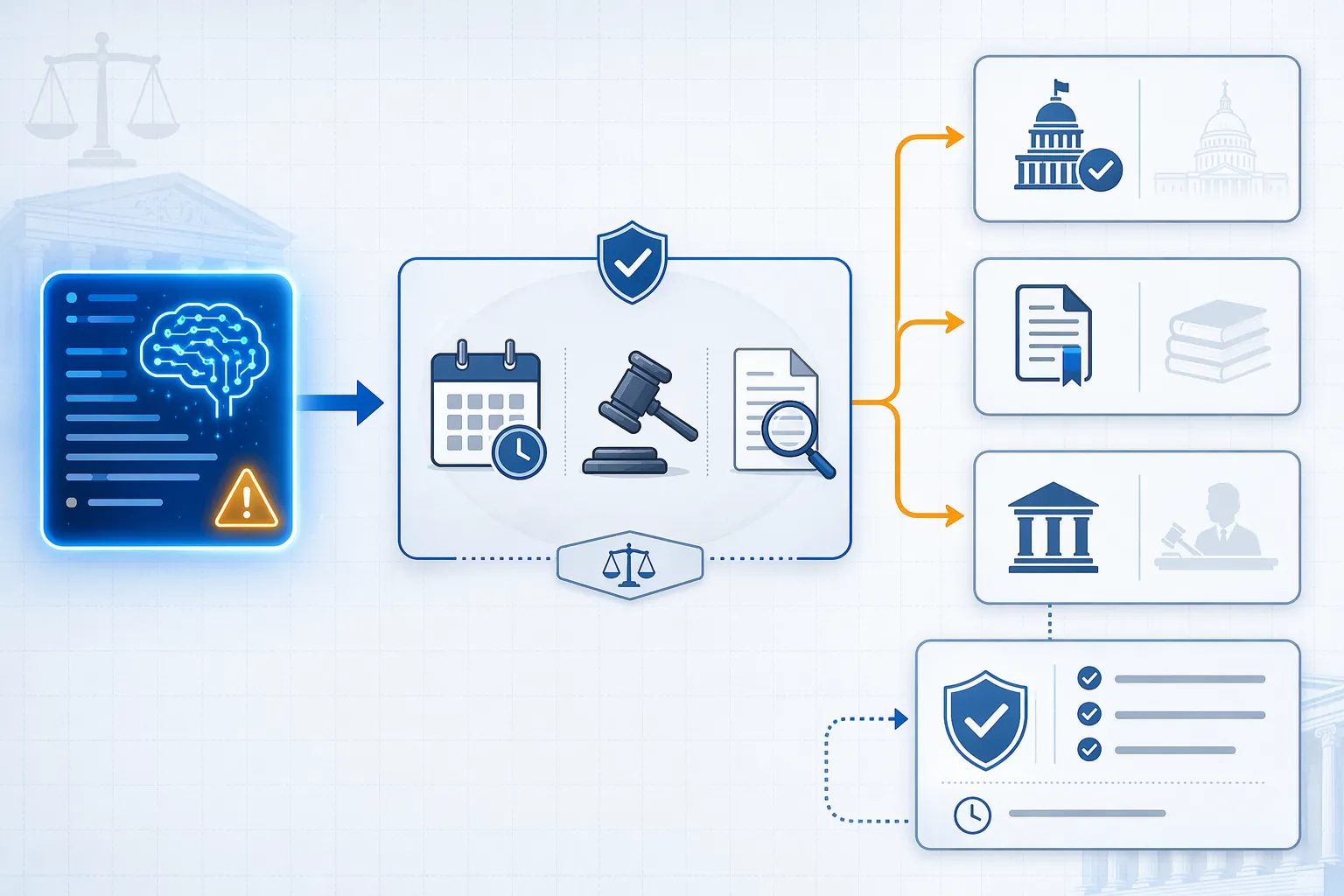
- Start with the exact object: identify the bill number, chamber, version, amendment, or executive action being analyzed before asking what the measure does.
- Check Congress.gov or the official congressional record for bill status, text, sponsors, latest action, and version history; do not treat a news summary as the status authority.
- Separate legislative paths: record whether the claim concerns a stand-alone Senate vote, House passage, budget reconciliation, parliamentarian review, or executive action.
- Verify the Senate parliamentarian issue from the latest authoritative reporting or official materials before saying reconciliation is available, blocked, revived, or uncertain.
- Track the named Senate defectors separately from party-level shorthand; a statement that “Republicans support” the bill can be misleading where individual Republican votes are the procedural bottleneck.
- Stamp every current-status sentence with a last-verified date and time, especially any sentence using “now,” “currently,” “has passed,” “failed,” “blocked,” “requires,” or “would require.”
- For constitutional analysis, distinguish holdings from commentary and flag that the supplied record does not identify a direct Supreme Court ruling on a federal documentary-proof-of-citizenship registration requirement.
- For disenfranchisement or documentation statistics, preserve the source, methodology label, population measured, and exact wording; do not convert documentary-proof figures into photo-ID figures.
ABA Formal Opinion 512 makes the same point in professional-responsibility terms: lawyers using generative AI must understand the tool’s limits and verify outputs, including legal authorities and factual assertions, rather than delegating professional judgment to the system.[13] In a stable doctrine area, that verification may be routine. In the SAVE Act dispute, it is the work.
Test the Output Before It Reaches the Client
A useful internal test is to turn the AI answer into discrete assertions and assign each assertion a source. The answer should not be reviewed as prose. It should be reviewed as a chain of claims.
| AI Claim Type | Required Check | Reason |
|---|---|---|
| The SAVE Act has passed or failed | Congress.gov status and latest chamber action | House passage, Senate failure, and reconciliation movement can coexist |
| The bill requires a specific document | Operative bill text for the exact version | Different SAVE-branded proposals may impose different terms |
| The Senate route is blocked | Latest parliamentarian and Senate-procedure source | A reconciliation obstacle is not the same as permanent legislative defeat |
| Trump can implement the policy by executive order | Text of the order, court orders, and current injunction status | Threatened executive action and enforceable law are different things |
| The bill is unconstitutional | Case law plus clearly labeled expert analysis | The supplied record supports uncertainty, not a definitive Supreme Court answer |
| Millions of citizens lack documents | Original study or careful secondary source with methodology | Different estimates measure different populations |
This review is not cosmetic. If a draft pleading tells a court that a requirement is in force when it is only pending, the problem is not an AI hallucination in the abstract. It is a false representation in a legal document. If a client alert says an executive order has changed registration obligations when the relevant provisions are blocked, the risk moves from research quality to client reliance. If a procurement memo says a tool “correctly analyzed the SAVE Act” without checking whether it confused the legislation with the DHS database, the evaluation is not measuring what it claims to measure.
The safest use pattern is therefore narrow. Use AI to collect candidate issues and possible authorities. Use primary sources and clearly identified authoritative reporting to decide status. Keep the last-verified timestamp beside the sentence it supports. In this dispute, every asserted status, bill requirement, senator position, procedural route, executive-action claim, constitutional statement, and voter-documentation statistic needs that treatment before it is trusted.
References
- President Trump, John Thune disputes grows over stalled SAVE Act, USA Today, 2026-07-23,
- SAVE Act, Republicans' voting overhaul, fails in the Senate, NPR, 2026-06-04,
- House passes SAVE America Act anti-voting measures in budget reconciliation, Democracy Docket,
- The SAVE America Act is unlikely to pass in the Senate. Executive action could be next., Votebeat, 2026-03-16,
- Systematic Alien Verification for Entitlements, DHS SAVE,
- Top Republican John Thune Clashes With White House on SAVE Act: 'Get the Votes', Newsweek,
- Federal judges blocked key provisions of Trump's March 2025 executive order on elections in January 2026, Democracy Docket,
- Vals AI VLAIR benchmark, Vals AI, 2025,
- The Constitution and the SAVE America Act, Constitution Center,
- The Supreme Court and voting identification, SCOTUSblog, 2026-03,
- New SAVE Act Bills Would Still Block Millions of Americans from Voting, Brennan Center,
- Competing Claims on SAVE America Act Disenfranchising Voters, FactCheck.org, 2026-03,
- Formal Opinion 512: Generative Artificial Intelligence Tools, American Bar Association, 2024,
Operationalizing workflow
No workflow has been explicitly linked to this obligation yet. See Workflows generally.
Illustrative cases
No illustrative case is currently tracked for this obligation. See Risk Digest for documented incidents generally.
← Back to RegulationReport a correction or tip
Spotted an outdated figure, a misstated fact, or a ruling this regulation entry should reflect? Public comments are disabled for this content given the professional cost of a misreported case outcome, penalty amount, or rule text — use the structured correction channel instead.
Report a correction or tip for this record →