
Why the Byrd Rule Blocks Thune's SAVE Act Reconciliation Strategy
- Authority
- U.S. Congress
- Rule type
- statute
- Jurisdiction scope
- US federal
- Source text
- Read primary rule text ↗
Provisions in reconciliation bills must have a budgetary effect not merely incidental to non-budgetary policy changes
As of July 25, 2026, the live procedural question is not whether Republicans can find another vehicle for the SAVE Act. They have already tried. The House has attached it to the National Defense Authorization Act, passing that version 216–212 on July 22, and Senate Democratic Leader Chuck Schumer has said the NDAA “will not pass the Senate” with the voter-eligibility language attached.[1] Sen. Lindsey Graham has also floated a reconciliation blueprint reported at $95 billion, including $10 billion in SAVE Act grants to states.[2]
The harder question is whether that second move changes the vote threshold. If the SAVE Act’s operative provisions remain election-law mandates with budgetary effects attached, reconciliation does not make them filibuster-proof. It merely moves the fight from cloture to the Byrd Rule, where the same 60-vote problem reappears.
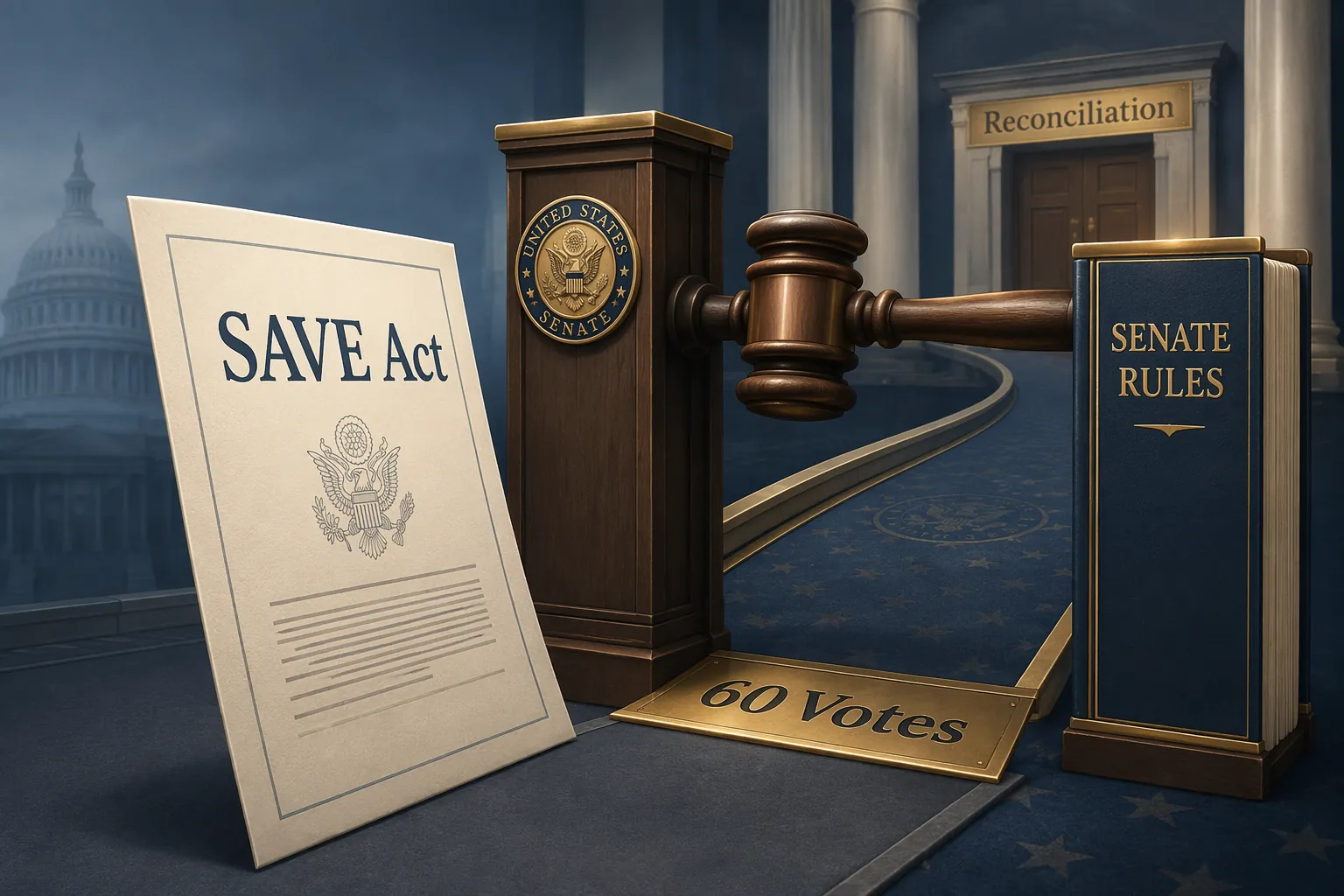
The Graham Proposal Does Not Avoid the Main Objection
Graham’s proposal matters because it is the most concrete reconciliation workaround now on the table. The reported idea is to use a budget blueprint with SAVE-related grants to states, rather than attempting to pass the Act as a stand-alone election bill.[2] That is the right place to look if the goal is to avoid ordinary Senate cloture. It is also exactly where the Byrd Rule starts doing work.
Roll Call reported on March 25, 2026, citing multiple Senate aides, that the Senate parliamentarian had already signaled that the SAVE Act’s core provisions likely violate the Byrd Rule.[3] That should not be overstated as a formal published opinion; the reported signal is not the same thing as a written ruling released for public reliance. But in Senate practice, this kind of parliamentarian guidance is not background noise. It tells leadership, committee staff, and counsel where a point of order is likely to land.
Thune’s own public description of the problem is unusually direct. He told the New York Post that the budgetary impact “has got to be principally budgetary, not policy-oriented,” while also acknowledging “some level of subjectivity.”[2] That is a careful way of saying the label on the vehicle does not control. A reconciliation bill can carry many things, but it cannot carry every policy Congress would rather not expose to a 60-vote cloture vote.
The Byrd Rule Test That Matters
The relevant rule is § 313(b)(1)(D) of the Congressional Budget Act, commonly described as the “merely incidental” test. Under that test, a provision is extraneous if it produces a change in outlays or revenues but that budgetary effect is merely incidental to the non-budgetary components of the provision.[4] For SAVE Act purposes, that is the central legal bottleneck.
The core legal effect of the SAVE Act is not to appropriate money. It is to change voter-eligibility administration by requiring documentary proof of citizenship for federal voter registration and by imposing related duties on election officials. Those are election-law commands. They may cost money to implement. They may be paired with grants. They may even be drafted so that federal funds move through state election offices. But the operative policy judgment remains who may register, what documents must be produced, and what election administrators must do with those applications.
That distinction is where the grant strategy becomes vulnerable. Congress often writes policy conditions into spending programs. Reconciliation, however, adds a separate Senate-procedure screen: the budgetary effect must not be a pretext for carrying a policy change whose real weight lies elsewhere. The Legislative Procedure Blog’s explanation of the Byrd Rule emphasizes that reconciliation provisions must survive several tests, including the merely incidental test, and notes that attempts to use “terms and conditions” on money can run into both Byrd Rule limits and Senate jurisdictional constraints under Rule XXV.[4]
A hypothetical example shows the difference. Congress could create a grant program that reimburses states for specified election-administration costs, with reporting requirements tied to the use of those funds. That looks budgetary because the money is the program. A different provision that says states must impose a new voter-registration eligibility screen, then adds reimbursement money to soften implementation costs, looks much less like budget policy. The money is present, but the legal center of gravity is elsewhere.
Why the 2021 Precedents Are the Closest Fit
The closest reconciliation precedents are not prior voter-ID fights. They are the 2021 rulings that kept a $15 minimum wage and immigration overhaul provisions out of the Build Back Better reconciliation package.[3][4] Both had real budgetary consequences. A higher minimum wage affects wages, tax receipts, federal spending, and program costs. Immigration status changes can affect federal benefits, fees, labor markets, and revenues. Those budget effects did not end the inquiry.
The procedural question was whether the budget effects were the provision’s principal function or merely incidental to a broader policy change. The parliamentarian’s 2021 treatment of those provisions is why SAVE Act proponents cannot assume that putting a dollar amount beside an election-law mandate solves the Byrd Rule problem.[4]
That is also why Sen. Rick Scott’s assessment is more useful than most of the public positioning around the bill. He told Roll Call he saw “no way that any part of the SAVE America Act, of any teeth, gets included in a reconciliation package.”[3] The phrase “of any teeth” does the work. A provision watered down enough to survive reconciliation may no longer be the operative SAVE Act policy that its supporters are demanding.
The Vote Count Turns Procedure Into Outcome Risk
Republicans hold a 53–47 Senate majority. Ordinary cloture requires 60 votes, and no Democratic votes are expected for the SAVE Act.[5] That is the familiar filibuster problem. Reconciliation is attractive because qualifying reconciliation bills can pass with a simple majority after limited debate. But the Byrd Rule is enforced by points of order, and waiving a successful Byrd Rule point of order requires 60 votes.[4]
| Procedural route | Threshold problem |
|---|---|
| Stand-alone SAVE Act or NDAA with SAVE attached | Needs 60 votes for cloture if Democrats withhold support |
| Reconciliation package with SAVE’s operative election-law provisions | Faces Byrd Rule point of order if policy effects are not merely incidental |
| Waiver of the Byrd Rule | Needs 60 votes, recreating the same supermajority problem |
| Filibuster abolition or alteration | Thune says Republican support is “not even close” to 50 senators |
Thune has rejected changing the filibuster, and he told ABC News in March that Republicans were “not even close” to having 50 senators for that move.[5] That matters because it closes the usual escape hatch. If the parliamentarian sustains a Byrd Rule objection, leadership would need 60 votes to waive the rule. If leadership cannot get 60 votes for cloture on the underlying policy, there is no obvious reason to assume it can get 60 votes to waive the procedural rule that blocks the same policy.
The June DHS-funding episode points in the same direction. Four Republicans — Lisa Murkowski, Mitch McConnell, Susan Collins, and Thom Tillis — joined Democrats to block the SAVE Act as a DHS-funding amendment.[6] That vote does not mechanically decide every future vote, and appropriations amendments are not reconciliation points of order. But it is a warning against treating the Republican conference as a guaranteed 53-vote unit on every SAVE Act tactic, let alone as a conference prepared to detonate Senate rules for this bill.
The Ultimatum Changes the Pressure, Not the Rule
Trump’s pressure campaign has made the impasse more visible. In March, he threatened to veto all other legislation until the SAVE Act passed the Senate, though a White House official later excluded DHS funding from that threat.[7] The housing bill episode then showed the limits of treating veto threats as a complete legislative map: that bill became law without Trump’s signature, according to The Conversation’s July 2026 account.[6]
Those episodes are important pressure markers, but they do not answer the Senate question. A veto threat can increase the cost of inaction for party leaders. It can change floor time, messaging, and the willingness to attach a rider to a must-pass bill. It cannot change the text of § 313(b)(1)(D), the parliamentarian’s likely treatment of policy-first election provisions, or the 60-vote requirement for waiving a Byrd Rule point of order.
Nor does the NDAA attachment solve the reconciliation problem. It creates another high-stakes vehicle and another confrontation with Senate Democrats. It may be politically useful because defense authorization bills are difficult to discard. But if the question is whether Graham’s reconciliation route can make SAVE filibuster-proof, the NDAA rider is a separate pressure tactic, not proof that the Byrd Rule obstacle has been removed.
What Would Have to Change
There are only a few ways around the present ceiling. One is a provision so substantially rewritten that its budgetary operation is genuinely principal, not merely a funding wrapper around voter-eligibility rules. That would likely mean losing much of what supporters mean when they demand the SAVE Act “with teeth.” Another is a separate 60-vote breakthrough, either for cloture on a legislative vehicle or for a Byrd Rule waiver. The available vote evidence does not point toward that outcome.
A third route would be a change to Senate rules or precedents. Thune’s March comments make that route look unavailable for now, not because a majority leader lacks procedural creativity, but because the Republican votes for changing the filibuster are not there.[5] That is the piece often lost in accounts that treat reconciliation as a magic side door. The side door has its own lock.
This is a procedural-law analysis, not a constitutional merits prediction. The SAVE Act raises separate questions under constitutional provisions and election-law doctrine, and those questions would matter if Congress enacted the bill. They do not decide whether the Senate can move the bill through reconciliation in the first place.
For institutional planning, the practical conclusion is narrow but firm: absent a substantially watered-down provision with genuinely budgetary operation, or a separate 60-vote breakthrough, the SAVE Act’s reconciliation path remains procedurally blocked. Waiving the Byrd Rule requires the same supermajority Republicans lack for cloture, so reconciliation does not presently solve the Trump-Thune SAVE Act impasse. It relocates it.
References
- Trump's obsession with SAVE America Act puts MAGA's pressure on John Thune, The Hill.
- John Thune tells The Post about potential breakthrough on SAVE America Act — led by Lindsey Graham, NY Post, July 16, 2026.
- Byrd rule poses challenge for voter ID bill in reconciliation, Roll Call, March 25, 2026.
- What the Byrd Rule Actually Does — and How to Navigate It, Legislative Procedure Blog, March 25, 2026.
- Thune says no to filibuster changes even after Trump's threats about SAVE America Act, ABC News.
- Republicans control Congress, so why is Trump's SAVE America Act stuck?, The Conversation.
- Donald Trump threatens to veto all bills until SAVE Act passes Senate, The Hill.
Operationalizing workflow
No workflow has been explicitly linked to this obligation yet. See Workflows generally.
Illustrative cases
No illustrative case is currently tracked for this obligation. See Risk Digest for documented incidents generally.
← Back to RegulationReport a correction or tip
Spotted an outdated figure, a misstated fact, or a ruling this regulation entry should reflect? Public comments are disabled for this content given the professional cost of a misreported case outcome, penalty amount, or rule text — use the structured correction channel instead.
Report a correction or tip for this record →