
Where the SAVE Act voting law dispute stands now
- Authority
- U.S. Congress
- Rule type
- statute
- Jurisdiction scope
- US federal
- Source text
- Read primary rule text ↗
Proof of U.S. citizenship required at voter registration.
Last verified: August 2, 2026. This is a status record for readers trying to describe the John Thune SAVE Act voting law dispute without turning a litigation posture into a political conclusion. It is not legal advice, and it does not decide whether the SAVE Act’s proof-of-citizenship policy is wise, valid, or invalid on the merits.
The short answer is that the dispute should still be treated as unresolved unless the particular provision, jurisdiction, party, and order are identified. A statement that “the law is in effect” is incomplete. So is a statement that “the law is blocked.” In a voting-law case involving proof-of-citizenship requirements, the operative question is narrower: which command may be enforced today, against whom, and under which court order?

The status record has to be read provision by provision
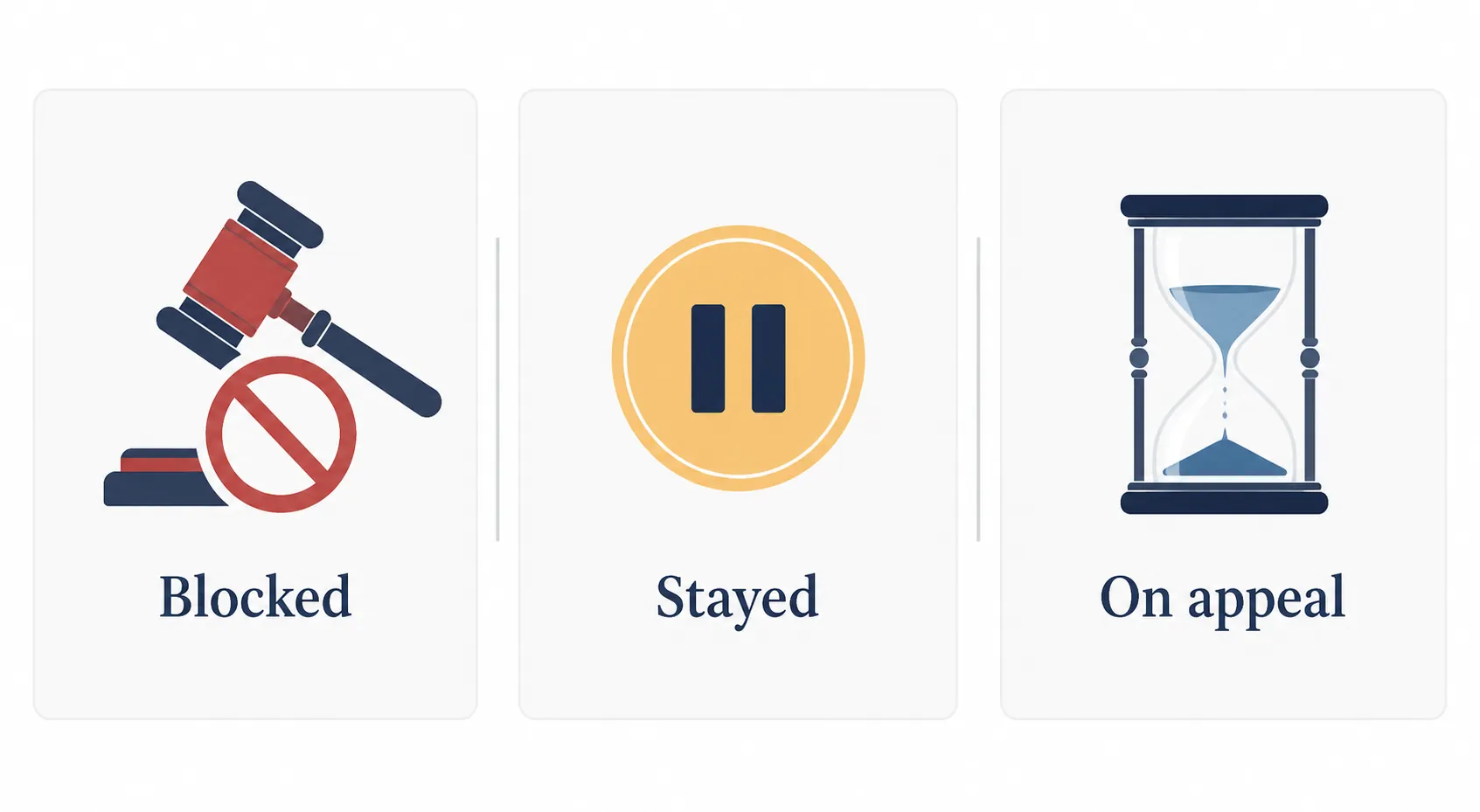
The SAVE Act dispute is best described in court-status terms, not campaign terms. For present-tense accuracy, the relevant labels are “blocked,” “stayed,” and “on appeal.” They do not mean the same thing, and using them interchangeably is the fastest way to misstate the case.
| Status label | What it means for a present-tense description | What it does not prove |
|---|---|---|
| Blocked | A court order presently prevents enforcement of the identified provision, usually against the identified parties or within the identified scope of the order. | It does not necessarily mean there has been a final merits judgment against the entire statute. |
| Stayed | A court has paused the effect of an order, or a higher court has allowed a provision or ruling to operate temporarily while review continues. | It does not necessarily mean the appellate court has finally approved the law. |
| On appeal | A dispute over the lower-court order or judgment remains before an appellate court. | It does not, by itself, answer what is enforceable today. |
| Final judgment | A court has reached a merits disposition at the relevant level, subject to any further review or stay. | It should not be assumed unless the docket and order actually show it. |
That distinction matters because a proof-of-citizenship mandate can have more than one operative component. One order may address documentary proof required at registration. Another may address treatment of existing registrations, agency forms, cure processes, or enforcement deadlines. A broad public sentence about “the SAVE Act” may sound clear, but it usually skips the narrower legal question that determines what election officials and affected voters must do now.
Blocked is an operative restraint, not a full substitute for the merits
When a provision is blocked, the important first sentence is not “the statute is unconstitutional” or “the statute is dead.” The careful sentence is: a court order currently prevents enforcement of the identified provision within the order’s stated scope. That scope may be statewide, party-specific, agency-specific, deadline-specific, or limited in some other way. Without that scope, the word “blocked” does more work than the order may support.
A blocked provision may later be revived if an appellate court stays the injunction, narrows it, reverses it, or sends the case back under a different standard. That is why a present-tense status note should not quietly convert preliminary relief into a final outcome. The safer formulation is temporal: as of the verification date, enforcement is restrained to the extent stated in the order.
Stayed does not mean settled
A stay is often where public descriptions become sloppy. If an injunction is stayed, the practical result may be that an otherwise blocked provision can be enforced while review continues. If a lower-court ruling is stayed, the prior legal position may remain in place temporarily. Either way, a stay is a procedural event. It should not be reported as though the reviewing court has fully resolved the statutory or constitutional dispute unless the order actually says so.
For readers tracking the SAVE Act, the useful question is not merely whether a stay exists. It is what the stay pauses, for how long, and whether it applies to the whole order or only part of it. A stay can change the real-world enforcement posture without ending the lawsuit.
On appeal means the dispute remains live
An appeal is not an enforcement rule by itself. It tells the reader that a lower-court ruling or order is under review. The operative status still depends on whether the challenged order has been stayed, whether any injunction remains in force, and whether the appellate court has issued interim relief. A case can be on appeal while a provision remains blocked. It can also be on appeal while enforcement proceeds under a stay. The docket posture and the enforcement posture are related, but they are not identical.
That is the point most likely to be lost in fast political coverage. “Appealed” sounds active and important, but it does not answer the operational question. A journalist, election administrator, or policy researcher still has to identify the current order controlling enforcement.
Where John Thune’s statements fit
John Thune’s public defense of the SAVE Act belongs in the record as a political and legislative statement. It can help explain why supporters present the law as an election-integrity measure and why the proof-of-citizenship issue remains prominent in public debate. It cannot establish the current enforceability of any contested provision.

That is not a criticism unique to Thune. It is a source-category problem. Elected officials commonly speak about what a law is intended to do, what problem it is meant to answer, or why their side believes it should survive challenge. Courts, meanwhile, issue orders that determine whether particular provisions may be enforced while litigation proceeds. Those are different kinds of claims.
A senator’s statement may be accurate as a description of legislative purpose and still be unusable as a description of operative legal status. Likewise, an opponent’s criticism may identify alleged burdens or harms without showing which provision is currently enjoined, stayed, or awaiting appellate review. For the status question, neither side’s public framing outranks the docket.
The practical rule is simple: use Thune’s comments, if relevant, to describe the political defense of the SAVE Act. Do not use them as evidence that the proof-of-citizenship mandate is enforceable in a particular place on a particular date. For that, the citation has to be to the controlling order, stay, mandate, or docket entry.
How to state the dispute without overstating it
A reliable present-tense description of the SAVE Act litigation should include four elements: the date checked, the provision being described, the court order controlling that provision, and whether any stay or appeal changes its current effect. Without those elements, the sentence may still be politically recognizable, but it will not be litigation-status accurate.
- Better: “As of August 2, 2026, enforcement of the identified proof-of-citizenship provision should be described according to the current injunction, stay, and appellate posture.”
- Too broad: “The SAVE Act is in effect.”
- Too broad: “The SAVE Act has been blocked.”
- Too broad: “John Thune says the law is necessary, so the dispute is settled.”
The sentence a reader can safely write depends on the actual order in front of them. If the order blocks only one implementation step, say that. If a stay has allowed temporary enforcement, say that and avoid calling it a final victory. If an appeal is pending but no stay has changed the injunction, say that the appeal is pending while the injunction remains operative within its stated scope.
This is especially important for voting-law disputes because election administration turns on deadlines and instructions, not just abstract validity. A provision that is unenforceable during one registration period may matter differently from a provision under review after an election cycle has passed. The status label should therefore be tied to the time window and task it affects.
The usable conclusion as of August 2026
As of August 2, 2026, the SAVE Act voting-law dispute should be treated as unresolved for status-reporting purposes unless the controlling court record shows otherwise for a specific provision. The accurate account is not supplied by John Thune’s defense of the law, by opponents’ objections, or by a shorthand claim that the statute is simply “in effect” or “blocked.” The operative answer is the current litigation record: what is blocked, what is stayed, and what remains on appeal.
Operationalizing workflow
No workflow has been explicitly linked to this obligation yet. See Workflows generally.
Illustrative cases
No illustrative case is currently tracked for this obligation. See Risk Digest for documented incidents generally.
← Back to RegulationReport a correction or tip
Spotted an outdated figure, a misstated fact, or a ruling this regulation entry should reflect? Public comments are disabled for this content given the professional cost of a misreported case outcome, penalty amount, or rule text — use the structured correction channel instead.
Report a correction or tip for this record →