
SAVE America Act 2026: Legal Analysis and Key Risks for Practitioners
- Authority
- U.S. Congress
- Rule type
- statute
- Jurisdiction scope
- US federal
- Source text
- Read primary rule text ↗
Documentary proof of citizenship and strict voter ID required for federal elections
Last verified July 27, 2026. The SAVE America Act 2026 is pending legislation, not enacted law. It is also not dead in any operationally useful sense. The House passed the standalone SAVE America Act in February 2026 by 218-213; the Senate failed to advance it on April 22 in a 48-50 procedural vote after several Republican senators crossed over; House supporters then tried to attach the measure to the FY2027 National Defense Authorization Act on July 22 by a 216-212 vote and also attached it to FY2027 budget reconciliation by 216-214.[1] Senate Democratic leadership has called the measure “dead on arrival,” but that is a political status marker, not a risk-control instruction.
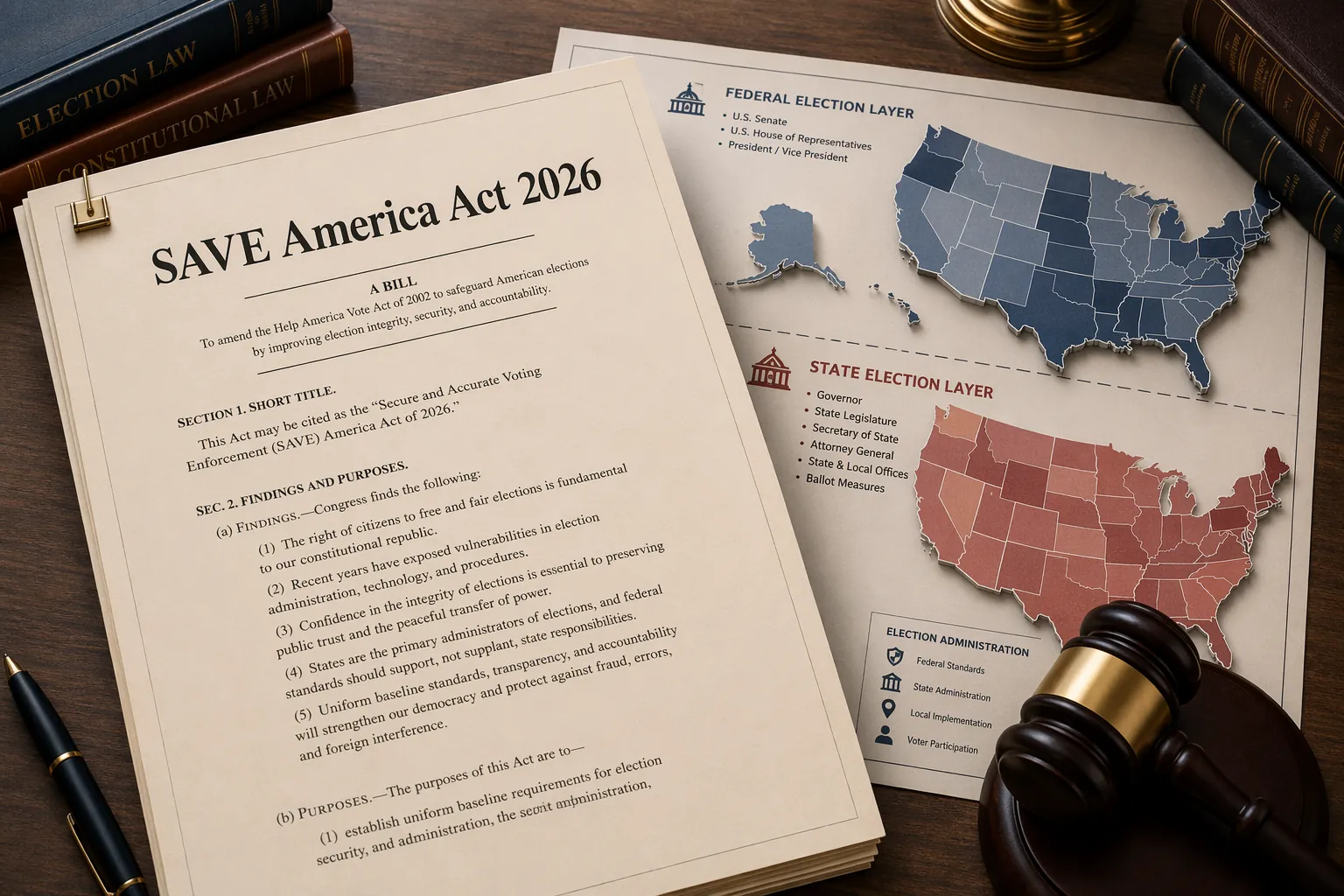
For legal and compliance teams, the useful posture is narrower: the Act is a live federal election-law proposal moving through more than one vehicle, with a Senate outcome still uncertain. It would change registration, identification, enforcement, and election-administration workflows for federal elections. This article is a legal-risk analysis, not legal advice.
The naming also matters. Coverage often collapses the “SAVE Act” and the “SAVE America Act” into one label. They are related, but not identical. The original SAVE Act focused on documentary proof of citizenship for voter registration; the SAVE America Act adds stricter voter-identification rules and broader enforcement features, while separate MEGA Act proposals move in adjacent but distinct lanes.[2] A partner memo that treats those labels as interchangeable is already losing precision.
What the Act Would Change
At the center of H.R. 7296 and S. 1383 is a federal documentary proof of citizenship requirement for voter registration in federal elections.[3] In practical terms, that means an applicant would need to present qualifying citizenship documentation before being registered to vote in federal contests. The bill also tightens photo-identification rules for voting in federal elections, with a list that does not map neatly onto many state ID regimes.
That distinction between legal requirement and administrative channel is not cosmetic. If documentary proof must be verified in person, the Act would effectively disable the ordinary function of online and mail registration for federal-election registration, even if those channels are not named in a sentence saying “online registration is abolished.” The legal mechanism is documentary verification; the operational consequence is a registration system that can no longer treat remote submission as complete.
| Provision | Legal Effect | Operational Consequence |
|---|---|---|
| Documentary proof of citizenship for federal registration | Creates a federal prerequisite for registration in federal elections | Forces election offices to verify citizenship documents before treating an applicant as federally registered |
| Strict federal voter ID list | Displaces less restrictive state ID practices for federal contests | Creates mismatch between state-accepted IDs and federally accepted IDs |
| EAC guidance within 10 days | Requires rapid federal implementation guidance if enacted | Leaves states, counties, vendors, and counsel little time to redesign forms, systems, training, and public notices |
| Private right of action expansion | Allows new litigation targeting officials who register voters without required proof | Turns ordinary registration decisions into potential statutory-liability events |
| Criminal penalties up to 5 years | Adds exposure for knowing and willful violations | Raises the stakes for documented decision-making even if prosecutions remain unlikely |
The Elections Clause Is the Starting Point, Not the Ending Point
Congress is not legislating in a vacuum. The Elections Clause gives state legislatures authority over the “Times, Places and Manner” of congressional elections, while allowing Congress to “make or alter” those regulations.[7] That clause is the strongest federal hook for a national rule governing federal-election registration procedures. It is also why a quick “states run elections” objection does not answer the constitutional question.
But a power to regulate the manner of federal elections does not make every implementation design legally tidy. The Act would sit on top of the National Voter Registration Act, state constitutions, state election codes, local registration systems, and existing voter-file architecture. The harder question is not whether Congress has some authority here. It is how far Congress may go in converting a federal registration rule into an administratively separate federal election layer, and what happens when that layer conflicts with state processes that remain lawful for state and local contests.
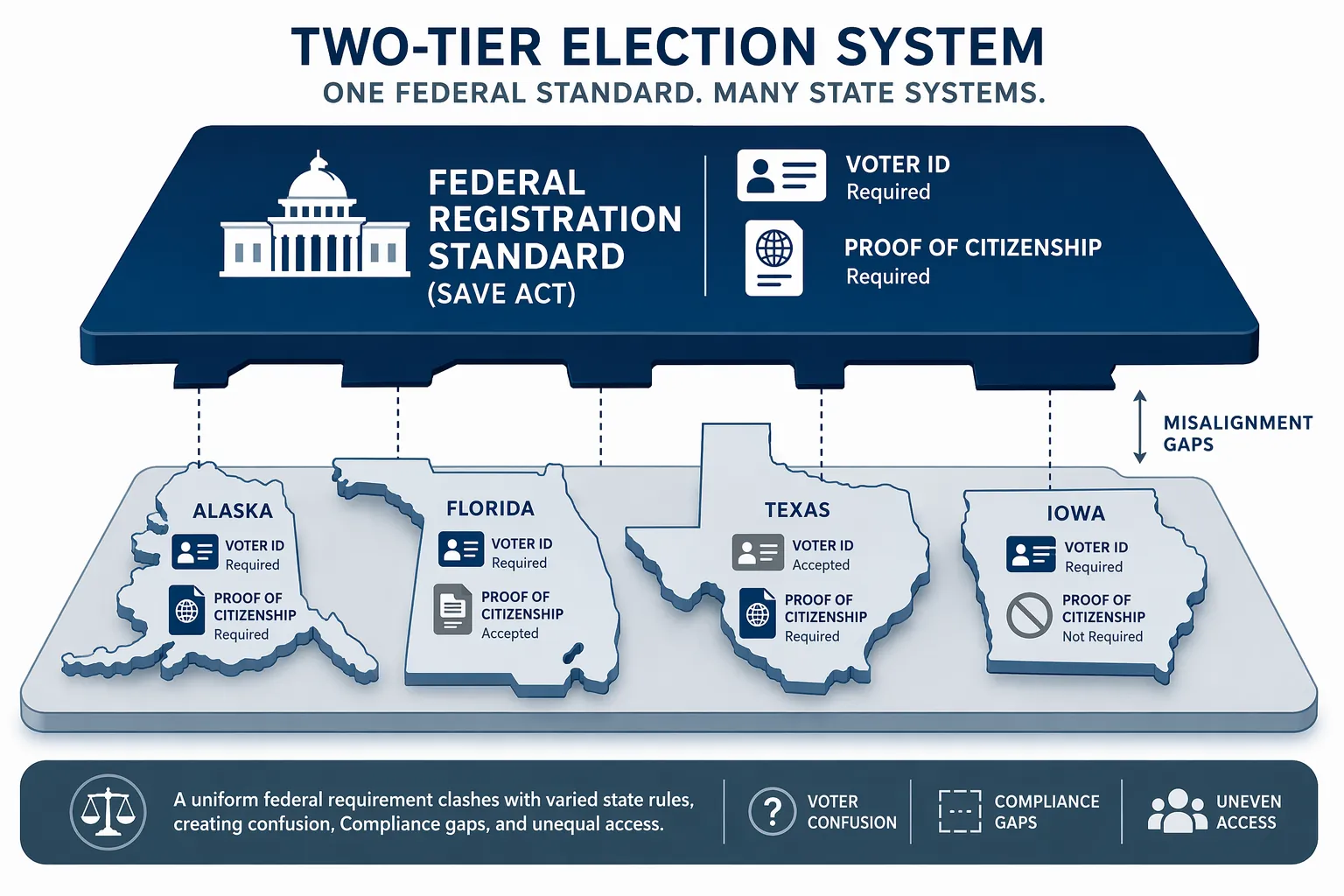
The Election Law Blog analysis frames the resulting structure as a two-tier election system: one set of rules for federal-election eligibility and administration, another for state and local contests.[4] R Street reaches the same practical concern from a governance angle, identifying the two-tier system as one of the Act’s most significant underexamined consequences.[5] That is the point practitioners should hold onto. The Act does not merely add a document check. It requires offices to decide which election layer a person is registered for, which ballot that person may receive, which ID rule applies, and which database flag controls the answer.
Why State-Law Mismatch Is the Core Legal-Operational Problem
No state’s current election rules perfectly match the proposed federal standard, according to the Election Law Blog analysis.[4] That matters more than the usual red-state blue-state shorthand. Even states with strict voter-identification laws have local compromises, legacy categories, expired-ID grace periods, attester rules, tribal-document rules, or agency-specific credential lists that do not line up with the SAVE America Act.
Alaska shows the category problem. It accepts hunting and fishing licenses for state voter-identification purposes, but the Act’s federal list does not. Florida shows the issuing-authority problem. It accepts concealed-weapon permits issued by the Department of Agriculture, while the Act requires issuance by a motor vehicle authority. Texas shows the expiration problem. It accepts licenses expired up to four years, while the Act requires unexpired identification. Iowa shows two problems at once: it accepts attesters and IDs expired up to 90 days, neither of which the Act would accept for federal purposes.[4]
Those examples are not trivia. They are implementation tests. A voter acceptable under state law may be unacceptable under the federal layer. A poll worker trained under one state rule may need a federal override rule at the same check-in table. A vendor’s electronic pollbook may need to distinguish a state-valid voter from a federal-valid voter without producing a misleading ballot style. A county attorney may need to advise whether a provisional ballot cure process applies to one contest, all contests, or none.
Arizona is the warning light because it already has a federal-only voter category. The Election Law Blog analysis cites Arizona’s federal-only voters as roughly 0.4% of registered voters, a useful benchmark against claims that every documentation rule necessarily produces catastrophic federal registration collapse.[4] But the benchmark cuts both ways. It shows that a two-tier voter file can exist; it also shows that it is not a theoretical construct. If the SAVE America Act became law, Arizona could face a three-tier structure: voters eligible for all elections, voters eligible for federal elections under one pathway, and voters whose state or local status does not map cleanly onto the new federal proof and ID requirements.[4]
The NVRA Fight Would Not Be a Side Issue
The National Voter Registration Act is where the SAVE America Act becomes more than a constitutional-law seminar. The NVRA is the existing federal architecture for voter registration in federal elections. A new documentary-proof mandate would not simply supplement that architecture; it would revise the working assumptions behind mail registration, motor-voter processes, list maintenance, and registration-form design.
Kansas supplies the most concrete cautionary example. Its documentary proof of citizenship law blocked more than 30,000 eligible registrants, about 12% of registrations, over two years and was struck down under the NVRA.[4] That is not proof that the federal Act would suffer the same fate. A state DPOC law and a federal statute enacted under congressional election authority occupy different positions in the preemption analysis. But Kansas is strong evidence of the administrative failure mode: eligible applicants can stall in large numbers when a proof requirement is added to registration workflows.
The legal question, then, is not just whether the Act preempts inconsistent state law. It likely would, at least for federal elections, where Congress is purporting to regulate registration and voting standards. The harder downstream question is what remains of state procedures once the federal layer is severed from them. Does the state keep its existing online portal for state and local races while building a separate in-person proof process for federal races? Does it redesign one universal system to satisfy the federal standard and thereby impose the stricter federal rule on state elections as a practical matter? Does state law allow that consolidation, or would state constitutional voting provisions require a separate state pathway?
Those are preemption questions, but they are also procurement questions, training questions, ballot-design questions, and public-notice questions. The Act’s federalism structure would force state and county actors to choose between legal bifurcation and administrative unification, and either choice creates a litigation target.
The Burden Evidence Needs Careful Attribution
The broadest burden estimates come from advocacy organizations and should be labeled that way. The Brennan Center for Justice estimates that about 21 million U.S. citizens lack ready access to documentary proof of citizenship and that about 69 million women have current legal names that do not match their birth certificates, creating potential documentation mismatch issues under proof-of-citizenship regimes.[6] Those figures are important. They are not the same as a prediction that all of those people would be unable to vote.
For litigation, the distinction matters. Affected-population estimates help identify the class of people who may face friction. Registration-outcome data helps show what the friction did in a real system. Arizona’s federal-only percentage and Kansas’s blocked-registration experience are therefore doing different evidentiary work. One tempers certainty about national-scale outcomes; the other shows that a documentary rule can produce substantial registration failure when implemented through ordinary election offices.[4]
Ten Days for EAC Guidance Is Not an Implementation Plan

The Act gives the Election Assistance Commission 10 days to issue nationwide guidance and provides no federal funding or phase-in period.[3] That combination should make anyone who has ever reviewed an election-administration rollout sit up straighter. Guidance is not a database schema. It is not revised state law. It is not county staff training. It is not a vendor change order, security review, public-facing form, accessibility audit, or litigation hold.
The drafting oddity involving a reference to the “Department of War” is not legally dispositive by itself, but it is operationally revealing. The Department of War name has not been used in statute since the 1947 National Security Act restructuring, and its appearance in the bill text is the kind of anomaly counsel notices because it signals haste in a statute that would demand immediate nationwide execution.[3]
The first affected actors would not be appellate judges. They would be state election directors, county registrars, secretary-of-state counsel, election-management-system vendors, form vendors, call-center supervisors, public-records officers, and lawyers deciding what to say when the federal rule and the state manual point in different directions. If the Act were enacted close to an election cycle, the compressed timeline would sharpen every ordinary implementation problem into a potential emergency motion.
That is why pending status still matters. A vendor asked to estimate engineering work cannot wait for the first TRO. A state attorney general’s office tracking parallel state SAVE-type litigation cannot pretend the federal proposal is irrelevant. A county lawyer reviewing public communications may need to know whether an applicant told “you are registered” is registered for every contest, only some contests, or no contest until documentary review is complete.
The Private Right of Action Changes the Risk Map
The Act amends the NVRA’s private right of action to reach election officials who register voters without documentary proof of citizenship.[3] That is a serious design choice. It does not merely authorize federal enforcement by the Department of Justice. It invites private plaintiffs into the registration process and gives them a statutory theory aimed at officials’ acceptance of registrations.
The likely defendants would vary by state structure: secretaries of state, state election boards, county registrars, local election officials, or officials responsible for statewide voter-registration databases. The conduct newly contestable would include accepting an application without qualifying proof, treating a remote submission as complete, failing to segregate federal-only status, designing forms that do not capture required proof, or issuing guidance that plaintiffs characterize as too permissive.
The risk is not limited to final liability. A private right of action creates demand letters, emergency injunction motions, discovery requests, public-records fights, fee exposure, and pressure to freeze or alter registration procedures before authoritative appellate interpretation exists. Election officials may also face suits from the opposite direction: voters or advocacy groups challenging rejected applications, inaccessible proof processes, mismatched-name determinations, or unequal county implementation.
The Act’s criminal penalties, carrying up to five years’ imprisonment and a “knowingly and willfully” standard, should be read with the same discipline.[3] That mens rea requirement is meaningful, and registration-related prosecutions have historically been rare. But rare prosecution is not the same as no legal effect. Criminal language changes internal escalation practices, documentation habits, indemnity questions, and the advice public lawyers give frontline officials who are asked to process borderline applications.
State SAVE-Type Laws Are Early Warning Systems
At least 14 states have passed SAVE-type laws at the state level in 2026, generating parallel state-court litigation that may produce early signals for federal challenges. Those cases will not answer every Elections Clause question raised by a federal statute. They may, however, show how courts handle documentary-proof burdens, name mismatches, state constitutional voting protections, cure procedures, and election-official discretion under tight timelines.
The better monitoring question is not “will the federal Act pass?” in isolation. It is whether the pending state cases reveal remedial patterns: injunctions limited to certain voter classes, cure-process mandates, severability rulings, database-segregation orders, or judicial skepticism toward unsupported fraud-prevention claims. Those patterns would matter quickly if Congress enacted a federal version with a 10-day EAC clock.
What Practitioners Should Track Next
The Act’s immediate value for practitioners is as a risk map. It identifies where the pressure would land: federalism, NVRA preemption, voter-file architecture, county-level implementation, vendor readiness, private enforcement, and criminal-law escalation. Those exposures exist as planning issues even if they never ripen into enacted federal obligations.
- Senate disposition across the standalone bill, NDAA vehicle, and reconciliation vehicle, because each path carries different timing and amendment risk.
- Any EAC guidance trigger if the Act is enacted, especially whether guidance addresses remote registration, acceptable documentation, federal-only status, cure procedures, and database coding.
- Early rulings in state SAVE-type litigation, particularly on documentary-proof burdens, mismatch procedures, and state constitutional voting protections.
- Amendments that change the two-tier structure, funding gap, private right of action, criminal provisions, or implementation timeline.
- Vendor and county readiness assumptions, because the legal risk will be mediated through forms, databases, pollbooks, staff scripts, and ballot-issuance rules.
The practical mistake would be treating Senate uncertainty as permission to ignore the bill. The SAVE America Act may fail, change, or move through a vehicle that looks procedurally awkward until it does not. What is already clear is the shape of the exposure: a proposed federal registration regime that does not fit existing state systems, gives the EAC days rather than months, leaves funding unresolved, and creates targeted litigation risk for the officials expected to make it work.
References
- What You Need to Know About the SAVE Act, Campaign Legal Center, updated July 23, 2026.
- Explainer: SAVE, SAVE America and MEGA Acts, Issue One.
- H.R.7296 - SAVE America Act, Congress.gov.
- Some Musings on the SAVE America Act, Election Law Blog.
- The SAVE America Gets the What Right, But the How Wrong, R Street Institute.
- New SAVE Act Bills Would Still Block Millions of Americans From Voting, Brennan Center for Justice.
- The Constitution and the SAVE America Act, National Constitution Center.
Operationalizing workflow
No workflow has been explicitly linked to this obligation yet. See Workflows generally.
Illustrative cases
No illustrative case is currently tracked for this obligation. See Risk Digest for documented incidents generally.
← Back to RegulationReport a correction or tip
Spotted an outdated figure, a misstated fact, or a ruling this regulation entry should reflect? Public comments are disabled for this content given the professional cost of a misreported case outcome, penalty amount, or rule text — use the structured correction channel instead.
Report a correction or tip for this record →