
What SAVE Plan's Demise Means for Student Loan Repayment
- Authority
- U.S. Department of Education
- Rule type
- regulation
- Jurisdiction scope
- US federal
- Effective date
- Jul 1, 2026
- Source text
- Read primary rule text ↗
Borrowers have 90 days from servicer notice to select a repayment plan; automatic placement in Standard or Tiered Standard if no response
As of Q3 2026, the practical question is no longer whether the SAVE plan will survive. It will not. The question is which borrowers received which notice, when the 90-day clock began, and what happens if no one responds before the servicer moves the account into an automatic replacement plan.
The Education Department’s current transition position covers 7.5 million borrowers who were enrolled in SAVE when the plan was terminated. Servicer notices began July 1, 2026, and those notices give affected borrowers 90 days to choose another repayment option. Borrowers who do not act are to be moved automatically into either the Standard Repayment Plan or the Tiered Standard Repayment Plan, depending on their loan type and circumstances.[1]

That is the operational endpoint of the litigation over SAVE. It is also where many borrower-facing mistakes are likely to occur. The legal story has been told in broad phrases: injunction, settlement, reversal, unlawful plan, borrower relief withdrawn. Those words matter, but they do not tell a servicer, school compliance office, benefits lawyer, or borrower advocate what to calendar. The July 2026 notices do.
The borrower count should also be handled with care. Public descriptions have used figures around seven million, 7.5 million, 7.6 million, and nearly eight million at different moments. For current transition work, the controlling number is the Education Department’s March 27, 2026 figure: 7.5 million borrowers enrolled when the SAVE plan was terminated.[1] Earlier or slightly different figures may reflect different measurement dates or communication populations, not necessarily a substantive dispute over who must now be moved.
The Current Rule Is a Notice Rule Before It Is a Repayment Rule
The March 27, 2026 Education Department release does three things that should sit at the top of any SAVE transition file. First, it identifies the affected population. Second, it states that loan servicers would begin notifying borrowers on July 1, 2026. Third, it ties nonresponse to automatic placement in Standard or Tiered Standard repayment.[1]
| Transition point | What it means for tracking |
|---|---|
| Affected population | 7.5 million borrowers enrolled in SAVE when the plan was terminated |
| Notice start date | Servicer notices began July 1, 2026 |
| Borrower response period | Borrowers have 90 days from their notice to select another repayment option |
| No borrower response | Automatic placement in Standard or Tiered Standard repayment |
| Affirmative alternative | Borrowers may choose another available plan, including RAP if eligible |
For practitioners, the important distinction is between a borrower being moved and a borrower choosing. Automatic placement is not the same event as informed selection. Standard and Tiered Standard repayment may be administratively available fallback settings, but they do not require the borrower to evaluate income, dependents, forgiveness horizon, or tax treatment before the move occurs. RAP and other affirmative options do.
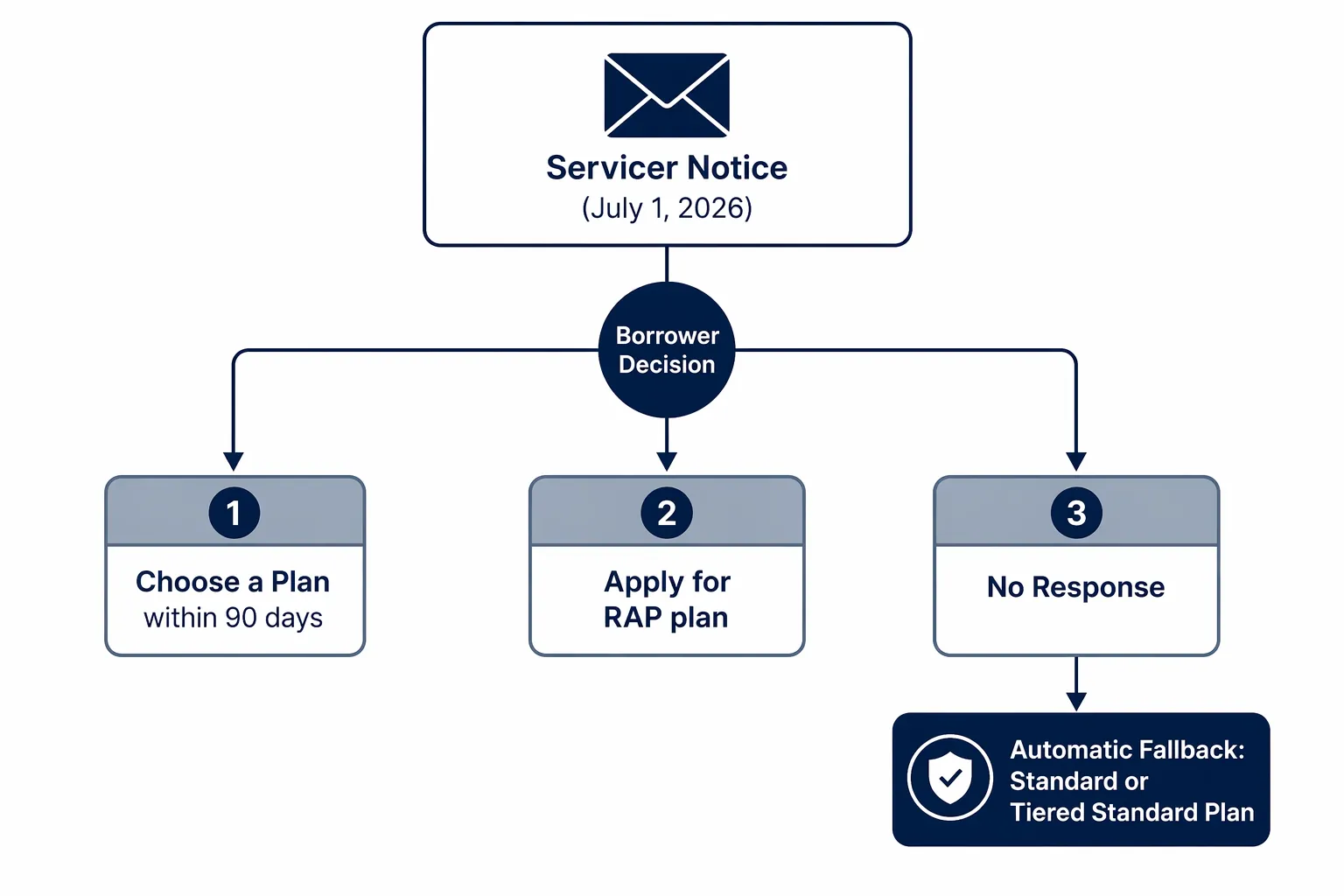
That difference is where legal exposure tends to hide. A borrower who misses a notice may later describe the event as a payment shock. A servicer may describe the same event as a disclosed, rule-based placement after a response window expired. Counsel reviewing the file will want the notice date, delivery evidence, plan-selection record, and the exact fallback applied.
How SAVE Became Legally Available to End
SAVE began as a regulatory repayment plan, not as a statute. That origin mattered once the litigation moved from policy disagreement to remedy. State challengers argued that the Education Department had exceeded its authority, particularly in creating a repayment structure with broad forgiveness consequences through agency rulemaking. The legal path from that challenge to the July 2026 transition was not a single clean order.
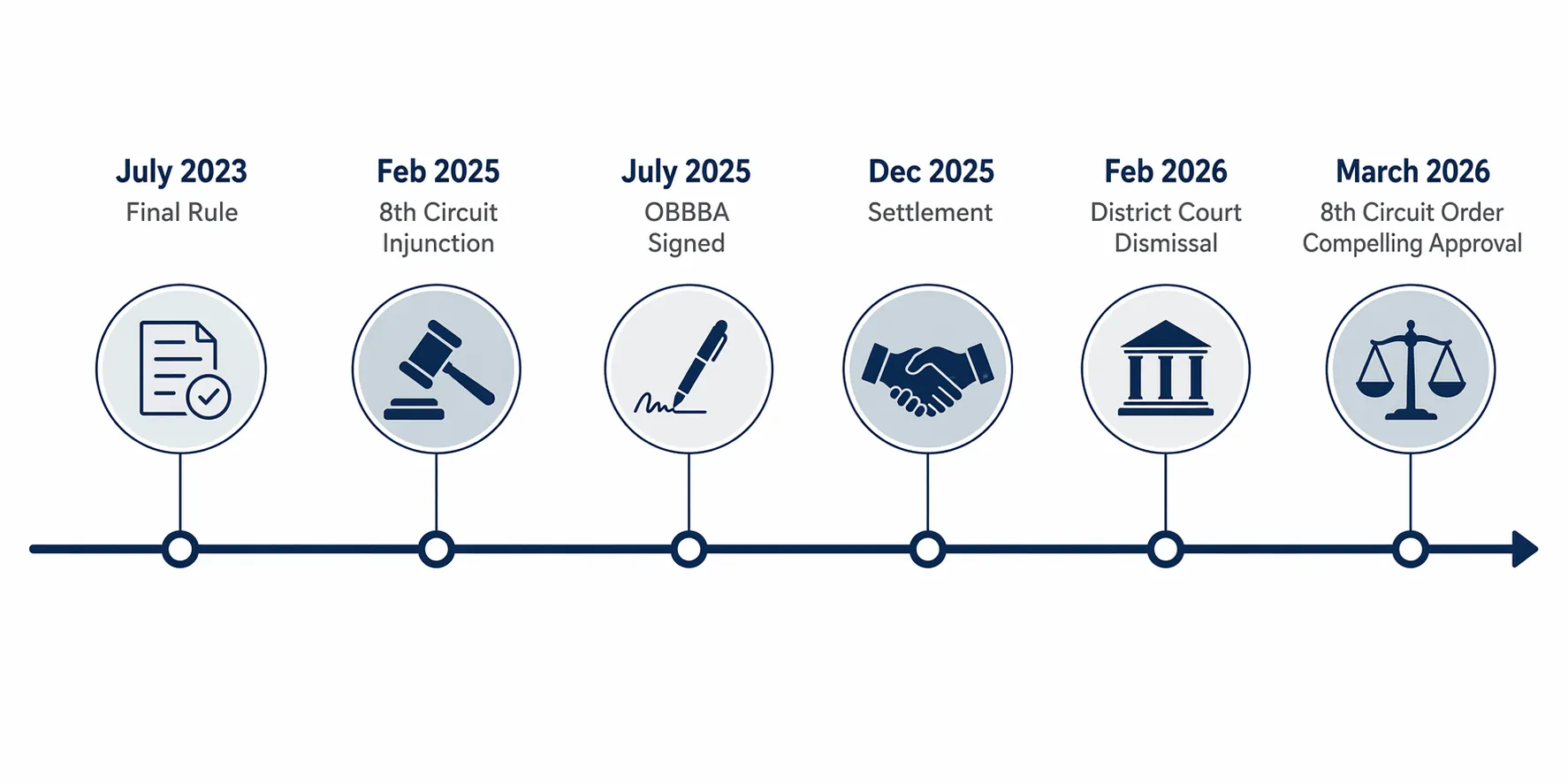
By February 2025, the 8th Circuit had blocked the SAVE plan in full. The injunction prevented the administration from implementing the plan while the litigation continued, and it substantially changed the risk posture for borrowers who had been placed into administrative workarounds while the case moved forward.[2]
Congress then added a second source of pressure. The One Big Beautiful Bill Act, signed July 4, 2025, required the phase-out of several existing repayment options by July 1, 2028 and created the new Repayment Assistance Plan, or RAP.[3] In later Education Department materials, the same legislation is also referred to as the Working Families Tax Cuts Act. The naming inconsistency is irritating but not decisive; the operative point is that legislation and litigation began pushing in the same direction.
The settlement posture arrived in December 2025. The Education Department announced an agreement with Missouri to end the Biden administration’s SAVE plan, framing the plan as unlawful and positioning the settlement as the mechanism for terminating it.[4] That announcement did not, by itself, finish the case. A settlement still had to pass through the court handling the litigation.
In February 2026, the district court in the Eastern District of Missouri declined to approve the settlement and dismissed the lawsuit. The following month, the 8th Circuit reversed in a terse order and directed approval of the agreement. Public reporting described the appellate order as two sentences long, an unusual procedural posture given the size of the borrower population and the effect of the settlement.[5]
That sequence leaves a small but important caution flag. The gap between the February 2026 dismissal and the March 2026 appellate reversal has generated questions about whether any forgiveness-related claims might have arisen while the injunction posture was unsettled. The materials available here do not resolve those claims. They should not be treated as settled merely because the transition mechanics are now underway.
The Dismantling Was Layered, Not Linear
The cleanest chronology is still worth keeping close because each layer created a different kind of obligation. The state lawsuits attacked agency authority. The 8th Circuit injunction froze implementation. Congress created a statutory replacement architecture and a long-stop phase-out. The administration’s settlement converted litigation risk into an agreed termination path. The March 2026 appellate order supplied the judicial command that allowed the Education Department to proceed with borrower transition notices.
| Date | Event | Compliance significance |
|---|---|---|
| July 2023 | Education Department issues the SAVE final rule | Creates the regulatory plan later challenged in state litigation |
| February 2025 | 8th Circuit blocks SAVE in full | Stops implementation while litigation continues |
| July 4, 2025 | OBBBA is signed | Creates RAP and mandates phase-out of existing repayment structures by July 1, 2028 |
| December 9, 2025 | Education Department announces settlement with Missouri | Sets an agency-backed path to ending SAVE |
| February 2026 | District court declines settlement approval and dismisses the case | Creates an unsettled interval before appellate correction |
| March 2026 | 8th Circuit directs approval of the settlement | Clears the way for termination and transition implementation |
| July 1, 2026 | Servicer notices begin | Starts borrower-facing transition work and the 90-day response process |
There is a separation-of-powers concern embedded in the March 2026 procedural posture: an appellate court ordering settlement approval at the joint request of the challenging states and the administration, after the district court had refused approval. Advocacy groups have flagged that concern. The available record supports noting it as unresolved; it does not support turning this borrower-transition tracker into a full constitutional analysis.
For compliance purposes, the more immediate point is that no single institution alone ended SAVE. Litigation made the plan vulnerable, Congress created overlapping replacement rules, and the agency implemented the borrower transition after the settlement route was restored. That combination is why the current obligations cannot be read from only one document.
What the 90-Day Window Requires Someone to Track
The 90-day period is not just a borrower-education window. It is a document-control problem. A practitioner reviewing a borrower’s file needs to know when the notice was sent, what it said, whether the borrower selected a new plan, and what the servicer did after the response period expired.
- Confirm whether the borrower was among the 7.5 million SAVE enrollees covered by the transition.
- Obtain the servicer notice and preserve the date tied to the borrower’s response period.
- Identify whether the borrower affirmatively selected a new repayment plan.
- If no selection occurred, verify whether the servicer placed the borrower in Standard or Tiered Standard repayment.
- Separately evaluate RAP availability, payment effects, forgiveness horizon, and tax consequences.
The fallback matters because Standard and Tiered Standard repayment are not simply neutral holding rooms. They may change monthly payment obligations and may not preserve the same forgiveness expectations borrowers associated with SAVE. If a borrower later says, “I thought I was still in an income-driven plan,” the answer will depend less on the public debate over SAVE and more on the contents and timing of the notice.
RAP Is an Option, Not an Automatic Substitute for SAVE
RAP is the major new affirmative option created in the same legislative environment that helped end SAVE. It became available July 1, 2026. Its payment formula is based on 1% to 10% of adjusted gross income, reduced by $50 per month for each dependent, with a $10 minimum monthly payment and forgiveness after 30 years.[6]
Those design details should not be compressed into “the new SAVE.” RAP uses a different formula and a longer forgiveness horizon. TICAS has estimated that a median family of four could see a monthly payment increase from $36 under SAVE to $440 under RAP.[7] That comparison is not every borrower’s outcome, and it should not be used as a universal payment estimate. It is useful because it shows why plan selection during the 90-day window is consequential rather than clerical.
A borrower may still decide RAP is the best available choice. The relevant compliance point is narrower: RAP requires an affirmative election and an eligibility/payment analysis. It is not the automatic landing place for a SAVE borrower who ignores the notice.
Tax Consequences Returned at the Same Time
The repayment transition also intersects with a tax change. Under the OBBBA framework described by borrower-assistance advocates, income-driven repayment forgiveness becomes taxable income again starting January 1, 2026.[8] That reinstated tax treatment is separate from the question of which plan a borrower enters after SAVE, but the two issues will often be reviewed together because both affect the long-term cost of repayment.
The tax point should not be overstated. It does not mean every affected borrower will immediately face a tax bill. It means that forgiveness planning after January 1, 2026 must account for taxability where applicable. A transition memo that compares only monthly payments may miss the later consequence that arrives after the repayment plan has done exactly what it promised to do.
What Remains Open
Some issues remain too uncertain for confident client-facing conclusions. The possible claims arising from the short February-to-March 2026 procedural gap have not been resolved by the transition notices. The separation-of-powers objection to the appellate settlement-approval posture remains a procedural concern, not a settled borrower remedy. And borrower counts used in public reporting should be tied to their source and date rather than blended into a single rounded figure.
What is not open is the immediate tracking obligation. SAVE’s demise is now a live compliance calendar created by litigation, legislation, and agency action acting together. The items to watch are the servicer notice date, the borrower’s 90-day response period, any affirmative plan selection, automatic fallback to Standard or Tiered Standard repayment, RAP availability, and tax consequences for forgiveness after January 1, 2026.
References
- U.S. Department of Education Announces Next Steps for Borrowers Enrolled in Unlawful SAVE Plan, U.S. Department of Education, March 27, 2026.
- U.S. appeals court blocks Biden SAVE plan for student loans, CNBC, February 18, 2025.
- Federal Student Loan Program Provisions Effective Upon Enactment Under the One Big Beautiful Bill Act, U.S. Department of Education, July 18, 2025.
- U.S. Department of Education Announces Agreement with Missouri to End Biden Administration’s Illegal SAVE Plan, U.S. Department of Education, December 9, 2025.
- SAVE plan for student loan borrowers is over, federal appeals court says, CNBC, March 10, 2026.
- Reconciliation 2025 Borrower FAQs, The Institute for College Access & Success.
- What the New Repayment Assistance Plan Could Mean for Borrowers, The Institute for College Access & Success, February 2026.
- Big Bill Means Big Changes for Student Loan Borrowers: What You Need to Know, National Consumer Law Center.
Operationalizing workflow
No workflow has been explicitly linked to this obligation yet. See Workflows generally.
Illustrative cases
No illustrative case is currently tracked for this obligation. See Risk Digest for documented incidents generally.
← Back to RegulationReport a correction or tip
Spotted an outdated figure, a misstated fact, or a ruling this regulation entry should reflect? Public comments are disabled for this content given the professional cost of a misreported case outcome, penalty amount, or rule text — use the structured correction channel instead.
Report a correction or tip for this record →