
Passing a stopped school bus penalty depends on the camera
- Authority
- Virginia General Assembly
- Rule type
- statute
- Jurisdiction scope
- US state
- Effective date
- Jul 1, 2027
- Source text
- Read primary rule text ↗
Do not pass a stopped school bus; camera-issued violations are civil penalties and officer-issued violations are moving violations, with state-specific amounts.
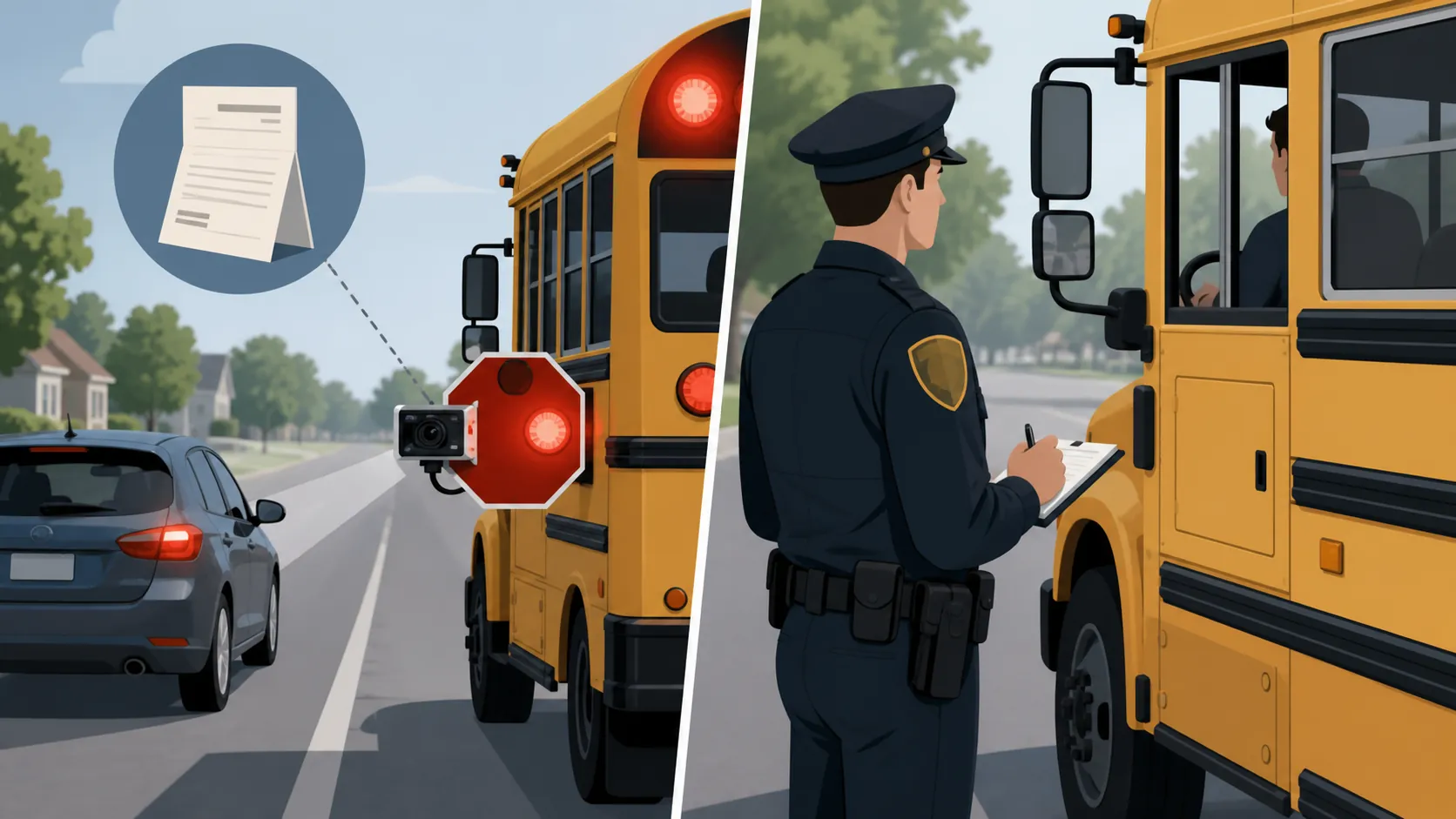
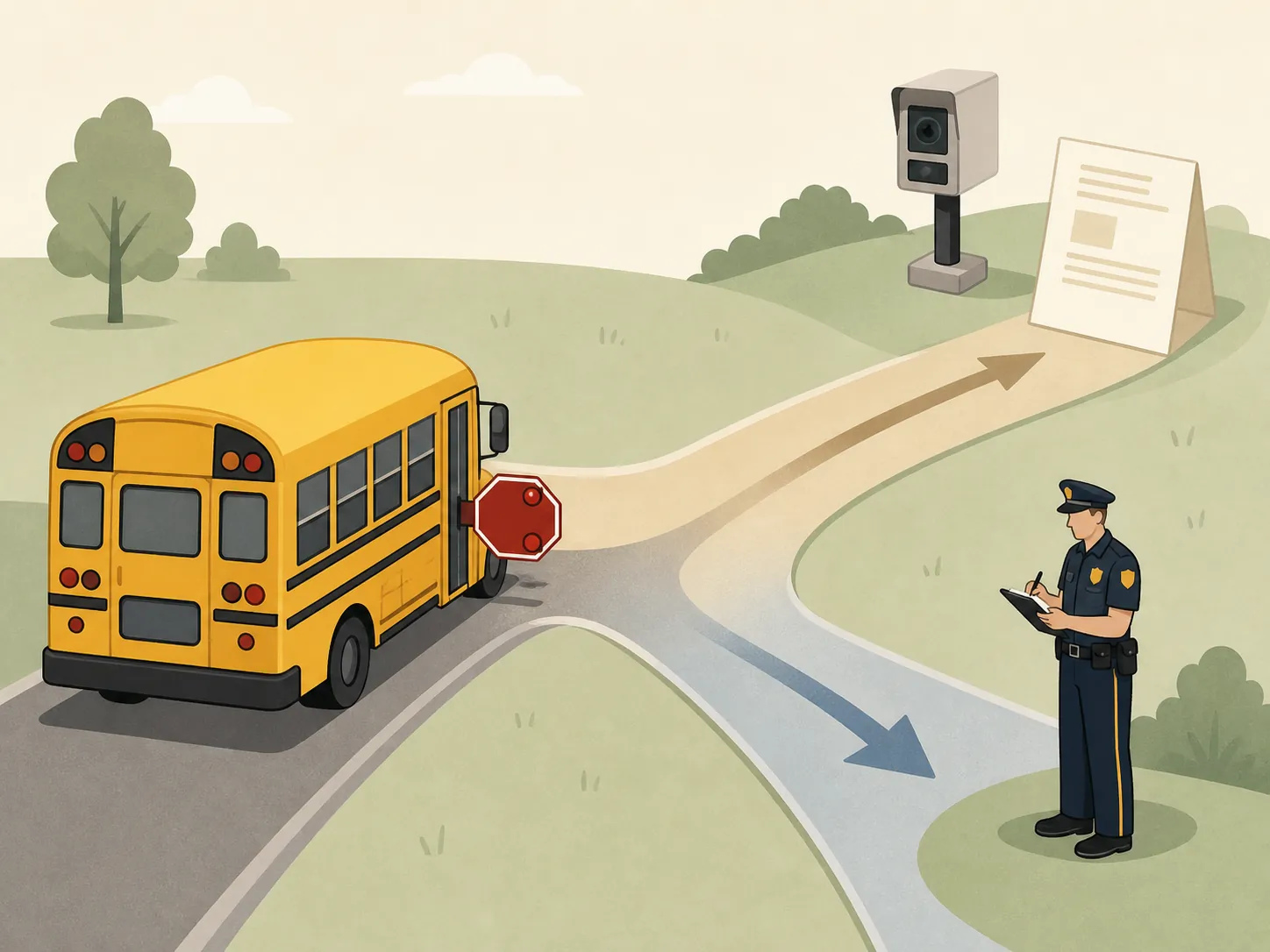
The answer to “what is the penalty for passing a stopped school bus in my state?” starts with a different question: who detected the violation? A stop-arm camera may produce a civil notice tied to the vehicle or its operator, while an officer’s roadside observation may produce a moving-violation citation against the driver. Those documents can arise from the same dangerous pass and still carry different rules for fines, points, court treatment, and suspension.
| Detection path | Typical enforcement form | What the notice may establish | What must be verified separately |
|---|---|---|---|
| Stop-arm camera | Civil violation notice | A vehicle-associated event, the applicable civil penalty, and any authorized administrative charge | Driver points, suspension, criminal classification, service requirements, and owner or operator liability |
| Officer observation | Traffic citation or criminal charge, depending on state law and circumstances | The driver allegedly committed a moving violation and must respond under the state’s traffic or criminal procedure | Fine level, points, suspension, court disposition, and any injury-or-death enhancement |
The camera notice and the officer citation are different legal records
A camera notice usually answers a narrow evidentiary question: a camera system recorded a vehicle passing a stopped school bus under the conditions defined by the authorizing law. Its civil classification matters because a civil penalty is not automatically the same thing as a driver conviction. A number printed on a camera notice should therefore not be converted into points or a suspension consequence unless the governing provision expressly provides for them.
An officer-issued citation begins from a different record. The officer identifies the driver, documents the roadside observation, and charges the conduct under the state’s traffic or criminal law. That route can expose the driver to consequences that a camera statute may not mention at all. The difference is not a technicality for a fleet manager reviewing a notice: it determines which law, response deadline, hearing process, and driver-record consequences deserve attention.
Virginia supplies the clearest verified camera figure
Within the available materials, Virginia is the only state for which the camera penalty is confirmed directly against primary statutory text. Virginia Code § 46.2-844 provides a $250 civil penalty for the covered school-bus passing violation. The provision also states that a vendor’s administrative fee may be capped at $25 when the penalty is paid within 60 days, or $100 when it remains unpaid after 30 days. The cited version is effective July 1, 2027. [1]
That statute supports a specific conclusion and no more: Virginia’s identified camera regime has a $250 civil penalty, with the stated fee caps. The supplied text does not establish driver points, a license suspension, a criminal conviction, or a general owner-liability rule. Those details should not be filled in from assumptions about how officer-issued school-bus violations work.
The future effective date also matters. A citation issued before July 1, 2027 should not be analyzed as though the cited version automatically governed it. The notice date, the law’s effective date, and any separate local or transitional provision need to be checked before the Virginia figure is applied to a live matter.
Why a state-by-state camera count does not settle the penalty question
The number of states authorizing stop-arm cameras is itself unsettled in the available sources. A National Highway Traffic Safety Administration figure reported by School Transportation News identifies 24 states or territories. [2] A separate July 2025 state-law compilation cited by Verra Mobility gives a count of 26. [3] Nevada’s authorization in July 2025 is a plausible timing explanation for part of the difference, but the available material does not resolve the discrepancy into one definitive national count.
The NHTSA figure should also be treated as an index rather than a substitute for reading each state’s law. The report’s official publication date, methodology, and complete per-state data are not extractable from the supplied packet. The Verra Mobility page is useful for identifying reported authorization changes, but it is not primary statutory text for every state and does not, by itself, verify each penalty amount or driver consequence.
The covered state references in that material are partial, not a complete national list: Oregon’s 2024 authorization; Nevada’s July 2025 authorization; Florida and Tennessee in 2023; Delaware in 2020; Michigan in 2021; and references to New York, Connecticut, Georgia, and Maryland. [3] The packet does not provide the full 26-state list, so the absence of a state from this paragraph does not establish that camera enforcement is unavailable there.
Officer-issued penalties can escalate well beyond a camera civil assessment
Florida illustrates why an officer-issued consequence cannot be folded into the Virginia camera figure or into a generic “school-bus fine.” The Florida Highway Safety and Motor Vehicles material reports that a violation involving serious injury or death can bring a $1,500 fine, six points, a minimum one-year license suspension, 120 hours of community service, and a victim-impact panel. [4] That is a serious-injury-or-death escalation reported on an agency webpage; the supplied page is undated and does not provide a statutory citation. It should be verified against the controlling Florida provision before being used to advise on a particular citation.
North Carolina is another example of a different enforcement architecture. A secondary law-firm discussion describes passing a stopped school bus as a criminal misdemeanor and discusses a prayer-for-judgment-continued, or PJC, issue. [5] Because that account is not the primary statute, it is a lead for verification rather than a complete statement of current punishment. It does, however, show why the words “school-bus penalty” are insufficient without identifying the charging route and the state provision applied.
Recent change reports reinforce the need to date the research. Posts from New Hampshire Governor Kelly Ayotte and KOMU 8 report signed or enacted increases involving penalties for passing a stopped school bus in New Hampshire and Missouri, respectively, but the supplied material does not specify the amounts or effective dates. [6][7] They are evidence that the rules are moving, not reliable figures for a citation analysis.
What this comparison covers—and what it does not
This reference covers the enforcement-pathway distinction, Virginia’s camera penalty as verified by the cited primary statute, the reported camera-authorization counts, and the limited state examples identified in the source packet. It does not provide a verified 50-state table of fines, points, suspensions, camera-specific liability rules, or criminal classifications. Camera penalties beyond Virginia remain unverified here unless traced to the governing state law.
Minnesota should not be used to fill that gap. The 2015 provision supplied in the research materials is superseded, and a 2021 Minnesota fine-increase and camera proposal was not confirmed as enacted. [8] An old statute or an unconfirmed proposal can make a state table look complete while giving the reader the wrong rule.
For a specific notice, begin with the document itself. Determine whether it was issued by a camera program or by an officer, identify the vehicle and alleged date of violation, and locate the state provision named on the notice. Then verify the penalty’s classification, payment or hearing process, and any points or suspension language in that provision. A number that appears only in a vendor page, a summary, or an undated announcement is a useful lead, but not yet the answer.
References
- Virginia Code § 46.2-844
- NHTSA Releases Report on Nationwide Illegal School Bus Passing Laws — School Transportation News, November 20, 2024
- School Bus Stop-Arm Camera Regulations by State — Verra Mobility
- School Bus Safety — Florida Highway Safety and Motor Vehicles
- Passing a Stopped School Bus Is a Crime in North Carolina — Browning & Long, PLLC
- I signed a law last week to increase penalties for passing a stopped school bus — Kelly Ayotte for New Hampshire
- A new Missouri law will increase the penalties and fines for drivers who illegally pass a stopped school bus — KOMU 8
- Minnesota House Session Daily: HF2172
Operationalizing workflow
No workflow has been explicitly linked to this obligation yet. See Workflows generally.
Illustrative cases
No illustrative case is currently tracked for this obligation. See Risk Digest for documented incidents generally.
← Back to RegulationReport a correction or tip
Spotted an outdated figure, a misstated fact, or a ruling this regulation entry should reflect? Public comments are disabled for this content given the professional cost of a misreported case outcome, penalty amount, or rule text — use the structured correction channel instead.
Report a correction or tip for this record →