
Senate Absence Rule Violations and Their Legal Implications
- Authority
- U.S. Senate
- Rule type
- standing order
- Jurisdiction scope
- US federal
- Source text
- Read primary rule text ↗
Senators must not be absent without leave; enforcement only through Senate quorum procedures and rarely used.
This article is for informational purposes only. It is not legal advice, does not create an attorney-client relationship, and is not legislative advocacy.
The July 2026 question is easy to phrase and harder to answer cleanly: if Senator Mitch McConnell has missed a long run of votes without apparent leave, is he “breaking the law”? A July 2026 news report put the count at 30 consecutive missed roll-call votes as of July 23, 2026, but that figure should be checked against the Senate’s public roll-call records before anyone treats it as a final factual premise. [1] The legal question does not turn on the news count alone. It turns on the source of the duty, the body that can enforce it, and the remedy that actually follows.
The short answer is this: Senate Rule VI can be violated as an internal Senate rule if a senator absents himself or herself without leave, but the available materials do not support treating absence alone as a practically enforceable disciplinary offense. “Rule violation” may be defensible if the absence was unauthorized. “Breaking the law” is too imprecise unless it is carefully limited to an internal Senate rule with no demonstrated independent enforcement teeth.

What Rule VI Actually Says
Rule VI is not coy. Paragraph 2 states: “No Senator shall absent himself from the service of the Senate without leave.” The same rule, as annotated in Senate procedure materials, also provides machinery for compelling absent senators when a quorum problem arises. Paragraph 4 makes an order to direct the sergeant at arms to request, and when necessary compel, the attendance of absent senators a privileged order; it is not debatable, and while the order is pending no other business is in order except a motion to adjourn. [2]
That is the first distinction worth preserving. Rule VI is a Senate rule, not a federal criminal statute. Its command is real, but its legal character is institutional. A senator who is absent without leave is not thereby exposed, on these materials, to prosecution by the Department of Justice, a civil enforcement action by a private plaintiff, or routine review by a court. The rule belongs to the Senate’s own law of proceedings.
The constitutional hook is Article I, Section 5. Each House may determine its own rules of proceedings, and a smaller number may compel the attendance of absent members “in such Manner, and under such Penalties as each House may provide.” [3] That language matters because it answers the “who can enforce it?” question. The power is lodged in the chamber. If the Senate wants an attendance remedy, the Constitution gives it room to provide one. It does not supply an automatic outside sanction.
| Question | Best Answer From The Materials |
|---|---|
| Is unauthorized absence forbidden? | Yes. Rule VI paragraph 2 forbids a senator from absenting himself or herself from Senate service without leave. |
| Is the rule constitutional in source? | The Senate’s authority rests on Article I, Section 5, which lets each House set rules and compel attendance under penalties it provides. |
| Who enforces the rule? | The Senate, through its own procedures, not prosecutors or private litigants on the materials reviewed. |
| Has absence alone produced formal discipline? | The cited Senate disciplinary materials do not show a censure or expulsion for absence alone. |
| What is the practical consequence? | The tools exist mainly as quorum-enforcement machinery and are dormant as independent absence discipline. |
The Enforcement Tools Are Old, Real, And Mostly Dormant
The Senate has not lacked paper tools. In 1798, it adopted a rule requiring absent senators to pay the expenses incurred in sending for them unless they could provide a sufficient excuse. In 1877, the Senate amended its rules to authorize the sergeant at arms to arrest absent senators and bring them to the chamber. [4] Those provisions are not decorative in the sense that they never existed. They are functionally dormant in the more lawyerly sense that their practical use has become vanishingly rare.
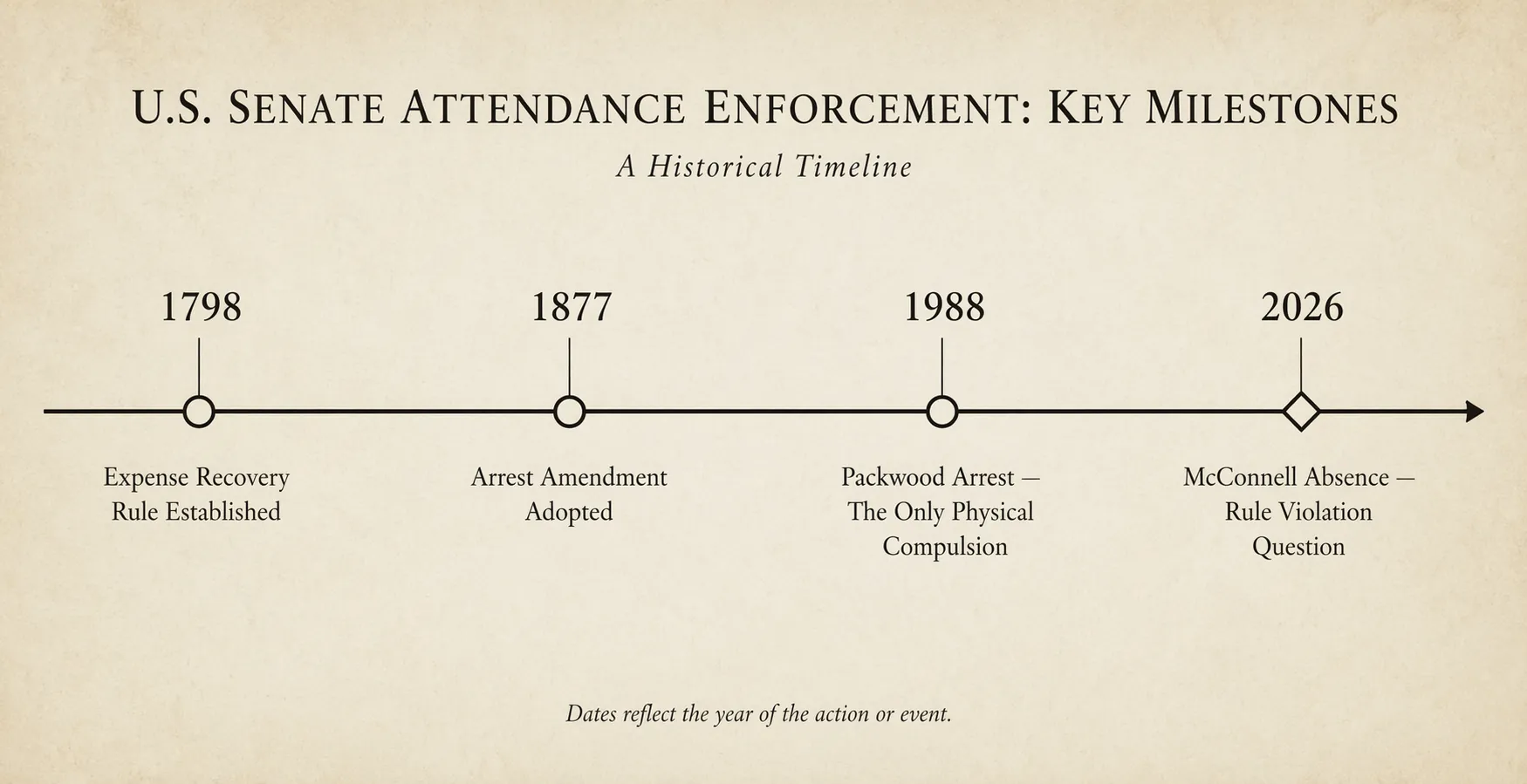
This history is important because it prevents two opposite errors. The first is to say Rule VI means nothing. It does not mean nothing; the Senate has long claimed the authority to recover expenses, send for absent members, and physically compel attendance if its procedures require it. The second error is to treat those old tools as though they operate like ordinary workplace discipline. They do not. They sit inside the Senate’s quorum and attendance procedures, and they depend on Senate action.
The compulsion machinery is therefore better understood as a way to make the chamber capable of acting when attendance becomes procedurally necessary. It is not a freestanding attendance code that automatically punishes every unauthorized absence. That is why the difference between a missed vote and a demonstrated absence of a quorum is not pedantry. It is the difference between a political fact and a procedural condition that can trigger Senate action.
Quorum Practice Explains The Gap Between Text And Consequence
The Senate does not constantly prove that a quorum is present. Congressional Research Service materials describe a presumptive quorum: the Senate assumes it has a quorum unless the absence of a quorum is demonstrated. CRS also distinguishes routine quorum calls, which often operate as pauses in floor activity, from “live” quorum calls that can become genuine attendance disputes. [5]
That presumption is doing a great deal of work. If the Senate had to verify every member’s presence before every act, Rule VI would have a different practical life. Instead, the ordinary floor system can keep moving unless someone makes absence matter procedurally. A senator’s missed votes may be visible, politically damaging, and easy to count. They still do not automatically transform into a disciplinary case.
Senate.gov’s account of quorum-busting shows how even live attendance fights tend to resolve without hauling senators into the chamber. When opponents try to prevent a quorum by staying away, the Senate may vote on a motion related to compelling attendance. That roll-call vote itself often draws enough senators to establish that a quorum exists, making actual arrest unnecessary. [6]
This is the procedural hinge. The Senate’s attendance rules have bite when absence prevents the body from doing business and the chamber chooses to respond. They do not, in the materials reviewed, create a standing remedial path for outsiders to demand punishment because a senator has missed a string of votes. In practical terms, the Senate has built ways to get to business, not a modern administrative system for punishing nonattendance.
Packwood Proves Compulsion Is Possible, Not Routine
The 1988 arrest of Senator Bob Packwood is the example that keeps this analysis honest. During a quorum dispute, the Senate directed the sergeant at arms to compel attendance, and Packwood was physically brought to the chamber. Senate.gov identifies it as the only instance in Senate history in which a senator was physically compelled to attend. [6]
That episode proves the arrest power is not purely imaginary. It does not prove that the Senate disciplines senators for absence alone. Packwood is an attendance-compulsion precedent in the context of a live quorum fight. It is not a general precedent for converting missed votes, by themselves, into a censure, expulsion, damages claim, criminal allegation, or judicially manageable controversy.
That limited reading is especially important in the McConnell setting. If the factual claim is that a senator missed votes, the nearest historical precedent does not answer: “then arrest or discipline follows.” It answers something narrower: if the Senate faces a quorum problem and chooses to use its compulsory attendance procedures, physical compulsion has happened once.
The Disciplinary Record Leaves Absence In The Negative Space
The Senate’s censure and expulsion history points the same way. Senate.gov states that nine senators were censured between 1811 and 1990, and that 15 senators have been expelled. [7] The cited censure page does not identify absence alone as the basis for those punishments. That absence from the disciplinary record is not a mathematical proof that no attendance controversy could ever be punished. It is enough, however, to reject the easy claim that an unauthorized absence normally carries a meaningful disciplinary consequence.
What The McConnell Absence Does And Does Not Change
If the reported McConnell missed-vote count is verified against Senate roll-call records, it may matter politically. Constituents may care. Colleagues may care. Party leadership may care. Reporters may fairly ask whether leave was requested, granted, or informally accommodated. None of that requires pretending the materials show a court-ready claim or a prosecutor-ready offense.
The strongest legally careful formulation is conditional: if a senator is absent from the service of the Senate without leave, that appears inconsistent with Rule VI paragraph 2. The practical consequence is a separate question. The Constitution allows the Senate to compel attendance under penalties it provides, and Senate rules preserve privileged procedures for sending for absent senators. But the modern practice described by CRS and Senate.gov shows quorum management, tactical delay, and occasional procedural confrontation—not routine discipline for nonattendance.
That is why “breaking the law” is a poor phrase here. It collapses four different possibilities: violation of an internal Senate rule, exercise of a constitutional compulsion power, formal Senate discipline, and external legal liability. The first may be arguable on the facts. The second exists only if the Senate invokes it. The third is not supported by absence-alone precedent in the materials reviewed. The fourth is not shown at all.
A Practical Answer For Lawyers Asked To Evaluate It
A defensible answer should separate the factual predicate from the institutional remedy. First, verify the missed votes through Senate roll-call records rather than relying only on a news count. Second, determine whether there is any record of leave, accommodation, or explanation. Third, identify who could act: the Senate itself. Fourth, avoid importing ordinary employment-law assumptions into a constitutional chamber that controls its own proceedings.
On the researched materials, the McConnell absence illustrates the gap between Rule VI’s formal command and the Senate’s institutional practice. The rule’s text is mandatory. The enforcement tools are real. The modern disciplinary consequence for absence alone is not demonstrated. Unless the Senate chooses to revive dormant attendance tools in a live procedural setting, the legal implication remains bounded: an unauthorized absence may be called a Senate rule violation, but calling it “breaking the law” without that limitation overstates what the rule has been shown to do.
References
- McConnell accused of breaking Senate rule, The Mirror US.
- §406 Senate Rule 6, Budget Counsel.
- Article I, Section 5, Constitution Annotated.
- The Senate Enforces Attendance, Senate.gov.
- Voting and Quorum Procedures in the Senate, Congressional Research Service.
- Quorum Busting, Senate.gov.
- About Censure, Senate.gov.
Operationalizing workflow
No workflow has been explicitly linked to this obligation yet. See Workflows generally.
Illustrative cases
No illustrative case is currently tracked for this obligation. See Risk Digest for documented incidents generally.
← Back to RegulationReport a correction or tip
Spotted an outdated figure, a misstated fact, or a ruling this regulation entry should reflect? Public comments are disabled for this content given the professional cost of a misreported case outcome, penalty amount, or rule text — use the structured correction channel instead.
Report a correction or tip for this record →