
No Law Requires FBI Background Checks for Senate Nominees
- Authority
- U.S. Senate Banking Committee
- Rule type
- executive order
- Jurisdiction scope
- US federal
- Source text
- Read primary rule text ↗
The legally important fact from the Senate Banking Committee’s July 23, 2026 closed session is narrow: the committee advanced nominees despite objections that FBI background-check information was incomplete, and the substance of the concerns raised in that closed session has not been publicly reported.[1] That leaves less room for confident accusation than the politics of a confirmation fight usually suggests. It also leaves a real process question: if a Senate committee moves nominees before completed FBI findings are in hand, what law has actually been violated?
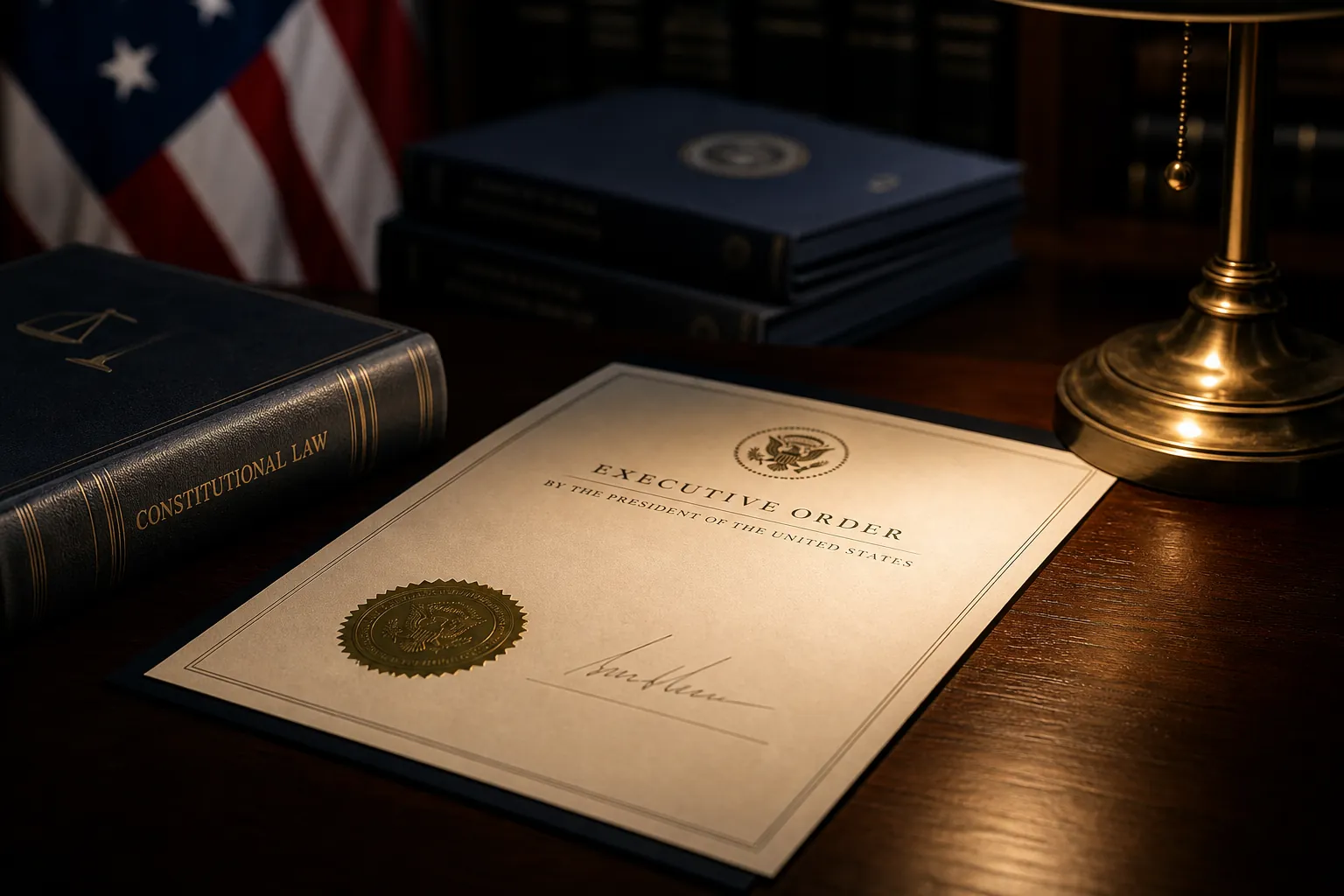
On the available record, the answer is not “a statute requiring FBI background checks for Senate nominees.” The practice rests principally on Executive Order 10450, issued in 1953, and on the nomination process that developed around White House vetting, FBI investigative work, committee review, and Senate consent. NPR’s 2025 explainer described that executive-order lineage and quoted the FBI’s own statement that it “serves as an investigative service provider and does not adjudicate or render an opinion” on nominees.[2] Vox reached the same basic legal architecture through expert interviews: FBI checks are customary in the modern confirmation process, but not compulsory by force of a statute directed at Senate nominees.[3]
The Missing Statute Matters, But It Does Not End the Inquiry
Confirmation lawyers tend to separate two questions that public debate often collapses. First, is there a legal command requiring an FBI background investigation before a nominee may receive a committee vote? Second, can a committee’s decision to proceed without complete FBI material still create legal, ethical, or institutional risk? The first question is comparatively clean. The second is where the file starts to matter.
Congress has considered making the background-check expectation mandatory. In late 2024, Rep. Ted Lieu and Rep. Don Beyer introduced legislation that would have required FBI background checks for certain presidential nominees, but that codification effort did not become law.[4] The failure of such a bill is not, by itself, proof that committees should disregard FBI files. It is proof of something narrower and more important for legal-risk analysis: the mandate people sometimes assume exists has not been enacted.
That distinction is why an incomplete FBI file does not automatically make a nomination unlawful. A Senate committee has constitutional and chamber-based authority to conduct its own advice-and-consent process. It may demand questionnaires, hold hearings, request documents, ask follow-up questions, and vote when it chooses under its rules. But the absence of a statutory FBI-check requirement is not the same thing as a clean bill of procedural health. A committee can act lawfully and still build a record too thin to bear later scrutiny.
The FBI Investigates; It Does Not Clear the Nominee
The FBI’s role is often described as if the Bureau gives nominees a pass-fail grade. That is not how the authority is framed. The Bureau gathers information for the entity that must make the judgment. Its own formulation—that it is an investigative service provider and does not adjudicate or render an opinion—is not a bureaucratic nicety.[2] It is the line between fact development and decision-making.
For a nominee, that means the risk does not depend only on whether an FBI report contains a dramatic allegation. The more durable risk is inconsistency: a questionnaire answer that omits something later found in investigative material, a hearing answer that becomes misleading when compared with third-party interviews, or a supplemental disclosure that arrives only after a committee vote. Those are not necessarily crimes, and they are not necessarily disqualifying. But they are the kinds of discrepancies that follow a nominee into ethics reviews, inspector general referrals, oversight letters, and agency litigation strategy.
For the committee, the FBI’s limited role cuts in both directions. Senators are not bound to accept an FBI file as dispositive because the FBI does not decide suitability. At the same time, a committee that proceeds without completed investigative material cannot later pretend that the FBI silently resolved questions it never had the chance to finish developing. The decision-maker owns the decision.
Committee Investigation Is Real, But It Is Not an FBI Substitute
A Senate committee is not powerless without an FBI file. It has professional staff, subpoena-adjacent political leverage, public hearing tools, member-level access to agencies, and the ability to pause a nomination until questions are answered. In many confirmation fights, committee staff do the most important work: comparing questionnaires against financial disclosures, checking employment histories, chasing inconsistencies, and deciding which facts deserve member attention.
Still, committee diligence and FBI diligence are not equivalent products. The FBI has access to law-enforcement databases, field personnel, and interview practices that a committee staff team cannot replicate on deadline. Vox’s expert discussion captured the customary-but-not-compulsory nature of the process, but that point should not be flattened into “the Senate can just do the same thing itself.”[3] It can investigate. It cannot become the Bureau for purposes of database access, field capacity, or witness leverage.
That practical gap explains why private-investigator substitutes have been a flashpoint. In 2024, The Hill reported that Senate Republicans rejected the idea that private investigators could stand in for FBI background checks, with senators objecting that private investigators would lack the same access and credibility.[5] That was not merely partisan atmospherics. It was a recognition, from actors with every incentive to move nominees, that an investigative file is only as useful as the authority behind it.
| Process Actor | What It Can Do | What It Does Not Do |
|---|---|---|
| FBI | Collects background information, conducts interviews, and provides investigative material | Does not adjudicate nominee fitness or issue a Senate confirmation decision |
| White House | Selects nominees and manages executive-branch vetting before and during nomination | Does not control the Senate’s final advice-and-consent vote |
| Senate committee | Reviews disclosures, holds hearings, requests information, and votes under committee process | Does not have the FBI’s full law-enforcement database access or field-investigation capacity |
| Full Senate | Confirms or rejects nominees through its constitutional role | Does not retroactively cure every defect in the investigative record |
Incomplete Can Mean Several Different Things
The word “incomplete” does too much work in confirmation disputes. It can mean the FBI has not finished routine field interviews. It can mean a new issue emerged late and needs supplemental inquiry. It can mean a nominee delayed disclosures. It can also mean the committee has received some material but not enough for every senator to feel comfortable voting. Those are different risk profiles.
Timing alone is not proof of concealment. The Center for Presidential Transition tells prospective appointees that FBI background investigations can take from 30 to 180 days, depending on complexity and other factors.[6] A nominee with foreign contacts, complicated finances, extensive employment history, or late-arriving records may present a longer investigative path without any misconduct by the nominee or the committee.
That timeline cuts against easy narratives on both sides. Delay is not automatically obstruction. Speed is not automatically regularity. A committee that votes before the file is complete may have a defensible reason, especially if the outstanding items are minor or duplicative. It may also be choosing to accept risk without knowing whether the unresolved items are minor. The public record from July 23 does not allow a conclusion about the content of Senator Elizabeth Warren’s closed-session concerns, and it should not be made to carry one.[1]
Where the Legal Risk Actually Lands
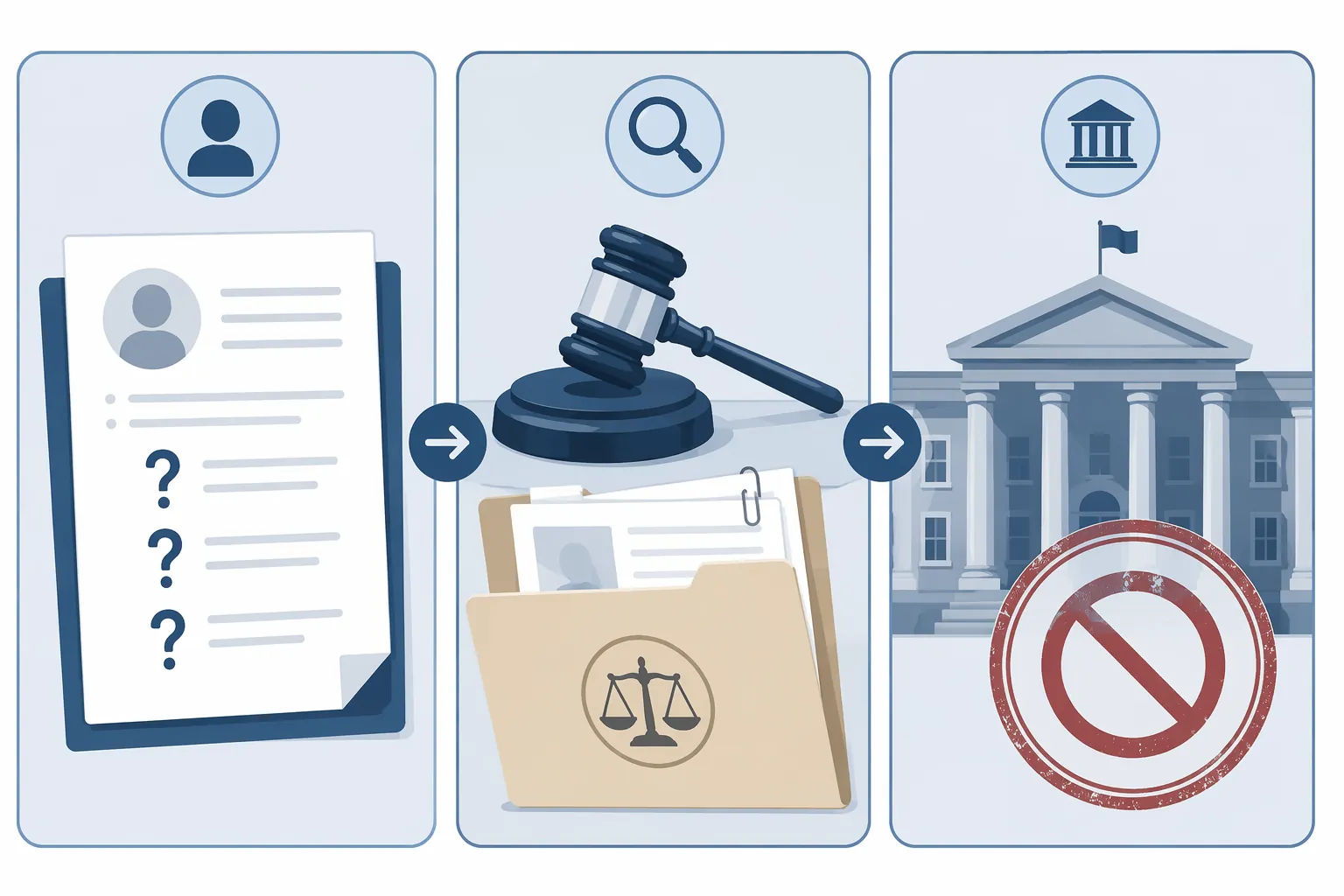
If no statute requires a completed FBI background check before committee action, the main risk is not a simple claim that the vote was ultra vires. The more plausible exposure is distributed across three files: the nominee’s disclosure file, the committee’s diligence file, and the agency’s later litigation file.
Nominee Risk: Incomplete or Misleading Disclosures
The nominee’s immediate legal exposure is not that the FBI failed to finish on time. It is that the nominee may have signed, submitted, or testified to something that later proves incomplete or misleading. Background investigations often matter because they create an independent comparison set. If the FBI later obtains information that conflicts with a nominee’s committee questionnaire, ethics materials, or hearing testimony, the problem becomes the nominee’s statement—not the Senate’s schedule.
Counsel reviewing such a file would look for correction opportunities: supplemental answers, clarifying letters, amended ethics paperwork, or hearing-record updates. The safest time to repair ambiguity is before a vote. After confirmation, the same correction can look less like diligence and more like damage control, even if the underlying omission was not intentional.
Committee Risk: Adequacy of Investigation
The committee’s exposure is harder to frame as a direct legal violation. Senate committees have broad control over their internal process, and courts are generally reluctant to police legislative procedure in the middle of advice and consent. But institutional risk is not limited to lawsuits. A thin investigative record can become the subject of minority reports, inspector general correspondence, oversight hearings, ethics complaints, or future nomination precedent.
The relevant question is not whether the committee perfectly replicated the FBI. It cannot. The better question is whether the committee identified the missing information, assessed its materiality, created a record of why it could proceed, and gave the nominee a chance to correct or explain inconsistencies. That is the difference between accepting a known residual risk and simply voting into opacity.
Agency Risk: Later Challenges to Official Action
The most aggressive downstream theory is that actions taken by a confirmed official could later be challenged because the confirmation process rested on an incomplete or defective background record. That theory should be treated carefully. The research record does not identify a direct precedent holding agency action void because an FBI background check for a Senate-confirmed official was incomplete. A lawyer should not overstate it as settled doctrine.
But absence of precedent is not the same as absence of litigation risk. Regulated parties challenge agency action through whatever procedural and authority arguments the record makes available. If a later enforcement action, rulemaking, or supervisory decision is tied to an official whose confirmation file contained unresolved credibility or eligibility questions, challengers may try to convert those facts into an appointment, delegation, due-process, or arbitrary-and-capricious argument. Whether that works is another matter. Agency counsel still has to answer it.
This is also where broader disputes over agency officials’ authority can become relevant, though they should not displace the background-check issue. Challenges to removal protections and officer authority, including debates discussed in Humphrey’s Executor after the Slaughter ruling, show how litigants can turn structural objections into pressure on agency action. A defective or underdeveloped confirmation record would be a different theory, and a less tested one, but it belongs in the same risk inventory.
What a Defensible Record Would Show
A committee does not need a statutory FBI mandate to justify waiting for FBI material. Nor does it need one to justify asking what remains unresolved before advancing nominees. The legally disciplined approach is to identify the gap with enough precision that later reviewers can see the committee made a judgment rather than ignored a file.
- What portion of the FBI process remained open: routine interviews, database checks, supplemental inquiry, or issue-specific follow-up.
- Whether the missing information related to credibility, conflicts, financial exposure, foreign contacts, professional discipline, or another material category.
- Whether the nominee had been asked to update or correct prior disclosures before the vote.
- Whether committee staff received substitute documentation, and why that substitute was considered adequate or inadequate.
- Whether members were told the practical consequence of voting before the FBI completed its work.
That kind of record does not eliminate political conflict. It does something more useful for the lawyers who arrive later: it shows what was known, what was not known, who accepted the residual risk, and why.
The Narrow Answer
The Senate Banking Committee’s decision to advance nominees despite objections about incomplete FBI background-check information does not, on the available materials, appear to violate a statute requiring completed FBI checks for Senate nominees. The governing practice traces to Executive Order 10450 and to institutional custom, not to an enacted confirmation statute.[2][3][4]
That is the clean legal answer, but not the whole risk answer. Bypassing or compressing the FBI process can still expose nominees to later disclosure problems, committees to adequacy-of-investigation criticism, and agencies to untested challenges against actions taken by officials whose vetting record remained unresolved. The risk is not that an FBI background check magically confers legality. It is that an incomplete file leaves future counsel defending decisions without the facts the process was designed to collect.
References
- Warren questions FBI background checks, The Hill, July 23, 2026
- What to know about FBI background checks for Trump’s Cabinet nominees, NPR, January 15, 2025
- FBI background checks for Trump’s nominees, explained, Vox
- Will Trump Nominees Face FBI Background Checks? Here’s What To Know, Forbes, December 2, 2024
- Senate Republicans reject private investigators, The Hill
- Background Checks and Security Clearances, Center for Presidential Transition
Operationalizing workflow
No workflow has been explicitly linked to this obligation yet. See Workflows generally.
Illustrative cases
No illustrative case is currently tracked for this obligation. See Risk Digest for documented incidents generally.
← Back to RegulationReport a correction or tip
Spotted an outdated figure, a misstated fact, or a ruling this regulation entry should reflect? Public comments are disabled for this content given the professional cost of a misreported case outcome, penalty amount, or rule text — use the structured correction channel instead.
Report a correction or tip for this record →