
Senate GOP Memo Legal Analysis Shows SAVE Act Dead End
- Authority
- Senate Republican Conference
- Rule type
- statute
- Jurisdiction scope
- US federal
- Source text
- Read primary rule text ↗
Proof-of-citizenship and photo-ID mandates for voter registration
The leaked Senate Republican Conference memo matters less for what it says about the SAVE Act’s policy merits than for the procedural position it appears to concede. In the available excerpts reported by USA TODAY on July 28, 2026, the memo does not read like a whip operation still searching for a path. It reads like a vote-facing defense: Senate Republicans should be prepared to explain that they do not have the votes to pass the bill or eliminate the filibuster, and should point ahead to fall elections rather than promise an immediate Senate maneuver that cannot be delivered.[1]
That is the starting point for any serious legal analysis of the Senate Republican SAVE Act memo. The reported document sits against a 53-47 Republican Senate majority, a 60-vote cloture threshold, Democratic opposition, and four named Republican senators — Susan Collins, Lisa Murkowski, Mitch McConnell, and Thom Tillis — publicly committed to voting against cloture.[1] On those facts, the operative question is not whether the House can keep escalating, or whether outside pressure can make the bill more visible. The question is whether visibility supplies votes. The memo’s answer appears to be no.
There are limits to the source base. The full memo has not been independently verified here beyond USA TODAY’s published excerpts. The reconciliation analysis discussed below relies on secondary procedural reporting and commentary rather than a public written opinion from the Senate parliamentarian on this exact bill. The House vote counts cited for the NDAA attachment strategy also come from secondary sources. Those caveats do not make the procedural conclusion disappear. They define the standard of proof: the available record supports a source-scoped legislative-risk judgment, not a claim of omniscience about every private Senate conversation.
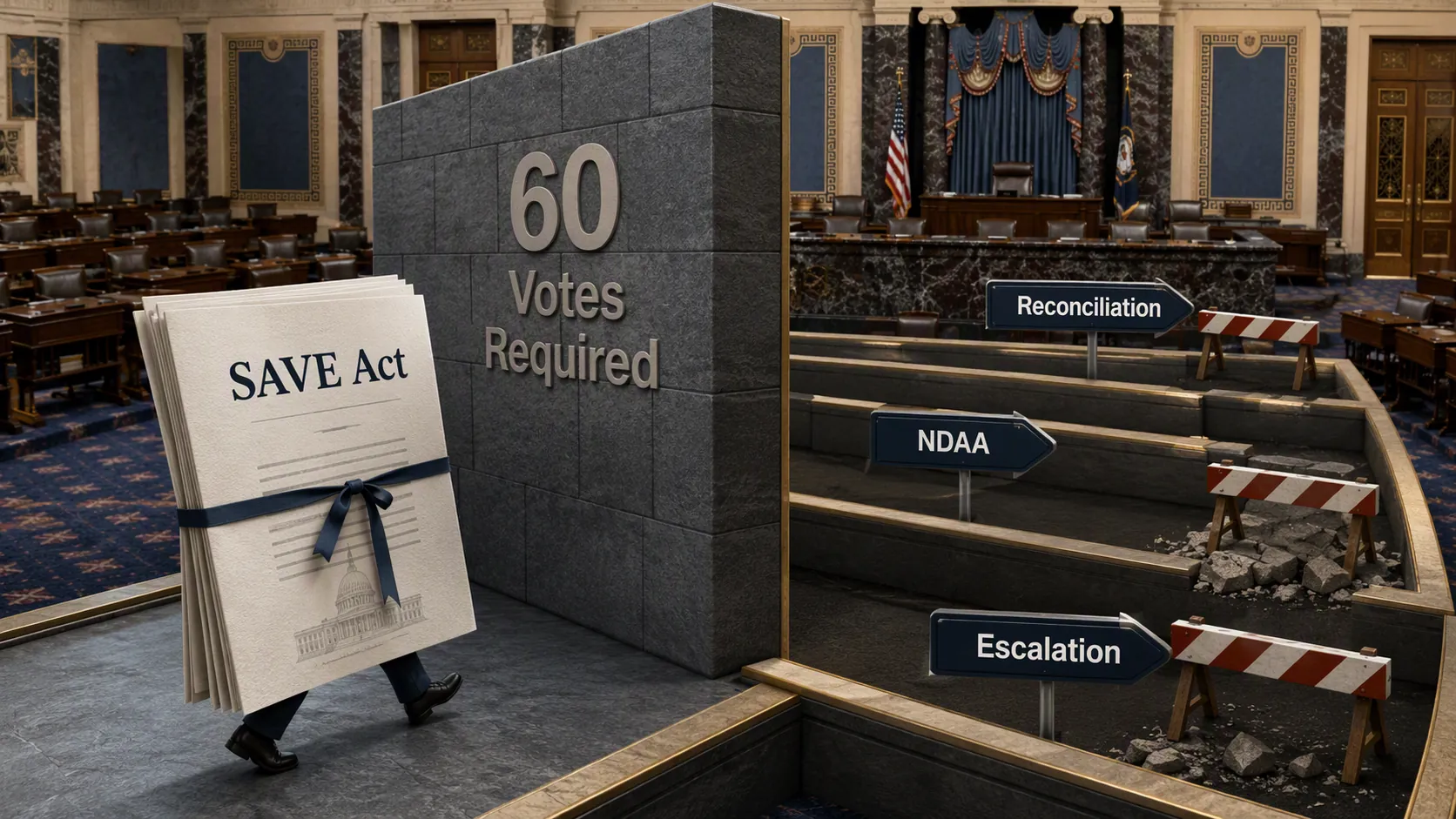
The Memo’s Legal Significance Is Its Defensive Grammar
A messaging memo can be bluster. A rules memo usually leaves fingerprints. The reported Senate GOP document is notable because it equips senators to defend inaction, not to sell inevitability. Its practical function is to keep members from committing themselves to a procedural claim that the conference cannot honor: that the SAVE Act can be pushed through the Senate by willpower, attachment, reconciliation, or filibuster brinkmanship.
The most important phrase in the reported account is the concession that Republicans do not have the votes to pass the SAVE America Act or eliminate the filibuster.[1] That is not merely a political admission. It is a procedural-law acknowledgment that the bill’s enactment path is blocked at the Senate threshold where most campaign-style analysis becomes irrelevant. A 53-seat majority can control the floor in many ways. It cannot, without 60 votes or a rules change, end debate on legislation facing a filibuster.
The named Republican defections matter because they remove the ambiguity often hidden inside the phrase “short of 60.” If Democrats remain opposed, Republicans would need party unity plus Democratic votes. The reported public commitments by Collins, Murkowski, McConnell, and Tillis against cloture cut in the opposite direction.[1] Even before counting any Democratic votes, the bill is below the majority’s own baseline.
The same logic applies to abolishing or weakening the filibuster. USA TODAY reported that 15 of 20 GOP senators it polled opposed ending the filibuster.[1] That figure is not a formal Senate vote, and it should not be inflated into one. But as evidence of conference posture, it explains why the memo would steer members away from promising escalation. A rules-change threat only changes the legal risk analysis if there is a credible majority for the rules change. The reported evidence points the other way.
Why 53 Seats Do Not Become 60 Votes
The Senate math is easy to recite and easy to underweight. In a 53-47 Senate, a Republican majority can say the bill has majority support inside the chamber if its members line up. But cloture is the relevant legal gate for contested legislation. If the SAVE Act cannot obtain 60 votes to end debate, it does not reach a final passage vote in the ordinary way.
That distinction is where the memo does its real work. It keeps senators from treating a majority coalition as an enactment coalition. The difference matters for regulated parties, election administrators, vendors, and counsel watching federal obligation risk. A bill that can pass the House, command attention from party leaders, and appear repeatedly in floor fights may still be legally remote if the Senate’s cloture math is fixed against it.
The four reported Republican cloture opponents are especially significant because they prevent the usual optimistic reading that the majority merely needs a handful of cross-party votes.[1] With those defections, the bill first has to repair losses inside the majority before it can even begin solving the Democratic-vote problem. That is a materially different risk profile from a bill that has 53 unified senators and is searching for seven more.
For legal-risk purposes, the memo’s instruction to look toward elections is therefore not filler. It is a recognition that the present Senate composition does not supply a procedural route. Elections may change the composition of a future Senate. They do not change the cloture threshold in the current one.
Reconciliation Is the Weakest Place to Blur Strategy and Law
The reconciliation argument sounds attractive because it promises a way around the 60-vote cloture problem. That is precisely why it needs the most careful treatment. Reconciliation is not a general-purpose filibuster bypass for any bill with budgetary side effects. The Byrd rule screens out provisions whose budgetary effect is merely incidental to the non-budgetary policy change. The SAVE Act’s central provisions — proof-of-citizenship requirements, photo-ID mandates, and voter-roll data sharing — are vulnerable under that test because their evident center of gravity is election administration, not federal budgeting.[2][3]
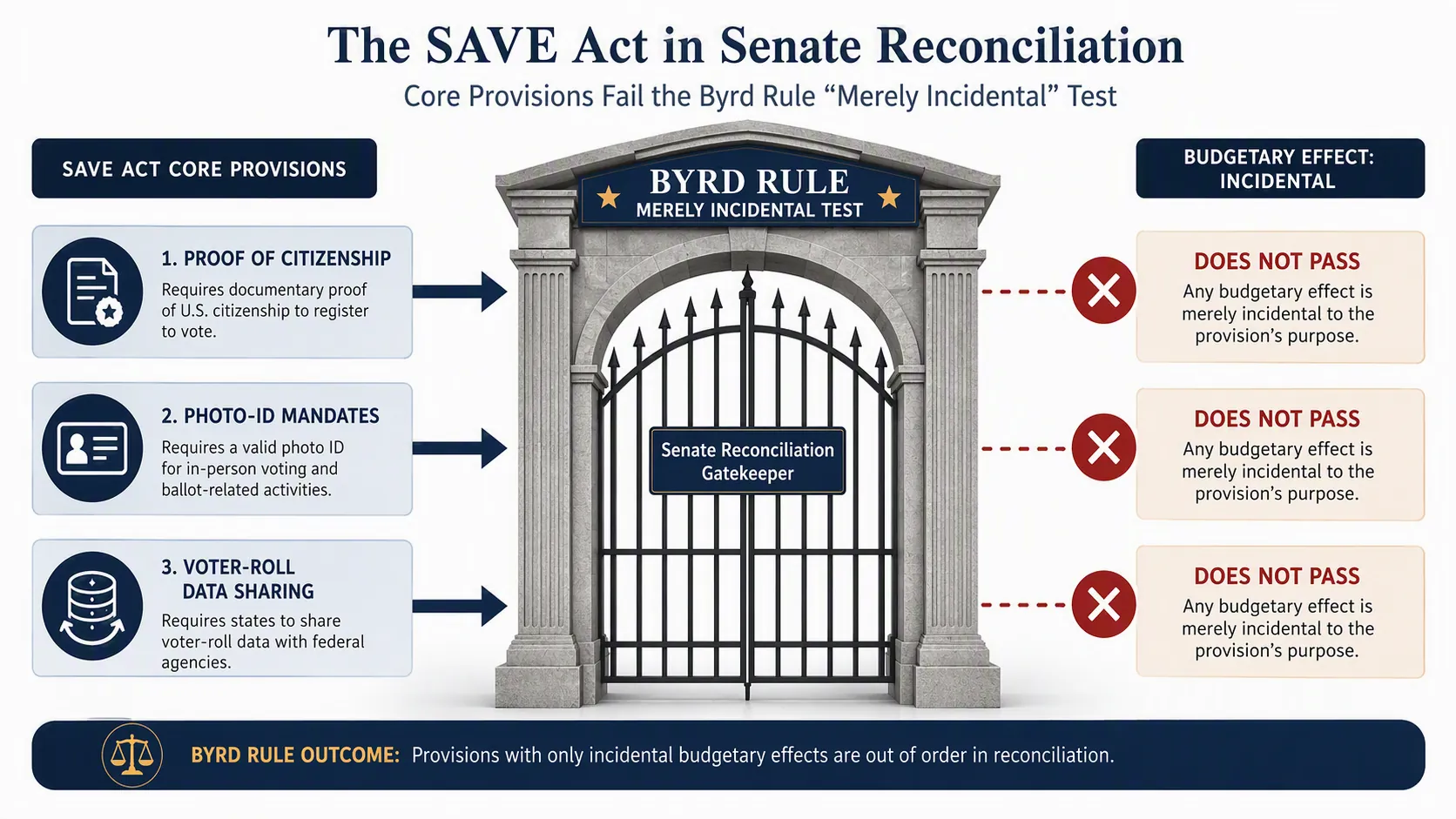
That does not mean no provision touching elections can ever have fiscal consequences. States spend money administering federal election rules. Federal agencies may incur costs when data-sharing obligations change. But the Byrd rule inquiry is not satisfied by pointing to some fiscal echo. The question is whether the budgetary effect is more than incidental to the policy objective. On the reported procedural analysis, the SAVE Act’s core obligations are the sort of substantive regulatory requirements that would invite a Byrd rule point of order in reconciliation.[2][3]
The 2021 minimum-wage and immigration rulings are useful analogues, not perfect factual matches. In those disputes, the Senate parliamentarian treated large policy changes as outside reconciliation when their budgetary effects did not carry the provision’s primary purpose.[2][3] The analogy is procedural: it shows how a provision may have fiscal consequences and still fail if the budgetary component is incidental to the regulatory command.
| Proposed route | Legal problem |
|---|---|
| Regular order | The bill still needs 60 votes to invoke cloture, and the reported Senate math does not supply them. |
| Reconciliation | Core election-administration provisions are vulnerable to a Byrd rule challenge as policy changes with merely incidental budgetary effects. |
| NDAA attachment | Attaching the bill to must-pass legislation does not itself eliminate the Senate cloture problem. |
| Filibuster escalation | Reported Republican opposition to ending the filibuster leaves no evident majority for the rules change. |
This is where ordinary political shorthand can mislead regulated readers. “Use reconciliation” is not an answer unless the provisions can survive the reconciliation rules. If the parliamentarian is likely to strike the provisions that make the bill meaningful, reconciliation does not rescue the SAVE Act. It converts the same enactment problem into a Byrd rule problem.
The NDAA Strategy Raises Pressure, Not the Vote Ceiling
The House attachment strategy deserves attention because it shows escalation. The SAVE America Act was attached to the NDAA in House votes reported as 217-209 on July 15, 2026, and 216-212 on July 22, 2026.[4][5] Those votes may matter politically. They put Senate Republicans in a more visible position and tie the election-law fight to a defense authorization vehicle that members usually prefer not to derail.
But attachment is not alchemy. A provision placed on the NDAA still has to survive the Senate’s procedural environment. If the contested election-law language remains in the package, opponents can still force the same cloture confrontation. The relevant question becomes whether senators who oppose cloture on the SAVE Act would accept it because of the vehicle. The research record supplied here does not establish that they would. It establishes the opposite baseline: four Republican cloture opponents and unified Democratic opposition leave the bill short of 60 votes.[1]
For counsel assessing implementation risk, the NDAA tactic therefore changes the monitoring posture more than the enactment odds. It is a reason to watch conference negotiations and floor procedure. It is not, by itself, a reason to treat the SAVE Act’s federal requirements as likely to become binding law in the current Senate.
Trump’s Pressure Explains the Memo; It Does Not Supply the Procedure
Trump’s demand that Senate Majority Leader John Thune keep the Senate in session until the SAVE Act passes helps explain why a conference memo would need to be so defensive. USA TODAY reported on July 27, 2026, that Trump publicly pressed Thune not to let the Senate leave before passing the measure.[6] The reported memo’s response — prepare senators to point to fall elections and resist canceling August recess — is procedural triage, not a competing public-relations flourish.[1]
The personality conflict is less important than the institutional mismatch. Public pressure can force votes, extend attention, and raise the cost of visible nonaction. It cannot make a 60-vote threshold disappear. Nor can it make senators who oppose eliminating the filibuster suddenly irrelevant to the rules-change calculation. The memo’s apparent purpose is to keep members aligned with those constraints while the external demand points in the other direction.
There is symbolic value in forcing repeated votes, and that value should not be confused with nothing. Parties use failed votes to define issues, pressure incumbents, and set up future campaigns. But symbolic value is not enactment risk. For the audience that needs to know whether new federal election-law obligations are realistically moving toward enforceability, the distinction is decisive.
What the Memo Means for Legislative Obligation Risk
The reported Senate GOP memo should be read as an internal risk-control document that became public. It limits promises. It identifies the absence of votes. It points senators away from a near-term procedural cure. That is not how a conference writes when it has a credible, imminent enactment route.
The legal conclusion is narrow but important. As of Q3 2026, on the reported memo excerpts and available procedural analysis, the SAVE Act is not merely stalled in the ordinary sense of a bill waiting for momentum. Regular order fails for lack of 60 votes. Reconciliation is likely blocked by the Byrd rule problem. NDAA attachment does not erase cloture. Filibuster escalation lacks reported Republican support.
That makes the bill a live political instrument but a weak source of near-term federal legal obligation. Election administrators and regulated parties can continue monitoring amendments, negotiations, and any new parliamentarian developments. On the present record, however, the Senate Republican Conference’s own reported messaging treats the SAVE Act as procedurally boxed in.
References
- Senate GOP internal messaging on SAVE America Act, USA TODAY, July 28, 2026.
- Can Reconciliation Save the SAVE America Act, Legislative Procedure, March 24, 2026.
- Byrd rule poses challenge for voter ID bill in reconciliation, Roll Call, March 25, 2026.
- SAVE Act, Wikipedia.
- SAVE Act, Campaign Legal Center.
- Trump-Thune tension over SAVE America Act, USA TODAY, July 27, 2026.
Operationalizing workflow
No workflow has been explicitly linked to this obligation yet. See Workflows generally.
Illustrative cases
No illustrative case is currently tracked for this obligation. See Risk Digest for documented incidents generally.
← Back to RegulationReport a correction or tip
Spotted an outdated figure, a misstated fact, or a ruling this regulation entry should reflect? Public comments are disabled for this content given the professional cost of a misreported case outcome, penalty amount, or rule text — use the structured correction channel instead.
Report a correction or tip for this record →