
What Did the Senate's Iran War Powers Votes Legally Do?
- Authority
- U.S. Congress
- Rule type
- concurrent resolution
- Jurisdiction scope
- US federal
- Source text
- Read primary rule text ↗
No binding presidential obligation; concurrent resolution lacks force of law without presentment.
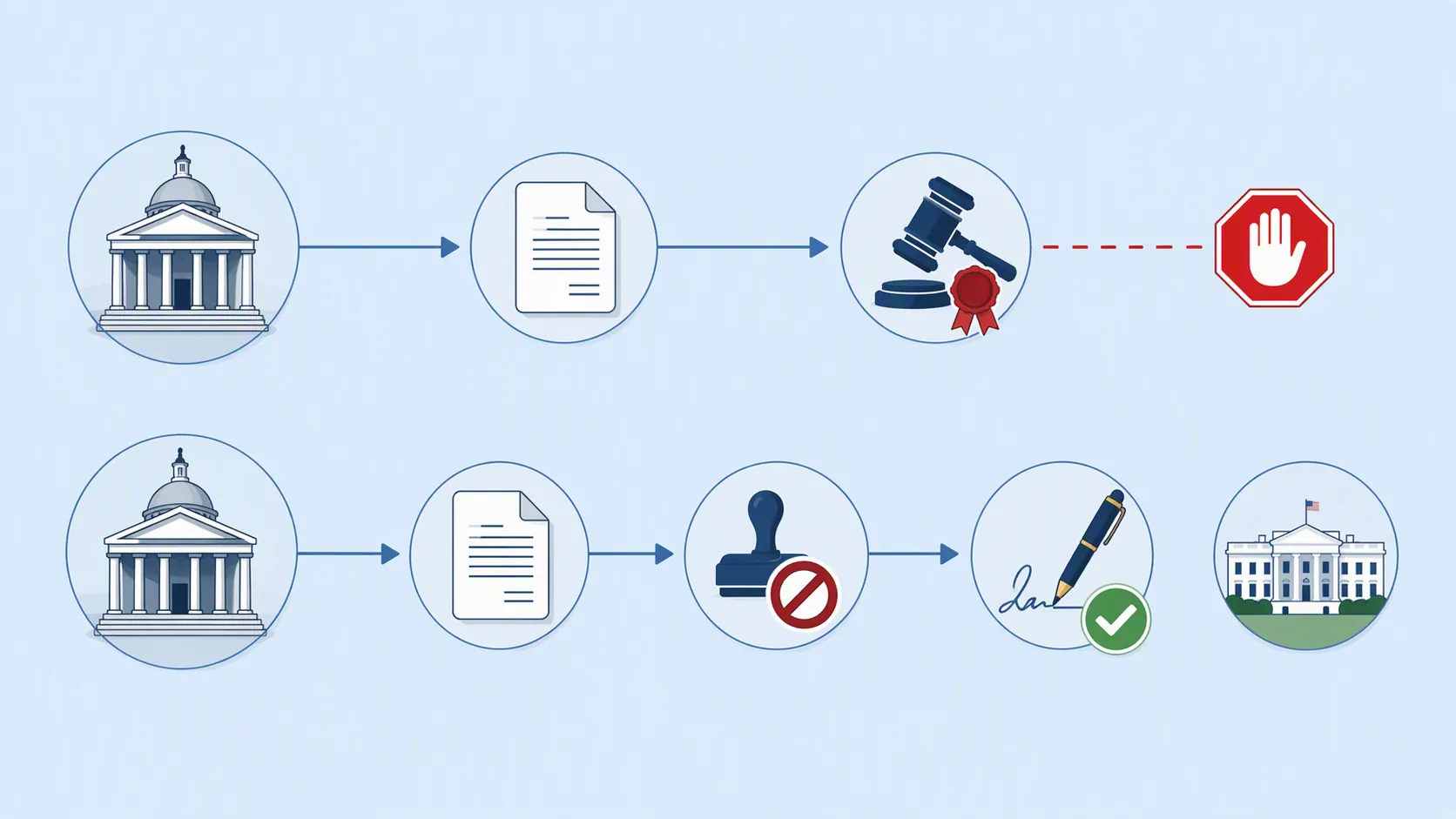
The short legal answer is awkward because the most dramatic vote is the least law-like instrument. H.Con.Res. 86 passed the House, 215-208, on June 3, 2026, and passed the Senate, 50-48, on June 23, making it the first Iran war powers measure in this record to clear both chambers. But it was a concurrent resolution. Senate guidance distinguishes concurrent resolutions from measures that go to the president: they are not presented for signature and do not become law. H.Con.Res. 86 therefore did not bind the president as a statute would, even though its sponsors claimed it operated under the War Powers Resolution’s removal mechanism.[1][2]
The July 30 vote is best cited as The Hill’s date-stamped count: the 13th Senate vote on an Iran war powers motion, following 11 prior blocks and one June 23 approval. That count is useful, but it should stay attributed. NPR had described the June 23 vote as the Senate’s “10th time” taking up an Iran war powers resolution, so ordinal labels in this record depend on the date and the source’s counting method.[3][4]
The Senate Iran war powers vote record
The table below separates verified roll-call facts from counted-but-not-itemized entries. Where the available record does not identify a measure number, date, tally, or Senate roll-call page, the table says so. Those rows should not be cited as more than ordinal placeholders within The Hill’s July 30 count and NPR’s June 23 count unless the underlying Senate pages support the details.
| # | Date | Measure and procedural posture | Result and tally | Source | Legal effect |
|---|---|---|---|---|---|
| 1 | Feb. 28, 2026 | Iran war powers motion; measure number and exact procedural posture not identified in the cited materials. | Not adopted; tally not available in the cited materials. | Included only as part of the later 13-vote / pre-June 23 ordinal record attributed to The Hill and NPR.[3][4] | No binding legal command shown. Treat as a nonadopted Senate proceeding unless a roll-call page is later added. |
| 2 | Mar. 4, 2026 | S.J.Res. 104; motion to discharge. | Rejected, 47-53. | Senate roll call vote 46.[5] | No discharge, no Senate passage, no presentment, and no binding command. The rejection matters only as part of the institutional record. |
| 3 | Before June 23, 2026; exact date not verified | Iran war powers motion counted among the pre-June 23 attempts; measure number not identified in the cited materials. | Blocked or not adopted; tally not available in the cited materials. | Ordinally implied by The Hill’s July 30 count and NPR’s June 23 count, but not independently itemized here.[3][4] | No binding legal effect shown. |
| 4 | Before June 23, 2026; exact date not verified | Iran war powers motion counted among the pre-June 23 attempts; measure number not identified in the cited materials. | Blocked or not adopted; tally not available in the cited materials. | Ordinally implied by The Hill’s July 30 count and NPR’s June 23 count, but not independently itemized here.[3][4] | No binding legal effect shown. |
| 5 | Before June 23, 2026; exact date not verified | Iran war powers motion counted among the pre-June 23 attempts; measure number not identified in the cited materials. | Blocked or not adopted; tally not available in the cited materials. | Ordinally implied by The Hill’s July 30 count and NPR’s June 23 count, but not independently itemized here.[3][4] | No binding legal effect shown. |
| 6 | Before June 23, 2026; exact date not verified | Iran war powers motion counted among the pre-June 23 attempts; measure number not identified in the cited materials. | Blocked or not adopted; tally not available in the cited materials. | Ordinally implied by The Hill’s July 30 count and NPR’s June 23 count, but not independently itemized here.[3][4] | No binding legal effect shown. |
| 7 | Before June 23, 2026; exact date not verified | Iran war powers motion counted among the pre-June 23 attempts; measure number not identified in the cited materials. | Blocked or not adopted; tally not available in the cited materials. | Ordinally implied by The Hill’s July 30 count and NPR’s June 23 count, but not independently itemized here.[3][4] | No binding legal effect shown. |
| 8 | Before June 23, 2026; exact date not verified | Iran war powers motion counted among the pre-June 23 attempts; measure number not identified in the cited materials. | Blocked or not adopted; tally not available in the cited materials. | Ordinally implied by The Hill’s July 30 count and NPR’s June 23 count, but not independently itemized here.[3][4] | No binding legal effect shown. |
| 9 | May 19, 2026 | S.J.Res. 185; motion to discharge. | Agreed to, 50-47. | Senate roll call vote 129.[6] | Procedural effect only: the Senate agreed to discharge the measure. The available record does not show enactment into law. |
| 10 | June 23, 2026 | H.Con.Res. 86; Senate passage after House passage. | Senate passed, 50-48; House had passed, 215-208, on June 3. | PBS/AP and NPR reporting on the first bicameral approval.[2][4] | Cleared both chambers, but as a concurrent resolution it was not presented to the president and did not become law. Its claimed War Powers Resolution section 5(c) effect is disputed and untested. |
| 11 | June 24, 2026 | Joint-resolution effort; exact measure number not identified in the cited materials. | Reported as defeated, 50-47. | CBS News reporting identified in the cited record.[7] | No enacted joint resolution, no presentment-based legal command, and no binding removal obligation. |
| 12 | July 23, 2026 | S.J.Res. 180; motion to discharge. | Failed, 47-49. | Roll Call reporting on the Van Hollen discharge vote.[8] | No discharge and no Senate passage. The vote contributes to the record of congressional resistance but does not itself command the executive. |
| 13 | July 30, 2026 | Iran war powers resolution or motion; exact measure number not identified in the cited materials. | Failed, 49-50. The Hill reported that Collins, Murkowski, and Paul crossed party lines, while Fetterman was the lone Democratic no. | The Hill’s July 30 report.[3] | No passage, no presentment, and no binding legal effect. Its importance is evidentiary and institutional, not operative. |
This is a deliberately conservative table. It does not pretend that a headline count supplies the same information as a Senate roll-call page. For a broader legal-risk chronology, see the earlier Senate war powers risk record; this piece is narrower. Its concern is the legal consequence of each procedural act.
The votes that change the legal analysis
March 4: a failed discharge motion is not nothing, but it is not law
The March 4 vote on S.J.Res. 104 is the cleanest early example of a proceeding that matters only in the secondary sense. A 47-53 rejection of a discharge motion did not move the measure out of committee, did not pass the Senate, and did not create a statutory command.[5]
Still, a defeated discharge motion can matter when the question is not “what law now binds the president?” but “what record exists of congressional opposition?” In war powers litigation and advice, that distinction matters. A failed vote is not presentment. It can, however, help rebut a later claim that Congress silently accepted the executive’s position.
May 19: discharge succeeded, but discharge is not enactment
The May 19 vote on S.J.Res. 185 did something procedurally real. The Senate agreed to discharge the measure, 50-47.[6] That is not the same thing as passing a joint resolution, sending it to the House, presenting it to the president, and either obtaining a signature or overriding a veto.
For citation purposes, the May 19 entry should not be compressed into “the Senate voted for an Iran war powers resolution.” It voted to discharge one. That may be important under expedited procedures; it is not itself a binding withdrawal order.
June 23: the bicameral vote that stopped short of presentment
H.Con.Res. 86 is the central event because it crossed the line most of the other measures never reached: both chambers agreed to the same measure. The House passed it on June 3, 215-208; the Senate passed it on June 23, 50-48.[2] That is a significant congressional record. It is not a statute.
The form controls the consequence. A concurrent resolution can express the sentiment, position, or internal will of both houses, but Senate guidance says it is not sent to the president and does not have the force of law.[1] If the question is whether the president received a legally operative command through Article I bicameralism and presentment, H.Con.Res. 86 did not provide one.
July 23 and July 30: two late failures, two different uses
On July 23, the Senate failed, 47-49, to discharge S.J.Res. 180.[8] On July 30, another Iran war powers effort failed, 49-50, in the vote The Hill counted as the 13th Senate motion in the sequence.[3] Neither vote enacted anything. Neither vote supplied the missing presentment step.
Their legal use is narrower and more plausible: they extend the record that Congress was repeatedly presented with withdrawal proposals and did not simply disappear from the field. That may matter in a Youngstown analysis and in any later argument over constitutional impasse. It does not convert defeat into a command.
Two procedural tracks, two different consequences
The Iran votes moved along two tracks that should not be merged in shorthand. The House’s successful measure was a concurrent resolution under the War Powers Resolution framework. The Senate’s later joint-resolution efforts used a different mechanism associated with the 1983 compromise now codified at 50 U.S.C. 1546a, which borrows expedited procedures from the Arms Export Control Act context.[9]
| Track | What it can do procedurally | What it cannot do by itself | Why it mattered in this record |
|---|---|---|---|
| Concurrent resolution, as with H.Con.Res. 86 | Can clear both chambers without presidential presentment. | Does not become a law through signature or veto-override mechanics; Senate guidance treats concurrent resolutions as non-presented instruments.[1] | Created the strongest congressional signal in the record, but left the legal force of the asserted removal command dependent on the disputed War Powers Resolution section 5(c) theory. |
| Joint resolution under the 1983 expedited procedures | Can receive privileged treatment, including discharge and simple-majority procedures that can bypass the filibuster.[9] | Still must survive presentment. The president can veto it unless Congress overrides. | Offered a cleaner Article I route to a binding law, but the cited joint-resolution efforts did not become law. |
The 1983 route is not legally trivial just because it is veto-prone. It can change what the Senate is able to vote on by bypassing ordinary obstruction. But its virtue is also its limit: it respects presentment. If a joint resolution passes both chambers and reaches the president, the constitutional fight is over enactment, veto, and possible override. That is a different fight from claiming that a concurrent resolution alone removes forces.
CRS has identified another reason H.Con.Res. 86 is procedurally unusual: no concurrent resolution had previously been adopted through the War Powers Resolution section 7 expedited procedures. Prior withdrawal measures involving Somalia in 1993, Iraq in 2014, and Iran in 2020 did not clear the Senate Foreign Relations Committee.[10] That does not answer the constitutional question, but it prevents the easy answer that H.Con.Res. 86 merely followed a settled congressional practice.
Why H.Con.Res. 86’s form is the whole problem
The War Powers Resolution contains a mechanism that, on its face, contemplates removal of forces by concurrent resolution. The constitutional problem is that Congress cannot usually change legal rights or duties outside bicameralism and presentment. After INS v. Chadha, one-house and two-house legislative veto devices became constitutionally suspect when they purport to produce binding legal consequences outside the Article I enactment process.
Scott R. Anderson’s Lawfare analysis treats the validity of the War Powers Resolution’s concurrent-resolution removal mechanism as seriously doubtful after Chadha, while emphasizing that the specific section 5(c) question has not been litigated to a definitive judicial answer.[9] That is the conventional caution. It is not the same as a court judgment invalidating H.Con.Res. 86; it is a warning that the theory depends on a constitutional mechanism many lawyers would expect to fail.
Michael Glennon has argued the other side in functional and historical terms. In his account, Chadha was wrongly decided in this setting, and section 5(c) does not delegate legislative power to Congress so much as reserve Congress’s own war power against unilateral executive continuation. Glennon also highlights the political consequence of the conventional view, including then-Senator J.D. Vance’s January 2026 description of the provision as “fundamentally a fake and unconstitutional law.”[11]
That dispute should be treated as real, not decorative. The conventional view makes H.Con.Res. 86 legally doubtful because it bypassed presentment. The Glennon view defends the concurrent-resolution mechanism as a permissible war-powers control. What neither view supplies is an enacted statute from the June 23 vote.
For readers tracking the narrower Chadha and Youngstown implications of H.Con.Res. 86 itself, the separate H.Con.Res. 86 legal analysis goes deeper into that instrument. The point here is the vote record: the Senate approved a concurrent resolution, not a joint resolution or bill.
The Meeks enforcement experiment
Representative Gregory Meeks treated the June 23 Senate vote as more than symbolic. His statement after Senate passage described H.Con.Res. 86 as “binding under the War Powers Resolution.”[12] That is the contested claim in its most practical form: not whether Congress expressed opposition, but whether this particular concurrent resolution can be enforced as a removal command without presentment.
The July 23 move was different. Meeks proposed making Speaker Mike Johnson the lead plaintiff in an enforcement suit, an evident attempt to address standing and institutional-injury problems by putting the House’s presiding officer in the caption.[8] That proposal belongs in the enforcement analysis, not in the general pile of political statements. It tries to convert a concurrent-resolution theory into a justiciable case.
Whether that lawsuit theory would work is beyond what the cited record proves. Courts have often been reluctant to decide interbranch war-powers disputes without a clear constitutional impasse. The failed and successful votes help build the impasse record; they do not guarantee standing, ripeness, a cause of action, or a merits ruling.
The related 60-day clock and pause analysis covers a separate timing question. The enforcement problem here is simpler to state and harder to solve: who can ask a court to enforce a concurrent resolution, and what exactly would the court be enforcing?
What the votes still do in Youngstown and justiciability analysis
A vote that does not bind the president can still change the legal setting around executive power. The executive’s strongest war-powers arguments often rely, in part, on congressional authorization, acquiescence, appropriations, or long-running tolerance. A record of repeated withdrawal votes cuts against the easy version of acquiescence.
That is where Youngstown does the real work. If Congress has not spoken, executive action may be analyzed in a zone of uncertainty. If Congress has spoken against the executive’s course, the president is closer to Justice Jackson’s third category: power at its “lowest ebb.” Lawfare’s later 60-day analysis treats congressional opposition and the statutory clock as part of that broader separation-of-powers setting.[13]
The vote record also matters to justiciability. Courts that decline war-powers disputes often point to the absence of a final, concrete clash between the branches. H.Con.Res. 86 gives Congress its strongest fact for saying there was a bicameral clash. The failed discharge and joint-resolution votes add texture by showing that the conflict was recurring, not accidental. But the same record also shows why the president would answer that Congress never enacted a law.
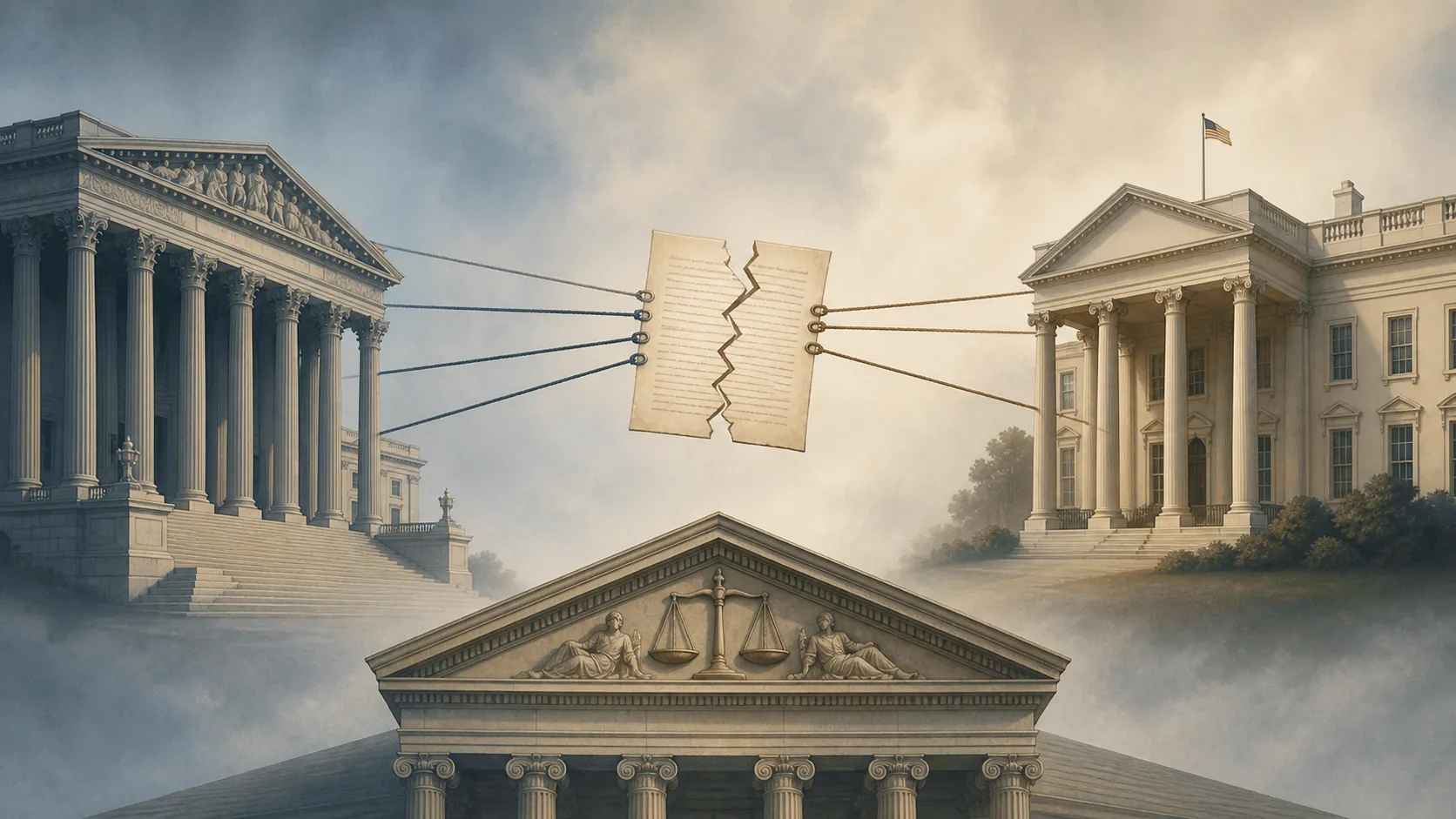
So the accurate formulation is not that Congress ended the Iran conflict, and not that the Senate approved it. No Senate vote in this record produced a law binding the president. H.Con.Res. 86 remains the strongest congressional act in the sequence, but its claimed removal command rests on a concurrent-resolution mechanism whose validity is seriously doubtful after Chadha and untested in court. The votes’ strongest legal force is indirect: they weaken historical-acquiescence arguments, support a Youngstown category-three framing, and build the constitutional-impasse record that a court would likely want to see before deciding whether to intervene.
References
- Types of Legislation, U.S. Senate.
- Senate again set to vote on war powers resolution to halt Iran conflict, PBS NewsHour / Associated Press.
- Senate GOP blocks Iran war powers resolution, The Hill, July 30, 2026.
- Senate Iran war powers resolution, NPR, June 23, 2026.
- U.S. Senate Roll Call Votes 119th Congress - 2nd Session, Vote Number 46, U.S. Senate, March 4, 2026.
- U.S. Senate Roll Call Votes 119th Congress - 2nd Session, Vote Number 129, U.S. Senate, May 19, 2026.
- Senate Trump Iran war powers, CBS News, July 23, 2026.
- 23warpowersvote, Roll Call, July 23, 2026.
- What Congressional Resolutions Mean for the War in Iran, Lawfare.
- CRS R47603, Congressional Research Service.
- The Court Gutted Congress's War Power. It's Time to Give It Back., Just Security.
- Meeks Statement on Senate Passage of His Iran War Powers Resolution, House Foreign Affairs Committee Democrats, June 2026.
- Law and the Iran War, After the First 60 Days, Lawfare.
Operationalizing workflow
No workflow has been explicitly linked to this obligation yet. See Workflows generally.
Illustrative cases
No illustrative case is currently tracked for this obligation. See Risk Digest for documented incidents generally.
← Back to RegulationReport a correction or tip
Spotted an outdated figure, a misstated fact, or a ruling this regulation entry should reflect? Public comments are disabled for this content given the professional cost of a misreported case outcome, penalty amount, or rule text — use the structured correction channel instead.
Report a correction or tip for this record →