
What the 2026 Senate Reconciliation Package Actually Changes
- Authority
- U.S. Congress
- Rule type
- statute
- Jurisdiction scope
- US federal
- Effective date
- Jun 9, 2026
- Source text
- Read primary rule text ↗
Distinguish enacted S.2 funding changes from pending Reconciliation 3.0; do not treat the framework as operative.

A useful Senate reconciliation package 2026 breakdown starts with status, not theme. As last checked on July 31, 2026, the controlling split is this: S.2 is the enacted track; Reconciliation 3.0 is still a pending framework; the election-grant line is contingent and should not be briefed as a direct federal election-law mandate.
| Track | Status as of July 31, 2026 | What changes now | What must still be watched |
|---|---|---|---|
| Secure America Act / S.2 | Enacted. Congress.gov identifies S.2 as the Secure America Act, with the source record reflecting June 9, 2026 enactment and an approximately $70B total. [1] | This is the only reconciliation vehicle in this record that currently creates binding legal and budget consequences. | Confirm the latest enrolled-law text and any agency implementation materials before issuing client-specific instructions. |
| FY2026 budget resolution / S.Con.Res. 33 | Adopted after Senate passage 50-48 on April 23, 2026 and House passage 215-211 on April 29, 2026. The resolution included $70B-per-committee reconciliation instructions, $140B total, and a PAYGO waiver. [2] | It supplied the procedural track for S.2 and, unusually, used reconciliation to replace rather than supplement discretionary appropriations. [2] | Do not treat the budget resolution itself as the same thing as the enacted S.2 statutory text. |
| Reconciliation 3.0 House framework | Pending. The reported framework was roughly $95B, with allocations of $60B for defense, $13B for intelligence, $12B for farm aid, and $10B for House Administration election-related grants. [3] | No current compliance obligation follows from those allocations unless and until the Senate acts and final statutory text is enacted. | As of July 26, 2026 reporting, no Senate vote was scheduled before recess and the package remained politically and procedurally unsettled. [4] |
| SAVE Act-related election grant track | Contingent. The Reconciliation 3.0 framework reportedly routes $10B through House Administration for SAVE Act-tied state election grants. [3] | The relevant legal posture is conditional funding, not an enacted direct command to states through reconciliation. | Track Byrd-rule treatment, grant conditions, and any separate legislative vehicle rather than rolling the election issue into the enacted S.2 row. |
That table is not a formatting convenience. It is the legal answer. The phrase “the 2026 reconciliation package” is now doing too much work in alerts and summaries. One vehicle has crossed the enactment line. Another is still a House framework awaiting Senate action. A third election-law issue is moving through conditional funding design and, in part, outside the reconciliation lane. Those distinctions decide whether a legal team can say “must,” “may,” “monitor,” or “do not brief as law.”
The enacted track: S.2 changed the funding lane
S.2 matters because it is the vehicle that moved from reconciliation procedure into enacted law. The budget mechanism behind it was not ordinary annual appropriations. The FY2026 budget resolution instructed the Homeland Security and Judiciary committees to produce $70B each in deficit increases, for $140B total, waived PAYGO, and used reconciliation to replace, rather than merely add to, discretionary appropriations. CRFB described that replacement feature as unprecedented in the Senate FY2026 budget resolution. [2]
For legal and compliance readers, “replace” is the operative word. A supplemental appropriation would sit beside ordinary discretionary funding and leave the annual appropriations track as the primary control point. This design moved a major slice of border and security funding onto a mandatory-funding path. NACO described the House-cleared budget resolution as advancing Reconciliation 2.0 to fund DHS and CBP on an approximately 3.5-year funding frame. [5]
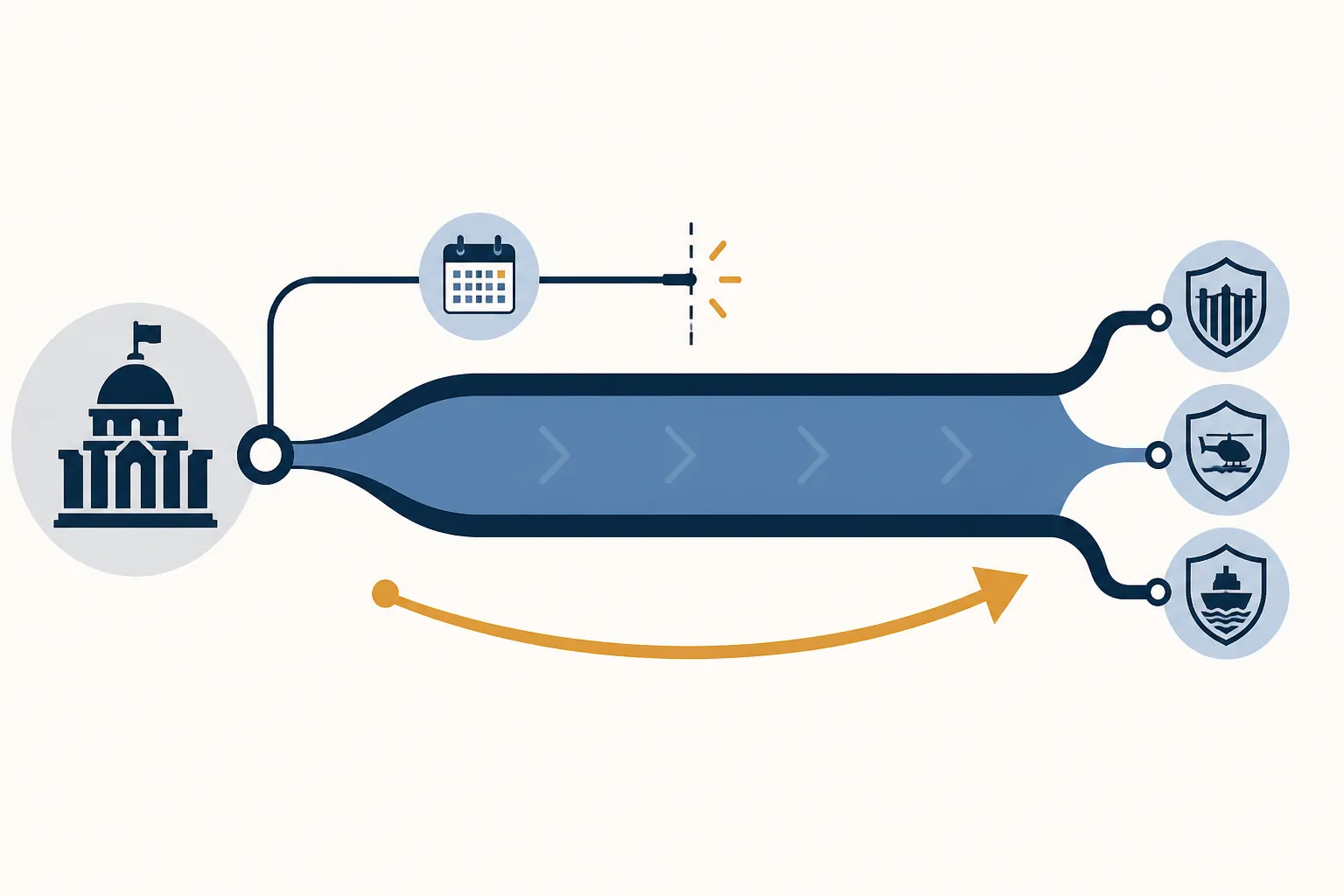
The committee-stage numbers should be kept in their own column. NLIHC reported the May 4, 2026 committee text at roughly $72B, including more than $38B for ICE, more than $26B for CBP, and $1B for Secret Service East Wing Modernization. [6] That is not an invitation to average the committee figure with the enacted-law figure. It is a stage label: committee text at roughly $72B; enacted S.2 record at approximately $70B. [1][6]
The practical consequence is budget availability and implementation capacity, not an immediate private-sector compliance rule. Contractors, state partners, local governments, and regulated entities still need agency action, grant notices, procurement documents, or implementing conditions before specific external duties attach. But counsel should not wait for a normal annual appropriations cycle to recognize that Congress has changed the funding track for the covered agencies.
What S.2 does not do by itself
- It does not make the pending Reconciliation 3.0 allocations binding.
- It does not convert every reported border-policy dollar figure from earlier drafts into enacted FY2026 law.
- It does not turn conditional election funding into a freestanding federal election-administration command.
- It does not eliminate the need to check agency-level implementation before assigning operational tasks to a department, vendor, county, or state office.
Older OBBBA draft-era enforcement and detention figures belong in a separate source file. They may be relevant to legislative history or advocacy comparisons, but they should not be imported into the enacted S.2 row unless the source is tied to the final 2026 statutory vehicle. This is the sort of mismatch that turns a monitoring memo into a false obligation.
Why the Byrd rule controls the election-law posture
The Byrd rule is not a civics footnote here. It explains why the election provisions are being handled as conditional state grants rather than as a direct election-law command inside reconciliation. The FY2026 budget resolution did not waive the Byrd rule, while also creating the reconciliation instructions and PAYGO waiver that enabled the funding track. [2]

That procedural choice matters for state and local legal teams. If Congress cannot carry a direct election-law mandate through reconciliation without a Byrd-rule problem, the safer route is to attach conditions to money. A state then confronts the legal question as a funding-condition question: what conditions attach, who is eligible, what acceptance requires, what existing state law must change, and whether the condition is vulnerable to challenge. Those are different questions from “did Congress directly rewrite election administration through reconciliation?”
The Reconciliation 3.0 framework’s reported $10B House Administration allocation for SAVE Act-tied state election grants therefore should stay in the pending-and-conditional column. [3] It may become operationally important if enacted. It is not, as of this check, an enacted mandate that a county election office can be told to implement on Monday morning.
For readers already tracking the SAVE Act issue, the existing Byrd-rule analyses — “Byrd Rule Blocks the SAVE America Act in Reconciliation” and “Why the Byrd Rule Blocks Thune’s SAVE Act Reconciliation Strategy” — are the right companion files. The important point for this briefing is narrower: the Byrd rule is the procedural constraint that keeps the election issue from being treated as just another enacted S.2 funding item.
Reconciliation 3.0 is a framework, not a compliance event
The reported Reconciliation 3.0 framework is substantial enough to monitor, but not enacted enough to operationalize. The Hill reported a roughly $95B package: $60B for defense, $13B for intelligence, $12B for farm aid, and $10B for House Administration election-related grants tied to the SAVE Act. [3] Those are allocation descriptions in a pending legislative framework. They are not current spending authority for agencies and not current conditions on recipients.
The Senate posture is the limiting fact. KCRA/Hearst reported on July 26, 2026 that Senate Majority Leader John Thune signaled there would be no vote before recess and that Republicans remained split on spending. [4] That reporting does not prove defeat. It proves the opposite of enactment: no Senate vote was then scheduled, and the package remained unsettled before the August recess.
This is where many summaries become unreliable. A House framework can be politically important and still legally nonoperative. A reported allocation can identify where leadership wants money to go and still impose no duty on an agency, grantee, state office, contractor, or regulated party. Until Senate text, votes, Byrd-rule decisions, House-Senate alignment, and enactment are resolved, the correct label is pending.
Current legal implications by audience
| Audience | What can be treated as operative now | What should not be treated as operative |
|---|---|---|
| In-house counsel and compliance teams | S.2’s enacted funding shift and the need to monitor agency implementation tied to ICE, CBP, and Secret Service funding. | Reconciliation 3.0 allocations, SAVE Act-tied grants, or draft-era enforcement totals as current obligations. |
| Law-firm KM and client-alert teams | A two-track alert: enacted S.2 versus pending Reconciliation 3.0, with last-verified status and source labels. | A single undifferentiated “2026 reconciliation package” summary. |
| State and local legal teams | Potential grant-condition exposure if election funding is enacted and accepted under a final statutory and administrative framework. | Immediate implementation of SAVE Act-related election rules through the enacted S.2 track. |
| Procurement and grants staff | Monitoring of agency notices, solicitations, grant terms, and availability periods flowing from enacted funding. | Assuming that appropriated or mandatory funding automatically creates a contract, grant award, or recipient duty. |
The legal risk profile is procedural before it is substantive. For S.2, the main risk is misreading the funding track or using the wrong dollar figure for the wrong legislative stage. For election provisions, the risk is treating conditional grants as direct mandates, or ignoring constitutional and administrative-law challenges that may arise if final grant conditions are attached. For Reconciliation 3.0, the immediate risk is premature implementation: briefing a pending framework as though the Senate had already enacted it.
What to recheck if the Senate acts
- Whether the Senate takes up Reconciliation 3.0 before or after recess, and whether the vehicle is textually identical to the House framework.
- Any Byrd-rule rulings, points of order, or negotiated deletions affecting the election-grant provisions.
- Whether the $10B House Administration line remains a conditional state-grant design or moves through a separate vehicle.
- Whether final text changes the defense, intelligence, farm aid, or election allocations reported in the House framework.
- Agency implementation documents: apportionment, grant notices, procurement notices, eligibility rules, and stated periods of availability.
- Any litigation filed over grant conditions, state acceptance requirements, or separation between federal funding incentives and state election administration.
As of the last verification for this briefing, the law on the books is the S.2 track, anchored in the FY2026 budget resolution’s mandatory-funding design. The pending Reconciliation 3.0 framework remains a monitoring item, not an obligation. If the Senate acts, the first task is not to update adjectives; it is to reopen the vehicle, check the text, check the Byrd-rule posture, and relabel each item as enacted, deleted, contingent, or still pending.
References
- S.2 - Secure America Act — Congress.gov.
- What’s in the Senate FY 2026 Budget Resolution? — Committee for a Responsible Federal Budget.
- House Republicans unveil new reconciliation budget resolution — The Hill, July 15, 2026.
- Senate budget reconciliation 3.0 — KCRA / Hearst, July 26, 2026.
- House clears budget resolution advancing Reconciliation 2.0 to fund DHS and CBP — National Association of Counties.
- Senate Republicans Release $72 Billion Reconciliation Bill Funding ICE, CBP, and White House — National Low Income Housing Coalition, May 4, 2026.
Operationalizing workflow
No workflow has been explicitly linked to this obligation yet. See Workflows generally.
Illustrative cases
No illustrative case is currently tracked for this obligation. See Risk Digest for documented incidents generally.
← Back to RegulationReport a correction or tip
Spotted an outdated figure, a misstated fact, or a ruling this regulation entry should reflect? Public comments are disabled for this content given the professional cost of a misreported case outcome, penalty amount, or rule text — use the structured correction channel instead.
Report a correction or tip for this record →