
The legal process that determines who fills a Senate vacancy
- Authority
- U.S. Constitution and state legislatures
- Rule type
- statute
- Jurisdiction scope
- US federal, US state
- Effective date
- Jul 26, 2026
- Source text
- Read primary rule text ↗
Verify state-specific Senate vacancy regime before relying on appointment authority
Last verified: July 26, 2026. This article is a legal-information reference for Regulation & Ethics readers, not legal advice. A Senate vacancy analysis should begin with primary authority, because the answer to “what happens if a senator cannot finish their term” is not a generic succession rule. It is a state-specific legal process built on a federal constitutional floor.
The practitioner’s first question is therefore not “who does the governor appoint?” It is: which state’s vacancy regime controls, and did that regime authorize a temporary appointment at the relevant time?
The 17th Amendment sets the floor, not the full process
The vacancy clause of the 17th Amendment requires the executive authority of the state to issue writs of election to fill Senate vacancies. It also permits the state legislature to empower the executive to make temporary appointments until the people fill the vacancy by election, as the legislature may direct.[1]

That division of labor matters. The Constitution supplies the election baseline. State law supplies the operative mechanics: whether a governor may appoint anyone at all, how long that appointee may serve, whether a fast special election must be held, and whether the governor’s discretion is limited by party, list, or legislative-approval rules.
A vacancy memo that stops at the 17th Amendment is incomplete. So is a memo that says “the governor appoints a replacement” without naming the state rule, its effective date, and the election calendar that turns the temporary appointment into either a short bridge or a longer interim tenure.
The current state-law split
As of the current verification date, the state-law universe falls into three broad categories. Pew described the same basic architecture in 2024, and later state changes show why the count must be checked rather than copied from an older explainer.[2]
| Vacancy regime | Current count | Legal consequence |
|---|---|---|
| Gubernatorial appointment until the next regular election | 36 states | The governor may appoint a temporary senator, and the seat is filled by voters at the next regular election point set by state law. |
| Gubernatorial appointment plus a proximate special election | 10 states | The governor may appoint a temporary senator, but state law requires a special election on a closer timetable. |
| Special election only | 4 states: Kentucky, North Dakota, Rhode Island, and Wisconsin | No gubernatorial appointment fills the Senate seat; voters fill the vacancy through a special election. |
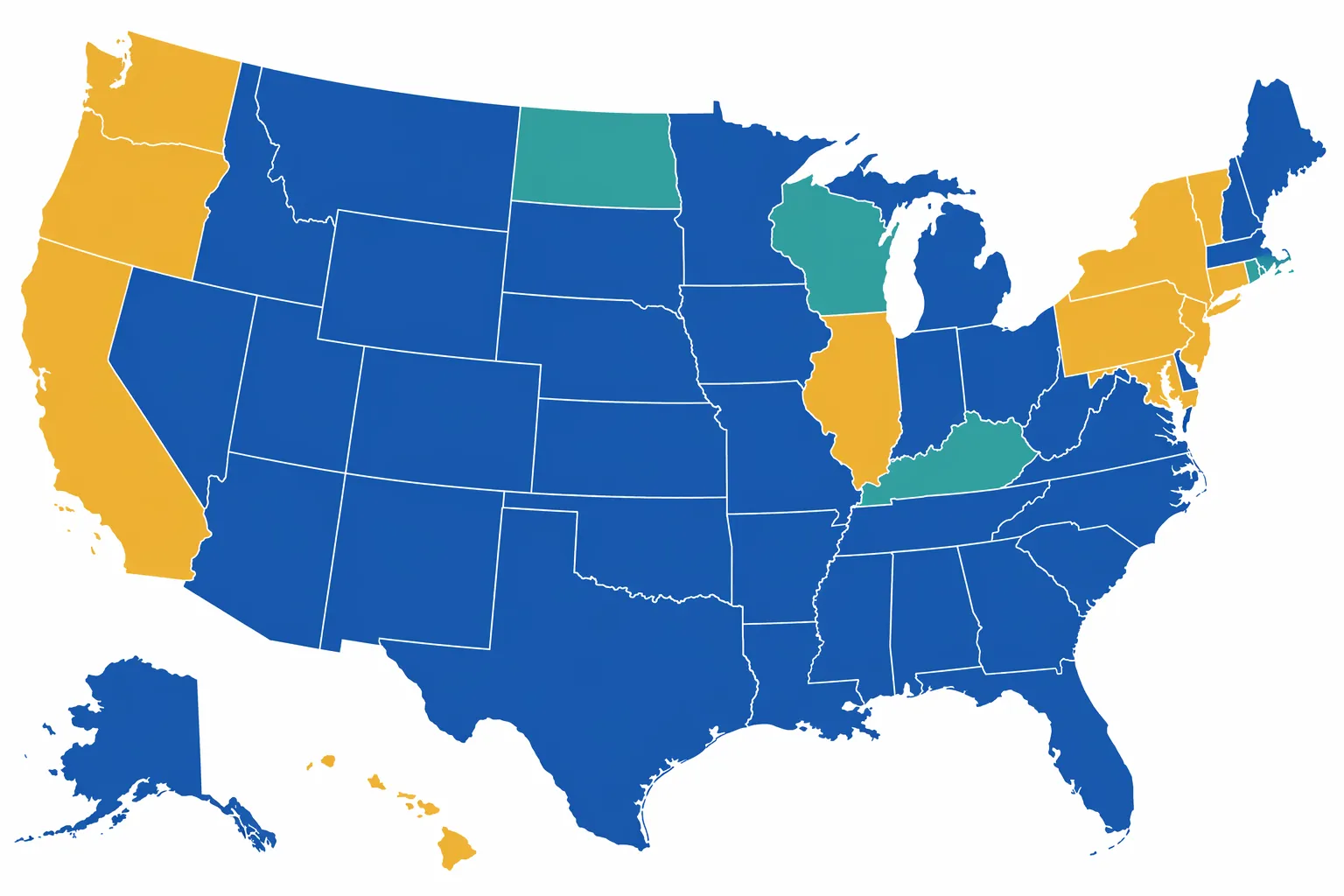
The broadest category can still mislead. “Appointment until the next regular election” does not mean one nationally uniform period of service. The practical length of the appointment depends on when the vacancy occurs, how the state defines the relevant election, candidate filing deadlines, primary-election timing, and any state-specific trigger that moves the vacancy onto or off a particular ballot.
The second category is even less suited to shorthand. A temporary appointment may be available, but only as a bridge to a proximate special election. For counsel assessing political risk, the difference between an appointee who may serve until the next regular statewide election and an appointee who must face a special election on an accelerated schedule can affect legislative forecasts, lobbying assumptions, procurement diligence, and pending-matter strategy.
Recent changes are not trivia
Oregon is the easiest freshness test. In June 2025, Oregon enacted SB 952, moving from a special-election-only model to a system allowing the governor to appoint a temporary senator, with the vacancy later filled by election.[3] Any source still treating Oregon as one of the states without gubernatorial appointment authority is stale on a point that could change the legal answer.
Kentucky supplies the opposite caution. Reporting on Kentucky’s current vacancy process notes that a 2024 change eliminated gubernatorial appointment authority for U.S. Senate vacancies, leaving the seat to be filled by special election.[4] That is not a stylistic difference in civic procedure. It means the governor’s purported appointment, if one were attempted under the old assumption, would run into a threshold authority problem.
Those two states explain why the 46-state appointment count needs a date stamp. It is accurate only if it reflects Oregon’s 2025 move into the appointment-authorizing group and Kentucky’s 2024 move out of it. A national count without those movements is not reliable enough for litigation support or a client alert.
Appointment authority is only the first gate
Even where a governor has appointment authority, the next question is whether state law restricts the appointment. Pew’s 2024 survey identified multiple states that do not leave the governor with unrestricted discretion: six require the appointee to come from the same political party as the departing senator, three require selection from a list supplied by the prior senator’s party, and Connecticut requires approval by two-thirds of each legislative chamber.[2]
Those restrictions are not decorative. They create the most obvious contest points. If the statute requires a same-party appointment, counsel has to verify the relevant party status and the statutory moment at which party affiliation is measured. If the statute requires a party-provided list, the appointment analysis shifts to whether the list was properly generated and whether the appointee came from it. If legislative approval is required, the appointment is not complete merely because the governor has announced a name.
Connecticut’s two-thirds approval condition is a useful reminder that “gubernatorial appointment state” is not a complete legal category. The governor may be part of the process without being the final unilateral actor. A risk assessment that collapses all appointment states into one box misses the source of the legal vulnerability.
The election calendar decides how temporary the appointment is
Once appointment authority and restrictions are confirmed, the election calendar controls the next practical issue: when voters fill the seat. The 17th Amendment requires an election process, but it leaves the legislature to direct how temporary appointments fit into that process.[1]
For a practitioner, that means the vacancy date has to be placed against state election law, not against a generic national assumption. A vacancy just before a filing deadline may produce a different operational timeline than a vacancy just after it. A state that uses the next regular election can produce a different tenure than a state that calls a separate special election. The legal answer is therefore partly statutory and partly calendrical.
The timing question also matters outside election administration. A committee vote, appropriations package, confirmation calendar, or state-specific regulatory matter may turn on whether the appointee is seated quickly, whether the seat remains vacant until a special election, and whether the appointee faces voters before a pending matter is likely to resolve. For an example of the legislative-risk side of congressional vacancies and absences, see How Congressional Absences Undermine Farm Bill Legislation.
Appointments are common enough to require discipline
Temporary appointment is not an odd constitutional relic. Senate historical data list 255 appointed senators since 1913: 208 appointed before election and 47 senators-elect appointed to fill vacancies before beginning their elected terms.[5]
The state distribution also undercuts any assumption that appointment practice is confined to a narrow regional or partisan pattern. Since 1913, California has had 12 appointed senators, New Jersey 11, and Kentucky, Ohio, and South Carolina 10 each.[5] Those figures do not prove that any particular state will use appointment authority today; they show why vacancy mechanics recur often enough that stale national summaries can do real work before anyone checks them.
History is context, not authority. The appointment of past senators does not answer whether a present governor may appoint under current law, especially in a state that recently amended its vacancy statute.
Do not import the House rule
House vacancies operate under a different constitutional rule. Article I, Section 2 provides for the executive authority to issue writs of election to fill vacancies in the House, and there is no parallel constitutional authorization for temporary gubernatorial appointment to a House seat.[6]
That contrast is a useful guardrail. A lawyer moving quickly from “congressional vacancy” to “governor appoints” has already crossed chambers without authority. Senate vacancy analysis belongs under the 17th Amendment and the controlling state Senate-vacancy statute; House vacancy analysis does not.
Administrative details still need current verification
One operational point deserves caution. A CRS report from 2003 describes Senate staff compensation arrangements after a senator’s death, including a 60-day window under the Secretary of the Senate.[6] Because that source is older, the rule should be verified against current Senate authority before anyone relies on it for payroll, office administration, or transition planning.
H.J.Res.198, introduced in June 2026, may matter politically as a proposal to change the 17th Amendment, but it does not change the current vacancy process unless enacted through the constitutional amendment process. For present legal work, the controlling materials remain the 17th Amendment, current state law, and the relevant election calendar.
A defensible Senate vacancy check
The safest way to answer a Senate vacancy question is to work in this order:
- Confirm the vacancy state and the effective date of the controlling state statute.
- Determine whether the state authorizes temporary gubernatorial appointment or requires a special election only.
- If appointment is authorized, check same-party, party-list, legislative-approval, or other statutory limits.
- Map the vacancy date against the state’s regular-election or special-election timetable.
- Verify any Senate administrative consequences, including staff or office-transition rules, against current Senate authority.
That is the legal process. The 17th Amendment requires the election floor and permits temporary appointments only when state legislatures authorize them. The controlling answer comes from the state regime in force at the time of the vacancy, the limits attached to any appointment power, and the election calendar that determines when voters fill the seat.
References
- About Electing and Appointing Senators | Filling Vacancies, Senate.gov
- How do states fill vacancies in the U.S. Senate? It depends on the state, Pew Research Center, August 6, 2024
- Oregon joins 45 other states in allowing the governor to make appointments to vacant U.S. Senate seats, Ballotpedia News, June 30, 2025
- Kentucky: What happens if Senator Mitch McConnell cannot finish his term?, WAVE3, July 10, 2026
- Appointed Senators (1913-Present), Senate.gov
- House and Senate Vacancies: How Are They Filled?, Congressional Research Service, February 12, 2003
Operationalizing workflow
No workflow has been explicitly linked to this obligation yet. See Workflows generally.
Illustrative cases
No illustrative case is currently tracked for this obligation. See Risk Digest for documented incidents generally.
← Back to RegulationReport a correction or tip
Spotted an outdated figure, a misstated fact, or a ruling this regulation entry should reflect? Public comments are disabled for this content given the professional cost of a misreported case outcome, penalty amount, or rule text — use the structured correction channel instead.
Report a correction or tip for this record →