
What the Senate war powers votes mean for legal risk
- Authority
- U.S. Congress
- Rule type
- statute
- Jurisdiction scope
- US federal
- Source text
- Read primary rule text ↗
Last verified: July 24, 2026. The unusual fact is not that Congress and the president disagree over Iran. The unusual fact is the density of the record: the 119th Congress has held 12 Senate votes and 4 House votes on Iran war powers in 2026, more war-powers votes on a single conflict than any Congress has produced since the War Powers Resolution was enacted in 1973.[1][2] The operative question is not whether a few floor speeches were dramatic. It is whether repeated votes, narrow Republican defections, and non-binding resolutions have changed the risk posture for clients who must keep contracting, advising, certifying, and complying while the constitutional dispute remains unresolved.

That distinction matters. A non-binding congressional vote does not itself terminate a contract, void a sanctions license, or supply a procurement officer with a clean answer about performance tied to Middle East operations. But repeated votes do make it harder to treat congressional silence as consent. They also create a record that may become relevant if Congress later attaches conditions to funding, authorizes litigation, or changes the statutory environment before the appropriations deadline.
The signal is conflicted in ways that matter for legal advice. Congress has generated an unusually thick record of objection. The executive has continued to assert authority. The courts have historically avoided deciding War Powers Resolution compliance on the merits. That leaves practitioners with a familiar but uncomfortable task: advising around an active public-law dispute without pretending that the dispute has already produced a rule.
What the votes actually show
The voting pattern is not a single event. It is a sequence of institutional objections, procedural tests, and party-line stress points. Four Republican senators — Rand Paul, Susan Collins, Lisa Murkowski, and Bill Cassidy — crossed party lines on at least one Iran war-powers vote. After President Trump’s June 24 Capitol meeting, however, reporting showed that the bloc narrowed, with only one consistent Republican defector remaining in later votes.[3][4][5]
That erosion is not just political color. For legal-risk purposes, it helps answer whether Congress is moving toward an enforceable constraint or only building a record. A stable bipartisan bloc can affect appropriations strategy, committee posture, oversight intensity, and the credibility of later riders. A shrinking bloc may still matter, but it weakens the assumption that Congress will soon convert objection into binding law.
The House also crossed a procedural threshold. On June 23, both chambers approved H.Con.Res.86, described in contemporaneous reporting as the first concurrent resolution approved by both chambers under Section 5(c) of the War Powers Resolution since the statute’s enactment.[6][7] That is a real institutional milestone. It is not, by itself, an enforceable stop-work order.
| Signal | Why it matters for legal risk | What it does not do by itself |
|---|---|---|
| 12 Senate votes and 4 House votes on Iran war powers | Creates an unusually detailed congressional record of objection and division | Does not automatically alter contract authority or terminate military operations |
| Republican defections that narrowed after the June 24 Capitol meeting | Shows the difference between episodic dissent and a durable cross-party enforcement coalition | Does not prove that Congress can override or constrain the executive without a binding vehicle |
| H.Con.Res.86 under Section 5(c) | Weakens any practical claim that Congress has been silent or passive | Does not have the force of enacted law after Chadha |
| Supplemental funding and appropriations pressure | Could become the route through which legal constraints affect procurement and performance | Does not impose conditions unless Congress actually enacts them |
The concurrent-resolution problem after Chadha
The legal mechanics are where the easy descriptions break down. Section 5(c) of the War Powers Resolution contemplated a concurrent resolution as a way for Congress to direct removal of U.S. forces. But the Supreme Court’s 1983 decision in INS v. Chadha held that legislative action with legal effect must satisfy bicameralism and presentment.[8] A concurrent resolution is passed by both chambers but is not presented to the president for signature or veto. After Chadha, that is the defect.
The consequence is narrow but important. H.Con.Res.86 can be legally meaningful without being legally operative. It may help show that Congress did not acquiesce. It does not function like an enacted statute. Counsel should therefore resist two opposite mistakes: treating the vote as a nullity because it is unenforceable, or treating it as binding because both chambers approved it.
The Youngstown question sits in that middle space. Under Justice Jackson’s well-known framework, presidential power is at its lowest ebb when the president acts against the expressed or implied will of Congress. Legal analysis by Scott R. Anderson has argued that the 2026 votes undermine an executive argument based on congressional acquiescence, even if they do not themselves compel withdrawal.[9] That is interpretation, not a settled holding resolving the Iran conflict. But it is exactly the kind of interpretation that may matter in an Office of Legal Counsel analysis, a congressional oversight fight, or a later litigation record.
This is why the formal record matters even when the enforcement route is weak. If the executive argues that Congress has tolerated or approved the operation through inaction, a sequence of votes, debate, and a Section 5(c) concurrent resolution makes that argument harder to state cleanly. It still does not answer who will enforce Congress’s view.
The enforcement gap is not theoretical
The judicial backstop is the weakest part of the structure. Federal courts have not supplied a merits ruling ordering presidential compliance with the War Powers Resolution’s withdrawal provisions. War-powers cases have repeatedly been dismissed on threshold grounds such as standing, ripeness, and political question doctrine; Campbell v. Clinton is the standard modern example from the D.C. Circuit.[10] Kucinich v. Obama followed the same practical pattern of non-resolution rather than merits enforcement.[11]
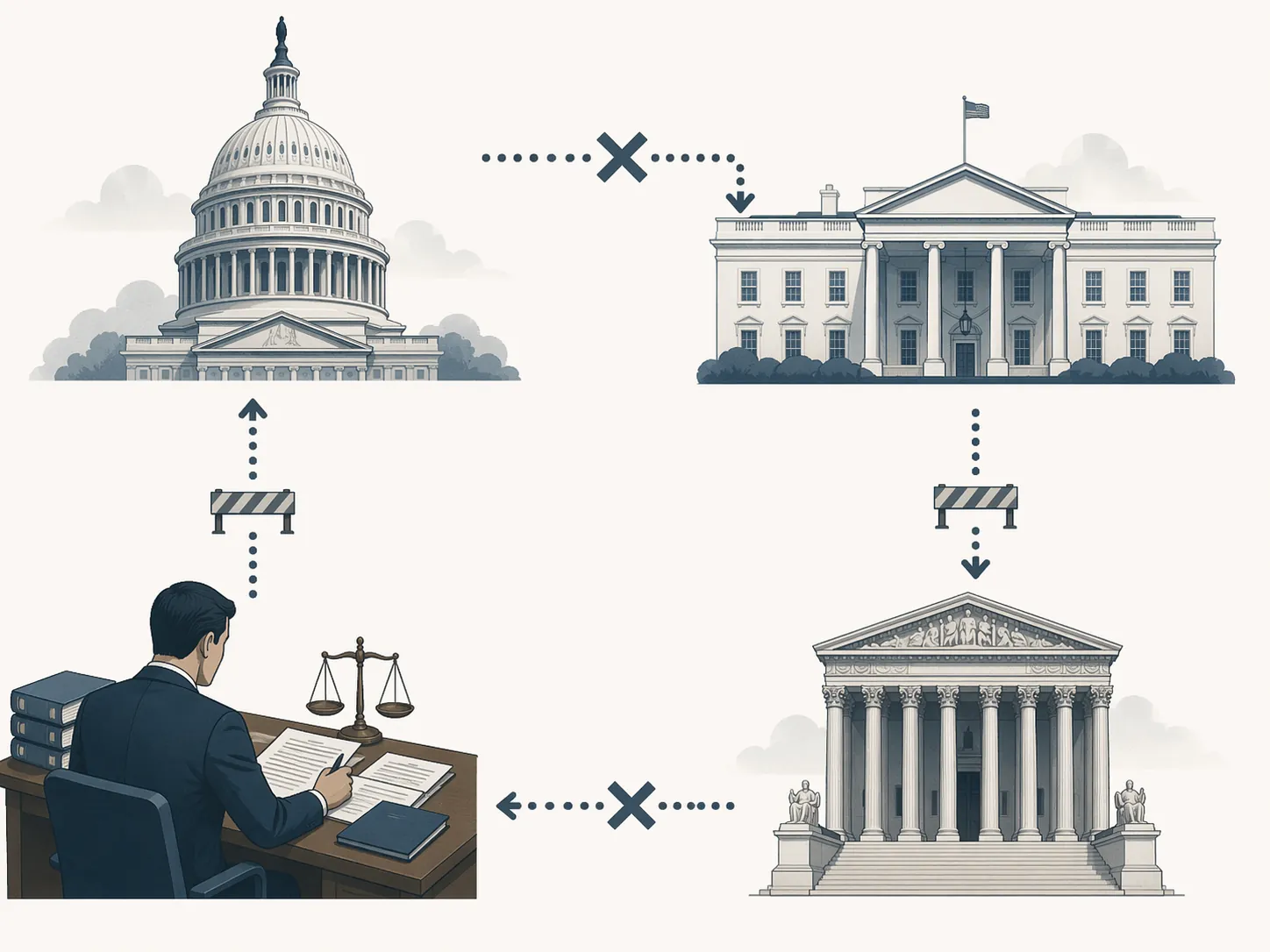
For practitioners, this matters more than abstract separation-of-powers taxonomy. A client asking whether an Iran-related support contract is now legally impaired will not be helped by an answer that says only that Congress has objected. The better answer has to separate authority, enforceability, funding, and reliance.
- Authority: the executive continues to assert power to conduct the operation.
- Congressional objection: the vote record is unusually strong and may defeat claims of passive acquiescence.
- Judicial enforcement: existing precedent gives little basis to assume a court will promptly decide War Powers Resolution compliance on the merits.
- Practical constraint: funding legislation, procurement conditions, or a viable institutional lawsuit would matter more immediately than another non-binding expression of disapproval.
The executive’s reported posture also matters. When an administration treats war-powers compliance as effectively insulated from judicial review, that position does not become correct merely because courts are reluctant to intervene. But reluctance to intervene changes the risk environment. It means legal departments cannot plan on a near-term judicial referee to reconcile the branches before obligations mature.
Funding is where objection could become operational
The appropriations track is the place to watch because it can move the dispute from constitutional position-taking into operational constraint. The Pentagon requested an $80 billion supplemental; senators were also given Pentagon-provided estimates of $11.3 billion for the first week of the conflict and a total projected near $100 billion.[12] Those figures should not be treated as audited totals. Their immediate importance is that they create pressure for Congress to decide whether money will continue to flow without conditions.
The Sept. 30 appropriations deadline gives Congress a more conventional enforcement tool than a concurrent resolution. Congress has used power-of-the-purse tactics before to end or restrict U.S. military involvement, including in Cambodia in 1973 and Angola in 1976.[13] The analogy is useful because it points to the mechanism: enacted funding restrictions can affect agencies, contractors, and program offices in a way that a concurrent resolution cannot.
That does not mean a rider is inevitable. It means procurement and compliance teams should treat appropriations text as primary-risk material. A floor vote may tell counsel where political pressure is building. A rider can change what an agency may obligate, reimburse, or direct. The first is a record. The second can become a condition of payment or performance.
What changes for defense, sanctions, and procurement counsel
The practical legal effect is not a single new rule. It is a deterioration in reliance assumptions. Lawyers advising defense contractors, sanctions teams, government-contracting officers, and corporate legal departments need to know which assurances rest on current executive policy and which rest on enacted law. Those are different categories of comfort.
For defense contractors, the immediate question is whether any statement of work, task order, logistics support, intelligence support, maintenance obligation, or subcontracting chain is tied closely enough to Iran operations that later funding restrictions could interrupt performance. The answer will depend on contract language, funding source, agency direction, and whether future appropriations conditions are drafted broadly or narrowly.
For sanctions and export-control teams, the war-powers votes do not themselves change sanctions law. But they may affect escalation assumptions, licensing posture, customer due diligence, force-majeure analysis, and the likelihood of new congressional conditions attached to Iran-related executive action. A sanctions memo that treats the conflict as settled executive terrain is more exposed than one that identifies the active congressional record and the absence of a judicial resolution.
For procurement officers and in-house counsel, the hard questions are more administrative than constitutional. Who is authorized to direct continued performance if appropriations lapse or are conditioned? Does the contract contain stop-work, changes, termination, or limitation-of-funds language that would be triggered by a funding restriction? Are representations to lenders, auditors, insurers, or counterparties overstating legal certainty? These are not questions a Senate vote answers, but the vote record tells counsel why they now need to be asked.
Signals to monitor before Sept. 30
The monitoring framework should be built from sources that can change legal exposure, not from commentary volume. As of July 24, the conflict remained live, with the Iran war resuming in July through 12 consecutive nights of U.S. strikes.[5] That continued military activity keeps the appropriations and war-powers questions from becoming retrospective.
| Monitor | Source type | Risk consequence |
|---|---|---|
| Appropriations bills, continuing resolutions, and supplemental funding text | Bill text, committee reports, amendments, conference materials | May create binding limits on obligation, expenditure, reimbursement, or covered operations |
| Funding riders or conditions tied to Iran operations | Amendment text and enacted appropriations language | Could turn congressional objection into contract-performance or payment risk |
| Republican defection patterns in Senate war-powers votes | Senate roll calls and near-primary vote records | Helps assess whether objection is becoming a durable cross-party enforcement coalition |
| House authorization for litigation | Resolution text, committee action, House floor action | May create a more plausible institutional plaintiff, though merits review remains uncertain |
| Executive legal statements asserting unilateral authority or non-reviewability | White House, DOJ, OLC, Defense Department, and litigation filings | Signals whether agencies will continue performance despite congressional objection |
| Operational escalation or de-escalation | Defense Department briefings and congressional oversight records | Affects funding pressure, contractor tasking, and urgency of legal review |
Rep. Gregory Meeks’s July 23 resolution to authorize the House to sue the administration is worth tracking for that reason. It does not solve the standing, ripeness, or political-question problems by announcement. But it could change the procedural posture from individual-member litigation toward an institutional claim, which is a more serious vehicle than another press statement.[5]
Public opinion belongs in the file, but in the correct compartment. Polling showed 53% to 59% of Americans opposing the Iran war, while one poll found 70% wanted it ended as soon as possible.[14][15] Those numbers do not answer the constitutional question. They may, however, affect congressional incentives as members approach appropriations votes, especially if the cost estimates and operational tempo remain salient.
How to state the risk without overstating the law
A careful risk statement should not say that the 2026 Senate war-powers votes have made Iran-related executive action unlawful in a way that courts will enforce. The materials do not support that. It should also not say that the votes are merely symbolic. That understates the record Congress has created and the possibility that the record will support later funding restrictions, oversight demands, or litigation arguments.
A defensible formulation is narrower: Congress has repeatedly objected to the Iran operation through an unusually dense sequence of war-powers votes, including a historically significant concurrent resolution; those votes likely weaken claims of congressional acquiescence but do not themselves bind the executive after Chadha; courts have historically avoided merits review of War Powers Resolution disputes; therefore, the most immediate legal-risk events are enacted funding constraints, a successful litigation vehicle, or a material change in congressional alignment.
That formulation is not satisfying in the way a bright-line rule is satisfying. It is more useful. It tells a contractor why an agency direction may still be operative today but vulnerable to funding disruption tomorrow. It tells a sanctions team why no sanctions rule has changed solely because of a Senate vote, while escalation and congressional pressure still matter. It tells an in-house legal department why representations about legal authority should be dated, sourced, and hedged.
Until there is a binding funding constraint, a successful litigation vehicle, or a material change in congressional alignment, the legal risk is not that practitioners have a clear new rule. It is that they must advise inside an enforcement gap and keep the record current from last-verified sources.
References
- Roll Call report on 2026 Iran war-powers votes — Roll Call, July 23, 2026.
- Senate roll call records — United States Senate.
- AP News report on Trump’s June 24 Capitol meeting and Republican war-powers votes — AP News, June 24, 2026.
- Al Daily News report on June 24 Iran war-powers vote developments — Al Daily News, June 24, 2026.
- NBC News report on July 23 Iran war-powers developments and Meeks litigation authorization — NBC News, July 23, 2026.
- CNN report on H.Con.Res.86 and Section 5(c) of the War Powers Resolution — CNN, June 23, 2026.
- BBC News report on H.Con.Res.86 and the War Powers Resolution — BBC News, June 23, 2026.
- INS v. Chadha — Supreme Court of the United States, 1983.
- Lawfare analysis by Scott R. Anderson on the War Powers Resolution, Chadha, and Youngstown — Lawfare.
- Campbell v. Clinton — U.S. Court of Appeals for the D.C. Circuit, 2000.
- Kucinich v. Obama — U.S. District Court for the District of Columbia.
- AP News report on Pentagon briefings and Iran war supplemental funding estimates — AP News.
- The Conversation analysis by Jasmine Farrier on Congress’s power of the purse in war-powers disputes — The Conversation.
- Brookings/UMD Critical Issues Poll on public opinion toward the Iran war — Brookings Institution / University of Maryland.
- YouGov/Economist polling on public opinion toward the Iran war — YouGov / The Economist.
Operationalizing workflow
No workflow has been explicitly linked to this obligation yet. See Workflows generally.
Illustrative cases
No illustrative case is currently tracked for this obligation. See Risk Digest for documented incidents generally.
← Back to RegulationReport a correction or tip
Spotted an outdated figure, a misstated fact, or a ruling this regulation entry should reflect? Public comments are disabled for this content given the professional cost of a misreported case outcome, penalty amount, or rule text — use the structured correction channel instead.
Report a correction or tip for this record →