
What Sheri Biggs' military travel bill means for TSA lanes
- Authority
- U.S. House of Representatives
- Rule type
- bill
- Jurisdiction scope
- US federal
- Source text
- Read primary rule text ↗
No new TSA obligation until enactment; if TSA establishes the pilot, it must preserve Secure Flight screening, boarding-pass eligibility, and local lane authority.
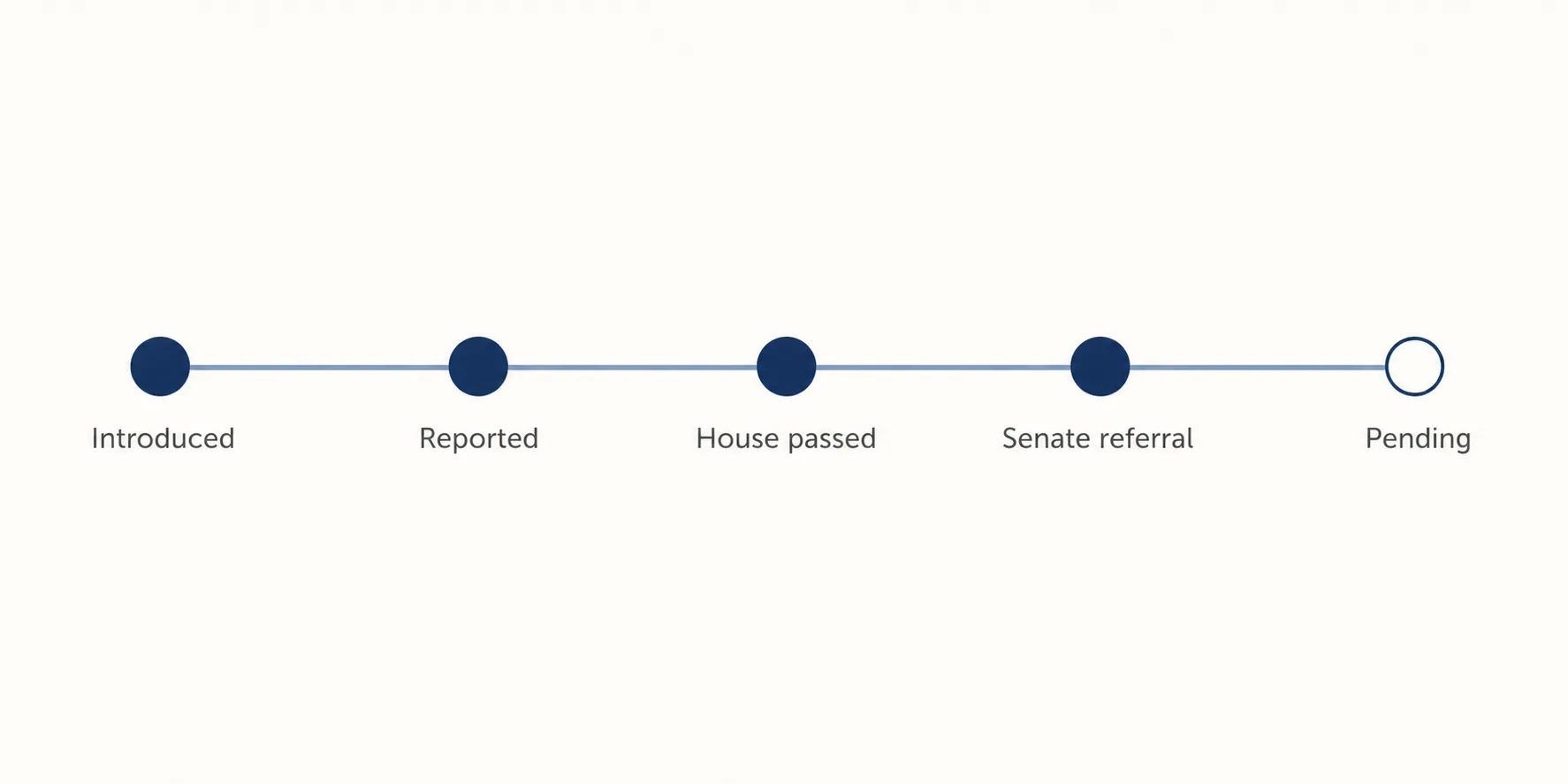
Last verified: Aug. 3, 2026, UTC. The controlling text reviewed here is the Referred-in-Senate version of H.R. 9328, the Improving Travel for Military Members Act.[1] Congress.gov and GovTrack show the bill was introduced on June 18, 2026, passed the House by unanimous consent on July 13, 2026, and was referred to the Senate Committee on Commerce, Science, and Transportation on July 14, 2026; no later Senate action was located in those status records as of this review.[2][3] House Report 119-741 was filed on July 13, 2026, after the House Homeland Security Committee ordered the bill reported, as amended, by a 30-0 vote on June 24, 2026.[4]
Legal-background review: Mara Voss. This article is general legal and regulatory information, not legal advice, and it does not create an attorney-client relationship.
Short answer: House passage did not create dedicated TSA lanes for military travelers, and it did not change passenger screening standards. Section 2(a) says the TSA Administrator “may establish” a pilot program within 60 days after enactment, and only “to the extent such access does not compromise security protocols.”[1] The operative bill is therefore a conditional pilot authorization, not a self-executing nationwide lane order.
What passed the House
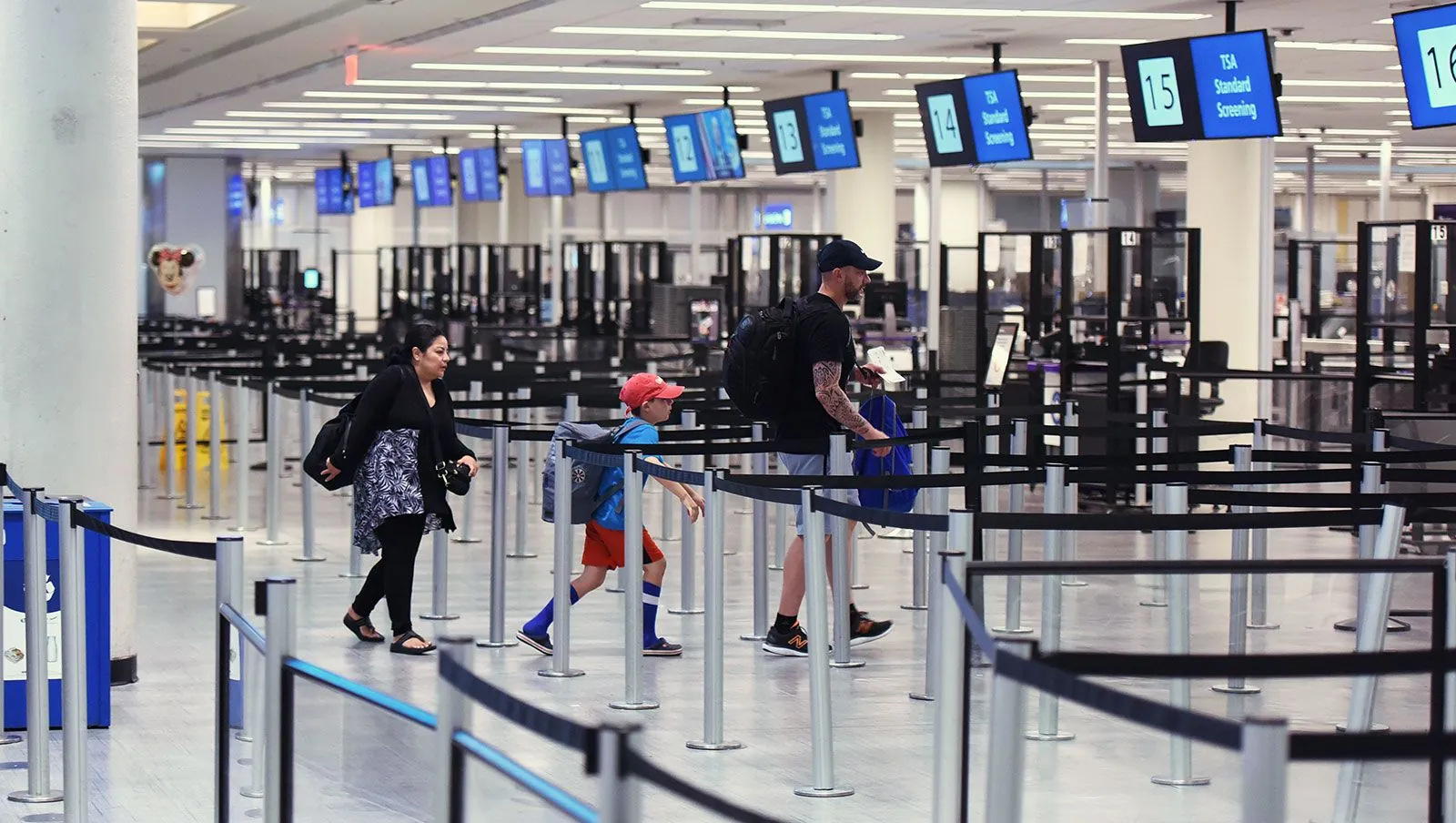
H.R. 9328 would authorize the TSA Administrator to create a pilot program for “dedicated access lanes” for members of the Armed Forces and their immediate family members at passenger screening checkpoints.[1] That is the bill’s practical appeal: a service member or family traveling through a participating airport could be routed into a lane intended to reduce checkpoint friction.
The legal effect is narrower than the phrase “dedicated TSA lanes” can make it sound. The bill does not itself designate airports, does not require every airport near a military installation to open a lane, and does not say that a military identification card substitutes for TSA’s existing vetting or boarding-pass eligibility systems. It gives TSA permission to establish a pilot if the statutory conditions are met.
That distinction matters because some public descriptions have framed the proposal around a “minimum of five airports.” Rep. Sheri Biggs’ House-passage release and Military.com’s July 20, 2026 report use that kind of public-facing description, but the Referred-in-Senate bill text does not contain a five-airport minimum.[5][6][1] The statute leaves airport selection to the Administrator, with priorities and considerations rather than a fixed airport count.
The may/shall structure is the center of the bill
Section 2 uses a familiar legislative pattern: discretionary authority first, mandatory operating rules second. The Administrator “may establish” the pilot program. If the Administrator does establish it, the Administrator “shall carry out” that program subject to specific screening and lane-control guardrails.[1]
| Provision | What the text does | Operational consequence |
|---|---|---|
| Section 2(a) | Authorizes the Administrator to establish a pilot program within 60 days after enactment, to the extent access does not compromise security protocols.[1] | No lane program exists merely because the House passed the bill; enactment and TSA action would still be needed. |
| Section 2(b) | Sets mandatory conditions for how the pilot must be carried out if established.[1] | The security rules become binding only after the Administrator uses the pilot authority. |
| Section 2(c) | Directs TSA to prioritize certain airports and consider lane space.[1] | Airport selection is not fixed in the bill text. |
| Sections 2(d) and 2(e) | Require a congressional briefing within 9 months after enactment and terminate the pilot 3 years after enactment.[1] | The bill creates an oversight and sunset clock, not a permanent program. |
The word “may” is not decorative. It means the bill authorizes TSA to act; it does not command TSA to open lanes regardless of checkpoint layout, staffing, airport configuration, or security assessment. The phrase “within 60 days after the date of enactment” is also not a current deadline. There is no enactment yet, and the bill remains pending in the Senate.
Three guardrails keep the pilot from becoming a screening shortcut
The legally significant part of H.R. 9328 is Section 2(b). It is where the bill stops being a general courtesy-lane proposal and becomes a security-conditioned pilot. Each guardrail addresses a different implementation risk: vetting status, expedited-lane eligibility, and local checkpoint control.
Secure Flight status still controls screening
First, the bill requires that participating passengers be screened “in accordance with the screening status of each such passenger” under 49 U.S.C. § 44903(j)(2), the Secure Flight provision.[1][7] In ordinary implementation terms, the lane may change where an eligible traveler queues. It does not erase the passenger’s vetting result.
That is the provision counsel should point to when asked whether the bill lets military travelers bypass standard screening. It does not. The statutory cross-reference ties the pilot back to the passenger’s existing screening status, rather than creating a military-family screening category outside TSA’s vetting structure.
The boarding pass must show expedited eligibility
Second, H.R. 9328 says the Administrator may not allow a member of the Armed Forces or an immediate family member to use a PreCheck or other expedited screening lane unless that passenger’s boarding pass indicates eligibility for that lane.[1]
That guardrail is more specific than a general “no security compromise” clause. It answers a concrete checkpoint question: if the military access lane feeds into or overlaps with an expedited lane, what document controls? The bill’s answer is the boarding pass, not the traveler’s status as a service member or family member standing alone.
Local TSA authority is preserved
Third, the bill preserves TSA’s local authority to open and close screening lanes and reallocate screening resources.[1] This is the provision airport operators will care about when a press-release sentence becomes a facilities question.
A statutory pilot lane can sound like a permanent real-estate claim inside a checkpoint. Section 2(b) cuts against that reading. Local TSA field leadership would still retain operational control over lane deployment. If passenger volumes, staffing, threat posture, or checkpoint configuration require a lane to close or resources to move, the bill text does not freeze the military access lane in place.
Airport selection is a TSA implementation question
Section 2(c) tells the Administrator to prioritize airports located within a distance, determined by the Administrator, from a military installation as defined by reference to 10 U.S.C. § 2801.[1] The important word here is “determined.” Congress did not write a mileage radius into H.R. 9328. TSA would have to decide what proximity means for the pilot.
The same subsection tells TSA to consider airport lane space.[1] That phrase is doing practical work. An airport may be near a base and still have a checkpoint layout that makes a dedicated lane difficult during peak periods. Conversely, a larger airport farther from a particular installation might have more flexible checkpoint space. The bill does not resolve those tradeoffs; it assigns them to the Administrator.
For airport counsel, the implementation question is therefore not simply, “Is this airport near a military installation?” It is also whether TSA’s eventual distance threshold includes the airport, whether TSA treats available lane space as adequate, and whether local lane-control decisions can support the pilot without displacing other checkpoint functions.
The oversight clock is short, and the program would sunset
If enacted, H.R. 9328 would require the Administrator to brief Congress within 9 months after enactment. The briefing recipients are the House Committee on Homeland Security, the Senate Committee on Homeland Security and Governmental Affairs, and the Senate Committee on Commerce, Science, and Transportation.[1]
The pilot would terminate 3 years after enactment.[1] That sunset matters for procurement, airport planning, and stakeholder messaging. A participating airport would not be implementing a permanent statutory entitlement unless Congress later extended or replaced the authority.
| Trigger | What follows | Who should track it |
|---|---|---|
| Enactment | The 60-day window for possible TSA establishment of the pilot begins.[1] | TSA headquarters, airport operators, congressional affairs teams |
| Administrator establishes pilot | Section 2(b) guardrails become operational requirements.[1] | TSA field leadership, airport counsel, checkpoint operations teams |
| 9 months after enactment | TSA must brief the specified House and Senate committees.[1] | Oversight staff, government-affairs counsel |
| 3 years after enactment | The pilot authority terminates unless Congress changes the law.[1] | Airport planning teams, TSA program offices |
The legislative record is straightforward
For status-sensitive briefings, H.R. 9328 belongs in the same category of pending-measure tracking as the Cornyn anti-weaponization legislation status record, the Andy Kim SAFE Act obligations mapping, and the Paramount-WBD deadline tracker: the first task is to separate a passed chamber vote from an enacted obligation.
| Date | Action | Source |
|---|---|---|
| June 18, 2026 | H.R. 9328 introduced in the House. | Congress.gov; GovTrack[2][3] |
| June 24, 2026 | House Homeland Security Committee ordered the bill reported, as amended, by a 30-0 vote. | House Report 119-741[4] |
| July 13, 2026 | House Report 119-741 filed. | House Report 119-741[4] |
| July 13, 2026 | House passed the bill by unanimous consent. | Congress.gov; GovTrack[2][3] |
| July 14, 2026 | Bill received in the Senate and referred to the Senate Committee on Commerce, Science, and Transportation. | Congress.gov; GovTrack[2][3] |
| Aug. 3, 2026 | No further Senate hearing, markup, or floor action located in the checked status records. | Congress.gov; GovTrack[2][3] |
Cost and program-overlap claims should stay narrow
House Report 119-741 states that the bill contains no congressional earmarks, no new budget authority, credit authority, or tax expenditures, and no duplicative federal program identified under the committee’s rule-based review.[4] The report also states that the Congressional Budget Office estimate and the federal mandates statement had been requested but were not received before the report was filed.[4]
That record supports a careful statement: the committee did not identify new appropriations or duplicative programs in its report. It does not support a dollar cost estimate, an unfunded-mandate conclusion, or a claim that TSA could implement the pilot without any operational tradeoffs. Those estimates were not available in the report record at filing.
The report also treats the bill as building on existing military-traveler screening efforts rather than replacing them. It describes TSA’s “Serve with Honor, Travel with Ease” initiative as operating at 119 airports, including 33 large-hub and 86 medium airports.[4] Separately, 49 U.S.C. § 44903(m) already addresses expedited screening for certain members of the Armed Forces and spouses.[7] Those background layers do not change the reading of H.R. 9328’s operative text: the new bill would add a pilot-lane authority subject to its own conditions.
What the bill would not do
- It would not relax TSA screening standards. The pilot must operate only to the extent access does not compromise security protocols, and passengers remain tied to their Secure Flight screening status.[1]
- It would not create automatic PreCheck access for military travelers or family members. Use of a PreCheck or other expedited lane depends on the boarding pass indicating eligibility.[1]
- It would not require local TSA officials to keep a dedicated lane open at all times. The bill preserves local authority to open and close lanes and reallocate resources.[1]
- It would not establish a statutory five-airport minimum. That figure appears in public descriptions, not in the Referred-in-Senate bill text.[5][6][1]
- It would not become permanent on enactment. The pilot would sunset 3 years after enactment unless Congress later extends or modifies it.[1]
What remains pending
As of Aug. 3, 2026, H.R. 9328 has cleared the House but remains in Senate Commerce. No Senate hearing, markup, floor passage, or enacted public law was located in the checked status records.[2][3] Until the Senate acts and the bill is enacted, TSA has no new H.R. 9328 pilot authority to implement.
If the bill is enacted, the real legal and operational questions will move to TSA’s choices: whether to establish the pilot, how to define proximity to military installations, which airports have sufficient lane space, and how local field leadership manages lane openings, closures, and resource reallocations. H.R. 9328 is best read as a security-conditioned pilot authorization with preserved TSA discretion, not as a statutory shortcut through TSA screening.
References
- H. R. 9328 (Referred-in-Senate) — Improving Travel for Military Members Act — govinfo.gov — July 14, 2026
- H.R.9328 — 119th Congress (2025-2026) — Congress.gov
- H.R. 9328 legislative history and status — GovTrack.us
- House Report 119-741 — govinfo.gov — July 13, 2026
- Congresswoman Sheri Biggs’ Improving Travel for Military Members Act Passes House — sheribiggs.house.gov
- House Bill Creates Dedicated TSA Airport Lanes for Active-Duty Military, Families — Military.com — July 20, 2026
- 49 U.S. Code § 44903 — Air transportation security — Legal Information Institute, Cornell Law School
Operationalizing workflow
No workflow has been explicitly linked to this obligation yet. See Workflows generally.
Illustrative cases
No illustrative case is currently tracked for this obligation. See Risk Digest for documented incidents generally.
← Back to RegulationReport a correction or tip
Spotted an outdated figure, a misstated fact, or a ruling this regulation entry should reflect? Public comments are disabled for this content given the professional cost of a misreported case outcome, penalty amount, or rule text — use the structured correction channel instead.
Report a correction or tip for this record →