
August 2026: No Second Social Security Check, But Two AI Sanctions to Know
- Authority
- American Bar Association
- Rule type
- ethics opinion
- Jurisdiction scope
- US federal
- Effective date
- Jul 1, 2024
- Source text
- Read primary rule text ↗
Lawyers must independently verify AI-generated case citations and factual statements from the administrative record before filing.
There is no second Social Security check in August 2026. There is no bonus payment, no hidden “extra” benefit, and no special SSA program created by the calendar. A person may see two deposits in a month for ordinary scheduling reasons, but that is not the same thing as a new federal payment.
That is the short August 2026 explanation. The longer and more important version, at least for lawyers who file Social Security cases in federal court, is about a different kind of “second”: the second documented AI-hallucination sanction in Social Security litigation within 12 months.
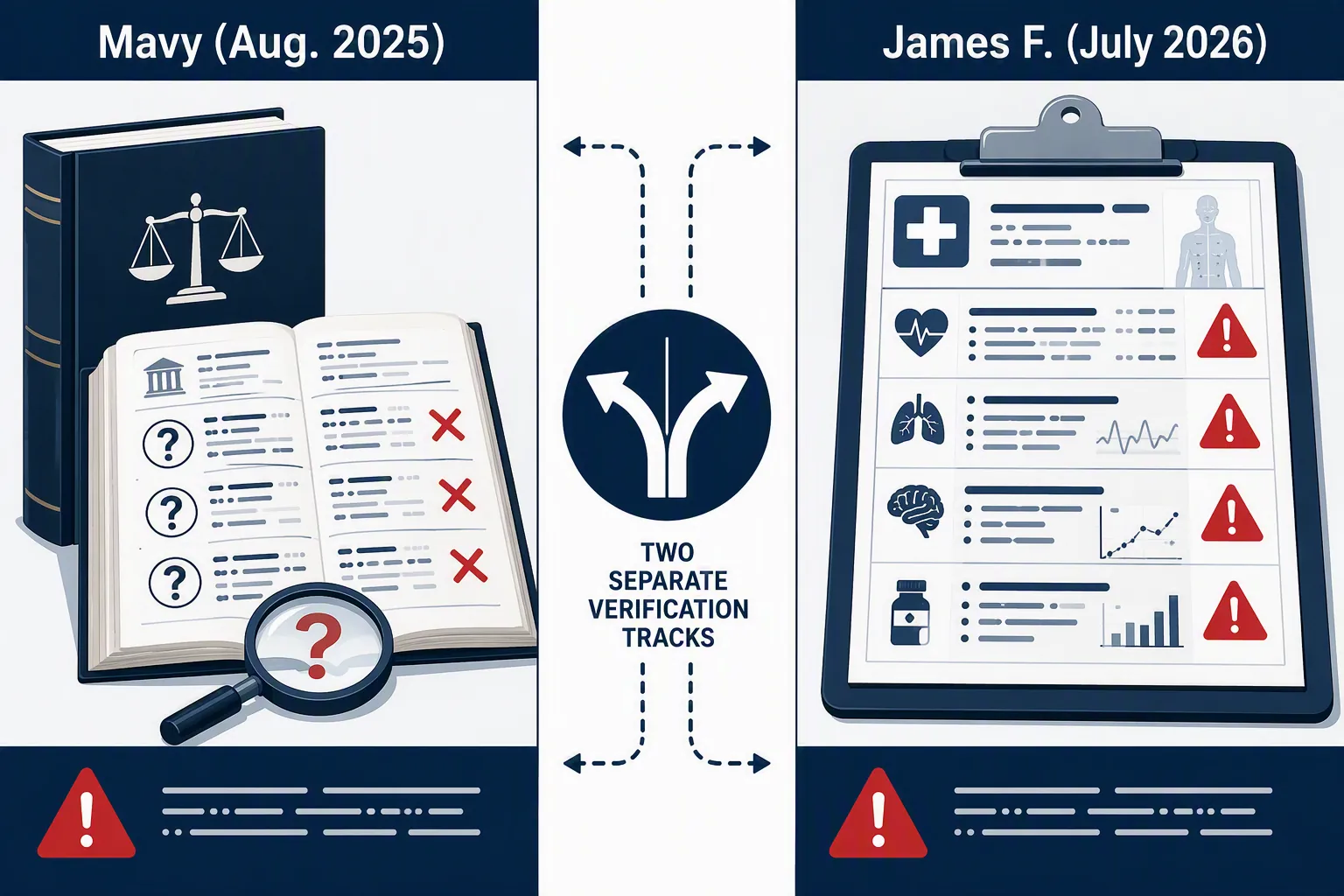
The first was Mavy v. Commissioner of Social Security, decided in the District of Arizona on August 14, 2025. The second was James F. v. Commissioner of Social Security, decided in the Eastern District of Michigan on July 13, 2026. They are not the same mistake. That is why they matter.
The benefits rumor is ordinary. The litigation pattern is not.
Social Security payment rumors thrive because the payment calendar is easy to misread. A recipient can receive money at an unusual point in a month because of weekends, holidays, benefit type, banking timing, or the way SSI and Social Security benefits interact for that household. None of that creates a second August 2026 Social Security check in the sense people usually mean online: an added, one-time, across-the-board payment.
For claimants, the practical answer is to check the SSA’s official payment information and the person’s own award documents, not a viral post. For lawyers, the more durable problem is that Social Security litigation has now produced two AI-related sanctions close enough together, and different enough in kind, to justify a separate risk discussion.
The AI Hallucination Cases database maintained by Damien Charlotin listed 1,252 documented U.S. cases as of July 29, 2026, with the pace increasing from roughly two cases per week to two or three per day; 486 involved lawyers, and 1,041 involved fabricated content.[1] Those numbers do not prove that Social Security litigation is uniquely vulnerable. They do show that fabricated legal and factual material is no longer a curiosity confined to one famous sanctions order.
Mavy: when the authorities are not authorities
In Mavy, the failure was the one lawyers have been trained to fear since the first wave of generative-AI sanctions: fabricated case law. The court found that 12 of 19 citations were fabricated, revoked the attorney’s pro hac vice status, and ordered notification letters to every judge whose name had been attached to fake cases.[1]
Those numbers are hard to soften. A brief can contain weak authority, distinguishable authority, even badly chosen authority. That is ordinary litigation failure. A brief that assigns fictional decisions to real judges crosses into a different category because it exports the cleanup work to the court, opposing counsel, and anyone later trying to understand the docket.
The obvious control for that kind of failure is citation verification. Someone must confirm that each cited case exists, that the quoted or paraphrased proposition appears in the decision, and that the case has not been made to stand for something it does not say. It is tedious work. It is also the work that makes a signed filing different from a plausible-looking memorandum.
Mavy fits neatly into the broader AI-sanctions story because the fabricated material looked legal. The problem was visible to anyone who ran the authorities through a reliable legal database or pulled the source. That does not make the error excusable; it makes the needed control comparatively clear.
James F.: when the record facts are not in the record
James F. is the more unsettling Social Security case because the reported failure was not fake case law. It involved AI-fabricated factual statements from medical records in an SSI brief, followed by a sanction that included mandatory continuing legal education on ethics and AI.[1]
That matters because a disability appeal often turns on what the administrative record says about symptoms, treatment, functional limits, medical opinions, and the administrative law judge’s handling of those materials. The legal argument may be short. The record path behind it may be hundreds or thousands of pages long. A sentence can look harmless until someone asks the only question that counts: where is that in the record?
A fake citation announces itself when the reporter number or database search collapses. A fake medical-record assertion can hide in a paragraph that otherwise sounds exactly like a disability brief. “The claimant repeatedly reported worsening neuropathy after medication changes” is the sort of sentence that might be true, partly true, or invented. Without a page check, the polish tells the reviewer nothing.
That is the second failure mode. A cite-checking workflow catches Mavy-type errors only if the problem is the law. It does not, by itself, catch invented factual scaffolding in a record summary. In Social Security practice, that distinction is not academic. The record is the battlefield.
Why Social Security briefs need two verification tracks
The two cases point to a workflow problem, not merely a technology problem. A generic AI policy that says “check the citations” would have been aimed at Mavy. It would not have been enough for James F. unless “citations” also meant every factual statement tied to the administrative record.
| Verification track | What must be checked | Failure illustrated by |
|---|---|---|
| Authority verification | Case existence, quotation accuracy, proposition support, treatment history | Mavy |
| Record verification | Administrative-record page support for medical facts, procedural history, testimony, symptoms, limitations, and treatment summaries | James F. |
Those tracks should not collapse into one another. The person checking the law needs access to reliable legal research tools and enough time to trace every proposition. The person checking the record needs a page-by-page method for confirming that factual assertions match the certified administrative record, not a model’s summary of it.
A practical review pass in an SSA case should treat unsupported factual language as a defect even if the law is perfect. If a draft says a doctor “restricted the claimant to occasional handling,” the reviewer should be able to point to the record page. If the draft says imaging showed a particular condition, the reviewer should confirm the imaging report. If the draft says the ALJ ignored a treatment note, the reviewer should verify both the note and the ALJ discussion.
This is where high-volume benefit litigation is exposed. The work rewards templates, recurring arguments, and fast record digestion. Many lawyers and staff members in this space are trying to serve clients with limited resources, tight margins, and large administrative records. That environment explains the temptation to use AI for summarization. It does not transfer the verification duty away from the lawyer who signs the filing.
The ethics issue is not that AI was used
ABA Formal Opinion 512, issued in July 2024, requires lawyers using generative AI to understand the relevant benefits and risks of the technology.[2] That framing is useful because it avoids the lazy conclusion that the only safe rule is abstinence. The professional problem is not that a lawyer used a tool. The problem is filing output that no competent human process independently verified.
Model Rule of Professional Conduct 1.1 supplies the competence baseline, and Model Rule 5.1 addresses supervisory duties for lawyers with managerial or supervisory authority.[3][4] In an AI-assisted workflow, those duties become concrete. Who reviewed the output? Who checked the cases? Who checked the record pages? Who had authority to stop the filing? A policy that cannot answer those questions is not much of a policy.
The Mavy sanction is especially direct on supervision: the court applied a non-delegable supervisory-duty concept in response to the fabricated citations.[1] That point should matter to firms, solo practices, and contract-heavy disability operations alike. Delegating a first draft to AI, staff, or an outside vendor does not delegate the signature.
For related risk records across other practice areas, the same lesson appears in different procedural clothing. The AI issue in the Robert Shiver murder-case litigation record and the administrative-law exposure discussed in Adongo immigration AI risk are not SSA cases, but they show why litigation teams should think in terms of verifiable tasks rather than generalized AI comfort.
What a defensible SSA review process should separate
The safest lesson from Mavy and James F. is modest but important: do not design one verification step and assume it covers both law and record facts. SSA litigation needs at least two separate questions before filing.
- For legal authorities: Does every cited case, statute, regulation, ruling, and quotation exist, and does it support the proposition in the brief?
- For record facts: Does every medical, vocational, testimonial, procedural, and ALJ-review assertion have a traceable administrative-record page?
- For AI-generated summaries: Has a human reviewer compared the summary to the source material rather than checking only whether the prose sounds plausible?
- For supervision: Does the signing lawyer know who performed each verification pass and what was actually checked?
That process can be scaled. A small practice may use a spreadsheet or checklist keyed to record pages. A larger firm may build a more formal review queue. A knowledge-management lawyer may maintain prompt restrictions, source-retention rules, and sampling procedures. The form matters less than the audit trail: when the court asks where a sentence came from, the answer should not depend on memory.
The verification-workflow problem is also a staffing problem. The associate or paralegal assigned to clean up an AI-assisted draft needs permission to slow the filing down when the record support is missing. Otherwise, the review process rewards the exact behavior that produces sanctions: a confident sentence survives because no one owns the page check.
For teams building more durable controls, the practical starting point is not a broad statement that AI must be used responsibly. It is a role map. The lawyer who signs, the person who drafts, the person who checks authorities, and the person who checks the administrative record may be the same person in a solo practice. They are still different functions. Treating them as different functions is what makes later review possible. A more detailed discussion of that career and workflow shift appears in How Lawyers Can Enter AI Legal Tech Through Verification.
The narrow conclusion
Two sanctions do not establish that Social Security litigation is uniquely vulnerable to AI hallucinations. The Charlotin database is broader than SSA practice, and the 1,252-case figure should not be misread as an SSA-specific trend.[1] The narrower conclusion is enough: two federal-court sanctions in Social Security cases within 12 months show two separate failure modes in the same sub-specialty.
Mavy is the warning about fake legal authorities. James F. is the warning about fake medical-record facts. An SSA practice that only cite-checks authorities has addressed the first warning and left the second one open.
So the August 2026 answer is simple on benefits and more demanding on practice risk. There is no second Social Security check. There is, however, a second SSA AI-sanctions case worth taking seriously, because it shows why administrative-law and disability practitioners need verification workflows built for both legal citations and the administrative record.
References
- AI Hallucination Cases Database, Damien Charlotin.
- Formal Opinion 512, American Bar Association, July 2024.
- Model Rules of Professional Conduct: Rule 1.1 Competence, American Bar Association.
- Model Rules of Professional Conduct: Rule 5.1 Responsibilities of Partners, Managers, and Supervisory Lawyers, American Bar Association.
Operationalizing workflow
No workflow has been explicitly linked to this obligation yet. See Workflows generally.
Illustrative cases
No illustrative case is currently tracked for this obligation. See Risk Digest for documented incidents generally.
← Back to RegulationReport a correction or tip
Spotted an outdated figure, a misstated fact, or a ruling this regulation entry should reflect? Public comments are disabled for this content given the professional cost of a misreported case outcome, penalty amount, or rule text — use the structured correction channel instead.
Report a correction or tip for this record →