
SSA AI and Your 2026 Social Security Payment: Legal Risks
- Authority
- Social Security Administration
- Rule type
- regulation
- Jurisdiction scope
- US federal
- Source text
- Read primary rule text ↗
Current as of Q3 2026, this is legal information, not legal advice. The ordinary Social Security payment schedule for 2026 is still predictable on paper: most retirees are paid on Wednesdays based on birth date, with separate timing for some SSI recipients and people who began receiving benefits before May 1997.[1][2] The legal problem is what happens when a payment that should arrive under that schedule does not arrive because a file was flagged, a notice was missed, a record was extracted incorrectly, a hearing transcript is wrong, or an overpayment process has already started moving.
The Social Security Administration’s public AI inventory is now part of any serious 2026 benefits-risk check. SSA lists multiple AI use cases, including systems that extract records, triage claims, scan draft decisions, transcribe hearings, and support fraud controls.[3] That inventory is a living source, which matters: a lawyer relying on it should save the version reviewed, record the date, and avoid assuming that a system description from one quarter still covers the next one.
The 2026 Payment Schedule Is the Starting Point, Not the Whole File
For a retiree, the schedule question is practical: which Wednesday, which account, and whether a holiday changes the date. The broader legal question is different: if the money is not there, can the claimant tell whether the interruption came from ordinary banking delay, a fraud-control action, an overpayment withholding, a pending eligibility issue, or a decision that was shaped by an AI-supported workflow?
That distinction matters because benefit law runs on short clocks. Overpayment notices, appeal rights, hearing objections, and federal-court deadlines do not wait for a claimant to understand the back-end technology. The safest working assumption in 2026 is not that every late or reduced payment is AI-related. It is that AI involvement is now plausible enough to investigate early when the explanation is unclear.
The 2026 cost-of-living adjustment and the birth-date-based payment calendar are useful for household planning, but they do not answer whether SSA had a legally sufficient basis to withhold, reduce, or delay a benefit. A calendar tells the retiree when money should arrive. The administrative record explains why it did not.
Four SSA AI Systems to Check Before Treating a Payment Problem as Routine
SSA’s AI footprint is not one model making one benefits decision. The legally relevant systems have different jobs and different failure modes. A record-extraction tool raises a different due-process problem than a hearing transcription tool. A quality-control scanner is not the same thing as a predictive allowance model. Lumping them together makes the file harder to challenge.
| System | What SSA says it does | Where it can touch benefit access or timing | Legal issue to preserve |
|---|---|---|---|
| IMAGEN | Extracts medical evidence from records | Can affect how disability evidence is summarized or surfaced in a claim file | Whether relevant evidence was omitted, distorted, or treated as absent |
| QDD | Flags likely disability allowances for accelerated processing | Can speed obvious allowances, but also raises questions about cases that are not selected | Whether triage criteria are reviewable and whether non-prototypical cases are disadvantaged |
| Insight Software | Scans draft decisions for about 30 error types before issuance | Can influence decision quality review before a notice is sent | Whether the final record shows what was changed, ignored, or approved |
| HeaRT | Uses generative AI for hearing recording and transcription | Can affect the transcript used by Appeals Council reviewers and federal courts | Whether the transcript is accurate enough for meaningful review |
SSA’s inventory confirms IMAGEN, QDD, Insight Software, and HeaRT as agency AI uses, but the inventory description alone does not supply the kind of record a claimant needs in an appeal: model version, quality controls, human-review steps, exception handling, and error data tied to the decision at issue.[3]
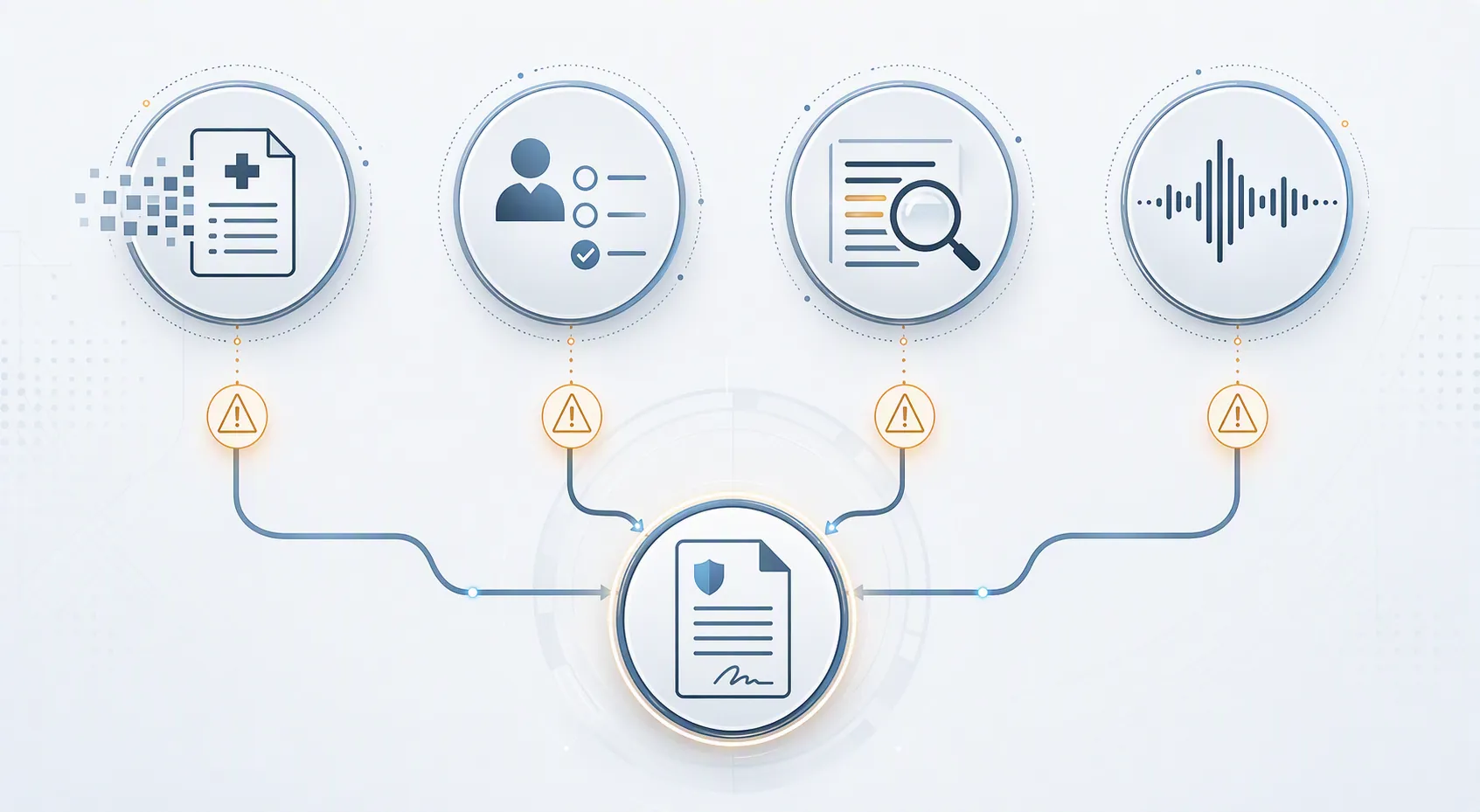
IMAGEN: Extraction Error Is Still Evidence Error
IMAGEN’s risk is not that extraction software exists. Agencies have to process enormous medical files, and a tool that pulls relevant evidence into view can help a human reviewer move faster. The risk is that the extracted version of the file becomes the working file, while the unextracted page, conflicting notation, or context sentence disappears from practical attention.
For retirees and disabled beneficiaries, that can matter even when the dispute is not a new disability award. Medical evidence can affect continuing disability reviews, eligibility history, capacity findings, and related benefit determinations. If a notice or decision appears to ignore a treating record, a medication history, or a functional limitation, counsel should not stop at arguing that the agency weighed the evidence badly. The record should also be checked for whether the evidence was actually captured and presented to the decision-maker.
QDD: Fast Allowances Are Welcome, But Triage Is Not Adjudication
Quick Disability Determinations is the easiest SSA AI use to defend in human terms. If a predictive system helps identify clearly allowable disability claims and moves them faster, the benefit to a claimant can be immediate: less waiting, less arrears pressure, fewer months without income. That is not a trivial gain.
The legal concern is narrower. QDD selection should not be treated as proof that non-selected claims are weaker, less urgent, or less deserving of careful development. Triage tools can misfire on complex or non-prototypical cases, and a 2025 NASI Task Force summary warned that AI tools at SSA carried documented risks in that direction while meaningful human-review safeguards remained unevenly implemented.[4] That supports a modest conclusion: QDD may be humane when it accelerates obvious allowances, but it should not become an invisible benchmark against which harder claims are informally discounted.
Insight Software: Quality Control Can Create Its Own Record Problem
Insight Software scans draft decisions for roughly 30 error types before issuance.[3] That sounds like a quality-control layer, and in many files it may be exactly that. A draft decision with inconsistent dates, missing findings, or formulaic defects should be caught before a claimant receives it.
The review problem is whether the software’s intervention is visible. If the tool flags an issue and the human decision-maker changes the draft, the final notice may look cleaner. But if the final record does not show what the tool flagged, what was accepted, what was rejected, and who made the final call, later review becomes needlessly foggy. A claimant cannot challenge a quality-control process that is treated as both influential and nonexistent.
HeaRT: The Transcript Is Where Review Either Lives or Dies
HeaRT deserves more attention than the average agency technology upgrade because hearing transcripts are not office housekeeping. They are the record that Appeals Council reviewers, federal judges, and litigators use to test whether the decision is supported by substantial evidence.
SSA announced that HeaRT, its Hearing Recording and Transcription system, replaced hearing-recording hardware in every hearing office by March 17, 2025. The agency said the system processes about 500,000 hearings annually and produces about $5 million in annual savings.[5] Those are operational facts, not accuracy findings. SSA has not published independent accuracy benchmarks comparing HeaRT transcripts against court-reporting standards.
That absence does not prove that a particular transcript is wrong. It means the burden shifts back to file work. If a claimant says the vocational expert gave different testimony than the transcript reflects, or if counsel remembers an ALJ question that is missing from the written record, the transcript has to be checked against the audio, hearing notes, exhibits, and any contemporaneous objection. Waiting until federal court to discover a transcript problem is a bad position; by then, the court may be looking at a certified administrative record that appears complete on its face.
The due-process issue is simple enough to state without turning it into a technology debate: a claimant must have notice and a meaningful chance to respond to the evidence used against them. If the transcript misstates testimony, drops qualifiers, confuses speakers, or omits exchanges that bear on credibility, residual functional capacity, onset, earnings, or overpayment fault, the claimant’s chance to respond has already been narrowed.
Backlog Numbers Matter, But They Do Not Answer Legality
SSA is under real administrative pressure. In June 2026, the agency reported that its initial disability claims backlog fell by 30%, from about 1.3 million to 853,000; that online transactions in FY 2026 year-to-date reached 385 million, a 37% increase over 2024; that field office wait times fell by 30%; and that better controls saved $16 billion.[6] Anyone writing about SSA systems should acknowledge the scale problem those numbers reflect.
But those figures do not disaggregate how much of the improvement came from AI, staffing changes, process redesign, online adoption, fraud controls, or other management choices. They also do not show whether an individual claimant received a legally adequate notice or whether a particular record supports a particular payment action. Throughput is not substantial evidence. Savings are not notice. A shorter line at the field office does not cure a missing explanation in an overpayment notice.
Overpayment Withholding Is the Payment-Timing Risk Retirees Feel First
For retirees searching the 2026 Social Security payment schedule, the most immediate legal risk is often not a denied claim. It is an overpayment notice followed by withholding. SSA says that if an overpayment is not resolved within 30 days of notice, it automatically withholds 50% of a monthly Social Security benefit, or 10% of SSI.[7] SSA also describes recovery tools that can include federal tax-refund interception, wage garnishment, and estate recovery.[7]
That is where timing becomes law. A retiree may still be trying to learn why SSA thinks an overpayment exists while the 30-day period is running. If the underlying trigger came from a data match, fraud-control flag, earnings issue, record extraction, or other automated workflow, the notice may not explain enough for the person to test the premise quickly. The rent problem arrives before the administrative-law problem has been decoded.
Counsel should separate three questions immediately: whether the alleged overpayment is correct, whether recovery should be waived, and whether collection should stop while the challenge is pending. Those are not the same argument. A claimant can dispute the existence or amount of the overpayment, request waiver where the standards are met, and ask SSA to suspend collection while the issue is reviewed.
Fraud Controls and Scams Now Share the Same Digital Surface
The agency’s digital-first direction also changes the fraud-risk environment. SSA’s AI inventory includes fraud-related use cases, including enhanced fraud-detection interactive voice response deployed in March 2026.[3] Separately, SSA warns the public that scammers use AI as an additional tactic in government imposter schemes.[8] Those are different problems, but retirees experience them through the same practical channel: a phone call, account lock, redirected payment, identity question, or urgent demand for action.
A fraud-control hold may be lawful and necessary. A scammer may be trying to exploit exactly the fear that benefits will stop. The protective response is boring but important: do not use phone numbers or links from an unsolicited contact; check the official SSA account or field office channel; preserve screenshots, call logs, notices, and bank records; and do not assume that a payment interruption is resolved just because someone on the phone says so.
What to Do Before the Deadline Runs
The first response to an unexpected reduction, missing payment, overpayment notice, or adverse decision should be administrative preservation. The point is not to prove an AI defect on day one. The point is to keep the case alive long enough to find out what happened.
- Save the notice, envelope, online-message screenshot, bank record, and any call notes showing when the claimant first learned of the action.
- Calendar the appeal or response deadline from the notice date and from the actual receipt date; preserve both if timeliness later becomes disputed.
- Request reconsideration, hearing review, Appeals Council review, or federal-court review as appropriate in the SSA sequence.
- For overpayments, separately request waiver when applicable and ask SSA to stop or suspend collection while the dispute is pending.
- If a hearing occurred, request the transcript and audio, then compare the transcript against the issues that actually mattered in the decision.
The appeal path remains the old one: reconsideration, ALJ hearing, Appeals Council, then federal district court. AI does not create a special side door. It creates additional facts to investigate within the existing path.
FOIA Requests Should Be Specific Enough to Be Useful
A Freedom of Information Act request aimed at “all AI records” is likely to become slow, overbroad, or easy to narrow against the requester. A better request ties the tool to the claimant’s file, the relevant office, the date range, and the decision point. The request should ask for documents, not conclusions.
- System documentation for the specific SSA AI tool that may have touched the file, including user guides, operating procedures, and human-review instructions.
- Version, deployment, and change-management records for the relevant period.
- Accuracy, validation, audit, and exception reports, including any office-level quality checks if they exist.
- Policies explaining when staff may rely on, override, correct, or ignore the AI output.
- Records showing whether the claimant’s file was processed, flagged, transcribed, extracted, or quality-scanned by the tool.
A FOIA request is not a substitute for an appeal. It may not return records before the benefits deadline. It is still valuable because it builds the transparency record for later administrative objections, class-wide investigation, or APA litigation.
Transcript Objections Should Be Made While the Record Can Still Be Fixed
With HeaRT, the practical move is to identify transcript problems before they harden into the certified administrative record. Counsel should compare the transcript to the audio where the dispute depends on testimony: vocational-expert job numbers, hypothetical limitations, onset testimony, statements about work activity, waiver fault, or an ALJ’s explanation of missing evidence.
The objection should identify the page, speaker, disputed wording, proposed correction, and why the difference matters. A vague complaint that AI transcripts are unreliable will not help much. A targeted objection that the transcript attributes the vocational expert’s answer to the claimant, or omits a limitation included in the ALJ’s hypothetical, gives the reviewer something to rule on.
APA Arguments Need a Record, Not Just Suspicion
No federal court has yet supplied a settled rule for when an SSA AI-influenced determination satisfies the APA’s substantial-evidence standard. That uncertainty should be preserved carefully, not exaggerated. The strongest argument is usually not that AI touched the file, therefore the decision is unlawful. It is that the agency relied on a process or output that is not disclosed well enough for meaningful review, or that the resulting record does not contain substantial evidence for the finding made.
In federal court, discovery or record-completion requests should be tied to the defect: the missing extraction trail, the unexplained fraud flag, the transcript discrepancy, the quality-control change, or the triage treatment of a claim. Courts are more likely to understand a concrete record problem than a generalized objection to automation.
Class and Pattern Claims Are Possible, But the Individual Clock Still Runs
SSA benefit litigation has a history of systemic challenges and settlements, including overpayment and class-type vehicles such as Martinez v. Astrue and Campos. Those examples matter because AI-related errors may also emerge as patterns: a category of beneficiaries repeatedly flagged, a transcript issue across hearing offices, or an extraction problem affecting a recurring medical-record format.
That possibility does not protect the retiree who has a withholding notice in hand. Individual preservation comes first. Pattern evidence can be built later through FOIA, shared records, expert review, and litigation coordination. A missed appeal deadline is harder to repair than an incomplete theory.
Lawyers Have Their Own AI Risk in SSA Cases
Agency AI is not the only source of legal risk. In Mavy v. Commissioner of Social Security Administration, a Social Security disability appeal brief containing AI-generated hallucinated citations led to Rule 11 proceedings, pro hac vice revocation, and a judicial opinion cataloging fabricated citations.[9] Later reporting and analysis noted an important procedural wrinkle: the Rule 11 finding was vacated, while the pro hac vice revocation was upheld under a careless-administration-of-justice standard.[10]
Mavy is not a merits ruling on SSA’s own AI systems. It is a warning about litigation hygiene. A lawyer challenging opaque agency technology loses credibility quickly if the brief contains fabricated authority. Every citation, quotation, administrative-record reference, and medical-record pin cite needs human verification before filing.
The Working Rule for 2026
For ordinary retirement planning, use the 2026 Social Security payment schedule and confirm the expected deposit date. For a missing, reduced, redirected, or withheld payment, move immediately from calendar thinking to record thinking. Identify the notice, preserve the deadline, request the file, compare the transcript where hearing testimony matters, and ask whether IMAGEN, QDD, Insight Software, HeaRT, or a fraud-control workflow touched the decision.
SSA’s AI systems are already embedded in benefits administration, while independent accuracy benchmarks, public transparency responses, and substantial-evidence doctrine remain unsettled. That is enough to justify early investigation. It is not enough to skip the ordinary administrative steps. The remedy path still runs through notices, appeals, waiver requests, FOIA, record objections, and, when the record supports it, APA review.
References
- Social Security Payment Schedule for 2026, Kiplinger, link
- Social Security Payment Dates 2026, J.P. Morgan Chase, link
- Artificial Intelligence at SSA, Social Security Administration, link
- NASI Task Force Issues Report on AI at SSA, Empire Justice Center, April 17, 2025, link
- Social Security Announces Nationwide Rollout of Hearing Recording and Transcription System, Social Security Administration, March 13, 2025, link
- Social Security Reduces Disability Claims Backlog, Improves Customer Service, and Saves Billions, Social Security Administration, June 29, 2026, link
- Resolve Overpayments, Social Security Administration, link
- Protect Yourself from Social Security Scams, Social Security Administration, link
- Mavy v. Commissioner of Social Security Administration, Legal AI Governance Tracker, link
- Another Week, Another AI Hallucination Sanction — With a Twist, FKKS Technology Law, link
Operationalizing workflow
No workflow has been explicitly linked to this obligation yet. See Workflows generally.
Illustrative cases
No illustrative case is currently tracked for this obligation. See Risk Digest for documented incidents generally.
← Back to RegulationReport a correction or tip
Spotted an outdated figure, a misstated fact, or a ruling this regulation entry should reflect? Public comments are disabled for this content given the professional cost of a misreported case outcome, penalty amount, or rule text — use the structured correction channel instead.
Report a correction or tip for this record →