
State Voting Laws, Not the SAVE Act, Define 2026 Election Risk
- Authority
- U.S. State Legislatures (14 states with DPOC laws)
- Rule type
- statute
- Jurisdiction scope
- US state
- Effective date
- Jul 28, 2026
- Source text
- Read primary rule text ↗
Documentary proof of citizenship or SAVE database verification for voter registration in 14 states
Regulation/Ethics risk note, last verified July 28, 2026, UTC: this article is a compliance and litigation-risk tracker, not legal advice. The federal SAVE Act’s Senate stall matters, but it is not the first operational question for the 2026 midterms. The first question is which state rule changes now affect a registration form, a database check, a provisional-ballot decision, a voter-list maintenance process, or a state-only versus federal-only ballot split.
For the legal question behind the federal SAVE Act’s Senate stall, the practical answer starts below the federal level. A Center for American Progress tracker identifies 14 states with SAVE Act-like state measures: seven documentary-proof-of-citizenship states, five SAVE-database verification states, and two hybrid states. That tally is useful as an index, but individual enforcement calls should be checked against state election-office guidance, enacted statutory text, and live court dockets before being treated as settled law.[1]
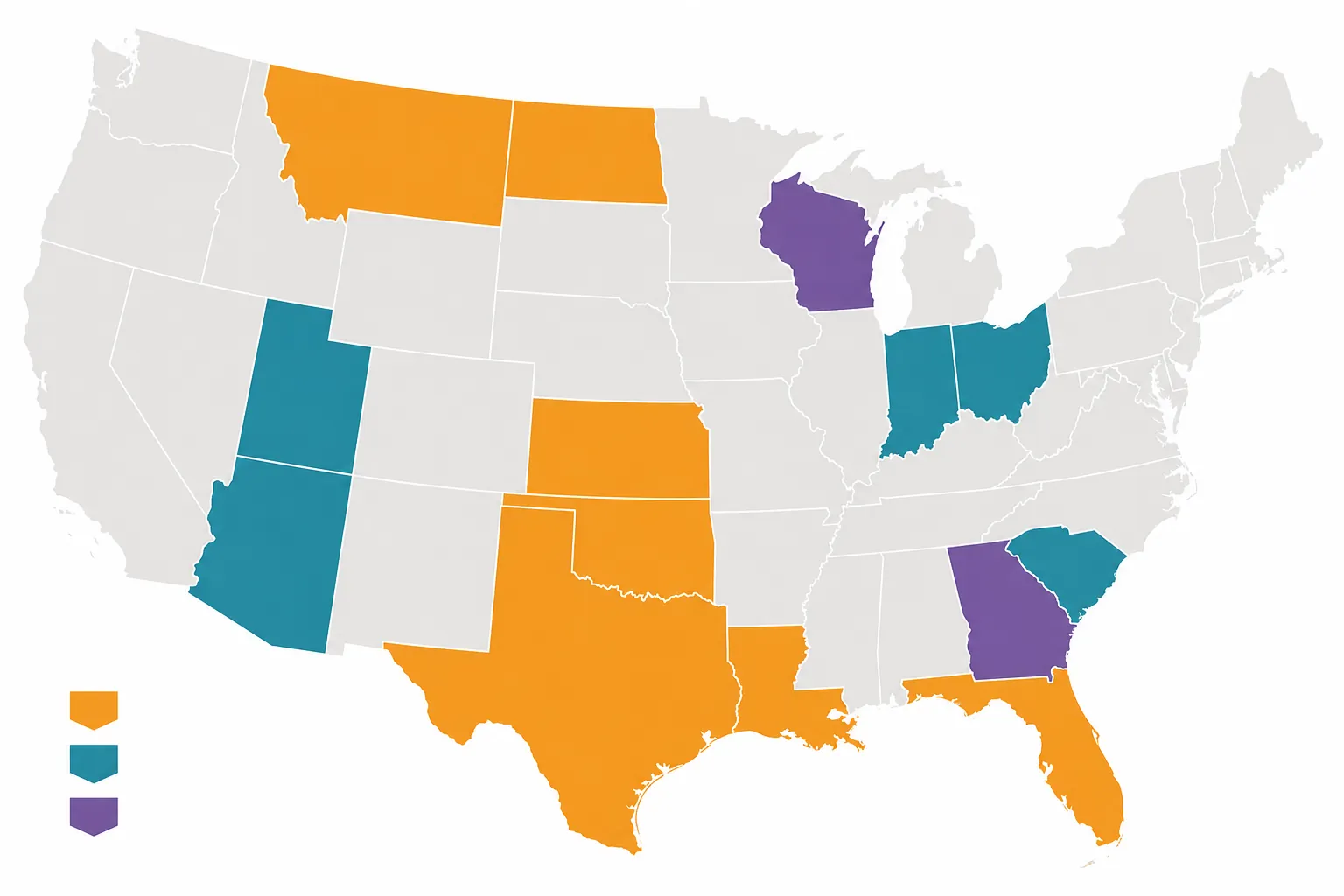
| Functional bucket | Jurisdictions identified in cited sources | What changes operationally | Midterm risk posture as of July 28, 2026 |
|---|---|---|---|
| Documentary proof of citizenship for new registrants | Arizona, Kansas, New Hampshire, Wyoming, Ohio, South Dakota, Utah | A voter may need to produce citizenship documentation before being treated as fully eligible for state and local elections. In NVRA-covered states, the federal-form problem may require separate federal-only and state/local eligibility treatment. | Highest immediate processing risk. New Hampshire, Wyoming, Ohio, South Dakota, and Utah are the five first-time DPOC enforcement states for 2026, so county practice, form design, cure notices, and provisional-ballot instructions need close review.[1] |
| SAVE-database citizenship verification | Texas, Missouri, Louisiana are specifically identified in the cited sources; two additional CAP-tracked verification jurisdictions require primary-source confirmation before reliance | Election officials route voter records or registrant information through a citizenship-status check rather than relying only on documents presented by the voter. | Highest false-positive and list-maintenance risk. Texas and Missouri examples show that a database flag is not the same thing as proof of ineligibility.[1] |
| Hybrid approaches | Two CAP-tracked hybrid states; the cited sources supply the count but not primary-source state names | A jurisdiction combines documentary-proof rules with database-based citizenship review or related voter-list procedures. | Treat as unstable until counsel has reviewed the actual state statute, implementing guidance, and any federal-form or purge litigation. |
The table’s incompleteness is part of the risk. A 14-state advocacy tally can tell a legal team where to start, but it cannot substitute for the boring documents that decide election administration: secretary-of-state memoranda, county registrar instructions, form acceptance rules, database-match standards, cure letters, and court orders. The difference between “copy accepted” and “original required,” or between “Tribal ID treated as sufficient” and “Tribal document routed for further review,” is not a messaging detail. It is where eligible voters can become pending files.
The five first-time DPOC states are the October problem
New Hampshire, Wyoming, Ohio, South Dakota, and Utah deserve more attention than the federal bill because 2026 is the first midterm cycle in which their documentary-proof requirements may have to be administered at scale. A statute can look simple when described as “proof of citizenship required.” It becomes less simple when a registrar has to decide whether a voter’s married name, naturalization record, birth certificate, Tribal document, photocopy, passport, or missing document should lead to full registration, pending status, rejection, cure, or a provisional ballot.
Those distinctions are not technicalities added by lawyers after the fact. They are the system. Registration deadlines arrive before most appellate courts finish clarifying the rules; voters who discover a problem late may not have time to retrieve documents; and county staff may be asked to apply new state instructions while federal-form obligations remain unchanged. In a close local race, the litigation record may be built out of cure logs, rejected applications, provisional-ballot envelopes, and call-center scripts rather than floor statements.
New Hampshire shows why first-cycle enforcement is different from enacted-law tracking. In May 2026, a federal judge struck down the state’s documentary-proof law on First and 14th Amendment grounds after roughly 250 voters were blocked in low-turnout 2025 town elections. The ruling is on appeal, so no midterm plan should assume the New Hampshire rule is permanently gone or safely enforceable.[1]
The roughly 250-voter number matters because it is small enough to inspect and large enough to disprove the idea that documentary-proof laws operate only at the margin. These were not millions of speculative records in a national debate. They were voters stopped in actual town elections, in a low-turnout setting, under a rule that election officials had to administer in real time.
Utah presents a different kind of caution. Cited materials note that Utah’s comprehensive citizenship review found zero instances of noncitizen voting. That does not by itself decide the constitutionality of Utah’s rule, but it should shape how lawyers assess state interests, tailoring, evidentiary burden, and remedial risk if eligible voters are delayed or misclassified.[1]
The federal-form problem turns one registration system into two
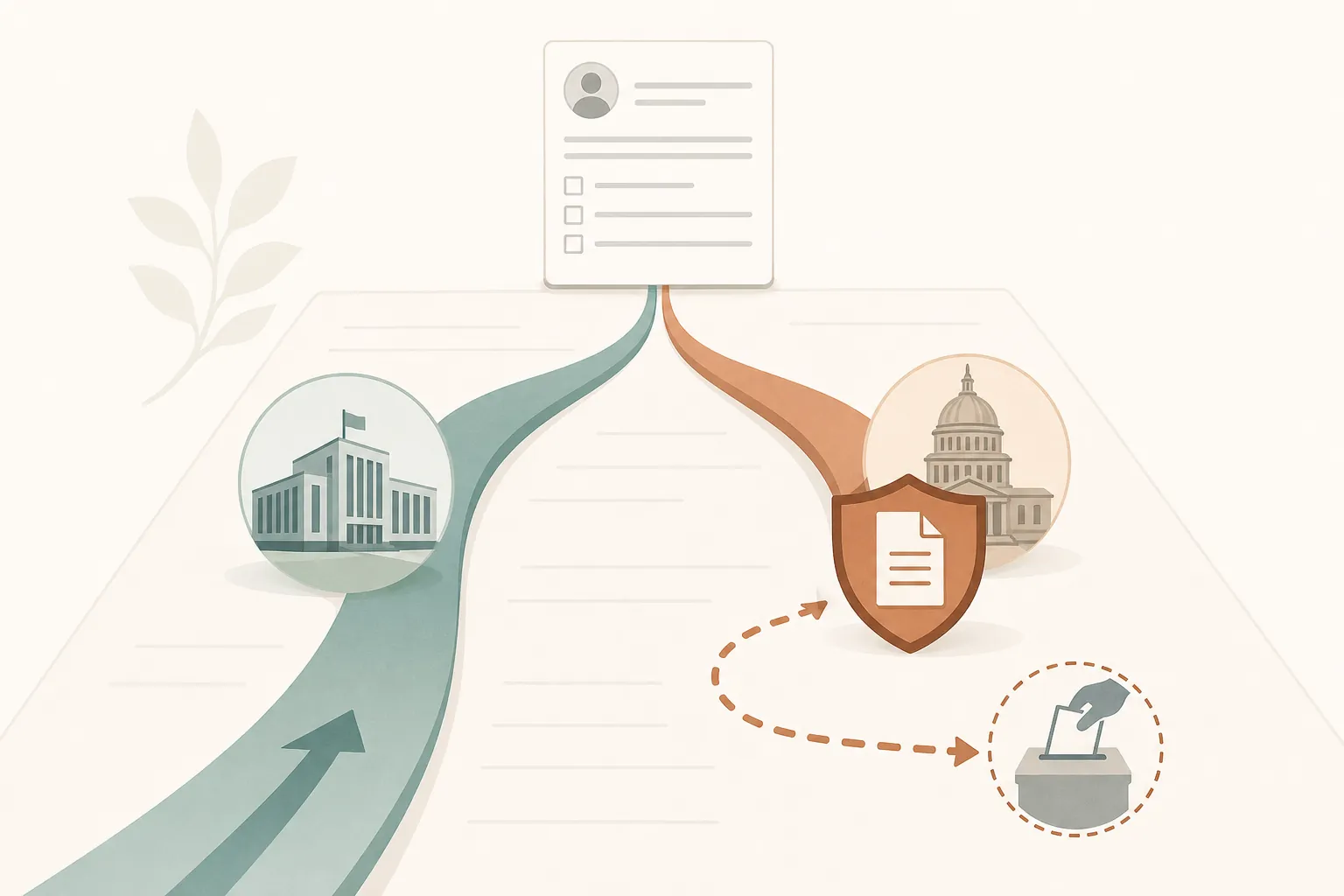
The most important constraint on state documentary-proof rules is not rhetorical; it is architectural. Under Arizona v. Inter Tribal Council of Arizona, states covered by the National Voter Registration Act cannot simply add documentary-proof requirements to the federal voter-registration form for federal elections. The result, in the 44 NVRA-covered states, is a bifurcation problem: a voter may be registered for federal contests while remaining ineligible, pending, or separately classified for state and local contests if the state demands additional proof for those races.[1]
That split creates several practical failure points. A registration database has to carry the correct eligibility code. Poll books must display that code in a way a poll worker can apply under pressure. Ballot-style programming must keep a federal-only voter from receiving state contests without incorrectly denying the federal ballot. Provisional-ballot review teams then need a rule for what happens when the missing proof arrives after Election Day, or when the record shows a mismatch that was not the voter’s fault.
This is where litigation over proof-of-citizenship rules often becomes less abstract than the national debate suggests. A plaintiff does not need to prove that every voter is burdened in the same way. A record of eligible voters moved into pending status, misclassified between federal-only and full-ballot eligibility, or forced into remedial steps after ordinary name changes can be enough to change the posture of a case. For defense counsel, the same details decide whether the state can show workable administration and adequate notice.
Database verification is not a shortcut around proof problems
The SAVE database bucket presents a different hazard. It may sound cleaner than asking voters for paper documents, but a database flag is not a citizenship adjudication. It is an administrative signal that has to be interpreted, matched to the correct person, checked against updated records, and cured before it becomes a basis for denial, removal, or referral.
Texas is the clearest warning in the current cited record. Texas flagged 2,724 voters through citizenship checks, and at least 5% were later confirmed to be citizens. In Missouri’s Boone County, more than half of the voters flagged were citizens.[2][3]
Those figures should change how lawyers describe the risk. They do not prove that every SAVE-based program is unlawful, and they do not measure the full error rate of every state process. They do show that a flag-to-action pipeline can capture eligible citizens unless the state builds in notice, cure, secondary review, and careful matching rules before taking adverse action.
The June 22, 2026 ruling in League of Women Voters v. DHS adds another layer. The federal district court in D.C. blocked a SAVE database overhaul, reinforcing that the database itself is now part of the litigation terrain, not a neutral background utility that states can invoke without process questions.[4]
For election offices, the exposure is not limited to an incorrect removal. It includes voters wrongly placed into challenge status, delayed applications that miss a statutory deadline, public lists that imply ineligibility before verification is complete, and inconsistent county treatment of the same type of flag. For campaigns and litigators, the evidence will sit in batch files, query criteria, match logs, letters mailed, calls returned, and the number of voters restored only after intervention.
Kansas remains the scale test
Kansas is still the example to keep on the desk when a documentary-proof rule is described as facially modest. Its 2011-era DPOC law blocked roughly 32,000 eligible voters from registering and produced no measurable impact on noncitizen voting, according to the Brennan Center’s account of the litigation history.[5]
Kansas matters less as a one-size-fits-all prediction than as a deployment lesson. The burden did not appear only at the moment a voter lacked a document. It appeared in suspended applications, administrative follow-up, incomplete cures, and the separation between what state law demanded and what federal registration law permitted. That is the pattern to watch in the five first-time DPOC states in 2026.
The Brennan Center has also estimated that 21.3 million Americans lack ready access to proof of citizenship. That figure is a modeled estimate, not a count of voters who will be blocked in 2026. Its value is narrower but still important: it identifies the population likely to bear the remedial work when a state moves from attestation to documentary proof.[5]
Louisiana and the federal form fight
Louisiana belongs on the active-monitoring list because its attorney general has sued the Election Assistance Commission over the federal voter-registration form. That posture places the state not only in the citizenship-verification category but also in the federal-form conflict that has repeatedly shaped proof-of-citizenship litigation.[1]
For compliance planning, the key question is not whether Louisiana’s position is framed as election integrity or federal overreach. The question is whether a registrant using the federal form receives the same ballot status as a registrant using a state form, what notice is given if the state treats the application as incomplete, and whether federal contests remain available while state contests are disputed.
The federal SAVE Act is live, but not currently decisive
The federal bill should not be ignored. The SAVE Act passed the House twice, and in June 2026 the Senate rejected a DHS amendment push 48-50, with Senators Lisa Murkowski, Mitch McConnell, Susan Collins, and Thom Tillis crossing party lines.[6]
The revival paths remain narrow but real. House Republicans attached SAVE Act language to the National Defense Authorization Act, which passed the House 216-212 on July 22, 2026; reconciliation remains uncertain after a parliamentarian ruling against SAVE provisions; and standalone consideration is constrained by Senate leadership signals and the limited September legislative window before the midterm campaign break.[6][7]
That federal uncertainty may matter for preemption, future form design, and national litigation strategy. It does not tell a registrar in New Hampshire, a county lawyer in Texas, or a campaign counsel in Utah what to do with a voter record today. Until Congress changes the governing federal rule, the immediate compliance surface is the state patchwork.
Midterm risk posture by workstream
| Workstream | Where the risk is highest | What to monitor before November 2026 |
|---|---|---|
| Registration intake | New Hampshire, Wyoming, Ohio, South Dakota, Utah; any DPOC state using new or revised forms | Accepted documents, copy/original rules, name-change handling, Tribal-document treatment, cure deadlines, and whether federal-form applicants are coded separately. |
| Federal-only versus full-ballot eligibility | All NVRA-covered DPOC states | Database fields, poll-book coding, ballot-style logic, provisional-ballot instructions, and notices explaining why a voter is eligible for one set of contests but not another. |
| SAVE database verification | Texas, Missouri, Louisiana, and the remaining CAP-tracked verification states once confirmed against primary sources | Match criteria, batch-query procedures, secondary review, citizen-confirmation rates, adverse-action timing, and restoration procedures. |
| List maintenance and purges | Any state moving from database flag to cancellation, challenge, or referral | Notice language, response windows, documentation demanded from the voter, public disclosure practices, and audit logs showing how flags were resolved. |
| Emergency litigation | New Hampshire appeal posture; Louisiana federal-form litigation; jurisdictions with late guidance or uneven county implementation | Temporary restraining-order risk, preliminary-injunction records, administrative declarations, voter affidavits, and county-level variance. |
The states requiring immediate monitoring are the first-time DPOC enforcement states and the jurisdictions using SAVE checks in ways that can affect registration status or list maintenance. The legally unstable rules are those already struck down, appealed, or tied to federal-form disputes. The false-positive exposure is concentrated in database-verification systems where a flag can move faster than a voter’s opportunity to correct it.
This tracker should be treated as updateable. The defensible mid-2026 judgment is not that the federal SAVE Act is dead, or that every state proof-of-citizenship law will fail. It is that present compliance planning should start with the state rules now touching registration files, ballot eligibility, purge procedures, and cure obligations. Those claims depend on primary-source verification as court rulings, secretary-of-state guidance, and county implementation practices change.
References
- The SAVE Act May Be Stalled in Congress, but State Versions Are Being Advanced All Across the Country, Center for American Progress.
- Texas’ Effort to Check Voters’ Citizenship Status Is Creating Mistakes and Confusion, The Texas Tribune, February 13, 2026.
- Watch Out for False Voter Fraud Claims Fueled by SAVE Program, Brennan Center for Justice.
- League of Women Voters v. DHS, Fair Elections Center.
- The SAVE Act and the Election Power Grab, Brennan Center for Justice.
- WATCH: Padilla Leads Charge to Successfully Block Another SAVE America Act Push, Senator Alex Padilla.
- House Passes SAVE America Act Anti-Voting Measures in Budget Reconciliation, Stock Trading Bills, Democracy Docket.
Operationalizing workflow
No workflow has been explicitly linked to this obligation yet. See Workflows generally.
Illustrative cases
No illustrative case is currently tracked for this obligation. See Risk Digest for documented incidents generally.
← Back to RegulationReport a correction or tip
Spotted an outdated figure, a misstated fact, or a ruling this regulation entry should reflect? Public comments are disabled for this content given the professional cost of a misreported case outcome, penalty amount, or rule text — use the structured correction channel instead.
Report a correction or tip for this record →