
How a Steer Tire Blowout in Arizona Uncovers CDL Violations
- Authority
- FMCSA
- Rule type
- regulation
- Jurisdiction scope
- US federal
- Source text
- Read primary rule text ↗
Vehicle tires must meet 49 CFR 393.75; driver must have valid CDL and medical certificate; carrier must have operating authority and insurance.
A steer tire lets go on an Arizona highway. The driver gets the truck to the shoulder or does not. AZDPS arrives, traffic control begins, and the first visible issue is rubber: tread gone, sidewall damaged, front axle disabled. For a carrier, that may sound like a maintenance event. In a post-crash file, it is more often the first door.
The legal significance of an Arizona tire-blowout crash involving CDL violations is not limited to whether the tire was defective before it failed. Once a commercial vehicle enforcement inspection starts, the officer is not confined to admiring the casing on the pavement. The inspection can move from tire condition to driver qualification, medical certification, registration, carrier identifiers, operating authority, insurance filings, and out-of-service consequences. That is where trucking regulation turns a roadside mechanical failure into a compliance record.
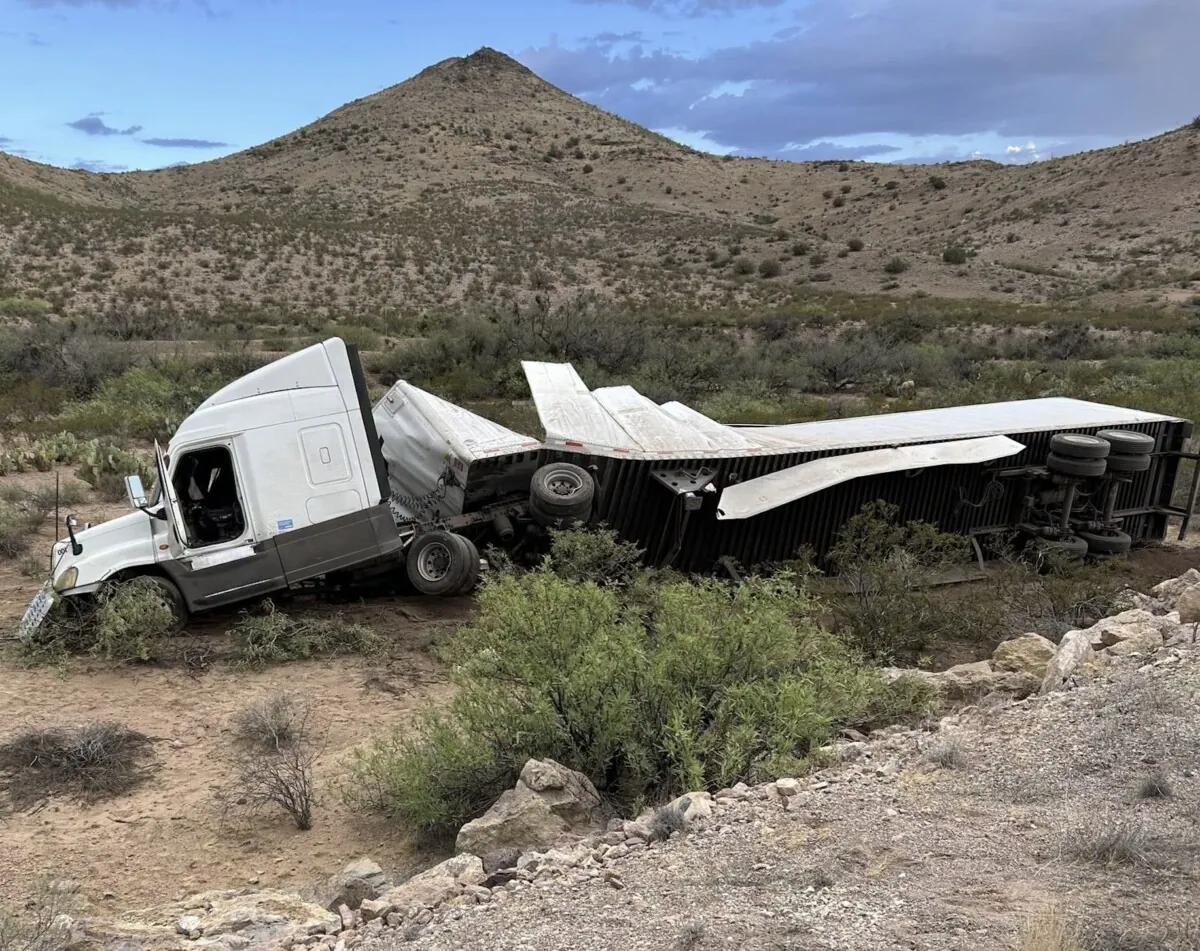
One recent Arizona example illustrates the pattern, with an important sourcing limitation. CDLLife reported that a July 25, 2026 crash on US-70 in Graham County, Arizona, began with a steer-tire blowout and that AZDPS Highway Patrol later reported no CDL, no medical certificate, no registration, and no operating authority for the commercial vehicle involved. The public account available for this article is CDLLife’s secondary reporting of AZDPS Facebook posts; no primary AZDPS incident report, inspection packet, citation file, or court record was independently retrieved. The Graham crash is therefore useful as an illustrative pattern, not as a final adjudication of fault or a substitute for the underlying enforcement file.[1]
This article is a Regulation & Ethics analysis current to Q3 2026. It is not legal advice, not an accident-reconstruction opinion, and not a survey of every Arizona tort issue that could follow a tire-related crash. The narrower question is what a post-crash commercial vehicle inspection is permitted to uncover, and how the resulting paperwork can become regulatory, insurance, and civil-liability ammunition.
The tire is the trigger, not the whole file
Federal tire rules give the officer a concrete starting point. Under 49 CFR 393.75, a vehicle may not be operated on a tire with body ply or belt material exposed through the tread or sidewall, a tire with tread or sidewall separation, a tire that is flat or has an audible leak, or a tire with a cut exposing ply or belt material. The same rule sets a minimum tread depth of 4/32 inch for tires on a front wheel and 2/32 inch for other tires, measured in a major tread groove.[2]
The steer-axle minimum matters because the failed tire is not just another tire on the unit. A steer-tire failure affects the driver’s ability to keep the vehicle in its lane, and the front-wheel tread rule is stricter than the rule for other positions. The officer looking at the blown tire may not be able to determine from roadside debris alone whether the tire was below 4/32 inch before the failure, whether it struck road debris, whether it had an internal defect, or whether it had been run underinflated. But the rule gives the inspection a defined legal vocabulary: exposed ply, separation, cuts reaching cord, inflation failure, and tread depth.
That vocabulary is important because post-crash files do not usually preserve uncertainty in a neutral way. They preserve observations. If the inspection report records a tire-condition violation, the carrier later has to address that entry as a documented regulatory fact, even if the carrier’s accident reconstruction expert eventually argues that the blowout was caused by debris or sudden road hazard rather than poor maintenance.
How the inspection expands from rubber to credentials
The practical cascade starts with 49 CFR Part 396, not with a negligence complaint. Part 396 governs inspection, repair, and maintenance obligations for commercial motor vehicles. It includes the driver vehicle inspection report framework, the driver’s duty to be satisfied that the vehicle is in safe operating condition before driving, periodic inspection requirements, and the authority to place a vehicle out of service when violations are found.[3]
Part 396.9 is the key inspection hinge. When a specially trained officer or authorized employee performs a roadside inspection and records violations, the motor carrier receives an inspection report. If the vehicle is declared out of service, the carrier may not operate it until the out-of-service defects are corrected. The carrier must also certify that violations listed on the report have been corrected and return the completed report as required by the rule.[3]
That is why “single-vehicle mechanical failure” is an incomplete description in a commercial case. A crash gives enforcement a reason to inspect the equipment. The inspection report then creates a formal place to record not only the condition of the vehicle but also the driver and carrier information needed to decide whether the vehicle should have been operating at all.
In practical enforcement terms, the difference between a Level 1 and Level 2 inspection matters because the deeper the inspection, the more complete the paper trail. A Level 1 inspection is the broader driver-and-vehicle examination; a Level 2 inspection is more limited but still reaches driver credentials and vehicle items that can be checked without the same full under-vehicle component. No rule makes every steer-tire blowout an automatic Level 1 inspection. Officer discretion, scene safety, available personnel, crash severity, traffic conditions, towing needs, and evidence preservation all affect the scope. The risk pattern is still clear: the tire opens the inspection, and the inspection can reach the credential stack.
| Roadside event or observation | Likely inspection question | Why it matters later |
|---|---|---|
| Steer tire failed | Did the tire violate 49 CFR 393.75 before or at the time of operation? | Creates a vehicle-maintenance issue and may support an out-of-service notation if a violation is recorded.[2][3] |
| Commercial driver identified | Does the driver hold the required CDL class and endorsements and required medical qualification? | Moves the file from mechanical condition to driver qualification and possible CDL consequences. |
| Vehicle and carrier identified | Is the unit registered, and does the carrier have operating authority? | Turns a roadside crash into a carrier-compliance inquiry. |
| Authority or insurance gap appears | Was the carrier legally authorized and financially responsible for the operation? | Creates regulatory exposure and gives civil litigants a direct route into dispatch, hiring, and compliance practices. |
The table is not a guaranteed sequence for every Arizona blowout. It is the sequence safety officers and lawyers should expect to test after a serious commercial-vehicle tire event. If the inspection stayed narrow, that limitation matters. If it expanded, the resulting report may become the most important document in the early case file.
Graham County shows the pattern, with the caveat kept visible
The Graham County report is useful because it has the precise shape that post-crash compliance files often take. The public story begins with a dramatic roadside event: a steer-tire blowout on US-70 on July 25, 2026. It does not end there. CDLLife’s account, relying on AZDPS Highway Patrol social posts, says the post-crash inspection revealed no CDL, no medical certificate, no registration, and no operating authority, and that the driver received numerous citations with the vehicle placed out of service.[1]
Those reported facts should not be inflated. A social-media-derived account is not the same as the officer’s inspection notes, a certified motor vehicle record, a court docket, or an insurer’s coverage position. It does not tell us the tire’s maintenance history, who owned the tractor, who dispatched the load, whether any broker or shipper had relevant knowledge, or whether a later tribunal sustained every citation. But it does show why the phrase “blowout crash” can understate the legal event.
If the reported missing items are accurate, the tire failure was only the first violation visible from the shoulder. The larger exposure came from the inspection’s movement into driver qualification and carrier authority. That movement is exactly what a carrier should expect a plaintiff’s lawyer, regulator, safety director, or insurer to reconstruct after the tow truck leaves.
No CDL is not a clerical problem after a crash
A missing CDL changes the posture of the file immediately. In Arizona, operating a commercial motor vehicle without obtaining a commercial driver license is classified as a “serious traffic violation” under A.R.S. § 28-3312(J)(8). The same statute provides a 60-day CDL disqualification for a second serious traffic violation within three years and a 120-day disqualification for a third or subsequent serious traffic violation within three years.[4]
That does not mean every single no-CDL finding automatically produces the same disqualification outcome. The statute’s disqualification periods depend on the driver’s violation history and the timing of prior violations. The better reading for post-crash purposes is narrower and more useful: once “no CDL” is documented, the matter is no longer only about whether the tire was properly maintained. It is also about whether the driver was legally qualified to operate the commercial vehicle at all.
For a motor carrier, that distinction matters because a CDL defect can be pleaded or investigated as more than driver error. It invites questions about hiring, onboarding, qualification-file review, dispatch controls, and whether anyone checked the license class before the load moved. If the driver did not hold the required commercial license, the carrier may face direct-negligence theories that do not depend solely on proving exactly why the tire failed.
The medical certificate sits in the same credential stack
The reported missing medical certificate in the Graham incident belongs in the same stack of evidence. It is not a tire fact. It is a driver-qualification fact. After a crash, that difference is exactly why it matters. A tire violation may support a maintenance theory; a medical-certification violation supports a broader argument that the carrier permitted a driver to operate without satisfying the required qualification process.
There is a fairness boundary here. A missing medical certificate does not prove that a medical condition caused the crash. It does not prove fatigue, impairment, or incapacity. What it can prove, if confirmed in the official record, is that the driver’s qualification paperwork was deficient at the time enforcement reviewed it. That is enough to change the discovery plan.
Registration, operating authority, and financial responsibility widen the defendant map
No registration and no operating authority are not the same violation as a bad tire, but they often surface through the same roadside inspection. In the Graham account, those defects appeared only after AZDPS responded to the blowout crash and reviewed the vehicle and carrier status.[1] That is the cascade in its cleanest form: a tire failure generates enforcement contact; enforcement contact generates a credential and authority check; the authority check generates a carrier-compliance problem.
Operating authority matters because it connects the vehicle on the shoulder to the legal right to perform the transportation. Once the record says no operating authority, the next questions are predictable: Who arranged the movement? Who owned or leased the equipment? Was the carrier for-hire? Was a USDOT or MC number displayed or omitted? Did anyone verify authority before dispatch? Did the load move through a broker or other intermediary that relied on carrier records?
Financial responsibility is the next layer. Under 49 CFR Part 387, for-hire motor carriers transporting non-hazardous property in interstate or foreign commerce must maintain minimum financial responsibility of $750,000.[5] A no-authority finding should not be casually described as automatic proof that no insurance exists, because coverage depends on policy language, filings, parties, and facts not visible from a social post. The safer and more accurate point is that missing authority destroys the comfortable assumption that the required federal financial-responsibility structure is in place and matched to the operation.
That distinction matters in litigation. A plaintiff’s lawyer will not stop at the tire tread if the inspection suggests the carrier may have been operating without authority. The document requests will move to insurance filings, MCS-90 endorsements where applicable, lease agreements, dispatch records, carrier setup packets, broker-vetting materials, driver qualification files, maintenance records, and communications showing who knew the truck was on the road. A defense lawyer will want the same materials early, not after a complaint frames the carrier as an outlaw operation.
Out-of-service paperwork is evidence with deadlines
An out-of-service order is not just an officer’s opinion that the truck should not continue. Under Part 396.9, once a vehicle is declared out of service, it may not be operated until required repairs are made. The carrier must correct violations listed on the inspection report and certify completion in the manner the regulation requires.[3]
After a tire blowout, that paperwork can do several things at once. It can identify the vehicle defect that stopped the unit. It can list driver violations discovered during the same inspection. It can identify the carrier responsible for correction. It can set a timeline for when the carrier learned of the violations. And it can create a record against which later statements are measured.
That last point is where carriers often lose credibility. If the inspection report says no CDL, no medical certificate, no registration, and no authority, later calling the matter “paperwork” may be technically tempting and strategically disastrous. Some paperwork is the legal permission to operate. Some paperwork is the proof that the driver was qualified. Some paperwork is the financial-responsibility structure required before the trip began.
Civil liability does not have to wait for a perfect tire reconstruction
A tire expert may still matter. The carrier may argue that the tire failed because of road debris, a sudden puncture, a manufacturing issue, improper mounting by a third party, or damage that could not reasonably have been detected before the trip. Those arguments are not erased simply because the crash triggered an inspection. A blowout is not automatically a moral indictment of the carrier.
But once credential and authority violations are documented, the civil case no longer depends entirely on tire causation. A plaintiff can investigate negligence theories tied to the driver’s legal qualification, the carrier’s dispatch decision, maintenance-system controls, inspection practices, authority status, and financial-responsibility compliance. The tire may explain why DPS arrived. The inspection record may explain why the carrier’s broader safety system is now in dispute.
The strongest version of the liability argument is usually not “the tire blew, therefore the carrier is liable.” It is more specific: the carrier put or allowed a commercial vehicle on the road with a steer tire that enforcement could cite, driven by a person whose credentials enforcement could not verify, under a carrier status enforcement could not confirm. If the official file supports those premises, the plaintiff has a much easier path into direct negligence discovery.
The defense response should be equally specific. Was the cited tire the failed tire or another tire on the unit? Was tread depth measurable after the failure? Did the driver hold any license, and was the issue class, endorsement, suspension, expiration, or absence of a CDL altogether? Was the medical certificate missing from the driver’s possession, expired in the qualification file, or not issued? Was operating authority truly absent, inactive, revoked, or simply not matched in the roadside system? The inspection report starts the inquiry; it should not be allowed to flatten every distinction.
CSA and carrier reputation consequences are secondary, but not small
The roadside report also has consequences outside the lawsuit. Tire and maintenance violations can affect how regulators and counterparties view the carrier’s maintenance controls. Driver-qualification violations can raise a different set of concerns. Authority and financial-responsibility problems are worse because they suggest the operation itself may not have been legally structured.
For a safety officer, the internal question after a blowout should not be limited to whether the tire vendor will warranty the casing. The file has to be reconstructed in layers: pre-trip inspection, maintenance history, annual inspection status, driver license and medical status, registration, operating authority, insurance filings, dispatch records, and the carrier’s response to the out-of-service report. If the company cannot assemble those documents quickly, that delay becomes its own signal to regulators, insurers, and opposing counsel.
There is a temptation to support this point with broad violation statistics. The research materials included a reported figure of 68,136 tire-tread-depth violations in 2021, attributed by a plaintiff-law-firm page to FMCSA inspection data. Because the underlying FMCSA data release was not independently retrieved for this article, that number should not carry any argument here. The Graham pattern and the operative regulations are enough.
What the official record can prove, and what it cannot
The inspection record can prove that an officer observed and documented specified violations at a particular time. It can show that a vehicle was placed out of service. It can show what the driver produced or failed to produce at roadside. It can show the carrier identifier used for the inspection. It can create correction obligations under Part 396.9.[3]
It cannot, by itself, answer every causation question. A post-failure tire observation may not establish the tire’s pre-failure condition. A missing document at roadside may require follow-up to determine whether the document existed elsewhere. A reported lack of authority may need to be checked against federal records, company structure, lease arrangements, and the nature of the transportation. A citation is not the same as a judgment.
In Arizona, a steer-tire blowout is best understood as a regulatory trigger event. It may begin as maintenance failure, road hazard, or unresolved tire causation. Once DPS documents the vehicle, driver, and carrier record, the legal exposure can extend well beyond rubber, tread depth, and the moment the driver lost control.
References
- Steer tire blowout crash in Arizona reveals no CDL, medical certificate, registration, or operating authority, CDLLife, 2026.
- 49 CFR § 393.75 - Tires, Electronic Code of Federal Regulations.
- 49 CFR Part 396 - Inspection, Repair, and Maintenance, Electronic Code of Federal Regulations.
- A.R.S. § 28-3312, Arizona Legislature.
- 49 CFR Part 387 - Minimum Levels of Financial Responsibility for Motor Carriers, Electronic Code of Federal Regulations.
Operationalizing workflow
No workflow has been explicitly linked to this obligation yet. See Workflows generally.
Illustrative cases
No illustrative case is currently tracked for this obligation. See Risk Digest for documented incidents generally.
← Back to RegulationReport a correction or tip
Spotted an outdated figure, a misstated fact, or a ruling this regulation entry should reflect? Public comments are disabled for this content given the professional cost of a misreported case outcome, penalty amount, or rule text — use the structured correction channel instead.
Report a correction or tip for this record →