
The Legal Safe Harbor Behind the Steven Bartlett Misinformation Controversy
- Authority
- Advertising Standards Authority (ASA)
- Rule type
- regulation
- Jurisdiction scope
- UK
- Source text
- Read primary rule text ↗
The awkward legal fact in the Steven Bartlett misinformation controversy is that the same health claim can move from regulated to barely reachable depending on where it is placed. Put it in a paid Facebook ad and the Advertising Standards Authority can ask whether the audience was misled. Put it in a YouTube version of a podcast and Ofcom or platform duties may at least enter the conversation. Put it in the audio-only editorial feed of a podcast interview and the clean regulatory answer becomes much thinner.
The BBC investigation that triggered the current legal question reviewed 15 episodes of Diary of a CEO and said it identified an average of 14 harmful health claims per episode, including claims about diet, cancer, vaccination, and PCOS, in episodes reviewed across April to November 2024.[1] Flight Studio’s response was that the BBC had reviewed less than 4% of episodes and had mischaracterized the program, while also relying on freedom of expression arguments.[2] Both points matter, but they do different work. The BBC’s finding shows scale and risk; Flight Studio’s objection weakens any attempt to generalize across the whole archive. Neither decides whether a regulator has jurisdiction.
The legal analysis therefore starts with the routing problem. Audio-only podcast editorial content is outside Ofcom’s ordinary broadcast-licensing framework, outside the ASA’s editorial remit, and not directly turned into creator liability by the Online Safety Act 2023’s platform-focused structure. The strongest formal rulings in the public record are advertising rulings, not rulings on editorial podcast speech.
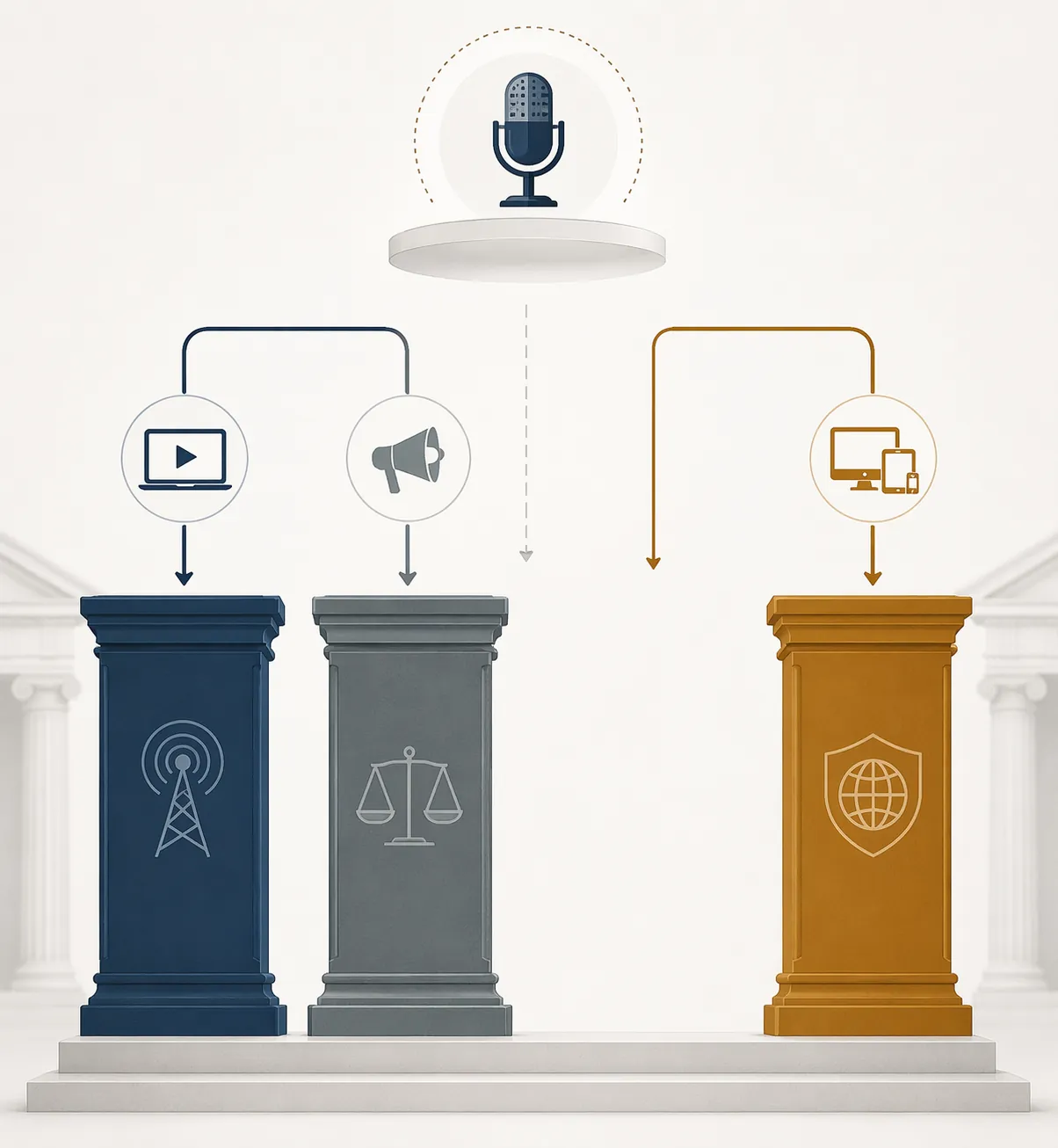
One controversy, three regulatory routes
Mills & Reeve’s published legal analysis of the Bartlett controversy is useful because it does not begin with the conclusion that “Ofcom should step in.” It asks the prior question: which version of the product would Ofcom be looking at? The firm concluded that Ofcom intervention was doubtful, particularly given Article 10 freedom of expression rights, and distinguished the YouTube video versions from audio-first distribution through services such as Apple and Spotify.[3]
The Online Safety Act 2023 adds another layer, but not the one many complainants assume. Its central architecture is aimed at regulated services, especially user-to-user and search services, rather than at making a podcast host directly answerable for every lawful but contested editorial statement made in an interview.[4]
| Route | What the regulator can see | Practical result |
|---|---|---|
| Audio-only editorial podcast feed | Not a licensed broadcast service; not paid advertising; not itself a user-to-user platform duty | Lowest formal regulatory risk for health misinformation in the current UK framework.[3][4] |
| YouTube or other platform-hosted video version | A platform-hosted version may bring Ofcom or Online Safety Act questions into view, depending on service categorization and enforcement posture | Not an automatic breach route. Mills & Reeve considered intervention doubtful, with Article 10 operating as a real constraint.[3][4] |
| Paid ads, host-read promotions, paid social placements | ASA can assess advertising identifiability, misleadingness, and omitted material information under the CAP Code | Highest demonstrated risk, because actual adverse rulings exist against commercial material connected to Bartlett.[5][6][7] |
The BBC finding is evidence of risk, not an adjudication
The BBC’s “14 harmful claims per episode” figure is the factual trigger for the legal analysis, not a binding finding that any particular statement was unlawful. It was an investigative conclusion drawn from 15 reviewed episodes, not a court judgment, ASA adjudication, Ofcom sanction, or professional disciplinary ruling.[1]
Flight Studio’s sample-size objection is also narrower than it may first appear. If the issue is whether Diary of a CEO as a whole is fairly described as a misinformation-heavy product, then reviewing less than 4% of episodes is a serious point.[2] If the issue is whether an audio-only podcast episode containing a harmful medical claim falls inside Ofcom’s Broadcasting Code or the ASA’s editorial remit, the percentage of the back catalog reviewed does not move the jurisdictional line.
That distinction is where many controversy pieces become legally unhelpful. A claim can be medically alarming and still sit outside the regulator the complainant wants to invoke. Conversely, a much narrower commercial statement can be actionable because it is advertising.
Advertising is where the record becomes concrete
The ASA rulings are the hardest legal material in the Bartlett record because they are actual decisions, with rule references, against specific ads. In August 2024, the ASA upheld complaints against Zoe Ltd and Huel Ltd over Facebook ads featuring Bartlett. The issue was not that Bartlett had appeared in a wellness conversation. It was that the ads used testimonial-style presentation while failing to disclose specific financial interests: an equity investment in Zoe and a directorship at Huel.[5][6]
The rulings applied CAP Code rules 3.1 and 3.3, which concern misleading advertising and the omission of material information. The legally important point is that a generic advertising signal is not necessarily enough where the audience also needs to know the nature of the endorser’s commercial connection. The missing information was not simply “this is an ad.” It was “this person has a specific financial relationship with the company whose product is being praised.”[5][6]
That is a very different problem from an interviewee making a contested health claim in an editorial segment. Once the content is an ad, the ASA can ask whether the average consumer was likely to be misled, whether material information was omitted, and whether the commercial nature of the communication was clear. Once the content is editorial podcast speech, the ASA’s remit largely falls away.
The earlier Huel podcast ad ruling points in the same direction. In August 2022, a Huel ad on Bartlett’s own podcast was banned after concerns that it was not clearly separated from editorial content.[7] That earlier decision matters because it shows that podcast format does not immunize advertising. The ASA can reach a paid message inside a podcast when the message is not properly identifiable as advertising.
For production lawyers, this is the most actionable part of the file. If a host reads sponsor copy, gives testimonial-style praise, posts paid social clips, or appears in brand advertising, the compliance questions are conventional and immediate: disclosure, substantiation, identifiability, omitted commercial relationships, and the line between endorsement and editorial presentation. The podcast wrapper does not change that.
Ofcom is not a universal health-claims regulator
The Ofcom question is where the format asymmetry becomes most visible. Audio-only podcasts are not licensed broadcast services. Treating a podcast as “broadcasting” because it is popular, professionally produced, or culturally influential skips the jurisdictional step that a lawyer cannot skip.
The YouTube version is different, but not simple. Mills & Reeve identified YouTube-distributed video versions as the place where Ofcom’s rules might be considered, while still concluding that intervention would be doubtful. The reason is not only technical categorization. Any official response to controversial health discussion also has to be balanced against Article 10 ECHR rights, and the legal threshold for sanctioning speech is not met merely because a regulator, journalist, or expert body dislikes the claim.[3]
This matters for complaints strategy. A complaint framed as “Ofcom should punish the podcast” needs to identify whether the complained-of item was an audio feed, a video-on-demand upload, a platform clip, or a paid placement. Without that step, the complaint may be morally forceful but jurisdictionally defective.
The Online Safety Act mostly regulates the road, not the driver
The Online Safety Act 2023 is often invoked as if it were a general solution to harmful online speech. It is not. Its duties are imposed on regulated services, not directly on every creator whose content is distributed online. A podcast producer uploading its own program is not the same legal problem as a platform hosting third-party user content at scale.[4]
That distinction is especially important after the move away from the old video-sharing platform regime into the Online Safety Act enforcement environment. For a platform such as YouTube, the regulatory analysis now has to account for service categorization and the timing of OSA obligations. For an audio-first podcast distributed through podcast apps, the analysis is materially weaker. The Act may shape platform systems, terms, complaints processes, and illegal-content handling, but it does not convert lawful editorial health misinformation into a direct creator offense merely because the content is available online.[4]
The removal of the adult “legal but harmful” model from the final Act reinforces the point. If the claim is not illegal content, and if the target is the host rather than the platform service, the OSA is a poor fit for the kind of sanction many critics appear to want.[4]
What remains actionable
As of Q3 2026, there is no public litigation against Bartlett or Flight Studio arising from the BBC’s misinformation investigation. That absence should not be inflated into legal clearance. It simply means the existing record is regulatory and analytical rather than judicial.
The live risk for a producer, advertiser, or complainant sits in the parts of the distribution chain that a regulator can actually reach:
- Paid ads using the host’s endorsement, image, or testimonial-style language, especially where financial interests are not specifically disclosed.
- Host-read or embedded podcast ads that are not clearly separated from editorial content.
- Platform-hosted video versions or clips, where Ofcom or OSA analysis may begin with the platform and service category rather than with the audio podcast feed.
- Contractual, brand-safety, and platform-policy consequences, which may be commercially serious even when they are not statutory sanctions.
The weak point remains the audio-first editorial interview. If a guest makes a contested health claim in that setting, the current UK framework offers no obvious equivalent to the ASA route for paid advertising or the clearer Ofcom route for licensed broadcasting. A producer may still decide to fact-check, edit, contextualize, or decline to publish. Those are editorial and commercial decisions before they are regulatory commands.
The safe harbor is structural
The legal safe harbor behind the Steven Bartlett controversy is not an express statutory exemption saying that podcasts may carry health misinformation. It is the combined result of separate regimes drawing their boundaries around different objects: broadcast services, advertising, and online platforms.
That is why the format matters so much. A paid Facebook ad featuring a health endorsement can be pulled into ASA analysis. A YouTube upload may raise platform and Ofcom questions, though not necessarily produce intervention. An audio-only editorial podcast interview sits in the least reachable position. For UK-based podcast health misinformation, the current legal risk is highest around paid advertising and platform-hosted video, and lowest around audio-first editorial speech. The gap is legally significant precisely because it is not the result of anyone deliberately creating a podcast exception.
References
- Steven Bartlett sharing harmful health misinformation on Diary of CEO podcast — BBC News, December 2024.
- Bartlett hits back over BBC disinformation claims — BusinessCloud, December 2024.
- A legal view on the airing of controversial health claims on Steven Bartlett's Diary of a CEO podcast — Mills & Reeve, January 2025.
- Online Safety Act 2023 — legislation.gov.uk, 2023.
- ZOE Ltd G24-1241850 — Advertising Standards Authority, August 2024.
- Huel Ltd G24-1237493 — Advertising Standards Authority, August 2024.
- Steven Bartlett nutrition adverts banned for being misleading — BBC News, August 2022.
Operationalizing workflow
No workflow has been explicitly linked to this obligation yet. See Workflows generally.
Illustrative cases
No illustrative case is currently tracked for this obligation. See Risk Digest for documented incidents generally.
← Back to RegulationReport a correction or tip
Spotted an outdated figure, a misstated fact, or a ruling this regulation entry should reflect? Public comments are disabled for this content given the professional cost of a misreported case outcome, penalty amount, or rule text — use the structured correction channel instead.
Report a correction or tip for this record →