
Student loan default legal consequences in 2025–2026
- Authority
- U.S. Department of Education
- Rule type
- regulation
- Jurisdiction scope
- US federal
- Source text
- Read primary rule text ↗
Extra-judicial collection of defaulted federal student loans via wage garnishment, tax refund offset, and benefit offset without court order; currently paused.
Last verified: July 25, 2026. This reference addresses federal student loan default consequences in 2025–2026, not private student-loan collection and not individualized legal advice. Its central distinction is procedural: several federal collection powers exist without a prior court judgment, but as of Q3 2026 some involuntary collection activity is under an active Education Department policy pause rather than repealed or permanently disabled.
The pause matters because it is administrative, not architectural. The Education Department announced on January 16, 2026 that it would delay involuntary collections, with no defined end date in the materials reviewed here; NPR had reported shortly before that wage garnishment was set to resume for the week of January 7, 2026.[1][2] A lawyer advising from this record should therefore separate three questions that are too often collapsed: whether the power exists, whether the government is currently using it, and what notice or contest rights attach before money moves.
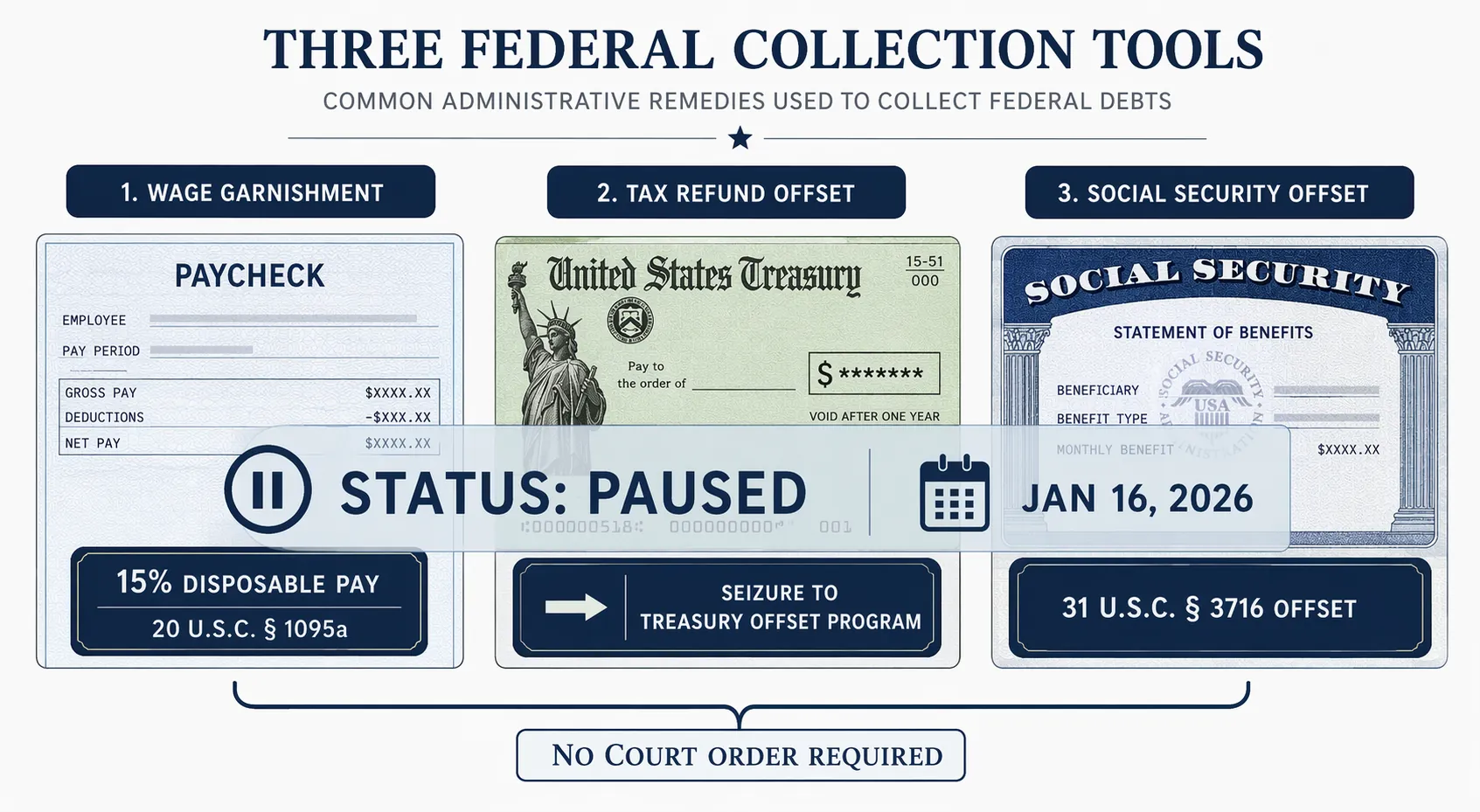
Operational Status Of Federal Default Consequences
For Direct and FFEL loans, default generally occurs after 270 days of nonpayment.[3] That threshold is the trigger condition for the legal machinery below; it is not, by itself, proof that every listed consequence is active against a particular borrower on the day an attorney reviews the file.
| Mechanism | Authority or source in reviewed materials | Q3 2026 operational status | Practical effect |
|---|---|---|---|
| Administrative wage garnishment | 20 U.S.C. § 1095a; Education Department collection materials | Legally available; involuntary collections paused by January 16, 2026 Education Department action, uncertain duration[1] | Up to 15% of disposable pay may be withheld without a court order, subject to a protected floor tied to 30 times the federal minimum wage. |
| Treasury Offset Program tax refund seizure | Treasury Offset Program; federal student-loan collection practice | Legally available; treated as within the involuntary-collections pause as of Q3 2026 unless current agency status says otherwise[1] | Federal tax refunds, including refunds attributable to refundable credits, may be intercepted for defaulted federal student debt.[4][5] |
| Social Security benefit offset | 31 U.S.C. § 3716 | Legally available; current policy pause noted in reviewed materials, uncertain duration | Covered federal benefits may be offset subject to statutory and regulatory limits; the issue is especially sensitive for older and disabled borrowers. |
| Acceleration | Higher Education Act collection framework and loan terms | Available after default | The full unpaid balance may become immediately due, changing the matter from missed installments to collection of the entire debt. |
| Collection costs and fees | Education Department regulations and collection practice | Available after default; application depends on collection path and timing | Collection costs may be assessed, with reviewed materials identifying fees up to 16% of principal and accrued interest upon default.[6] |
| Credit reporting | Federal loan servicing and reporting practice | Active consequence, file-specific | Default may appear as adverse credit information, which can matter beyond lending, including in some employment and clearance contexts. |
| Federal lawsuit | Federal debt collection authority; NCLC Student Loan Borrower Assistance | Possible but rare for federal student loans | The government can sue, but the extra-judicial tools often reduce the need for litigation.[3] |
| No statute of limitations | 1991 repeal of former six-year limit | Active legal feature | The government is not barred by an ordinary limitations period from collecting federal student loans.[7][3] |
| Professional-license suspension | State law | State-dependent and in flux | Some state regimes have tied default to licensing consequences, but variation and repeal trends make this a jurisdiction-specific research item.[3] |
| Security-clearance relevance | SEAD 4 financial-considerations framework | Conditional, not automatic | Default and related credit information may be relevant to adjudication, but it is not a guaranteed clearance denial. |
| Bankruptcy discharge litigation | Bankruptcy Code undue-hardship process; DOJ U.S. Trustee guidance | Available only through bankruptcy process | Defaulted student-loan debt is not automatically discharged, but adversary-process outcomes may be affected by current federal guidance.[8] |
The table’s most important word is not “paused.” It is “legally available.” A temporary operational pause changes immediate collection risk; it does not erase the underlying authority, eliminate arrears, or make prior notices irrelevant. The practical mistake is to advise as if the federal government needs to file a collection suit before touching wages, refunds, or covered federal payments. For federal student loans, that is often the wrong starting assumption.
Why Wage Garnishment Is The Pressure Point
Administrative wage garnishment is the cleanest example of the federal student-loan difference. Under 20 U.S.C. § 1095a, the government may garnish a defaulted borrower’s disposable pay without first obtaining a court order. The reviewed materials identify the ordinary cap as 15% of disposable pay, with a floor protecting an amount equal to 30 times the federal minimum wage.[2]
That structure matters to counsel because the employer becomes part of the collection channel. The borrower is not waiting for a complaint and summons in the way a defendant in an ordinary consumer-debt lawsuit might be. The procedural battleground shifts to agency notice, hearing rights, hardship arguments, rehabilitation status, and whether the collection contractor or servicer is applying the rules accurately.
The January 2026 sequence is therefore not a footnote. NPR reported in December 2025 that borrowers in default would soon face wage garnishment, with resumption expected for the week of January 7, 2026.[2] The Education Department then announced on January 16, 2026 that it was delaying involuntary collections.[1] As of Q3 2026, the record supplied here does not provide a defined end date for that delay.
A competent file note in mid-2026 should therefore avoid both extremes. “Wage garnishment is currently paused under Education Department policy” is too narrow if it omits the statutory authority that can be reactivated. “Wage garnishment will happen” is too broad if it ignores the current pause. The legally useful formulation is conditional: the authority exists, the ordinary cap and floor are identifiable, and current operational use must be verified close to the date of advice.
Tax Refund Offsets Do Not Look Like Collection Until The Refund Vanishes
Tax refund seizure through the Treasury Offset Program is less visible than wage garnishment because it does not arrive as a biweekly deduction. The borrower files a return, expects a refund, and the refund is intercepted against the defaulted federal debt. Reviewed consumer-law sources describe the offset as capable of taking the full federal refund, including amounts attributable to the Earned Income Tax Credit and Child Tax Credit.[4][5]
That is a severe collection tool because refund money often functions as a household’s annual liquidity event. It may be rent stabilization, car repair money, child-care catch-up money, or simply the first moment in the year when the family has a cushion. The legal point is not softened by that reality: the offset is an administrative collection mechanism, not a judgment-execution step after a lawsuit.
CNBC reported on January 14, 2026 that defaulted borrowers risked 2026 tax refunds.[5] Two days later, the Education Department announced the delay of involuntary collections.[1] For Q3 2026 advice, the same verification discipline applies: confirm whether the borrower’s debt has been certified for offset, whether the current pause covers the contemplated offset activity, whether any notice has issued, and whether an injured-spouse or other tax-specific issue is present.
Social Security Offset Is Legally Available, But Status-Sensitive
Social Security benefit offset sits under the federal administrative offset authority in 31 U.S.C. § 3716. The consequence is often described too quickly, either as if benefits are categorically untouchable or as if every recipient in default will immediately lose benefits. Neither formulation is careful enough for 2026.
The reviewed materials identify a current policy pause for Social Security offset, while also identifying the legal authority and conditions under § 3716. That makes the consequence real but status-sensitive. An attorney should verify the current Education Department and Treasury position, the type of benefit, applicable offset limits, notice history, and whether any separate hardship or compromise route is being pursued.
This is also where the “no court order” feature carries a human cost. A benefit offset does not require a creditor to persuade a judge before money is withheld. For an older borrower or a disabled borrower, the administrative character of the process can be the difference between a theoretical debt consequence and a grocery-budget emergency.
Acceleration, Fees, And The Missing Limitations Period
Default changes the size and posture of the claim. Acceleration allows the full balance to be treated as due, rather than only the missed installments. Collection costs can then deepen the hole. The reviewed Education Department materials identify collection fees up to 16% of principal and accrued interest upon default.[6]
The absence of a statute of limitations is the companion feature. The former six-year limit was repealed in 1991, and consumer-law sources continue to treat federal student-loan collection as not subject to an ordinary limitations bar.[7][3] That does not mean every collection act is lawful regardless of notice, identity, balance calculation, bankruptcy status, or discharge history. It means the usual consumer-debt question — “is this too old to sue or collect?” — does not do the same work here.
Fees also deserve more scrutiny than they usually receive. The CFPB has alleged collection misconduct where fee incentives affected borrower outcomes, including an action involving Performant Recovery in which the Bureau alleged delays in rehabilitation processing that triggered 16% collection fees.[9] That kind of enforcement record does not prove a fee error in any specific file, but it is a reason to inspect timing, communications, rehabilitation records, and fee assessment history instead of accepting the payoff number as self-executing.
The Default Population Is Large, But The Estimate Needs Its Caveat
The scale of default risk explains why these tools have become a live legal-reference problem rather than a niche collection issue. Protect Borrowers described a 2025 default crisis and reported a “borrower defaulted every nine seconds” framing, estimating 3.6 million new defaults by extrapolating from Education Department portfolio data and treating borrowers newly 270 or more days delinquent as defaulted.[10]
That attribution matters. The underlying Education Department portfolio data is the official data source; the “one every nine seconds” expression is an advocacy organization’s analysis and presentation of that data. It is useful shorthand for pressure on the system, not a substitute for checking a client’s actual loan type, delinquency age, servicer record, and default status. For broader crisis-context mapping, see the internal analysis Federal Enforcement Arsenal in the 2026 Student Loan Default Crisis.
Adjacent Consequences: Real, But More Conditional
Not every consequence of default has the same legal character as wage garnishment or Treasury offset. Some are downstream effects of credit reporting, state law, employment screening, or separate litigation choices. They belong in the file analysis, but they should not be described as automatic federal collection tools.
- Professional licenses: state law controls, variation is substantial, and NCLC materials identify a trend toward repeal. Treat this as a jurisdiction-specific research assignment, not a uniform federal consequence.[3]
- Security clearances: default can create credit-reporting and financial-responsibility facts relevant under SEAD 4, but the consequence is adjudicative and fact-specific, not a guaranteed denial.
- Federal lawsuits: suits to collect federal student loans are possible but rare; the availability of administrative collection tools is one reason the government need not rely on ordinary litigation in many cases.[3]
- Bankruptcy: student loans generally require a bankruptcy process and undue-hardship analysis rather than disappearing through default or age alone; DOJ U.S. Trustee guidance is relevant to how federal positions may be evaluated in bankruptcy proceedings.[8]
The CFPB’s Navient action belongs in this conditional category as well. The Bureau announced a $120 million resolution and a ban involving allegations that Navient steered borrowers into costly forbearance.[11] That enforcement history is not a default consequence in the narrow sense. It is evidence that servicing choices before and around default can create institutional exposure, especially where borrowers were moved away from cheaper or more sustainable options.
Repayment Reform Is Context, Not The Collection Rule
The One Big Beautiful Bill Act, enacted July 4, 2025, changed the repayment landscape by eliminating SAVE, replacing income-driven repayment options with the Repayment Assistance Plan, and extending maximum repayment terms to 30 years for new borrowers according to TICAS analysis.[12] Those changes affect counseling strategy and may affect how borrowers avoid or exit delinquency, but they do not rewrite the collection powers that attach after federal default.
That boundary is worth maintaining. A repayment-plan explainer answers how a borrower may prevent default or reenter manageable repayment. A default-consequences reference answers what the government can do once the loan is already in default. For repayment-program context, see SAVE plan exit: Legal options borrowers need to know; for litigation deadlines and enforcement disputes, see Student loan default cliff: Litigation and enforcement risks.
What Counsel Should Verify Before Relying On A Status Label
A status label is only useful if it is tied to a date, a mechanism, and an authority. “Collections paused” is not a complete answer unless it identifies which collection channel is paused, by whom, since when, and whether the pause applies to the borrower’s loan type and procedural posture.
- Confirm the loan category: Direct, FFEL, Perkins, commercially held FFEL, private student loan, or consolidated debt.
- Confirm default status: delinquency age, default date, rehabilitation history, consolidation history, and whether the 270-day threshold is actually met.
- Match the mechanism to the authority: 20 U.S.C. § 1095a for administrative wage garnishment, Treasury Offset Program for tax refunds, 31 U.S.C. § 3716 for federal administrative offset.
- Check current operational status close to the advice date: the January 16, 2026 pause has no defined end date in the reviewed materials, so stale advice is a real risk.
- Inspect notices and calculations: balance, interest, collection costs, hearing rights, hardship submissions, rehabilitation timing, and any bankruptcy or discharge record.
- Research overlays separately: state professional-license rules, security-clearance facts, tax filing status, injured-spouse issues, and employer compliance obligations.
Federal student loan default consequences in 2025–2026 are best understood as a standing statutory arsenal under a temporary and uncertain operational pause. The safer legal work is not to predict the borrower’s morality or the government’s next announcement. It is to identify the mechanism, cite the authority, verify whether the tool is active or paused on the advice date, and then check the file-specific and jurisdiction-specific facts that decide what can lawfully happen next.
References
- Delays Involuntary Collections, U.S. Department of Education, Jan. 16, 2026
- Student loan borrowers in default will soon risk wage garnishment, NPR, Dec. 23, 2025
- Lawsuits to Collect Federal Student Loans, NCLC / Student Loan Borrower Assistance
- Steps to Protect Your Tax Refund If You're in Default on Federal Student Loans, Nolo
- Defaulted borrowers risk 2026 tax refunds, CNBC, Jan. 14, 2026
- Collection fee capitalization, U.S. Department of Education regulations
- What Is The Student Loan Statute Of Limitations?, Bankrate
- U.S. Trustee Program Student Loan Guidance, DOJ
- CFPB docket, Consumer Financial Protection Bureau
- 2025 Student Loan Default Crisis: State by State, Protect Borrowers
- $120M fine and ban against Navient for steering borrowers into costly forbearance, Protect Borrowers
- How the Reconciliation Law Changes the Federal Student Loan System, TICAS
Operationalizing workflow
No workflow has been explicitly linked to this obligation yet. See Workflows generally.
Illustrative cases
No illustrative case is currently tracked for this obligation. See Risk Digest for documented incidents generally.
← Back to RegulationReport a correction or tip
Spotted an outdated figure, a misstated fact, or a ruling this regulation entry should reflect? Public comments are disabled for this content given the professional cost of a misreported case outcome, penalty amount, or rule text — use the structured correction channel instead.
Report a correction or tip for this record →