
The Legal Dispute Over SUNY's Charter School Approval
- Authority
- New York State Legislature
- Rule type
- statute
- Jurisdiction scope
- US state
- Source text
- Read primary rule text ↗
SUNY may approve charters after Board of Regents objections, subject to statutory process.
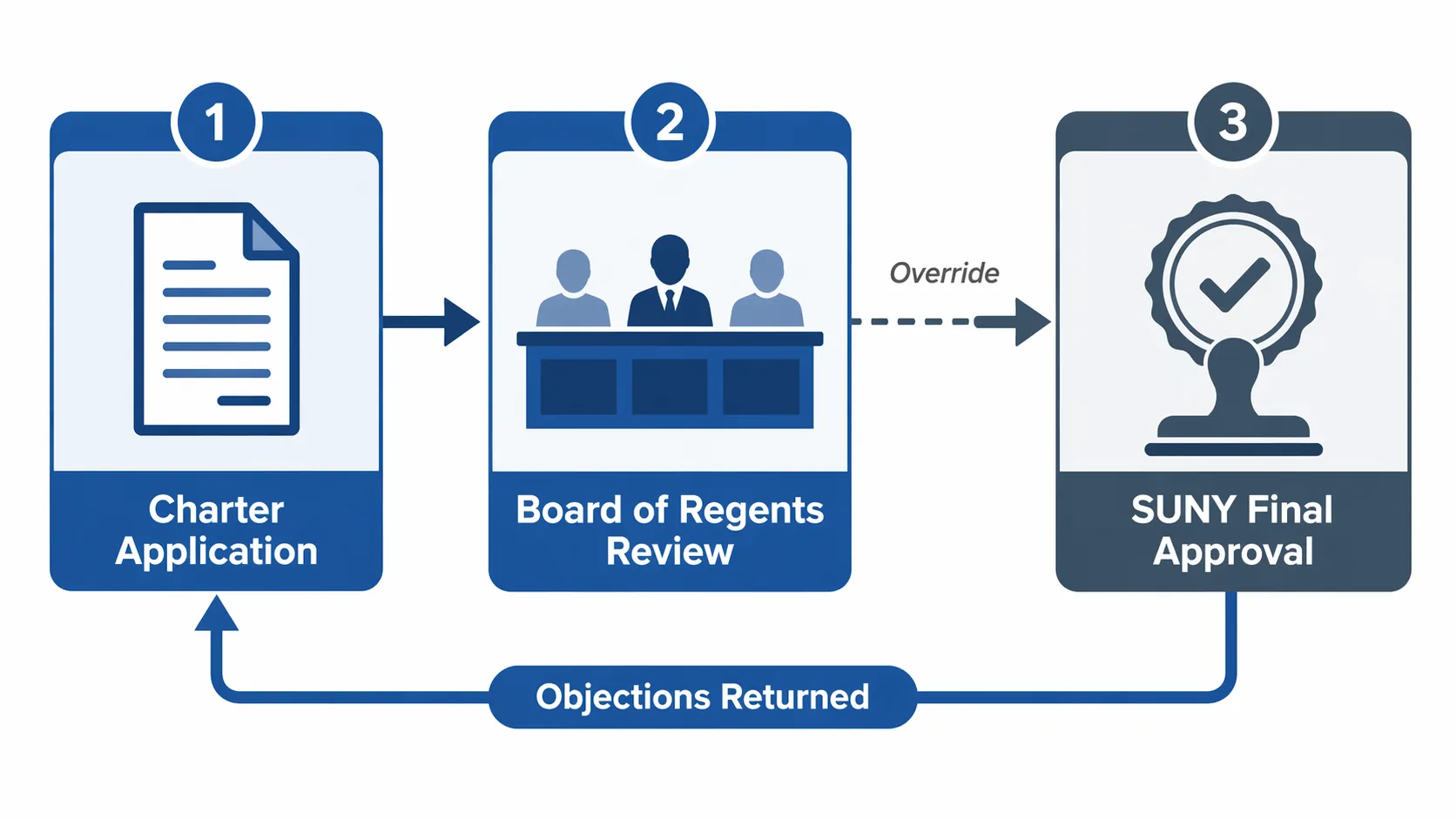
The legal dispute over SUNY’s charter school approval authority starts with an awkward but important distinction: the Board of Regents may object, return, and criticize a SUNY-approved charter action, but New York Education Law § 2852(5-b) gives SUNY a route to final approval after that review process runs its course.[1] That is the baseline legal answer. It is not, however, the whole risk answer, because two pending 2026 lawsuits now ask courts to decide whether SUNY’s override practice has enforceable limits when the Regents object on community-engagement grounds or when a charter transfer allegedly functions as a new-school workaround.[2][3]
The practical problem is not a single disputed approval. New York Focus reported that, since 2017, the Regents rejected 58 SUNY-approved charter actions and SUNY resubmitted at least 51 without modification, an 87.9% override rate by that analysis.[2] The raw dataset behind that count was not independently reviewed here, so the number should be treated as a reported third-party analysis rather than an official adjudicated fact. Even with that caveat, it describes the pattern now driving the litigation risk: a statutory process that formally permits SUNY to proceed, used often enough to look less like an exception than a parallel final-approval track.

The Statutory Hinge: Review Is Not the Same as Veto
Section 2852(5-b) is doing most of the work. Under the statute, when the Board of Regents returns a proposed charter with comments and recommendations, the charter entity may resubmit the proposal. If the charter entity resubmits, the statute gives the charter entity final authority to approve and issue the charter, subject to the statutory process.[1] For SUNY-authorized schools, that means the Regents’ review can be consequential without being dispositive.
That point matters because institutional names can mislead. The Board of Regents sits at the top of New York’s education governance structure in many contexts. But in this particular charter-approval mechanism, the question is not which body sounds more senior. The question is what the charter statute assigns each body to do. On the face of § 2852(5-b), the Regents’ objection is a procedural event; SUNY’s resubmission is the operative act that can move the charter to approval.
The lawsuits do not need to prove that the Regents have a conventional veto to create exposure. They can create risk by persuading a court that SUNY’s final authority is bounded by other statutory requirements, by administrative-law limits on reasoned decision-making, or by the charter cap. That is why a clean “SUNY can approve anyway” answer is too thin for counsel advising a school whose approval history includes a Regents rejection.
The Override Pattern Changes the Risk Profile
A high override rate does not, by itself, prove illegality. A statute can give one body final authority precisely because the Legislature expected disagreement. If SUNY reviews the Regents’ objections, makes its own record, and acts within the statute, repeated overrides may be politically abrasive but legally durable.
But the reported 58-to-51 pattern changes the risk profile in a different way.[2] It gives plaintiffs a narrative about institutional nullification: the Regents object, SUNY returns to the same result, and the statewide reviewing body’s objections allegedly have no practical effect. Courts are not supposed to rewrite statutes because one side thinks an authorized process is overused. Still, administrative-law cases are often fought in the space between formal discretion and meaningful review. If a judge sees the Regents process as treated perfunctorily, the remedy question becomes more serious.
For existing and proposed SUNY-authorized schools, the relevant exposure is therefore narrower than “all SUNY charters are in danger.” The higher-risk category is made up of approvals or transfers that drew Regents objections and then moved forward without material change, especially where the objection concerned a statutory criterion rather than a policy disagreement in disguise.
| Approval posture | Risk consequence |
|---|---|
| SUNY authorization with no reported Regents objection | Lower litigation linkage to the current override theory, though ordinary charter-law risks remain |
| SUNY approval returned by the Regents and resubmitted without modification | Higher risk because plaintiffs can point to the override pattern and argue the review process lacked practical force |
| SUNY approval challenged on community-engagement grounds | Higher case-specific risk if the record contains unresolved objections about statutory engagement obligations |
| SUNY-approved charter transfer alleged to create a new school under another name | Higher risk tied to the charter-cap theory rather than to ordinary approval discretion |
The Albany Case: Community Opposition and the Record SUNY Had to Confront
The first pending case, filed in January 2026 in Albany County Supreme Court, challenges SUNY’s approval of three Long Island charter schools after the Board of Regents unanimously returned the proposals in December 2025. News reports describe the Regents as citing “fatal deficiencies” in community engagement.[2] Because the full complaint was not reviewed here, the point should be stated carefully: plaintiffs allege that SUNY failed to give legally adequate weight to community opposition and defects in the approval record; that allegation has not been established.
That theory is more dangerous to SUNY than a generalized complaint that the Regents were ignored. A court may be reluctant to convert Regents comments into a veto. It may be more willing to examine whether SUNY’s final approval complied with the statute and had a reasoned basis after specific deficiencies were flagged. The difference is procedural but not cosmetic. One argument asks a court to reorder authority between agencies. The other asks whether the agency with final authority lawfully used it.
The schools and families affected by that distinction experience it as uncertainty long before a merits ruling. A charter approval can be formally valid and still become harder to finance, staff, enroll, or disclose around once a petition seeks to invalidate it. The risk is not limited to the final judgment; it includes the months in which boards, lenders, landlords, insurers, and parents must decide how much confidence to place in an approval that is actively being challenged.
The Manhattan Case: A Charter Transfer Becomes a Cap Fight
The second pending case, filed in June 2026 in Manhattan state court by NYSUT and the United Federation of Teachers, is not simply a duplicate objection to SUNY’s willingness to approve charters. It challenges the transfer of a Success Academy charter to an entity associated with Eric Grannis’s Strive Charter School. Plaintiffs allege that the transfer operates as a de facto new school and unlawfully circumvents New York City’s charter cap, reported at roughly 285 schools.[3][4]
The factual posture matters. Chalkbeat reported that Strive planned to open in fall 2026 with grades K-4, a year-round 7 a.m. to 7 p.m. schedule, and about 270 applications received.[3] Those facts do not resolve the cap question. They do explain why plaintiffs frame the transfer as more than a paper reassignment: if the transferred charter produces a school that looks operationally new, the litigation will likely turn on whether the governing statutes treat that transaction as a permissible transfer or as new capacity created without an available slot.
SUNY’s strongest response presumably begins with statutory authorization and its own approval power. The plaintiffs’ strongest framing avoids asking whether SUNY likes the school model and instead asks whether SUNY may use transfer authority to accomplish what the cap would otherwise block. That is a different kind of limit from Regents review. It is not about who gets the last word after objections. It is about whether the thing being approved is legally the same charter or a new school for cap purposes.
The Prior SUNY-Regents Case Is a Warning, Not a Shortcut
The earlier Board of Regents v. SUNY teacher-certification litigation is useful for one limited reason: it shows that courts have been willing to constrain SUNY when its regulatory action conflicts with Regents authority under the Education Law. In 2019, the Appellate Division, Third Department restricted SUNY’s regulatory authority over teacher certification in that setting, according to reporting cited in the current charter dispute coverage.[3]
It does not decide the charter-approval question. Teacher certification and charter approval arise under different statutory provisions, and § 2852(5-b) expressly addresses the approval sequence after Regents review. Treating the teacher-certification case as if it already answers the current dispute would overstate it. Treating it as irrelevant would understate it. The case gives plaintiffs a respectable institutional-authority analogy, not a ready-made veto.
Scale Claims Need Source Discipline
The largest scale numbers circulating around the dispute should be handled with care. Eric Grannis, a defendant in the Strive litigation, wrote in a New York Post opinion piece that SUNY authorizes 220 of New York’s 352 operating charter schools, or 62.5%; that the Regents authorize 92, or 26.1%; and that 40 are authorized by the New York City Department of Education.[5] The same source also associates SUNY-authorized schools with about 117,000 students.[5]
Those figures are relevant because they show why the dispute is not a boutique fight over one school. But they should not be treated as independently verified official NYSED exposure data on the strength of a defendant’s op-ed. The better risk formulation is narrower: the litigation does not place every SUNY-authorized charter in the same posture. It most directly affects schools whose approvals, renewals, revisions, or transfers were contested by the Regents or that share the legal features now being tested.
Legislation Is Pressure Weather, Not the Current Legal Engine
Pending and failed legislative proposals add pressure but do not decide the current cases. Assembly bill A10729, associated in reporting with Assemblymember Jessica Ramos, would require public hearings and local voter approval for new charters outside New York City.[2] A Senate bill associated with Senator Shelley Mayer reportedly would have tightened oversight but did not pass.[2]
For litigation-risk purposes, these bills matter less as law than as evidence of a live political effort to narrow SUNY’s room to maneuver. They may influence settlement incentives, public messaging, and legislative oversight. They do not change the operative statutory text unless enacted. A school making governance or financing decisions in Q3 2026 should treat them as part of the risk environment, not as existing approval criteria.
What Is Actually Uncertain
The useful question is no longer whether the Regents possess a simple veto over SUNY-authorized charter approvals. On the available statutory text, they do not. The useful question is which SUNY approvals now carry material uncertainty because they depend on an aggressive reading of final approval, a thin response to Regents objections, or a transaction structure that plaintiffs can characterize as evading the cap.
- Approvals returned by the Regents for specific statutory or record-based deficiencies carry more litigation risk than approvals with no reported Regents objection.
- Unmodified resubmissions after Regents rejection carry more process risk than approvals where SUNY made a documented change or built a fuller response record.
- Charter transfers that create materially new operations carry a distinct cap-risk profile, even if SUNY’s ordinary approval authority remains strong.
- Scale estimates tied to interested-party advocacy should be used for issue-spotting, not for precise exposure quantification.
SUNY likely begins from a strong statutory position on final approval. That does not make contested approvals risk-free while the Albany and Manhattan cases remain pending. Until courts clarify whether repeated unmodified overrides, alleged community-engagement deficiencies, or charter transfers can be invalidated despite SUNY’s nominal final authority, the highest-risk category is not “SUNY-authorized charter schools” as a class. It is SUNY-authorized charter actions that the Regents contested and that now resemble the theories plaintiffs have put before the courts.
References
- New York Consolidated Laws, Education Law - EDN § 2852. Approval of charter applications, FindLaw
- New York Charter Schools SUNY Regents, New York Focus, July 23, 2026
- Success Academy charter transfer faces lawsuit from UFT, NYSUT, Chalkbeat, June 16, 2026
- UFT lawsuit: School charter illegally granted to husband of Success Academy founder, New York Daily News, June 16, 2026
- Opinion, New York Post, June 24, 2026
Operationalizing workflow
No workflow has been explicitly linked to this obligation yet. See Workflows generally.
Illustrative cases
No illustrative case is currently tracked for this obligation. See Risk Digest for documented incidents generally.
← Back to RegulationReport a correction or tip
Spotted an outdated figure, a misstated fact, or a ruling this regulation entry should reflect? Public comments are disabled for this content given the professional cost of a misreported case outcome, penalty amount, or rule text — use the structured correction channel instead.
Report a correction or tip for this record →