
How the Supreme Court Reshaped Camping Ban Legal Basis in 2024
- Authority
- Supreme Court of the United States
- Rule type
- standing order
- Jurisdiction scope
- US federal
- Effective date
- Jun 28, 2024
- Source text
- Read primary rule text ↗
Ordinances must regulate conduct, not status, to avoid Eighth Amendment violation
A search for “bwca camping ban extended 2024 legal basis” can pull in two different legal tracks. One concerns federal land-management decisions in the Boundary Waters Canoe Area Wilderness. This article is about the other track: the Supreme Court’s 2024 constitutional ruling on municipal anti-camping ordinances, the decision now sitting at the center of city-attorney memos on public camping enforcement.
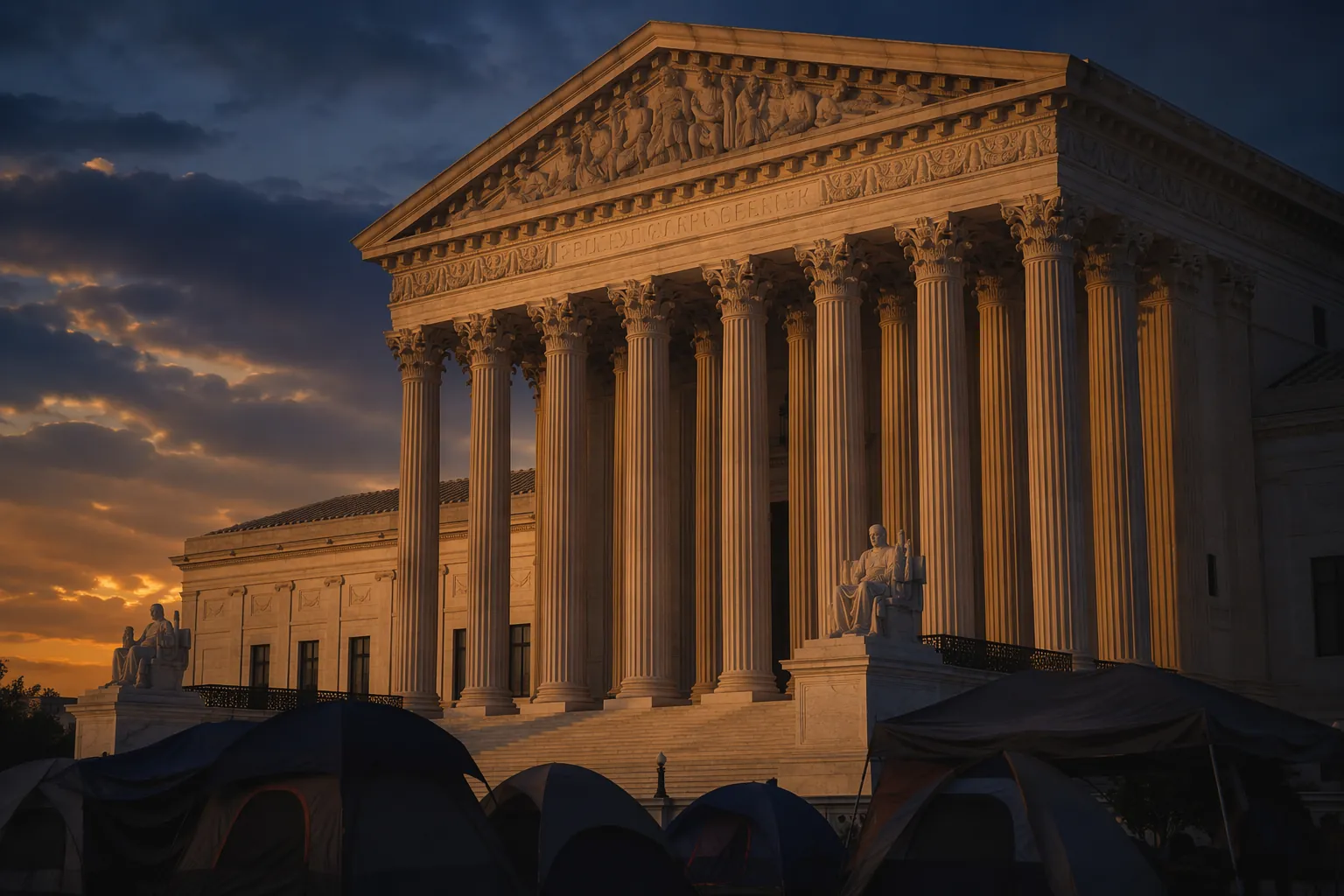
The controlling federal case is City of Grants Pass v. Johnson, 603 U.S. 520, decided June 28, 2024. In a 6-3 decision, the Court held that generally applicable laws regulating camping on public property do not violate the Eighth Amendment’s Cruel and Unusual Punishments Clause merely because they are enforced against people experiencing homelessness.[1] Last verified: July 25, 2026.
The Holding Is Federal, Narrower Than the Headline
The legal basis for the ruling is not a general Supreme Court endorsement of every camping ban. It is an Eighth Amendment holding about punishment. The majority opinion, written by Justice Gorsuch, rejected the argument that Grants Pass’s public-camping ordinances were cruel and unusual punishment when applied to people who lacked shelter. The Court treated the ordinances as laws regulating conduct—camping, sleeping with bedding, or using temporary shelter on public property—not as laws criminalizing the status of being homeless.[1]
That distinction matters because the Eighth Amendment inquiry begins in a different place from most homelessness-policy disputes. The Clause limits the kinds and severity of punishment government may impose. It is not, in the majority’s account, a freestanding command that courts supervise whether a city has enough shelter beds before enforcing public-space rules.[1]
For municipal lawyers, that is the first correction to make in any enforcement memo. Grants Pass changed the federal Eighth Amendment baseline. It did not erase state law, disability law, property-seizure rules, notice requirements, excessive-fines limits, or local political accountability.
Why Robinson Did Not Control the Case
The doctrinal hinge was Robinson v. California, the 1962 decision holding that a state may not criminalize the status of being addicted to narcotics. Robinson is the reason the status-versus-conduct line could not be skipped. If Grants Pass had punished the bare condition of being homeless, the city would have run into the boundary Robinson drew.[1]
The majority did not read the ordinances that way. It emphasized that the laws applied to conduct in public places and did not turn on a person’s identity, condition, or housing status. A backpacker, a housed resident, and an unhoused resident could all violate the same camping rule by using covered bedding or shelter in a prohibited public area.[1]
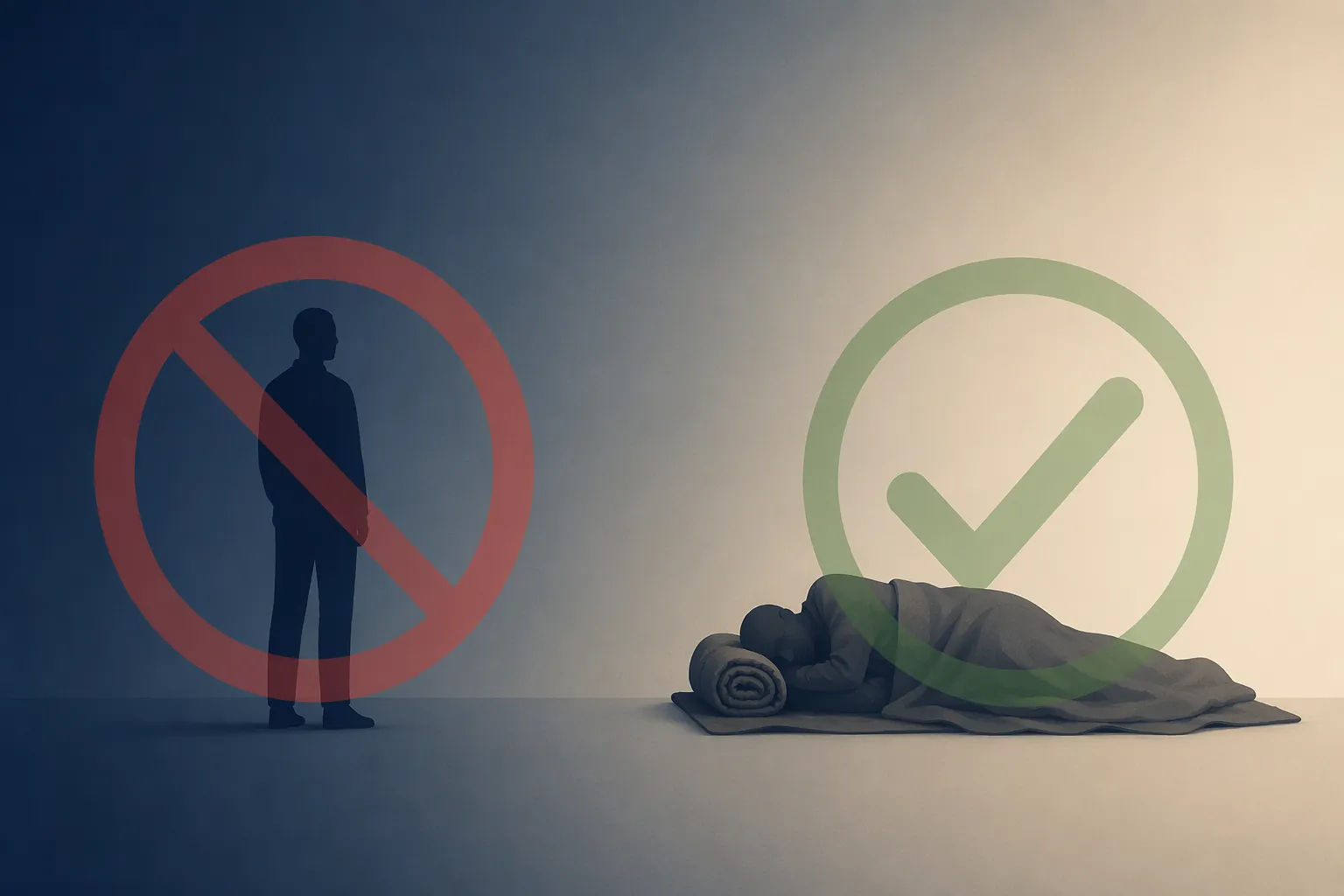
That is the formal move on which the case rests. It is also the move most likely to be overstated in practice. The Court did not hold that the human need to sleep outdoors disappears as a litigation fact. It held that the Eighth Amendment, as the majority understood it, does not convert that fact into a categorical bar on enforcing generally applicable camping restrictions.[1]
The Court Rejected the Martin Shelter-Capacity Rule
The decision also displaced the Ninth Circuit framework from Martin v. Boise. Under that approach, cities in the Ninth Circuit faced Eighth Amendment limits on enforcing public-camping laws against involuntarily homeless people when adequate shelter was unavailable. The Supreme Court viewed that shelter-capacity inquiry as unworkable under the Cruel and Unusual Punishments Clause.[1]
The majority’s concern was partly institutional. Counting available beds sounds simple until a city has to decide which beds count, which restrictions disqualify a bed, what happens when capacity changes overnight, and how police officers or municipal judges are supposed to operationalize those answers in real time. The Court treated those questions as policy and administration problems, not as Eighth Amendment elements.[1]
That reasoning gives cities more room than they had under Martin. It does not give them a clean enforcement script. A city can lose a later case for reasons that have nothing to do with the Eighth Amendment theory rejected in Grants Pass.
Thomas and Sotomayor Mark the Edges
Justice Thomas’s concurrence pushed the Eighth Amendment analysis toward a still narrower frame, emphasizing limits on the Clause’s role in regulating substantive criminal law.[1] The practical point is modest but important: litigants relying on the federal Cruel and Unusual Punishments Clause after Grants Pass face a Court majority that is not eager to use that provision as a municipal shelter-policy regulator.
Justice Sotomayor’s dissent, joined by Justices Kagan and Jackson, preserved the opposing account. In that view, the status/conduct distinction becomes unstable when the conduct punished is unavoidable and life-sustaining, such as sleeping outside when no lawful shelter is realistically available.[1] That argument did not prevail as federal Eighth Amendment doctrine. It remains the kind of argument counsel should expect to see recast under state constitutions, statutory reasonableness standards, disability-rights theories, and local enforcement records.
What Grants Pass Did Not Decide
The safest post-Grants Pass advice starts with the negative space in the opinion. The Court decided an Eighth Amendment cruel-and-unusual-punishment question. It did not decide every constitutional or statutory challenge that can arise when a city clears an encampment, issues fines, seizes property, denies accommodations, or applies an ordinance unevenly.
- Due Process: notice, clarity, opportunity to contest enforcement, and arbitrary application remain potential issues.
- Excessive Fines: escalating civil penalties can still invite scrutiny if they become punitive and disproportionate.
- Fourth Amendment: seizure, storage, destruction, or disposal of personal property can trigger separate claims.
- State constitutions: state courts may interpret punishment, dignity, property, or due-process provisions more protectively than the federal floor.
- Disability law: enforcement against people with disabilities can raise accommodation and discrimination theories outside the Eighth Amendment.
The Congressional Research Service described the decision as resolving the Eighth Amendment question while leaving other constitutional theories available.[2] That is the difference between a precedent shift and a litigation end point.
The City That Won Still Shows the Patchwork
Grants Pass itself is the cleanest warning against treating the ruling as a national permission slip. One year after the Supreme Court decision, reporting described the city as still unable to remove a homeless encampment because of state-law barriers, including Oregon legislation enacted in 2023, and because of a January 2025 lawsuit filed by Disability Rights Oregon.[3]
That sequence is not an ironic footnote. It is the operating environment. A city may win the federal Eighth Amendment issue and still be constrained by state statute, a state-court order, an injunction, an accommodation claim, public-record disclosures, or a local ordinance drafted more narrowly than the council remembers.
The ABA’s Criminal Justice Section later framed the post-decision landscape by emphasizing that criminalization of homelessness can remain unlawful under other constitutional theories and ineffective as a homelessness-reduction strategy.[4] The first point matters directly for litigation risk. The second matters because courts do not review municipal records in a vacuum; enforcement rationales, alternatives considered, and administrative burdens often appear in preliminary-injunction papers even when they are not elements of the Eighth Amendment claim.
State Law Is Now the Faster-Moving Risk Layer
After Grants Pass, state governments moved in different directions. Florida’s HB 1365, Missouri action in 2024, and Arizona’s Proposition 312 in November 2024 are examples of state-level measures requiring, incentivizing, or expanding local enforcement responses to public camping.[5] Oregon and Washington illustrate the other side of the map, where state-level limits, reasonableness standards, or municipal-research guidance complicate any simple “ban and enforce” instruction.[3][6]
| Legal layer | What changed after Grants Pass | What counsel still has to check |
|---|---|---|
| Federal Eighth Amendment | Generally applicable public-camping ordinances are not cruel and unusual punishment merely because they apply to people experiencing homelessness. | Whether the ordinance punishes conduct rather than status, and whether penalties create separate excessive-fines issues. |
| Other federal constitutional claims | The Supreme Court did not resolve them. | Due process, property seizure, notice, selective enforcement, and Fourth Amendment procedures. |
| State statutes and constitutions | States may expand enforcement authority or impose narrower local limits. | Current state legislation, injunctions, state constitutional precedent, and local implementing rules. |
| Disability-rights litigation | The Eighth Amendment ruling does not dispose of accommodation or discrimination claims. | Individual and classwide accommodation requests, enforcement alternatives, and administrative record support. |
Municipal commentary immediately after the ruling treated the case as a major enforcement change, especially for cities previously bound by the Ninth Circuit’s Martin framework.[5][6] That is right as far as it goes. The risk comes when a council hears “major enforcement change” as “no further legal constraints.”
The Practical Memo After Grants Pass
A city attorney advising after Grants Pass can now say something that was harder to say under Martin: the federal Eighth Amendment does not require the city to prove shelter availability before enforcing a generally applicable anti-camping ordinance. That sentence belongs near the top of the memo. It should not be the whole memo.
The next pages should ask different questions. Does state law require reasonableness in time, place, and manner restrictions? Has a state court entered or threatened an injunction? Are fines structured in a way that invites excessive-fines challenges? What happens to property found at an encampment? How are disability accommodation requests logged and reviewed? Are officers applying the ordinance citywide or only in locations where complaints are politically loudest?
Those questions are not policy decoration. They are where the next lawsuit is likely to find its record. The Eighth Amendment ruling narrows one path for plaintiffs, but it also pushes litigation toward the parts of municipal practice that are more factual, more local, and harder to clean up after discovery begins.
Bottom Line for the 2024 Legal Basis
The legal basis for the Supreme Court’s 2024 camping-ban ruling is the Eighth Amendment status-versus-conduct distinction. The Court read Grants Pass’s ordinances as regulating conduct in public space, not criminalizing the status of homelessness, and it rejected the Ninth Circuit’s shelter-capacity rule as an improper Eighth Amendment requirement.[1]
That is a substantial change in federal constitutional law. It is not a uniform national clearance for every public-camping enforcement plan. Through 2026, the live risk is the interaction between the federal status-conduct rule and the state-level patchwork: statutes, state constitutional claims, disability litigation, property procedures, and local records that will decide how much of the Supreme Court victory a city can actually use.
References
- City of Grants Pass v. Johnson, Supreme Court of the United States, June 28, 2024, https://www.supremecourt.gov/opinions/23pdf/23-175_19m2.pdf
- The Eighth Amendment and Homelessness: Supreme Court, Congressional Research Service, https://www.congress.gov/crs-product/LSB11203
- One year after Supreme Court ruling, Grants Pass still can’t remove homeless encampment, NPR, June 30, 2025, https://www.npr.org/
- Criminalization of Homelessness Remains Both Unlawful and Ineffective at Reducing Homelessness, American Bar Association Criminal Justice Section, March 2025, https://www.americanbar.org/
- Supreme Court Upholds Cities’ Ability to Enforce Public Camping Restrictions, Meyers Nave, July 8, 2024, https://www.meyersnave.com/
- U.S. Supreme Court Decision in City of Grants Pass v. Johnson Changes Landscape for Regulating Homelessness, Municipal Research and Services Center, July 15, 2024, https://mrsc.org/
Operationalizing workflow
No workflow has been explicitly linked to this obligation yet. See Workflows generally.
Illustrative cases
No illustrative case is currently tracked for this obligation. See Risk Digest for documented incidents generally.
← Back to RegulationReport a correction or tip
Spotted an outdated figure, a misstated fact, or a ruling this regulation entry should reflect? Public comments are disabled for this content given the professional cost of a misreported case outcome, penalty amount, or rule text — use the structured correction channel instead.
Report a correction or tip for this record →