
Supreme Court Upholds Mail Ballot Grace Periods in 5-4 Decision
- Authority
- U.S. Supreme Court
- Rule type
- regulation
- Jurisdiction scope
- US federal
- Effective date
- Jun 29, 2026
- Source text
- Read primary rule text ↗
States may count mail ballots postmarked by Election Day if received within a reasonable post-election window.
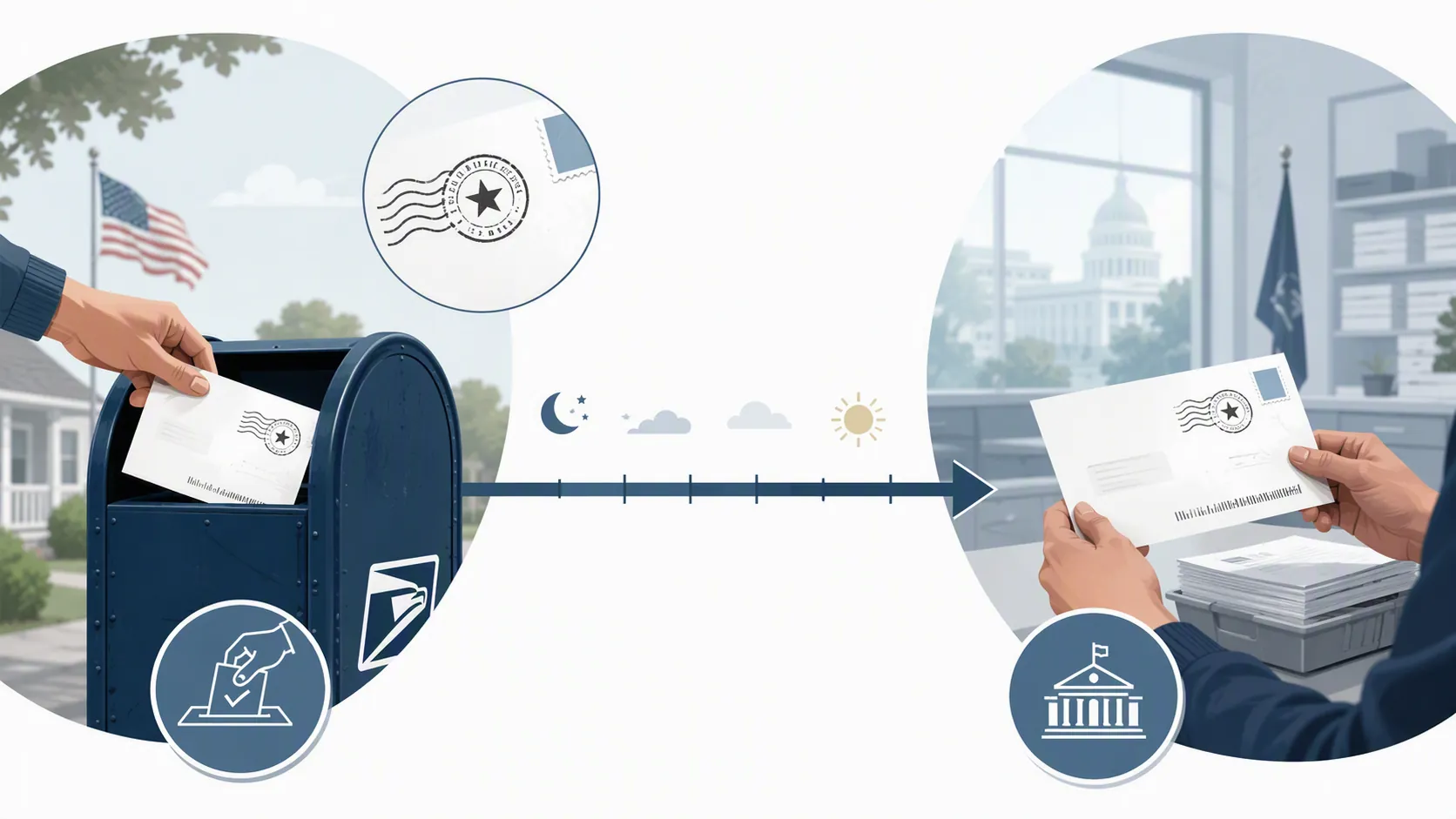
Watson v. Republican National Committee is the Supreme Court mail-voting restrictions update that matters most for 2026 compliance calendars: on June 29, 2026, the Court held 5-4 that the federal Election Day statutes do not require mail ballots to be received by Election Day when state law requires the voter to cast, or postmark, the ballot by that day and permits receipt within a reasonable post-election window.[1]
Justice Amy Coney Barrett wrote the majority opinion, joined by Chief Justice John Roberts and Justices Sonia Sotomayor, Elena Kagan, and Ketanji Brown Jackson. Justice Samuel Alito dissented, joined by Justices Clarence Thomas and Neil Gorsuch, and by Justice Brett Kavanaugh in part.[1] The statutes at issue were 3 U.S.C. § 1 for presidential electors, and 2 U.S.C. §§ 1 and 7 for House and Senate elections.[2]
This is a regulation-and-litigation tracking record, not legal advice. The practical point is narrow but consequential: Watson preserves postmark-plus-grace-period laws against this federal Election Day statute challenge. It does not decide every dispute over mail voting, ballot curing, postmarks, proof of citizenship, agency authority, or presidential power over election administration.
The Statutory Verbs Did Most of the Work
The federal statutes do not use the same words for every federal office, but they do share the same timing command. For presidential electors, 3 U.S.C. § 1 provides that electors “shall be appointed” on the Tuesday after the first Monday in November. For Representatives, 2 U.S.C. § 1 establishes that Tuesday as the day for the “election” of Representatives. For Senators, 2 U.S.C. § 7 does the same for the “election” of Senators.[2]
The Republican National Committee’s position turned on receipt. If the federal day is the day of the election, the argument ran, then a ballot that arrives after that day is too late, even if the voter completed it and placed it in the mail on time under state law. The majority rejected that receipt-based reading. Barrett wrote that “the defining element of an election has always been the electorate’s choice, not when ballots are received.”[1]
That sentence is the center of the holding. Under the majority’s rule, the voter’s choice is made when the ballot is cast by the federal deadline. A state may then count that ballot after Election Day if the state’s rule requires timely casting or postmarking and gives election officials only a reasonable window for receipt.[1][2]
That distinction is easy to blur in public summaries and hard to fix once blurred. Watson did not say states may keep voting open after Election Day. It said the federal Election Day statutes do not make later receipt the legal equivalent of later voting where the voter’s act of choice was completed by Election Day under state law.
| Question | Watson answer |
|---|---|
| Must the voter act by the federal Election Day? | Yes. The majority’s holding depends on the voter casting or postmarking the ballot by Election Day. |
| Must election officials receive the ballot by Election Day? | No, not under the federal Election Day statutes, if state law allows a reasonable post-election receipt window. |
| Did the Court approve every mail-ballot deadline rule? | No. The holding addresses this statutory preemption theory, not every state-law or federal-authority dispute. |
| Did the Court decide the March 31, 2026 executive-order litigation? | No. Watson affects that litigation, but it does not itself decide presidential or agency authority. |
Why Historical Receipt Practice Did Not Carry the Majority
The majority did not deny that older election practices often involved in-person voting and same-day collection. It refused to let that history override the statutory terms. Barrett wrote that “historical practice, detached from statutory text, is not controlling,” and warned that carrying old collection assumptions forward would “call into question the way modern elections work,” including early voting.[1]
That is a textual move with administrative consequences. If “election” means the voter’s act of choosing, a receipt window is a counting and administration rule. If “election” includes final physical receipt of every ballot, then post-election arrival becomes a federal timing defect. Watson chooses the first reading for these statutes.
The opinion therefore protects a category of state laws, not a mood about mail voting. The protected category is postmark-plus-grace-period law: the voter must act by Election Day, and the later event is delivery to officials inside a state-defined reasonable window. A state rule that tried to extend the voter’s time to choose would present a different problem.
The Dissent Preserves the Argument Election-Day Receipt Advocates Will Use Next
Alito’s dissent supplied the counter-reading that will remain live in briefs, agency memoranda, and emergency applications. In his formulation, “Having an election on a particular day meant completing ballot collection on that day.” He warned that the majority “spawns a slurry of troubling election-law questions and risks further undermining Americans’ confidence in election integrity.”[1]
The dissent’s force is not that it controls the statutory question after Watson; it does not. Its force is that it gives receipt-deadline proponents a historically framed theory to carry into adjacent disputes. Expect it to appear where litigants argue that a federal actor, rather than Congress through the Election Day statutes alone, may require same-day receipt.
That is why Watson should not be summarized as the Court “settling mail voting.” It settles one federal statutory preemption question. The disagreement over who may impose a national receipt deadline, and through what authority, has already moved to the executive-order cases.
Which State Rules Remain Protected
The state impact should be counted in two separate columns. Voting Rights Lab reports that 14 states plus the District of Columbia provide grace periods for all voters, while roughly 30 states provide grace periods for military and overseas voters.[3] Those are not interchangeable counts. An all-voter grace period changes the ordinary domestic mail-ballot rule. A military-and-overseas grace period implements a narrower absentee-ballot regime for voters who face different mailing constraints.
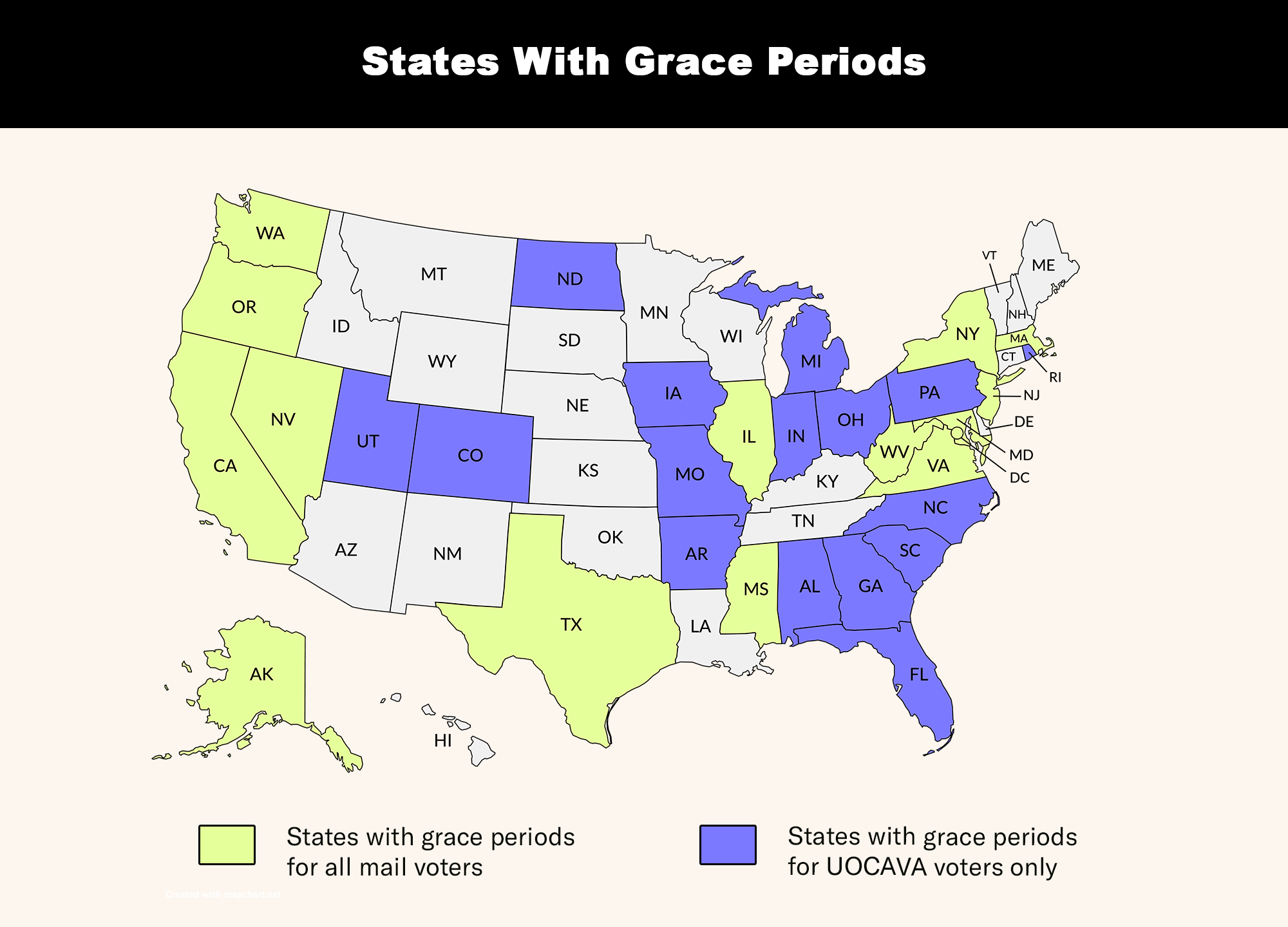
The scale is still substantial. A Brennan Center analysis of the Watson litigation reported that at least 750,000 ballots were postmarked by Election Day and counted within grace periods in 2024, citing VoteBeat; that figure excludes ballots counted under military-and-overseas-only grace states, so it is conservative by design.[4]
NPR reported that about 30% of ballots in 2024 were cast by mail.[5] That national share does not prove anything about the meaning of 3 U.S.C. § 1 or 2 U.S.C. §§ 1 and 7. It does explain why county officials, campaign counsel, and state election directors need the holding stated without embellishment before the 2026 midterms.
Mississippi illustrates the political and administrative aftermath. NPR reported that Gov. Tate Reeves called on the state legislature to repeal Mississippi’s 2020 grace-period law and require receipt by Election Day.[5] Watson prevents the federal Election Day statutes from doing that work by preemption, but it does not stop a state legislature from choosing a stricter receipt rule for its own elections if that rule is otherwise lawful.
The Executive Order Fight Is Where the Next Deadline Question Sits
The March 31, 2026 executive order, titled “Ensuring Citizenship Verification and Integrity in Federal Elections,” directed federal action touching election administration and included an attempt to impose a nationwide mail-ballot receipt deadline through federal mechanisms, including Postal Service-related implementation.[6] Watson undercuts the receipt-deadline rationale to the extent that rationale rests on the Election Day statutes themselves.
It does not, by itself, answer the separate authority question. The executive-order litigation asks who has power to impose such a rule and whether the President or federal agencies may do so without new congressional authorization. Watson says what the Election Day statutes do not require. It does not supply a complete separation-of-powers holding for the executive order.
That line matters in Trump v. California. The emergency application in No. 26A124 was filed July 27, 2026, and the 23 plaintiff states plus the District of Columbia cite Watson as a complementary ground for denying emergency relief.[7] The citation is sensible: if the statutes do not themselves impose an Election Day receipt rule, the administration has less statutory footing for a nationwide receipt deadline.
But the administration can still point to the Watson dissent’s historical account and argue that federal power exists from a different source or through a different implementation path. That argument is weaker after Watson on the statutory-text question, but it is not erased. For the broader litigation map, the companion record on USPS mail ballot court appeals tracks how Watson intersects with the executive-order challenge and related Postal Service disputes.
What Counsel and Administrators Should Take From Watson
For compliance purposes, the operative rule is short: a state law requiring a mail ballot to be cast or postmarked by Election Day, then received within a reasonable post-election window, is not preempted by the federal Election Day statutes on the theory that “election” means receipt by officials.
- Do not describe Watson as allowing ballots to be “cast after Election Day”; the holding depends on timely voter action.
- Do not merge all grace-period states into one figure; separate all-voter rules from military-and-overseas-only rules.
- Do not treat the 750,000-ballot figure as a nationwide total; it is a conservative figure that excludes military-and-overseas-only grace states.
- Do not cite Watson as deciding the full executive-order litigation; it supplies statutory support against a receipt deadline, not a complete ruling on executive authority.
For state-specific administration, Watson is the federal overlay, not the whole manual. A county still has to apply its state’s postmark rule, receipt window, signature verification law, cure procedure, canvass deadline, and military-and-overseas provisions. California readers working from rejection and cure procedures should keep those state rules separate from the Watson holding; the practical state-law layer is treated in the California mail ballot rejection rules record.
Fraud arguments were not the hinge of the statutory holding. Brookings reported in November 2025 that mail-voting fraud was 0.000043%, about four cases per 10 million mail ballots, and that universal vote-by-mail systems showed the lowest rates in its analysis.[8] That evidence may answer some confidence claims in policy debates, but Watson turned on the words Congress used to set the federal election day.
The clean legal update is therefore limited and usable: Watson preserves state postmark-plus-grace-period laws against this federal Election Day statute challenge, gives plaintiff states fresh support against a nationwide receipt deadline, and leaves the next live question to the executive-order cases.
References
- Justices uphold state law allowing for late-arriving mail-in ballots — SCOTUSblog
- Supreme Court Decides Watson v. Republican National Committee et al. — Faegre Drinker, June 2026
- Supreme Court Upholds Ballot Postmark Grace Period Laws — Voting Rights Lab, June 29, 2026
- Supreme Court arguments involved misleading claims about mail ballots — Brennan Center
- Supreme Court upholds grace periods for mail-in ballots — NPR, June 29, 2026
- Ensuring Citizenship Verification and Integrity in Federal Elections — White House, March 31, 2026
- Trump v. California emergency application — Supreme Court docket, July 27, 2026
- Mail voting in the US: Data points to very low fraud and significant benefits to voters — Brookings Institution, November 2025
Operationalizing workflow
No workflow has been explicitly linked to this obligation yet. See Workflows generally.
Illustrative cases
No illustrative case is currently tracked for this obligation. See Risk Digest for documented incidents generally.
← Back to RegulationReport a correction or tip
Spotted an outdated figure, a misstated fact, or a ruling this regulation entry should reflect? Public comments are disabled for this content given the professional cost of a misreported case outcome, penalty amount, or rule text — use the structured correction channel instead.
Report a correction or tip for this record →