
How Taiwan's public insult rulings affect AI content risk
- Authority
- Constitutional Court of Taiwan
- Rule type
- constitutional ruling
- Jurisdiction scope
- Taiwan
- Effective date
- Jan 1, 2024
- Source text
- Read primary rule text ↗
Apply the narrowed Article 309 public-insult standard; preserve Article 310 reasonable fact-checking for factual allegations; use Article 140 only for on-duty obstruction; treat 2026 online/deepfake penalties as pending.

| Field | Record |
|---|---|
| Jurisdiction | Taiwan |
| Category | Regulation & Ethics |
| Relevant provisions | Criminal Code Articles 309, 310, and 140 |
| Constitutional Court rulings | 113-Hsien-Pan-3, 113-Hsien-Pan-4, 113-Hsien-Pan-5 |
| January 29, 2026 Executive Yuan draft | Pending; no third-reading passage found as of August 3, 2026 |
| Last verified | August 3, 2026 |
| Legal-background review | Reviewed for Taiwan criminal-speech classification issues; not legal advice |
Taiwan did not remove public insult from the Criminal Code after the 2024 constitutional rulings. The operational change is narrower and more important for content review: Article 309 remains available only under a limiting construction for public speech that is purposefully given to damage another person’s reputation beyond what a reasonable person can tolerate, with courts balancing the value of the speech against reputational harm and excluding merely subjective feelings of honor from the protected interest.
That distinction is the starting point for anyone reviewing AI-generated reputational content for Taiwan. A model output that calls a private person a vulgar name, a generated post that asserts corrupt conduct, and a chatbot answer that insults a public official during an encounter with that official do not travel the same legal route. After 113-Hsien-Pan-3, 113-Hsien-Pan-4, and 113-Hsien-Pan-5, they need different labels before anyone asks whether to publish, block, escalate, or preserve the content.
The Article 309 Standard Is Narrower, Not Gone
In 113-Hsien-Pan-3, the Constitutional Court held that Article 309(1), Taiwan’s public insult offense, is constitutional only when read to cover public insult speech “purposefully given to damage the reputation of another person beyond the extent that a reasonable person may tolerate.” The official English summary gives the operative rule; the Chinese full text remains the controlling decision text.[1][2]
For review workflow, two words do most of the work: reputation and purpose. The Court did not preserve criminal punishment for every humiliating or offensive utterance. It rejected subjective honor as the protected interest and focused instead on external reputation. It also required a purposeful public expression that crosses a reasonable-toleration threshold, rather than mere bad manners or interpersonal friction.[1][2]
The same ruling matters for severity. The Court treated short-term imprisonment as constitutionally sustainable only in more serious circumstances, identifying online or viral dissemination as the paradigm in which reputational harm can scale beyond the ordinary public-insult case.[1][2]
That is where AI content systems create a different exposure profile from a one-off human exchange. A generated insult can be repeated, translated, ranked, clipped, reposted, or injected into search and recommendation surfaces. The constitutional ruling does not say that every online insult is punishable. It does say that dissemination conditions matter when courts assess whether criminal punishment, including a custodial sanction, survives constitutional review.
Route the Output Before Asking Whether It Is True
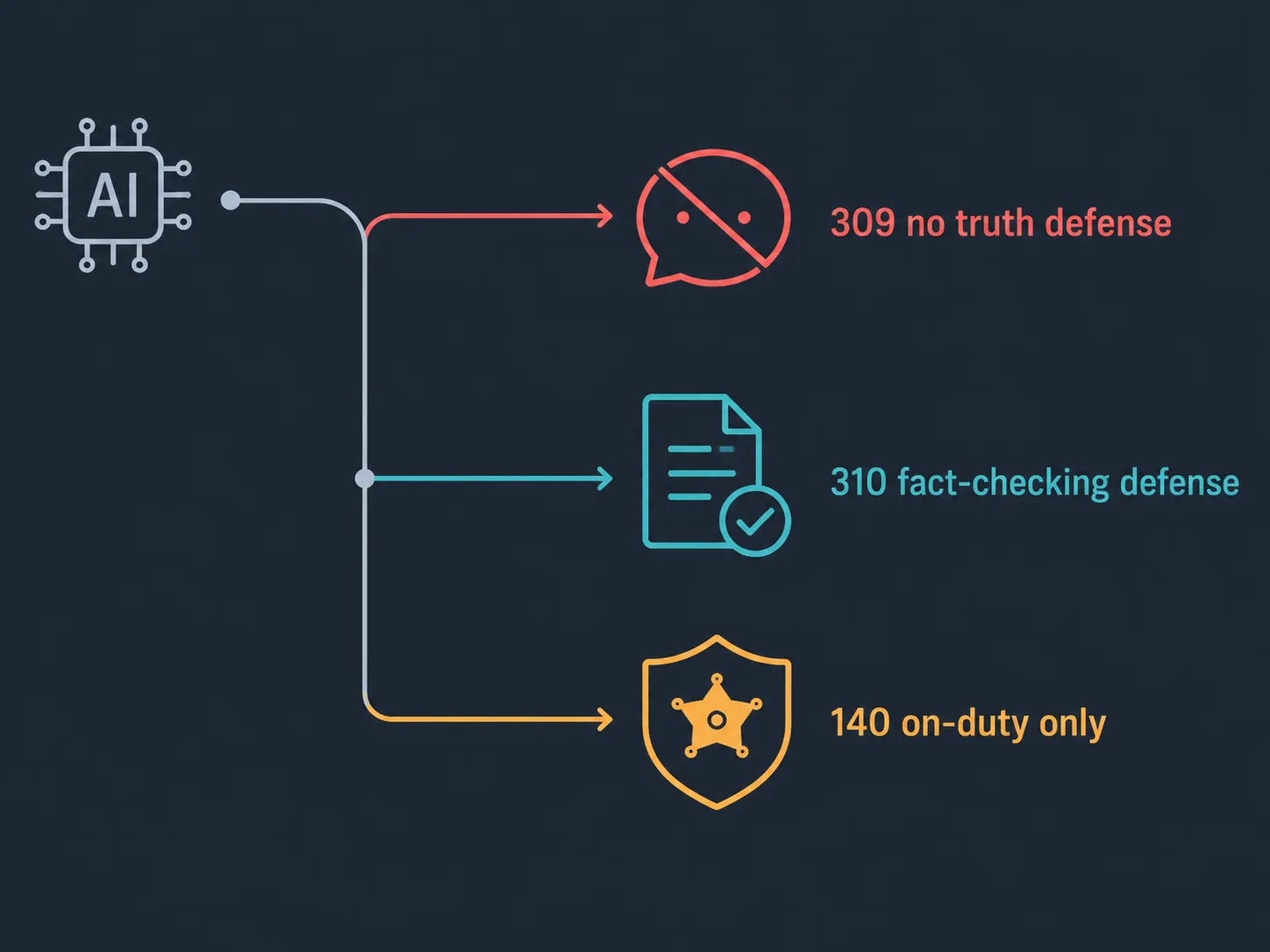
The first classification question is not whether the content is harsh. It is whether the output asserts checkable facts or merely insults. Taiwan’s post-2024 map splits those paths.
| Content type | Likely route | Review consequence |
|---|---|---|
| Pure insult aimed at a person’s reputation | Article 309 public insult | No truth defense; assess publicness, purpose, reputational damage, reasonable toleration, and dissemination severity |
| Factual claim damaging reputation | Article 310 defamation | Route to fact verification and reasonable-fact-checking analysis |
| Insult involving a public official | Article 140 after 113-Hsien-Pan-5 | Punishable only under the narrowed on-duty obstruction formulation |
A factual statement about a person’s conduct belongs in the Article 310 defamation lane, not the Article 309 insult lane. In 113-Hsien-Pan-4, the Constitutional Court restated the Article 310(3) truth-defense framework from 112-Hsien-Pan-8: where the accused has conducted reasonable fact-checking and has substantial reason to believe the statement is true, criminal defamation liability must be assessed through that verification standard.[3]
That matters for AI tools that summarize allegations, generate profiles, translate accusations, or answer questions about named people. A reviewer can ask what sources were used, whether the system preserved uncertainty, whether the claim was framed as fact or allegation, and whether a reasonable verification record exists. Those questions fit defamation analysis. They do not rescue a pure insult that carries no factual proposition to verify.
A hypothetical example shows the split. If an AI assistant outputs, “X stole charity funds,” the reviewer needs a defamation route: source review, attribution, uncertainty, and reasonable fact-checking. If the same system outputs only a demeaning slur about X, there may be nothing to prove true. The relevant Article 309 questions become whether the speech was public, purposeful, reputationally damaging beyond reasonable toleration, and disseminated in a way that aggravates harm.
This is also why generic “hallucination” controls are incomplete. Source grounding helps when the issue is a false factual assertion. It does not answer whether a generated insult, meme caption, avatar dialogue, or synthetic voice line is punishable as public insult under the narrowed Article 309 standard.
Public Officials Now Require a Separate Article 140 Check
Article 140 now has its own narrowed route. In 113-Hsien-Pan-5, the Constitutional Court struck down the part of Article 140 that punished insulting a public office, while preserving punishment for insulting a public official only where the conduct obstructs a public official acting in the course of duty.[4]
That ruling protects more than tone. It changes classification. A generated insult about a mayor, agency head, police officer, or election official is not automatically an Article 140 matter merely because the target holds office. The review has to ask whether the official was acting in the course of duty and whether the insult obstructed that duty. Otherwise, the content may still need Article 309 or Article 310 review, but the public-official insult route should not be over-applied.
For AI-content operators, this cuts both ways. Systems used in live chat, livestream moderation, civic forums, complaint intake, or protest-related content can produce speech close to an official’s performance of duty. But political commentary about officials, especially when separated from an on-duty obstruction setting, should not be collapsed into the same criminal bucket.
The January 2026 Draft Is a Pending Risk Signal
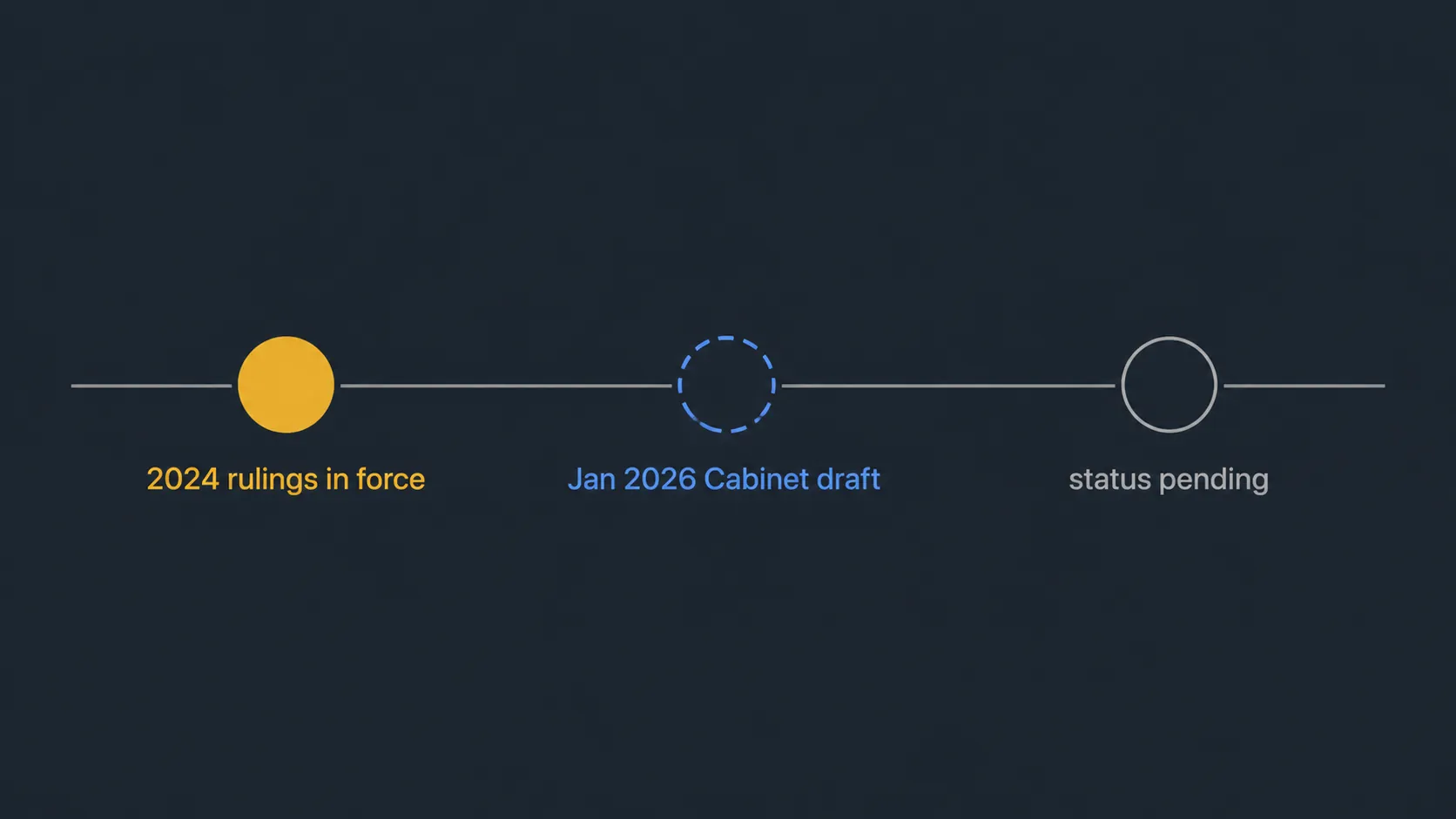
The Executive Yuan approved a Criminal Code amendment draft on January 29, 2026, but the draft should not be described as enacted law. As of August 3, 2026, no third-reading passage was found. The figures below are proposed penalties, not current enacted penalties.[5][6]
| Draft item | Proposed penalty change |
|---|---|
| General public insult | Proposed fine increase from NT$9,000 to NT$60,000 |
| Insult by force | Proposed fine increase from NT$15,000 to NT$100,000 |
| Online or deepfake insult | Proposed aggravated track of up to 2 years and/or NT$200,000 |
| General defamation | Proposed fine increase from NT$15,000 to NT$100,000 |
| Aggravated defamation involving audio, video, or electromagnetic records | Proposed fine of up to NT$200,000 |
| Online or deepfake defamation | Proposed aggravated track of up to 3 years and/or NT$300,000 |
The draft is not court-ordered compliance with a fixed amendment deadline. The 2024 rulings narrowed constitutional standards; they did not impose a legislative clock. The Cabinet proposal is better read as a policy response that would, if passed, make online and deepfake insults a distinct aggravated criminal track.
The proposal is politically contested. CNA and Taipei Times reported the Cabinet’s penalty proposal, while UDN reported opposition criticism that the amendment risked expanding criminal punishment for speech.[5][6][7]
For compliance purposes, the clean treatment is status discipline: the constitutional rulings are in force; the January 2026 penalty track is pending. Product counsel and trust-and-safety teams should not build public copy, risk labels, or user warnings that state the proposed NT$ figures as current law unless the bill status is re-verified.
What This Means for AI Content Review
The practical impact of Taiwan’s public insult rulings is a routing obligation. A Taiwan-facing review queue should not treat all reputationally harmful output as one moderation class. The legal consequences turn on whether the output is insult, factual defamation, public-official obstruction, or some combination that needs escalation.
- Flag pure insult separately from factual allegations; Article 309 has no truth defense.
- For factual reputational claims, preserve the verification record needed for Article 310 analysis.
- For public officials, ask whether the speech obstructs an official acting in the course of duty before using the Article 140 route.
- For online, viral, synthetic-media, or republishing scenarios, escalate dissemination severity rather than treating the output as an isolated utterance.
- For penalty references, label the January 2026 online and deepfake figures as proposed unless legislative status has changed.
The same routing should apply beyond original generation. Translation can convert a factual allegation into a sharper accusation. Summarization can remove attribution. Ranking can extend reach. A synthetic voice or image tool can make an insult appear more targeted and more shareable. None of those steps automatically establishes liability, but each can change the publication and dissemination facts a Taiwan reviewer needs to see.
Teams that already maintain speech-risk playbooks can map Taiwan as a heightened criminal-exposure jurisdiction for reputational output. The useful control is not a blanket ban on harsh speech. It is a jurisdiction-aware classifier that separates Article 309 insult from Article 310 defamation and narrowed Article 140 public-official insult before legal review begins.
Enforcement Context Is Still Thin
There is one important institutional caveat. Taiwan’s Constitutional Court issued no merits decisions from late October 2024 to December 19, 2025 during a quorum controversy, meaning the narrowed insult and public-official standards existed for roughly 13 months without new merits decisions from the Court.[8][9]
That does not prove a rise or fall in convictions. The available materials do not provide official post-ruling conviction statistics. The safer conclusion is narrower: lower courts and extraordinary-appeal pathways carried the practical burden of applying the 2024 standards during that period, while the Constitutional Court was not issuing merits decisions.
For ongoing monitoring, this record belongs with primary-source updates in the Regulation & Ethics obligations tracker, enforcement-status notes in the Risk Digest, and model-output controls in Tool Reliability Evaluations. As of the verification date for this article, the risk classification is clear enough even though the 2026 penalty draft remains pending: AI tools that generate, rank, translate, summarize, or publish reputational content touching Taiwan need Taiwan-specific criminal-speech review, especially because truth-oriented verification helps defamation analysis but does not cure pure insult.
References
- 113-Hsien-Pan-3, Constitutional Court of Taiwan
- 113-Hsien-Pan-3, Constitutional Court of Taiwan
- 113-Hsien-Pan-4, Constitutional Court of Taiwan
- 113-Hsien-Pan-5, Constitutional Court of Taiwan
- Executive Yuan approves draft Criminal Code amendments on insult and defamation penalties, CNA, January 29, 2026
- Cabinet proposes heavier penalties for online insults, defamation, Taipei Times, January 30, 2026
- Opposition criticizes proposed insult and defamation amendments, UDN, January 30, 2026
- Taiwan Constitutional Court, Verfassungsblog, December 3, 2025
- Taiwan Constitutional Court resumes operation amidst constitutive quorum controversies, JURIST, December 2025
Operationalizing workflow
No workflow has been explicitly linked to this obligation yet. See Workflows generally.
Illustrative cases
No illustrative case is currently tracked for this obligation. See Risk Digest for documented incidents generally.
← Back to RegulationReport a correction or tip
Spotted an outdated figure, a misstated fact, or a ruling this regulation entry should reflect? Public comments are disabled for this content given the professional cost of a misreported case outcome, penalty amount, or rule text — use the structured correction channel instead.
Report a correction or tip for this record →