
Tennessee Felony Camping Penalties Explained
- Authority
- Tennessee General Assembly
- Rule type
- statute
- Jurisdiction scope
- US state
- Source text
- Read primary rule text ↗
Class E felony for unauthorized public property camping; Class C misdemeanor for highway/bridge camping
Tennessee’s camping law does not create one penalty. It creates two very different criminal exposures that are easy to confuse in a client conversation: unauthorized camping on public property can be charged as a Class E felony, while camping along controlled-access highways, under bridges, or within overpasses is treated as a Class C misdemeanor with a $50 fine and community service requirement.[1]
That split matters before anyone gets to policy arguments. A felony camping charge changes the bond discussion, the plea discussion, the collateral-consequence discussion, and the practical question of whether a person without stable housing can keep track of court dates, conditions, and counsel communications. The misdemeanor highway provision is still a criminal case, but it does not carry the same kind of leverage.
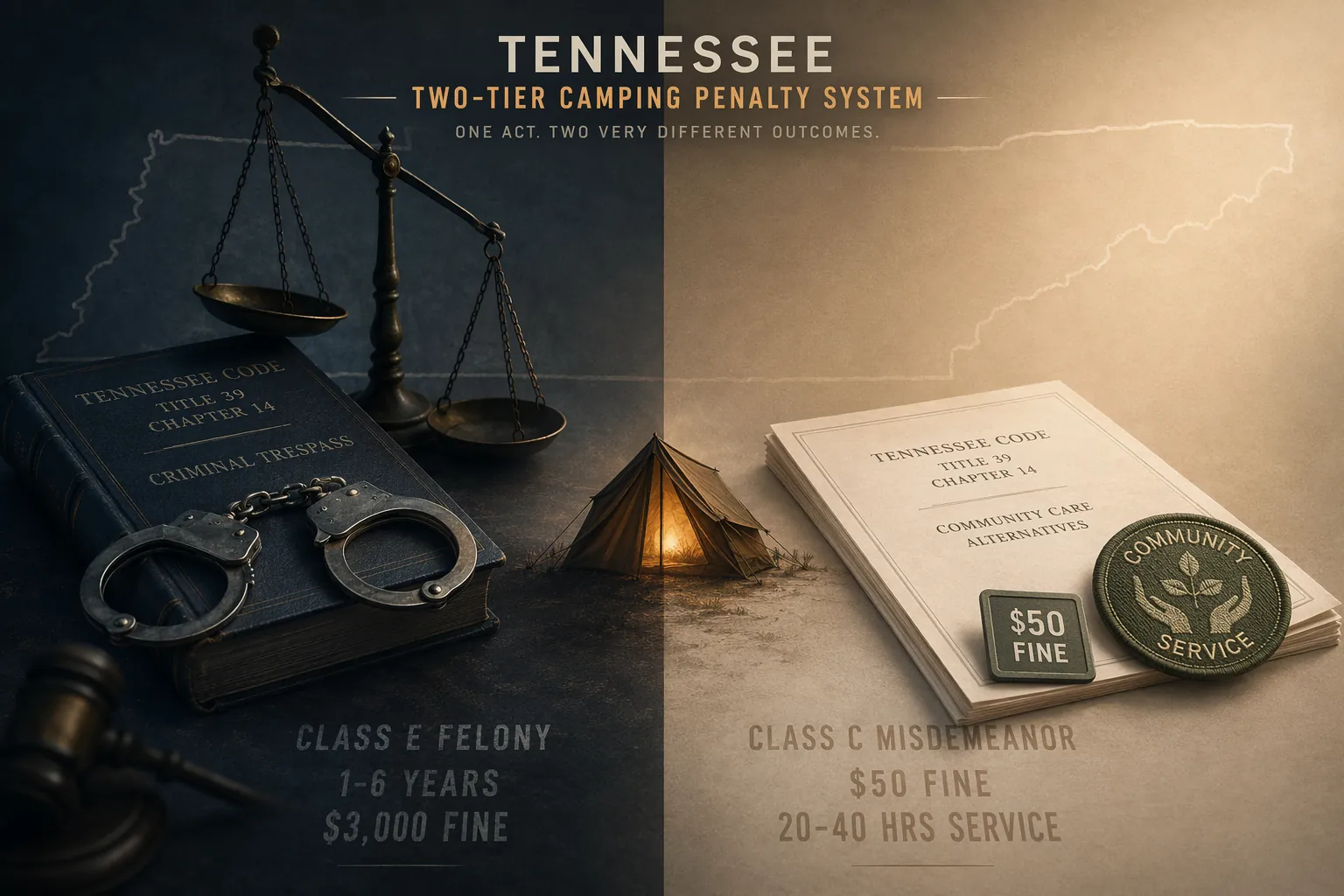
The Penalty Split
| Charge Tier | Covered Conduct | Classification | Stated Penalty Exposure |
|---|---|---|---|
| Public property camping | Camping on public property not designated for that use | Class E felony | One to six years and fine exposure up to $3,000 under Tennessee felony sentencing law |
| Highway, bridge, and overpass camping | Camping along a controlled-access highway, under a bridge, or within an overpass | Class C misdemeanor | $50 fine plus 20 to 40 hours of community service |
For the felony tier, the sentencing statute is where the paper risk becomes concrete. Tennessee law places a Class E felony at one to six years, with a fine of up to $3,000.[2] For a Range I standard offender, the practical sentencing range ordinarily begins at one to two years, but the classification still puts the case inside the felony framework.[2]
That distinction is not academic. A prosecutor may offer a misdemeanor resolution; a judge may consider probation; a first-time accused person may never see a prison sentence. None of that erases the starting point. The charge filed is still a felony charge, and the person sitting across from counsel has to understand what is possible before deciding what is likely.
What Makes the Public Property Charge a Felony Problem
The public-property offense is the part of Tennessee’s camping law that changes the case. The available sources describe a framework covering camping on public property not designated for that use, and the law uses a broad concept of camping that can include sleeping, erecting shelter, building a fire, or cooking. The precise application still depends on the facts: what the person was doing, where they were, whether the property was covered, and whether required procedures were followed.
The first charging question is location. “Public property” is not limited to a campground-style setting or a park with a posted sign. Tennessee’s general public-access concept can create difficult edges around plazas, rights-of-way, government-adjacent land, and spaces that the public uses but does not always clearly understand as state or local property.
The second question is conduct. A tent is easy evidence, but the harder cases are the ordinary survival facts: a tarp, a sleeping bag, cooking items, or an improvised shelter. Those facts may matter at bond, in negotiations, and in any challenge to whether the statutory term “camping” actually fits the conduct alleged.
The third question is notice. For arrests on local public property, the available statutory sources identify a required warning and a 24-hour notice to vacate before arrest. That is not a footnote. If the state is relying on the local-public-property pathway, counsel should ask who gave the warning, when it was given, what it said, how it was documented, and whether 24 hours actually passed.
There is also a property consequence. The law includes a 90-day impoundment provision for camping-related items such as tents, sleeping bags, and tarps. For an unhoused person, those items may be the difference between appearing in court in dry clothes and losing contact with everyone connected to the case. That consequence sits outside the sentencing grid, but it can shape the case as much as a court date.
Class E Exposure Is More Than the Sentence Range
The cleanest statutory answer is that a Class E felony carries one to six years and a fine up to $3,000.[2] The more useful answer is that felony exposure also changes the pressure points around the case. A felony arrest can affect bond conditions, release planning, employment, housing applications, and public benefits long before a conviction is entered.
A felony conviction also carries voting-rights consequences in Tennessee. The available legal sources identify loss of voting rights through the Tennessee Constitution and restoration procedures under Tennessee law. That does not mean every charged person will be convicted, and it does not mean every case will end as a felony. It does mean a plea to the felony tier cannot be discussed as if it were only a fine or a trespass-style citation.
Housing is another practical consequence. A felony record can create barriers in public housing and private rental screening. Employment consequences are similar: the conviction may be old news to the court file, but it is fresh every time an applicant has to answer a background-check question. In a camping case, that consequence can sound circular because the criminal record flows from homelessness-related conduct and then becomes another obstacle to stability.
Probation eligibility and sentencing alternatives should be analyzed case by case. Tennessee’s sentencing structure may leave room for non-incarcerative outcomes, especially where the person has limited criminal history, but that is not the same as saying the felony label is symbolic. A person can be eligible for a better outcome and still spend days in jail getting there.
The Highway and Overpass Offense Is a Different Case
The misdemeanor tier should not be folded into the felony analysis. Camping along a controlled-access highway, under a bridge, or within an overpass is treated as a Class C misdemeanor with a $50 fine and 20 to 40 hours of community service.[1] That is still a criminal charge, and community service can be difficult for someone without transportation, storage, phone access, or a stable schedule. But the sentencing leverage is not the same.
The confusion usually starts because both provisions are discussed as “camping bans.” In court, the first question should be narrower: is the state alleging camping on public property generally, or is it alleging conduct tied to a controlled-access highway, bridge, or overpass? The answer determines whether counsel is dealing with felony exposure or a low-level misdemeanor penalty.
Enforcement Through Mid-2026: Sparse, Then a Test Case
The available enforcement record is thin, and it should be described that way. Reporting by the Nashville Banner, relying on Open Table Nashville’s monitoring, described the 2022–2025 period as essentially lacking documented felony prosecutions and noted only one misdemeanor citation during that period.[3] That is not an official statewide prosecution database. It is still useful because, so far, it is one of the clearer public accounts of how rarely the felony tier appeared in court during the law’s first years.
NPR’s July 2026 reporting then gave the felony tier a courtroom fact pattern. Joseph Williams was charged in Davidson County with two felony camping counts, spent nine days in jail, and ultimately resolved the case through misdemeanor pleas with time served.[4] That sequence is more instructive than a maximum-penalty headline. It shows both sides of the risk: the felony filing was real, and the final resolution was far below the formal maximum.
Williams’s case should not be stretched into proof of a statewide prosecution wave. The available reporting does not support that. It supports a narrower conclusion: by July 25, 2026, at least one reported Davidson County case had moved the felony provision out of the realm of dormant statutory threat and into actual arrest, jail, negotiation, and misdemeanor disposition.
Why Grants Pass Matters, Briefly
The timing cannot be separated completely from the Supreme Court’s June 2024 decision in City of Grants Pass v. Johnson. The decision was widely understood as removing an Eighth Amendment obstacle that had made some local governments and prosecutors more cautious about camping-ban enforcement.[5] That does not answer every state-law, notice, selective-enforcement, or due-process issue in a Tennessee case. It does help explain why an office might feel less constitutionally constrained after June 2024 than before it.
The broader national trend also matters only to a point. The ACLU reports that, since Grants Pass, more than 300 municipalities and 11 states have passed camping bans.[5] Tennessee’s classification remains unusual because the public-property tier is a felony; the Vera Institute of Justice has described Tennessee as the only state using that felony classification for public camping.[6]
Tennessee lawmakers also continued adding homelessness-related penalties after the original felony law. WPLN reported in 2025 on additional measures, including a 30-day encampment-clearing provision and a commercial-property eviction measure.[7] Those additions show escalation in the legal environment, but they do not change the immediate charging analysis under the camping statute: identify the tier, then analyze the penalty and procedural prerequisites.
A Usable Risk Assessment for a Tennessee Camping Charge
The first move is not to argue the whole homelessness debate. It is to classify the charge. A public-property camping allegation raises felony exposure. A highway, bridge, or overpass allegation raises the misdemeanor fine-and-community-service structure. If the citation, warrant, affidavit, or indictment is vague, that vagueness is itself part of the early defense review.
- Confirm the exact statutory subsection or charging language.
- Identify the property and who controls it.
- Separate evidence of sleeping from evidence of shelter, cooking, fire, or stored camping items.
- Check whether a warning and 24-hour notice were required and documented.
- Ask what property was impounded and whether the person can retrieve it.
- Compare local enforcement history against the statutory maximum before advising on plea risk.
That last step is where statutory advice and courtroom advice part company. The statute supplies the ceiling. Local enforcement supplies the weather. Through July 25, 2026, the public record points to sparse enforcement followed by reported felony arrests that resolved as misdemeanors, not routine pursuit of maximum felony punishment. A practitioner who ignores the maximum understates the danger. A practitioner who predicts the maximum as the ordinary outcome overstates what the available cases show.
For defense strategy after the charging tier is clear, see the related article on defending felony camping charges after Grants Pass. The penalty analysis should come first because it tells everyone in the room what is actually at stake.
Last-Verified Bottom Line
As of July 25, 2026, Tennessee’s camping law creates severe felony exposure on paper for unauthorized public-property camping: Class E felony treatment, one-to-six-year imprisonment exposure, and a fine up to $3,000.[2] The separate highway, bridge, and overpass offense remains a Class C misdemeanor with a $50 fine and 20 to 40 hours of community service.[1]
The observed enforcement record does not justify treating the felony tier as routinely maximized. It also no longer justifies treating it as merely theoretical. Before advising a client, check both the statutory tier and the local enforcement record, then work from the facts that can be proved rather than from the loudest description of the law.
References
- Tennessee Code § 39-14-414. Equal access to public property, Justia, https://law.justia.com/codes/tennessee/title-39/chapter-14/part-4/section-39-14-414/
- Tennessee Code § 40-35-111. Authorized terms of imprisonment and fines for felonies and misdemeanors, Justia, https://law.justia.com/codes/tennessee/title-40/chapter-35/part-1/section-40-35-111/
- How Supreme Court ruling may impact Tennessee’s homelessness law, Nashville Banner, July 18, 2024, https://nashvillebanner.com/2024/07/18/supreme-court-ruling-tennessee-homelessness-law/
- Tennessee homeless arrest felony camping ban, NPR, July 21, 2026, https://www.npr.org/2026/07/21/nx-s1-5887358/tennessee-homeless-arrest-felony-camping-ban
- Two Years Since Grants Pass: Tracking the Criminalization of Homelessness, ACLU, https://www.aclu.org/two-years-since-grants-pass-tracking-the-criminalization-of-homelessness
- Vera Institute of Justice statement on Tennessee’s felony camping law, Vera Institute of Justice, https://www.vera.org/newsroom/vera-institute-of-justice-statement-on-tennessees-felony-camping-law
- Three years after making camping a felony, Tennessee lawmakers add more homelessness penalties, WPLN, https://wpln.org/post/three-years-after-making-camping-a-felony-tennessee-lawmakers-add-more-homelessness-penalties/
Operationalizing workflow
No workflow has been explicitly linked to this obligation yet. See Workflows generally.
Illustrative cases
No illustrative case is currently tracked for this obligation. See Risk Digest for documented incidents generally.
← Back to RegulationReport a correction or tip
Spotted an outdated figure, a misstated fact, or a ruling this regulation entry should reflect? Public comments are disabled for this content given the professional cost of a misreported case outcome, penalty amount, or rule text — use the structured correction channel instead.
Report a correction or tip for this record →