
Supreme Court Birthright Ruling Leaves Territorial Status Uncertain
- Authority
- U.S. Supreme Court
- Rule type
- Supreme Court decision
- Jurisdiction scope
- US federal
- Effective date
- Jun 30, 2026
- Source text
- Read primary rule text ↗
Verify citizenship basis for territorial-born clients; distinguish constitutional, statutory, and non-citizen national status.
Trump v. Barbara, U.S. Supreme Court No. 25-365, decided 6–3 on June 30, 2026, did not rewrite territorial citizenship law. It did something narrower and, for risk review, more useful: it reaffirmed 14th Amendment birthright citizenship for the 50 states and the District of Columbia while leaving U.S. territories outside the constitutional holding. The majority expressly identified “children born in American Samoa and Swains Island” as exceptions, and the Court declined to revisit the Insular Cases even after territorial officials asked it to do so. [1][2]
That boundary matters before any new bill becomes law. A file note that says “born in a U.S. territory, therefore U.S. citizen” now hides the very fact that has to be checked: whether the person’s status rests on the Constitution, a territorial statute, naturalization, or non-citizen national status. This is a U.S. federal-law risk question, not an EU compliance issue, and it should not be treated as legal advice for a specific person without reviewing the underlying records.
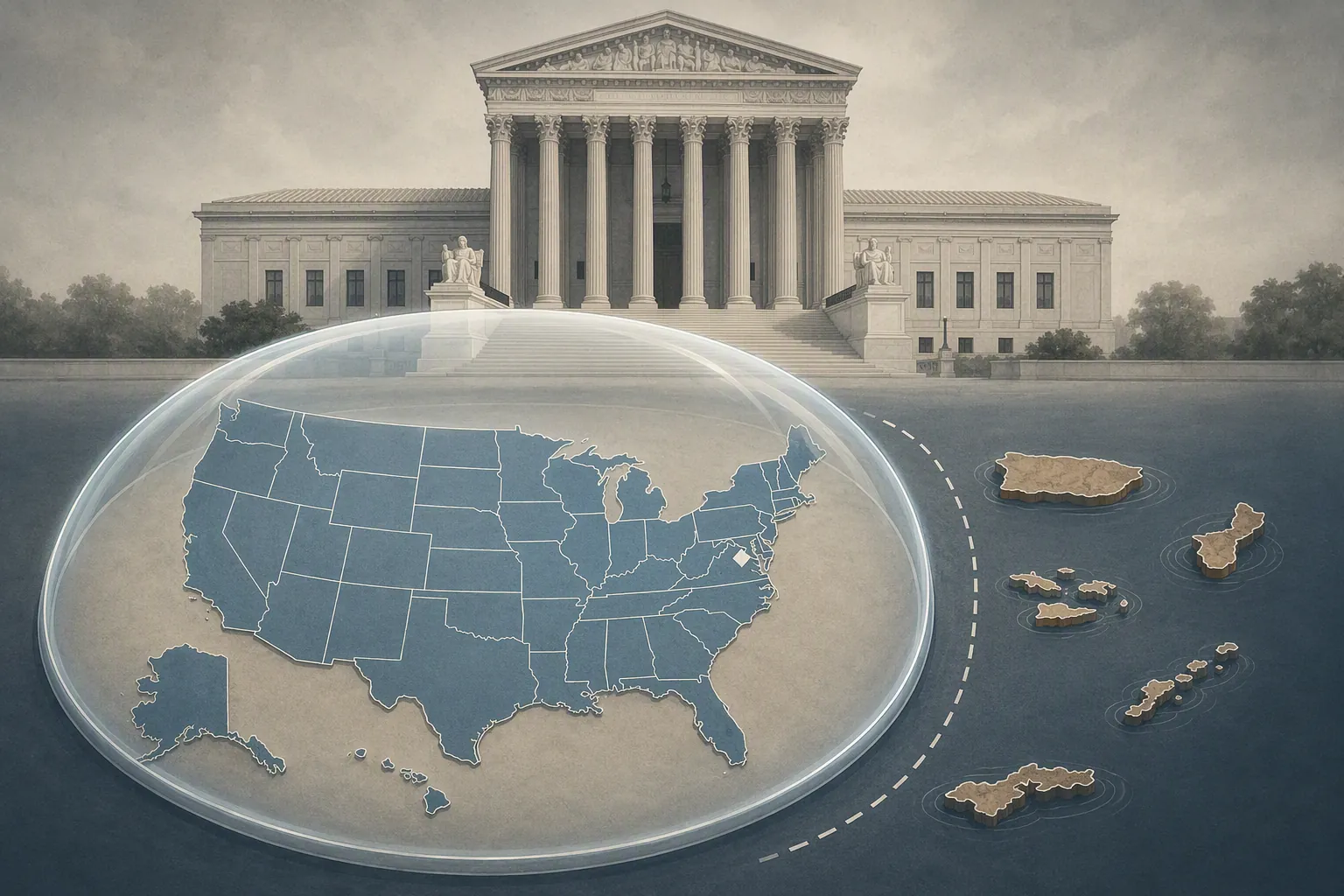
The Status Map Practitioners Actually Need
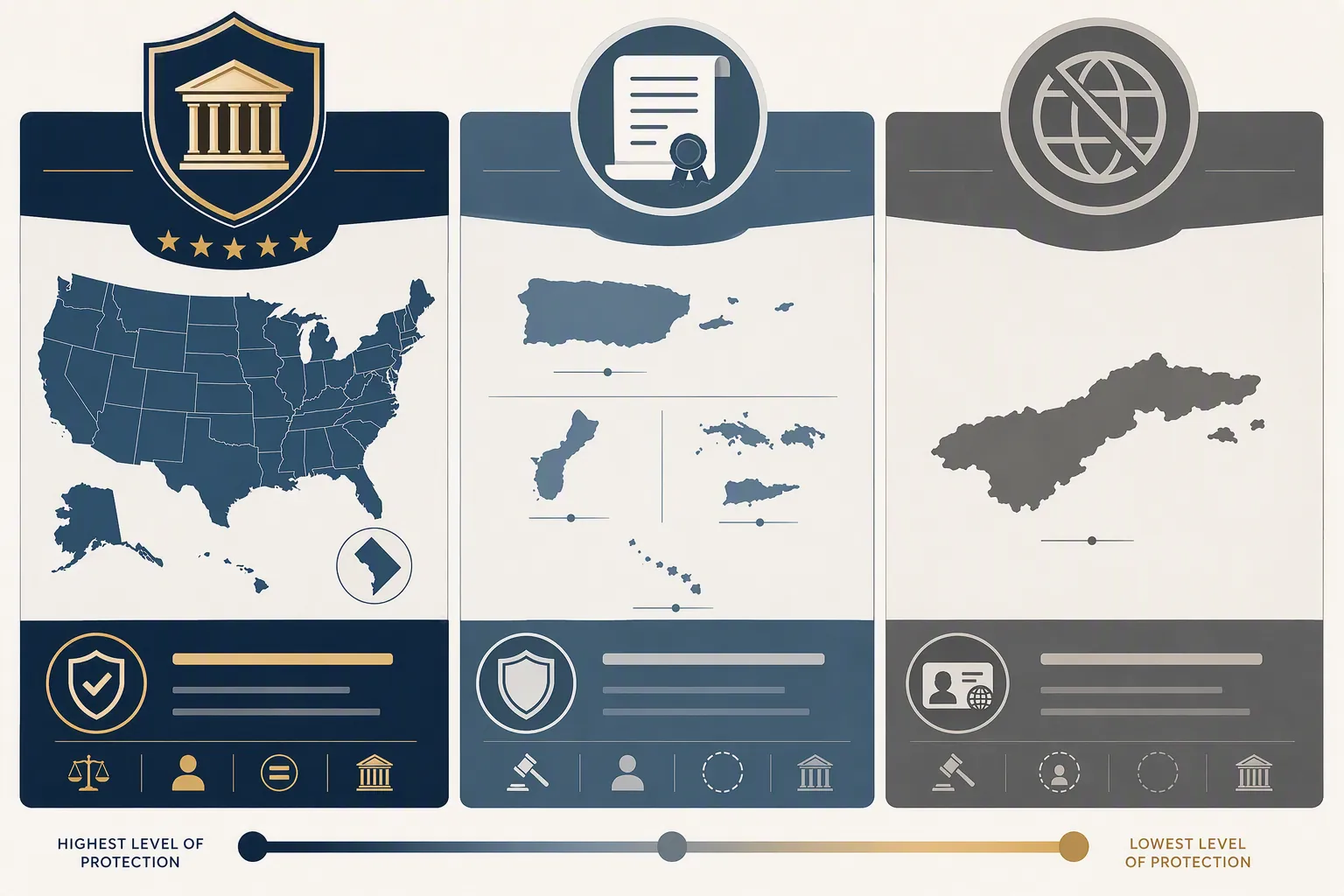
The practical split is not between “U.S.” and “foreign.” It is between constitutional citizenship, statutory citizenship, and non-citizen U.S. national status. The State Department’s 8 FAM 301.1 preserves those distinctions, and they should be reflected in intake, employment, litigation, clearance, and eligibility review. [3]
| Place of birth | Current status category | Why the distinction matters |
|---|---|---|
| 50 states and District of Columbia | 14th Amendment constitutional citizenship | Barbara reaffirmed this category as constitutionally protected birthright citizenship. |
| Puerto Rico, Guam, U.S. Virgin Islands, Northern Mariana Islands | Statutory citizenship under 8 U.S.C. §1401(a) and territorial organic acts | The person may be a U.S. citizen, but the source of that citizenship is statutory rather than the holding Barbara extended to the states and D.C. |
| American Samoa | Non-citizen U.S. national status | Birth in American Samoa does not confer U.S. citizenship; the resident population is about 54,000, and the distinction has already produced administrative harms. |
Puerto Rico, Guam, the U.S. Virgin Islands, and the Northern Mariana Islands should not be grouped with American Samoa. Their residents may hold U.S. citizenship by statute. American Samoans, by contrast, are U.S. nationals but not U.S. citizens by birth. The point is not to flatten these categories into one “territorial” box; the point is to stop letting the word “territorial” do work it cannot safely do. [3][4]
Why “Statutory” Is No Longer a Throwaway Label
Before Barbara, many files could absorb a loose status label without immediate consequence. The person had a U.S. passport, an employment record cleared, or a benefits form accepted. After Barbara, the same file can still be correct on outcome and weak on proof. The ruling did not strip citizenship from Puerto Rican, Guamanian, U.S. Virgin Islands, or CNMI-born citizens. It did, however, leave their citizenship outside the constitutional rule it announced for the states and D.C. [1]
That is where the statutory label becomes operational. Historical materials cited in the current debate have long treated territorial citizenship as a matter within Congress’s power. A 1989 Congressional Research Service memorandum described Congress’s plenary authority over territorial citizenship; a 1996 House Report asserted that Congress could alter Puerto Rican statutory citizenship; and a 2001 Department of Justice letter to the Senate Energy Committee entertained the argument that Congress could revoke statutory Puerto Rican citizenship under Rogers v. Bellei. Those materials do not mean revocation is imminent or judicially certain. They do mean a practitioner should not treat statutory citizenship as if it were indistinguishable from 14th Amendment citizenship for risk analysis. [5]
Justice Kavanaugh’s concurrence sharpened the same concern from a different angle. His view was that Congress could amend 8 U.S.C. §1401(a) to create new exceptions, offering a statutory route for territorial restrictions without requiring the Court to revisit every constitutional question at once. [6]
The Griffith bill belongs in that risk file, but with a bright caveat. Rep. Morgan Griffith announced the End Birthright Citizenship for Territories Act on July 16, 2026. According to the release, the bill would limit territorial birthright citizenship to children of U.S. citizens and lawful permanent residents, effective January 2027 if passed. Full bill text and committee status are not independently verified beyond the press release provided in the research record, and enactment prospects remain uncertain. [7]
That uncertainty is not a reason to ignore it. Pending legislation can be a warning signal without being treated as law. For a lawyer reviewing a live record, the relevant point is date sensitivity: a territorial-born person’s status may be secure under today’s statute, but the file should say which statute, which territory, and whether any pending proposal would matter prospectively if enacted.
American Samoa Shows the Damage Is Not Theoretical
American Samoa is the cleanest example of why status shorthand creates real administrative harm. It is the only inhabited U.S. territory where birth confers non-citizen U.S. national status rather than citizenship. That distinction has surfaced in security-clearance, voting, and candidate-eligibility settings: the U.S. Army stripped security clearances from long-time American Samoan service members; Oregon improperly registered American Samoans to vote in 2024; and Hawaii ruled an American Samoan candidate ineligible for state office. [4][8]
Those examples should not be inflated into a claim that every American Samoan record will fail review. They show something narrower and more important for practice: the distinction between citizen and non-citizen national already changes what agencies, employers, election officials, and courts may do with a record. Barbara did not resolve that category. It left it visible.
What to Verify Before Relying on Territorial Birth
The review should begin with the document, not the label someone typed into a form years earlier. A birth certificate, passport, certificate of citizenship, naturalization certificate, I-9 record, clearance questionnaire, voter registration, or pleading admission may all use citizenship language. They do not all prove the same legal basis.
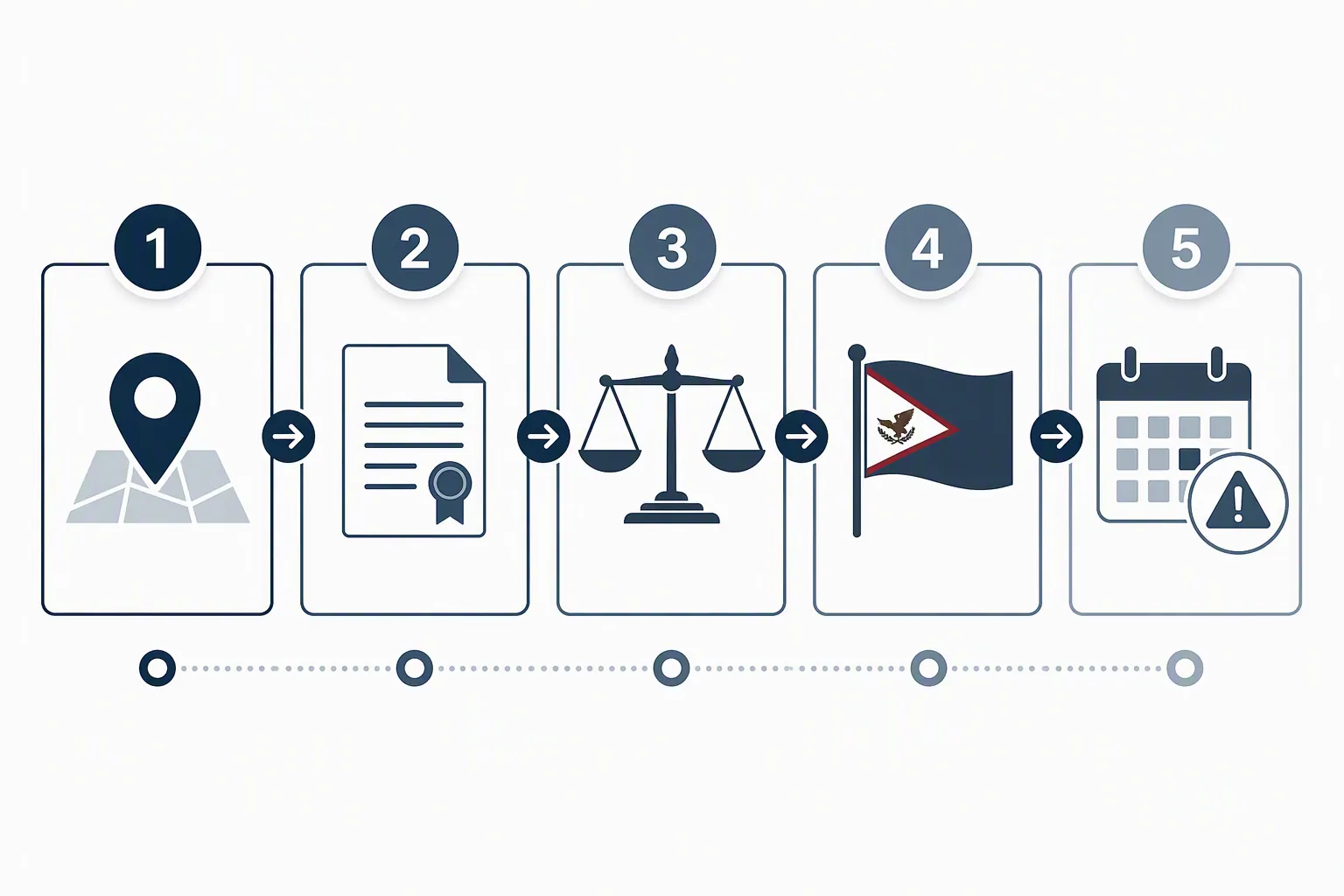
- Confirm the exact place of birth: state, D.C., Puerto Rico, Guam, U.S. Virgin Islands, CNMI, American Samoa, Swains Island, or another location.
- Identify the status basis: 14th Amendment citizenship, statutory territorial citizenship, naturalization, acquired or derived citizenship, or non-citizen U.S. national status.
- Separate statutory citizenship from naturalization: a Puerto Rico-born citizen under territorial statute is not in the same posture as a naturalized citizen, even if both are U.S. citizens.
- Flag American Samoan national status distinctly: do not convert “U.S. national” into “U.S. citizen” in internal systems, pleadings, HR records, or eligibility memoranda.
- Add a date-sensitive risk note where territorial statutory citizenship is material: cite the current legal basis and note any pending federal proposal only as pending, not enacted.
The employment setting is where bad shorthand tends to look harmless until it is not. An I-9 or E-Verify workflow may accept a document and move on, but the employer’s internal record still should not collapse all territorial birth into citizenship. If the employee was born in Puerto Rico, Guam, the U.S. Virgin Islands, or CNMI, the file should identify statutory citizenship. If the employee was born in American Samoa, the file should identify non-citizen U.S. national status and avoid assigning citizenship-dependent roles or attestations without further review.
In litigation, the same issue can surface through jurisdictional allegations, witness eligibility assumptions, immigration-history narratives, or government-benefit claims. A complaint that alleges “U.S. citizen by birth” may be accurate for one territorial-born plaintiff and imprecise for another. If citizenship is material to standing, eligibility, damages, intent, or statutory coverage, the pleading should state the basis rather than rely on geography alone.
For clearance and regulated-role review, the risk is slower but sharper. A person may have served, worked, voted, or held credentials for years before a later reviewer asks whether the original status assumption was correct. The American Samoan examples show how late correction can fall on the individual who trusted the system’s first answer. [4][8]
Where Denaturalization Review Fits
Denaturalization should not be casually imported into every territorial-born file. A person who is a citizen by territorial statute is not, for that reason alone, a naturalized citizen. The categories must stay clean: statutory citizenship, naturalization, and non-citizen national status are different legal pathways and carry different vulnerabilities.
The reason denaturalization still belongs in the risk conversation is enforcement posture. DOJ announced in June 2025 that denaturalization targeting individuals who “illegally procured” naturalization was a top enforcement priority, and the priority was reaffirmed in 2026. [5] When a territorial-born person also has a naturalization history, derivative claim, identity correction, prior immigration filing, or inconsistent status record, the review should move from a territorial-citizenship check into a denaturalization criteria review. The site’s July 27, 2026 Regulation & Ethics article, “Denaturalization Criteria and Legal Implications Under Trump,” is the natural companion analysis for that narrower question.
The sequencing matters. First determine whether the person’s status came from birth in a state or D.C., territorial statute, naturalization, acquired citizenship, or national status. Only then decide whether denaturalization exposure is even the right frame. A file that skips that step can overstate risk for one client and miss it for another.
The File Note Should Change Now
Barbara did not make territorial-born citizens lose citizenship. It made the old shortcut harder to defend. The constitutionally protected category is the 50 states and D.C.; the statutory citizenship category covers Puerto Rico, Guam, the U.S. Virgin Islands, and CNMI; and American Samoa remains a non-citizen national category. Those distinctions are not academic when an employer, court, agency, campaign, or clearance office later asks who verified the status and on what authority.
The safer record no longer says only “born in a U.S. territory.” It says the territory, the status category, the legal source of that status, and any date-sensitive statutory risk. That is the difference between a label that works until challenged and a file that can survive the challenge.
References
- Trump v. Barbara, No. 25-365, U.S. Supreme Court, June 30, 2026.
- Constitution Center explainer on Trump v. Barbara, Constitution Center, June 30, 2026.
- 8 FAM 301.1, U.S. Department of State.
- El Instituto/UConn explainer on territorial citizenship, El Instituto, University of Connecticut, February 21, 2025.
- Puerto Rico Report materials on DOJ, CRS, and territorial citizenship, Puerto Rico Report, April 2026.
- Stanford Law School analysis of Trump v. Barbara, Stanford Law School, July 7, 2026.
- End Birthright Citizenship for Territories Act press release, Rep. Morgan Griffith, July 16, 2026.
- SCOTUSblog piece by Neil Weare on American Samoan citizenship harms, SCOTUSblog.
Operationalizing workflow
No workflow has been explicitly linked to this obligation yet. See Workflows generally.
Illustrative cases
No illustrative case is currently tracked for this obligation. See Risk Digest for documented incidents generally.
← Back to RegulationReport a correction or tip
Spotted an outdated figure, a misstated fact, or a ruling this regulation entry should reflect? Public comments are disabled for this content given the professional cost of a misreported case outcome, penalty amount, or rule text — use the structured correction channel instead.
Report a correction or tip for this record →