
How Project 2025's Title IX changes shift risk from OCR to DOJ
- Effective date
- Jun 16, 2026
The June 16, 2026 agreement between the Department of Education and the Department of Justice did not rewrite Title IX. That is the first boundary institutions should keep clear. The legal implications of the Title IX enforcement change associated with Project 2025 are more procedural than textual: operational civil-rights enforcement moved out of Education’s Office for Civil Rights and into Justice’s enforcement machinery, where complaints are more likely to be developed through formal records demands, witness work, and litigation posture than through OCR’s familiar administrative-resolution rhythm.[1]
That distinction is easy to understate. Schools and colleges can comply with the same statute, cite the same policy language, and still face a different risk environment because the office asking the questions has changed. OCR historically functioned as a high-volume civil-rights intake and compliance office. DOJ is built to investigate, enforce, and, when necessary, litigate. The institution that treats this as a messaging change rather than a file-management change will discover the difference at the worst possible time.
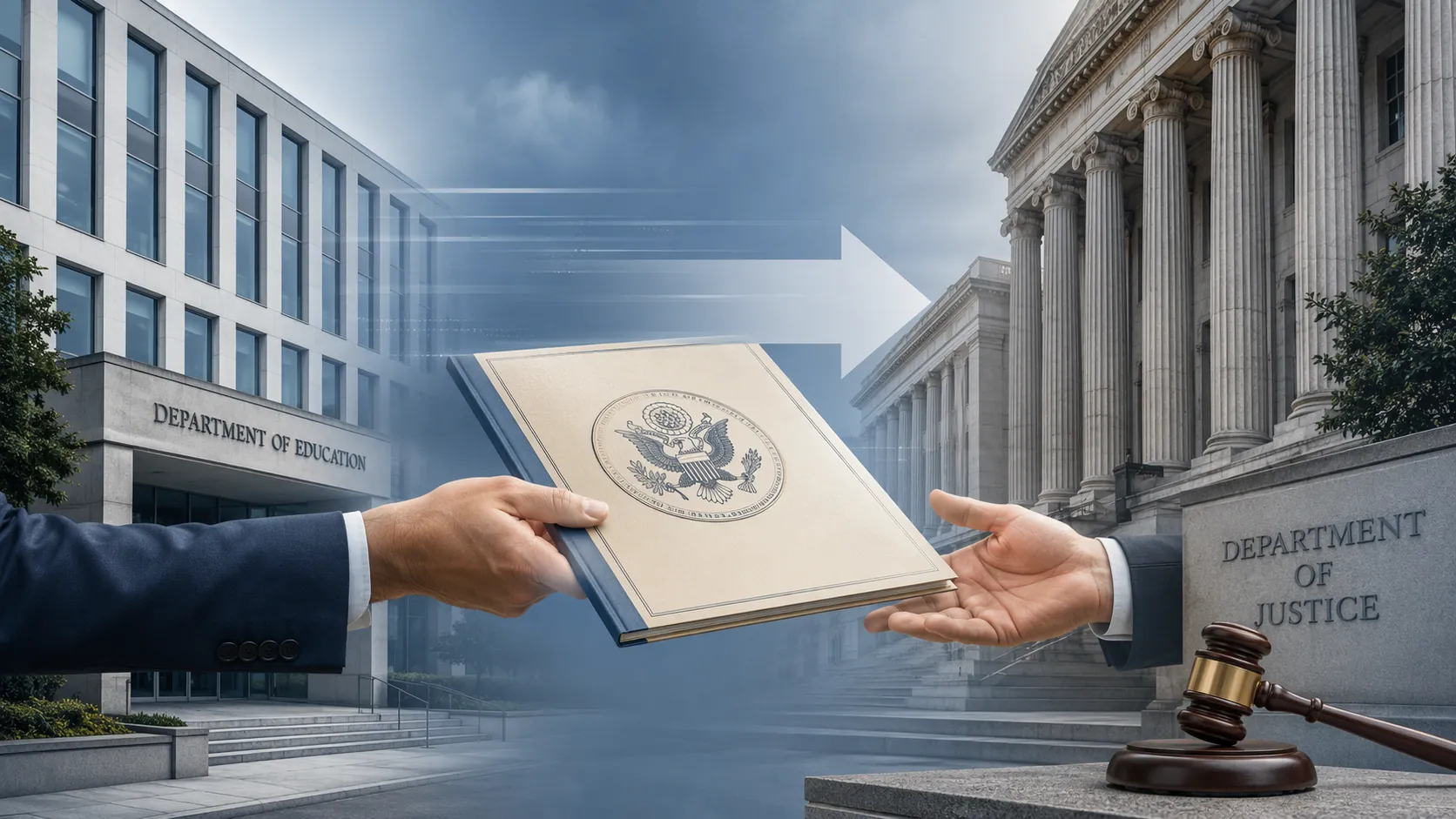
The Rule Stayed Put; the Enforcement Channel Did Not
Before the agreement, OCR was the place many institutions expected Title IX complaints to land when a matter moved beyond campus. Its process was administrative, and its institutional vocabulary was familiar: intake, data requests, voluntary resolution, corrective action, monitoring, technical assistance, and negotiated commitments. Counsel might be involved, but the system did not generally begin from the assumption that the matter was being built for court.
Littler’s June 26 analysis of the interagency agreement describes the change as a meaningful shift from OCR’s historically collaborative, resolution-driven model toward DOJ’s litigation-oriented fact-development approach, including formal data requests and witness interviews.[2] That description matters because it identifies the operational change, not merely the political one. A civil-rights complaint can look very different when the reviewing agency is trying to coach an institution into compliance than when it is developing an evidentiary record that could support enforcement.
The old OCR system was not small. In fiscal year 2024, OCR received 22,687 complaints, roughly 12,000 of them related to Title IX, and answered more than 11,000 public inquiries, according to figures cited from Education’s 2024 OCR report.[3] Those numbers do not predict what DOJ will receive or pursue. They do show the scale of the administrative pipeline that institutions had learned to navigate.
The comparison with federal court volume is blunt. Fewer than 1,000 education civil-rights cases were heard nationwide in federal courts in 2024, according to the same analysis.[3] OCR’s intake universe and the litigation universe were never the same thing. Moving operational enforcement toward DOJ does not automatically convert every complaint into a lawsuit, but it does move institutional exposure into a channel with a narrower funnel and a more formal record-building function.
| Question | OCR administrative model | DOJ enforcement model |
|---|---|---|
| Primary operating habit | High-volume intake, negotiated resolution, compliance monitoring | Formal fact development, legal review, potential judicial enforcement |
| Institutional posture | Cooperate, correct, document progress | Preserve, substantiate, defend process and rationale |
| Typical record pressure | Show responsiveness and corrective action | Produce records that can withstand adversarial scrutiny |
| Risk of informality | May complicate monitoring or negotiated resolution | May create evidentiary gaps in an enforcement record |
OCR Was Already Losing Its Administrative Capacity
The June transfer did not occur against a stable OCR backdrop. Inside Higher Ed reported in April 2026 that OCR resolved only 112 cases in all of 2025, the lowest total in more than a decade, after roughly 260 staff cuts and the closure of 7 of 12 regional offices.[4] The 112-case figure came from a Sanders-commissioned report cited in that coverage; it should be treated as reported, not as independently verified in this research cycle.[4]
Even with that caveat, the institutional lesson is not comforting. A lower number of OCR resolutions does not mean lower civil-rights exposure. It may mean the opposite operational problem: institutions that once expected OCR to move a matter toward negotiated correction may now encounter delay, triage, or transfer into a more adversarial enforcement channel. The risk has not disappeared merely because the old administrative cadence has weakened.
That point affects complainants and respondents as well as schools. A complainant may find fewer familiar OCR pathways for administrative pressure. A respondent may face a campus record that later becomes part of a federal enforcement file. Both sides have an interest in procedures that are documented, consistent, and intelligible to someone who was not in the room when the informal decisions were made.
Where Project 2025 Fits
Project 2025 should not be used as a substitute for reading the June agreement. But it is relevant because Chapter 11 of Mandate for Leadership proposed moving OCR to DOJ and limiting enforcement to intentional-discrimination litigation.[5] The June 2026 interagency agreement achieved the structural transfer. The available materials do not establish that DOJ enforcement is now limited exactly as Chapter 11 proposed; they do establish that the institutional architecture now resembles a central piece of that blueprint.[1][5]
For compliance offices, the practical significance is less about labeling the move and more about preparing for the office now likely to ask the next set of questions. If DOJ becomes the operational enforcement home, a school’s internal Title IX file needs to be legible as evidence, not merely as a narrative of good-faith engagement.
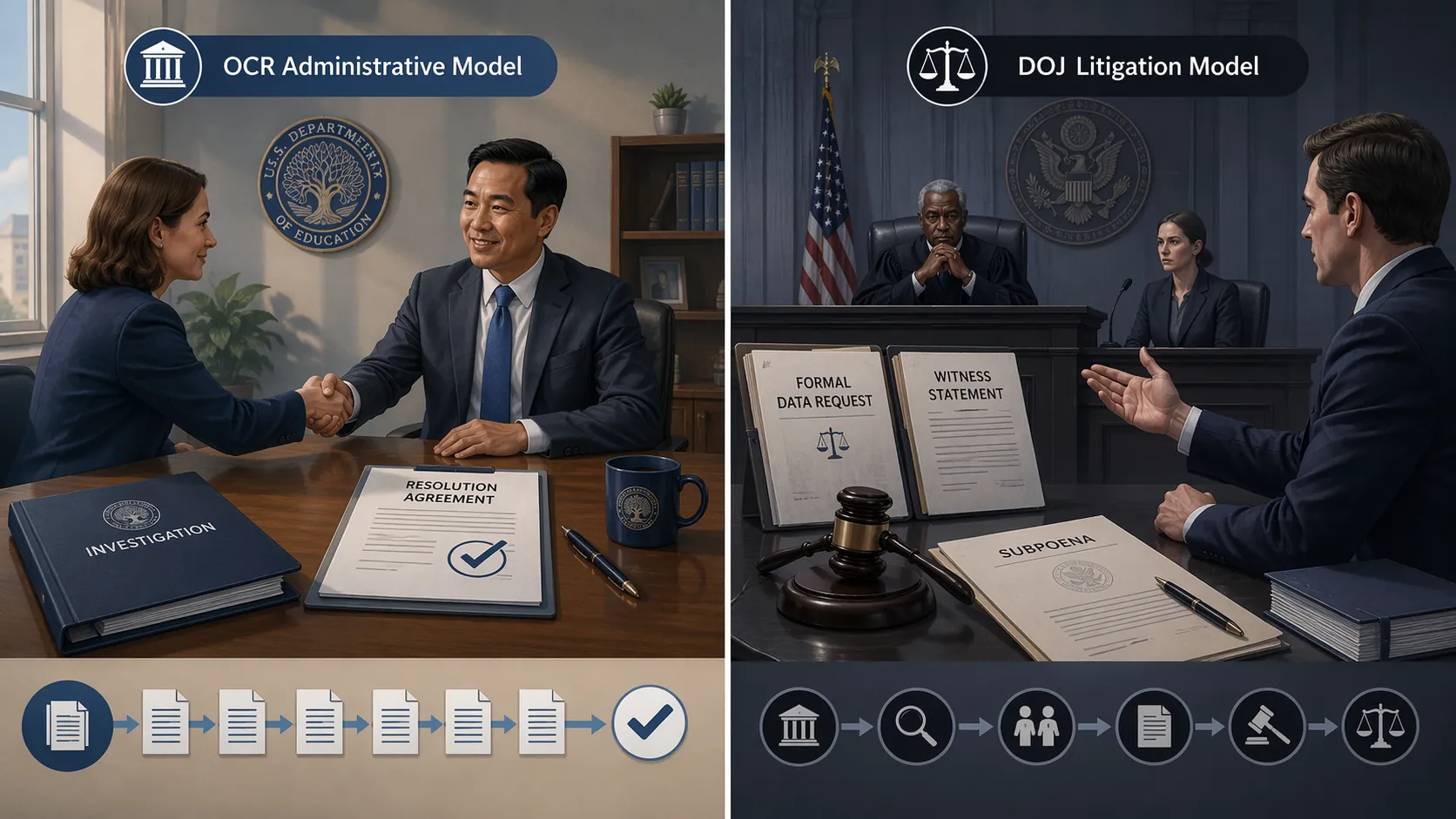
The File Now Has to Be Defensible Earlier
The most important adjustment is timing. Under a compliance-coaching model, institutions often expected to clarify gaps during the exchange: explain what happened, supplement the record, agree to corrective terms, and move into monitoring. Under a litigation-oriented model, the first production may frame the case. Missing chronology, inconsistent notices, undocumented supportive measures, or unexplained deviations from policy are not just administrative imperfections. They become vulnerabilities in the record.
ATIXA’s June 22 assessment states that the reshuffle requires audit-ready documentation, early legal engagement, and a higher standard of procedural rigor.[6] That is the right center of gravity. The institution does not need a theatrical litigation posture in every complaint. It does need to assume that a later reviewer may test each procedural choice against written policy, prior practice, communications, witness accounts, and the stated rationale for the outcome.
Audit-ready does not mean overproduced. It means the file answers basic questions without institutional memory doing the work: what policy version governed; when the school had notice; who assessed supportive measures; what was offered; what was accepted or declined; who interviewed whom; what evidence was considered; what credibility rationale was used; who reviewed the decision; and what remedy or discipline followed.
The danger zone is the informal resolution that depends on trust, speed, and undocumented side conversations. Informal resolution may still be appropriate where the governing rules allow it and the parties consent. But it is a poor defense strategy if the only surviving record is a handful of emails saying everyone wanted to move on. Once DOJ asks for records, the question is not whether administrators were trying to be constructive. It is whether the institution can prove what it did, why it did it, and whether it applied its process evenhandedly.
What Litigation Preparedness Means in Practice
Litigation preparedness is not a recommendation to make every campus matter combative. It is a discipline for preserving the institution’s ability to explain itself if the matter leaves campus. For Title IX coordinators, general counsel, and risk managers, that usually changes the work in six places.
- Formal data responses: maintain complaint logs, policy archives, training records, notice letters, supportive-measure records, investigation materials, hearing records, appeal materials, and remedy documentation in a form that can be searched and produced.
- Preserved communications: hold relevant emails, text-message exports where institutionally available, case-management notes, meeting summaries, and administrator communications before ordinary retention practices erase context.
- Witness-interview discipline: identify who conducted interviews, when they occurred, what was asked, what was said, whether follow-up occurred, and how conflicting accounts were assessed.
- Early counsel involvement: bring legal review in before the institution makes process choices that cannot be corrected later, especially where the complaint involves repeat allegations, employee respondents, athletics, minors, retaliation claims, or public controversy.
- Policy-version tracking: preserve the exact policy and procedure in effect at the time of the alleged conduct, the report, the investigation, and the decision if those dates cross regulatory or institutional changes.
- Rationale writing: state decision grounds in a way that connects evidence, standard of proof, credibility analysis, policy definitions, and remedy selection without relying on conclusory phrases.
The practical burden will fall unevenly. A large university may already have a case-management platform, litigation hold procedures, and counsel embedded in the escalation path. A small district may have one administrator, outside counsel on call, and inconsistent documentation habits across buildings. DOJ-facing enforcement pressure does not wait for those differences to become convenient.
Selective Enforcement Is Still Enforcement
There is not yet enough public evidence to say exactly how DOJ will allocate Title IX matters under the new arrangement. The early record supports a narrower conclusion: DOJ is active, and it appears capable of using directed initiatives rather than reproducing OCR’s broad intake model.
On July 10, 2026, DOJ announced a K-12 sexual misconduct initiative involving 20 directed investigations, according to ICS Lawyer’s July 21 discussion.[7] That is not proof of a complete enforcement pattern. It is, however, a useful signal for districts that assumed the transfer would mean less federal attention to Title IX sexual misconduct. A smaller, more selective channel can still create higher-stakes matters for the institutions selected.
The K-12 context also makes the law-enforcement coordination problem more concrete. Schools often must manage Title IX obligations while criminal investigations, child-protection duties, personnel rules, and parent communications are unfolding. Waiting for police or prosecutors to finish their work may feel cautious, but it can leave the school unable to show that it met its own civil-rights obligations on time. The federal reviewer will ask what the institution did with the notice it had, not merely whether another authority was also investigating.
State Law Makes the Record More Complicated
Federal restructuring does not erase state nondiscrimination regimes, state education rules, collective-bargaining constraints, or local board policy. In states with separate protections or reporting obligations, the institution may have to satisfy a federal enforcement reviewer while also complying with state requirements that use different definitions, timelines, or protected categories. That dual-obligation problem deserves jurisdiction-specific legal analysis; it should not be solved by assuming the federal shift controls every other duty.
The documentation answer is more portable than the legal answer. Where obligations overlap, the file should identify which authority triggered which step. If a supportive measure was required by campus policy, say so. If a notice went out because state law required it, preserve that basis. If counsel limited an interview to avoid interfering with a criminal investigation, document the reason and the follow-up plan. Ambiguity may feel flexible in the moment; later, it reads as confusion.
What Institutions Should Stop Assuming
The first assumption to retire is that fewer OCR-style resolutions mean fewer Title IX problems. The better assumption is that unresolved, weakly documented, or politically sensitive matters may move into a channel where the cost of reconstructing the record is higher.
The second assumption is that cooperation will substitute for proof. Cooperation still matters. It may affect tone, timing, and resolution. But cooperation without a reliable file leaves the institution asking a federal enforcement lawyer to accept intent in place of evidence.
The third assumption is that Title IX work can remain siloed in the coordinator’s office until a matter becomes visibly serious. The coordinator may own the process, but litigation preparedness requires records management, IT, student affairs, athletics, human resources, campus safety, school leadership, and counsel to know their roles before a demand arrives.
None of this requires treating every complaint as a federal case from day one. It requires building a record that can survive if one arrives. The law may not have changed, but the enforcement mechanism has moved into a more formal, adversarial, evidence-sensitive channel. Institutions that keep operating as though OCR’s old rhythm still governs the risk will be defending yesterday’s process in tomorrow’s forum.
References
- ED Shifts Some Civil Rights Enforcement to Justice Department, Inside Higher Ed, June 16, 2026.
- The New DOE–DOJ Interagency Agreement: A Meaningful Shift in Civil Rights Enforcement, Littler, June 26, 2026.
- Title IX's effectiveness in addressing campus sexual assault is at risk, The Conversation.
- Civil Rights Office Resolved Just 112 Cases Last Year, Inside Higher Ed, April 29, 2026.
- Mandate for Leadership: The Conservative Promise, Heritage Foundation.
- Title IX, IDEA, and the Federal Reshuffle of Civil Rights Enforcement, ATIXA, June 22, 2026.
- Tuesday Takeaway: A Familiar Title IX Expectation Reemerges, ICS Lawyer, July 21, 2026.
Operationalizing workflow
No workflow has been explicitly linked to this obligation yet. See Workflows generally.
Illustrative cases
No illustrative case is currently tracked for this obligation. See Risk Digest for documented incidents generally.
← Back to RegulationReport a correction or tip
Spotted an outdated figure, a misstated fact, or a ruling this regulation entry should reflect? Public comments are disabled for this content given the professional cost of a misreported case outcome, penalty amount, or rule text — use the structured correction channel instead.
Report a correction or tip for this record →