
Three Ethics Conflicts Behind the Todd Blanche Confirmation Delay
- Authority
- U.S. Senate Judiciary Committee
- Rule type
- confirmation proceeding
- Jurisdiction scope
- US federal
- Effective date
- Jul 30, 2026
- Source text
- Read primary rule text ↗
Verify DOJ signatory, authority basis, and recusal status before relying on agency actions while the AG nomination is pending.
Status record: what changed on July 30
Last verified for this record: July 31, 2026, UTC. The planned July 30 Senate Judiciary Committee vote on Todd Blanche’s attorney general nomination was scrapped after Republican Sens. John Cornyn and Thom Tillis withheld support over the proposed $1.8 billion Anti-Weaponization Fund tied to a Trump-IRS settlement; President Trump also said he may temporarily pull the nomination and resubmit it after Cornyn and Tillis leave office. That is the operative status of the Todd Blanche attorney general confirmation delay in 2026, not a completed vote waiting to be ceremonially recorded. [1]
| Question | Current working answer | Why it matters |
|---|---|---|
| What category is this record? | Regulation and ethics: DOJ leadership authority, recusal conditions, and reliance on agency action. | The useful question is not whether the nomination is politically awkward; it is whether a DOJ action can be relied on while leadership status and ethics conditions remain unsettled. |
| What is the nomination status? | The July 30 committee vote did not proceed; the White House floated a possible temporary withdrawal and later resubmission. [1] | A delayed, possibly paused nomination is different from a defeated nomination. The record should be rechecked before any filing or client update. |
| Is this the same as Blanche’s 2025 Deputy Attorney General confirmation? | No. The earlier Deputy Attorney General confirmation is a separate completed matter. It does not answer the 2026 Attorney General nomination question. | Search results and quick briefings are already conflating two different Senate actions. |
| Is DOJ leaderless while the nomination stalls? | No. The reported issue is not an empty chair; Blanche remains positioned to perform DOJ leadership functions while the AG nomination is delayed. [1] | For practitioners, the problem is verification of authority and recusal status, not the absence of a decisionmaker. |
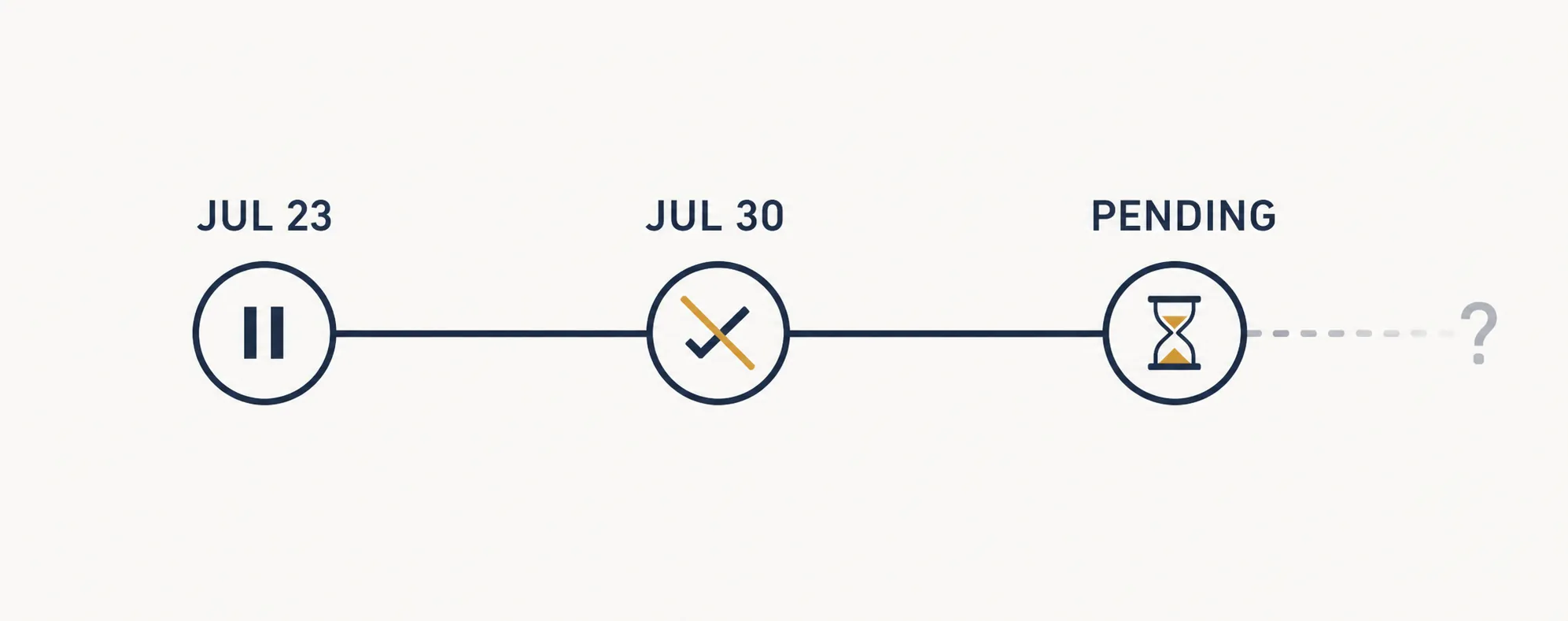
The dated record points to ethics objections, not routine calendar slippage
A committee hold can be mundane. This one is harder to treat that way because the public record now ties the delay to three ethics and recusal disputes, with the Anti-Weaponization Fund conflict doing the immediate work of stopping the July 30 vote.
| Date | Event | Source significance |
|---|---|---|
| Apr. 7, 2025 | DOJ issued the “Ending Regulation by Prosecution” memorandum on digital-asset enforcement priorities. [3] | The memo is the official DOJ artifact that the crypto-conflict allegations point back to. |
| Jan. 28, 2026 | Six senators sent a letter alleging a “glaring conflict of interest” involving Blanche, DOJ cryptocurrency enforcement, and Trump-related financial interests. [2] | This is an opposition letter, not an adjudicated finding, but it identifies the crypto-recusal issue in dated, source-linked form. |
| Apr. 23, 2026 | DOJ’s Office of the Inspector General opened an audit of the Department’s compliance with the Epstein Files Transparency Act. [4] | An OIG audit notice is not a finding of violation. It is, however, a live oversight marker on a politically and ethically sensitive DOJ file set. |
| May 18, 2026 | DOJ announced the Anti-Weaponization Fund. [5] | This is the official DOJ announcement that later became central to Republican objections to the AG nomination vote. |
| July 23, 2026 | The Senate Judiciary Committee held over the vote on Blanche’s AG nomination. [6] | The hold created the first visible Senate delay, before the vote collapse became tied to Republican demands over the settlement and fund. |
| July 29, 2026 | PBS/AP reported Blanche’s nomination was at risk of delay as Cornyn sought assurances on the Trump-IRS settlement. [7] | This is the bridge between a procedural hold and the specific ethics objection. |
| July 30, 2026 | The committee vote was scrapped after Cornyn and Tillis withheld support; Trump said he may temporarily pull the nomination and resubmit it later. [1] | This is the current operative event and should be reverified before publication or reliance. |
The settlement and fund dispute is what scrapped the vote
The Anti-Weaponization Fund deserves the most attention because it is not merely one more criticism attached to Blanche’s nomination. It is the issue that PBS/AP identified as causing Cornyn and Tillis to withhold support from the planned committee vote, after Cornyn sought assurances about the Trump-IRS settlement. [1][7]
The record also matters because the disputed ethics question sits beside an official DOJ act. DOJ announced the Anti-Weaponization Fund on May 18, 2026; the Senate fight then centered on a proposed $1.8 billion fund created through a Trump-IRS settlement that PBS/AP reported was signed by Blanche. [5][1] That connection is why this is not just a nomination-side controversy. The same person whose confirmation vote is now unstable remained linked to a Department action that lawyers may need to evaluate, cite, challenge, or distinguish.
The cautious formulation is important. The available record supports that Republican support for the committee vote failed over the settlement-and-fund dispute; it does not support declaring every related DOJ act invalid. For a practitioner, the immediate consequence is narrower and more useful: any filing, settlement analysis, or client memo that assumes continuity in DOJ’s position should identify the signatory, authority basis, recusal status, and any later leadership change.
That is especially true where a lawyer is relying on a DOJ approval rather than merely describing public events. A partner asking whether a federal settlement posture is stable does not need a prediction market on Blanche’s nomination. The better answer is a dated authority chain: who signed, in what capacity, under what ethics conditions, whether the matter touched a recusal category, and whether DOJ has since reaffirmed or modified the position.

The Epstein audit and crypto record widen the same problem, but with different proof
Epstein Files Transparency Act audit
The DOJ Office of the Inspector General opened an audit on April 23, 2026, of the Department’s compliance with the Epstein Files Transparency Act. [4] That is a live oversight proceeding, not a completed misconduct finding. It belongs in this record because the nomination delay is being evaluated against unresolved recusal and ethics concerns across DOJ files, and the Epstein materials are one of the sensitive file sets now under independent audit.
This article does not need to retell the survivor-facing implications in full. For that treatment, see Epstein Survivors’ Protest as a Stress Test for DOJ Ethics and Blanche Confirmation Raises Legal Risks for Epstein Accusers. The narrower point here is institutional: an OIG audit creates another file where counsel should avoid assuming that public DOJ posture, nomination testimony, and recusal obligations are aligned unless the documents show it.
Crypto-conflict record
The crypto issue rests on a different source mix. The January 28 letter from six senators alleges a “glaring conflict of interest” involving Blanche, cryptocurrency enforcement, and Trump-related financial interests. [2] The official DOJ document on the policy side is the April 7, 2025 memorandum titled “Ending Regulation by Prosecution,” which changed the Department’s stated digital-asset enforcement posture. [3]
Those two documents should not be collapsed into the same kind of proof. The DOJ memorandum establishes what DOJ said and did as a policy matter. The senators’ letter establishes that a conflict objection was raised in a dated form and directed at Blanche. It does not, by itself, prove that an ethics official found a violation or that a particular digital-asset case is tainted.
Advocacy and opposition materials can still help identify the document trail. Alliance for Justice’s nominee tracker and Campaign Legal Center’s complaint are useful for issue spotting, but they should not substitute for DOJ orders, OGE materials, committee responses, or OIG records when the question is whether an agency action can be relied on. [8][9]
For broader litigation-risk framing on the same cluster, see Todd Blanche Faces Multiple Ethics Proceedings as Confirmation Stalls and Four Litigation Risks From the Todd Blanche Confirmation Controversy. This record stays with the confirmation-status problem and the verification burden it creates.
Why this is not an empty-seat problem
The most common bad briefing on this situation will say DOJ is in limbo because the attorney general vote was delayed. That skips the more useful distinction. PBS/AP’s account treats Blanche as continuing to perform DOJ leadership functions while the nomination is delayed, which means lawyers still face Department decisions, signatures, negotiations, and approvals. [1]
An acting arrangement reduces one kind of uncertainty and creates another. It reduces the empty-seat problem because there is still an official positioned to act. It increases the verification problem because any later dispute may turn on capacity, delegation, recusal, ethics undertakings, or whether a successor reaffirms the position.
The earlier Deputy Attorney General confirmation does not cure that problem. It may explain why Blanche holds or held a DOJ leadership office, but it does not answer whether the Senate will confirm him as Attorney General in 2026, nor does it resolve whether he should have participated in a particular Trump-related, Epstein-related, or crypto-related matter.
What to verify before relying on a DOJ action
Until the nomination status is resolved, the durable work is document control. Before relying on a DOJ approval, settlement position, declination, enforcement posture, or public assurance connected to Blanche’s authority, build the file as if a court, client, or counterparty may later ask exactly which authority chain was checked.
| Verification point | What to look for | Practical consequence |
|---|---|---|
| Current leadership capacity | Confirm whether the relevant DOJ action was taken by the Attorney General, Acting Attorney General, Deputy Attorney General, or another delegated official, and verify the date of that capacity. | Do not cite “DOJ approved” when the real question is who approved and under what authority. |
| Signatory and scope | Pull the actual settlement, approval letter, memorandum, or public notice. Record the signatory, title, date, and subject matter. | If the matter touches the Anti-Weaponization Fund or Trump-IRS settlement, the signatory issue is not background; it is part of the risk analysis. |
| Recusal status | Check for any recusal memo, ethics agreement, waiver, screening instruction, or later clarification that covers Trump-related matters, Epstein materials, or crypto enforcement. | A delayed confirmation does not automatically taint an action, but an undisclosed or unresolved recusal condition can change how safely the action can be invoked. |
| OGE agreement and committee responses | If relying on Office of Government Ethics materials or Senate Judiciary Committee questions-for-the-record responses, open the PDFs directly before quotation or client use. | Secondary summaries are not enough for language that may become a filing representation. |
| Matter-specific oversight | For Epstein Files Transparency Act issues, check the OIG audit page for status changes. For crypto issues, distinguish DOJ’s policy memo from senators’ conflict allegations. | An audit notice, policy memo, and opposition letter do different evidentiary work. |
| Later status change | Recheck whether the nomination was reactivated, withdrawn, resubmitted, reported out of committee, or superseded by a different nominee. | A memo accurate on July 31 can become stale quickly if the White House or Senate changes the procedural posture. |
| Successor or reaffirmation risk | If a DOJ action is material to a settlement, transaction, compliance decision, or litigation deadline, look for later reaffirmation or modification by DOJ leadership. | The legal question may be less whether the first action existed and more whether DOJ will stand behind it after the leadership dispute. |
The July 30 delay matters because unresolved ethics and recusal questions now sit beside continuing DOJ authority. That combination does not justify treating every Department act as invalid. It does justify slowing down long enough to verify the authority chain before a lawyer relies on the act as settled federal policy.
References
- Trump says he may temporarily pull Blanche’s nomination for attorney general as Republicans seek concessions — PBS NewsHour/AP, July 30, 2026
- Letter from Senators to Deputy Attorney General Todd Blanche Regarding Cryptocurrency Conflicts — U.S. Senator Mazie K. Hirono, January 28, 2026
- Ending Regulation by Prosecution — U.S. Department of Justice, April 7, 2025
- Audit of the Department of Justice’s Compliance with the Epstein Files Transparency Act — U.S. Department of Justice Office of the Inspector General, April 23, 2026
- Justice Department Announces Anti-Weaponization Fund — U.S. Department of Justice, May 18, 2026
- U.S. Senate Judiciary holds over vote on Blanche nomination for AG; Grassley slams Dems — News From The States, July 23, 2026
- Blanche nomination at risk of delay as Sen. Cornyn seeks assurances on Trump-IRS settlement — PBS NewsHour/AP, July 30, 2026
- Todd Blanche — Alliance for Justice
- CLC Complaint Calls for Investigation into Crypto Conflict at DOJ — Campaign Legal Center
Operationalizing workflow
No workflow has been explicitly linked to this obligation yet. See Workflows generally.
Illustrative cases
No illustrative case is currently tracked for this obligation. See Risk Digest for documented incidents generally.
← Back to RegulationReport a correction or tip
Spotted an outdated figure, a misstated fact, or a ruling this regulation entry should reflect? Public comments are disabled for this content given the professional cost of a misreported case outcome, penalty amount, or rule text — use the structured correction channel instead.
Report a correction or tip for this record →