
What the Supreme Court TPS Ruling Means for Employer I-9s
- Authority
- U.S. Supreme Court
- Rule type
- Supreme Court decision
- Jurisdiction scope
- US federal
- Effective date
- Jun 25, 2026
- Source text
- Read primary rule text ↗
Reverify I-9 work authorization for employees with TPS-based EADs expiring July 10, 2026
As of July 27, 2026, the Supreme Court’s temporary protected status decision has an immediate impact for employers: it is a file-room problem before it is a constitutional-law problem. If an I-9 record contains a TPS-based employment authorization document for an affected Haitian or Syrian worker, the date that matters right now is July 10, 2026: the work-permit expiration date USCIS identified for most affected workers, subject to further district-court implementation orders after remand.[1]
That date should not be treated as final in the casual sense, because the district court still has implementation work to do. It also should not be treated as optional. The safe operating assumption for counsel and HR is that a July 10 EAD expiration in the employer’s own I-9 records has already become an active reverification issue. Future litigation may change pieces of the timeline, but it does not give an employer permission to ignore an expired work-authorization document while waiting for a cleaner answer.
This is not individualized legal advice. It is a regulation-and-ethics compliance read: identify the records, verify the current primary-source status, document the reverification path, and do not let “we thought something might change” become the explanation for continued employment after work authorization has lapsed.

What Mullin changed for employers
Mullin v. Doe was decided on June 25, 2026, by a 6-3 Supreme Court vote. Justice Alito’s opinion held that the statutory bar on judicial review reaches not only the final decision to terminate TPS, but also the predicate steps leading to that decision. In practical terms, failure-to-consult and arbitrary-and-capricious challenges no longer function as procedural brakes on the termination of TPS for the affected Haitian and Syrian holders.[2]
That is the reason the ruling matters to an employer with I-9s in a drawer or an electronic verification system. Before Mullin, some employers could plausibly assume that litigation might keep the operative TPS work-authorization framework in place long enough to avoid an immediate employment decision. After Mullin, that assumption is weaker. The procedural objections have largely fallen away, and the compliance calendar now has to be managed against the expiration date currently identified by USCIS and whatever implementation orders follow.[1][2]
Justice Kagan’s dissent matters here less as a prediction of who will ultimately win in the district court and more as a warning about the procedural vacuum left behind. If the process has fewer reviewable guardrails, employers cannot build their compliance plan around the expectation that a court will restore them at the last moment.[2]
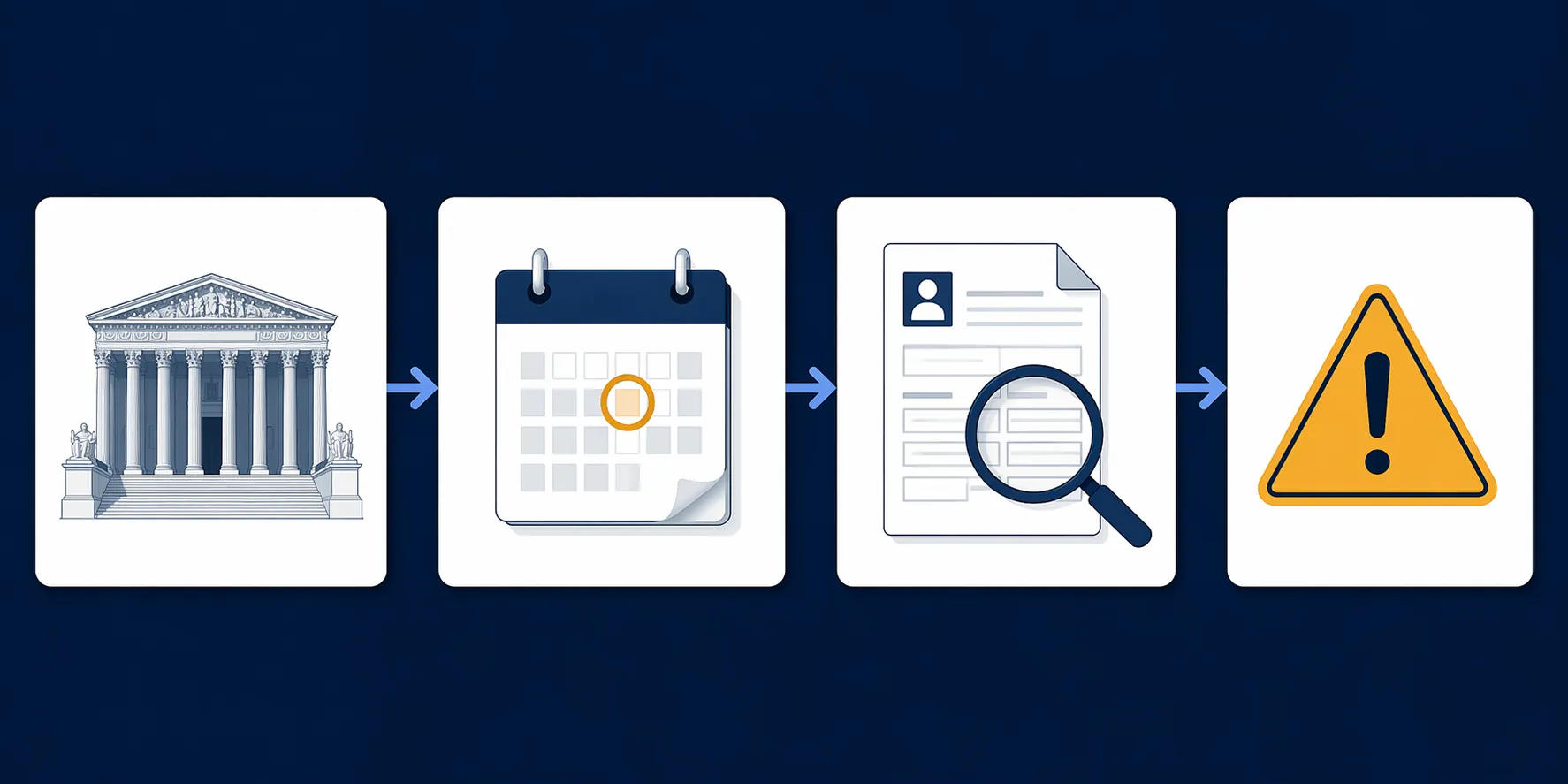
The deadline-to-liability chain
The chain is short, which is exactly why it is dangerous to overcomplicate it.
| Link in the chain | Employer consequence |
|---|---|
| Mullin removes key procedural challenges to TPS termination for Haitian and Syrian holders.[2] | Prior assumptions that litigation would keep work authorization intact are less reliable. |
| USCIS identified July 10, 2026, as the current work-permit expiration date for most affected Haitian and Syrian TPS holders, with implementation details still subject to district-court orders.[1] | The employer must track the date as current and live, not as a distant contingency. |
| An expired EAD in an I-9 file triggers the need to reverify work authorization. | The employer should not continue relying on the expired document. |
| Continuing employment despite an expired authorization record can support constructive-knowledge exposure under IRCA’s employer-liability framework.[2] | A good-faith “wait and see” explanation is not a safe harbor if the employer had the expiration information in its own records. |
The constructive-knowledge problem is not theoretical. The employer does not need to have intended to violate the law. The risk is that the employer’s own records show the expiration date, the date passes, and the person remains on payroll without timely reverification or another documented basis for work authorization. That is the kind of avoidable record fact that turns a sympathetic human situation into an employer-liability file.
There is also a narrow but important distinction between tracking a shifting court date and postponing action. Tracking means assigning someone to check USCIS, DHS, and docket updates, then updating affected I-9 records and employee communications accordingly. Postponing means leaving July 10 in the system while hoping the legal environment will improve. The first is compliance. The second becomes harder to defend after the date has passed.
Why alternative status will not solve this for most workers
The most painful part of this compliance event is that many affected workers have done exactly what the system asked of them: registered for TPS, renewed documents, worked lawfully, paid taxes, and built households around valid authorization. The problem is timing. The available alternatives are not designed to absorb a sudden July 10 EAD cliff.
Asylum is not a quick substitute for a lapsed TPS-based work permit. Family-based routes, including marriage-based green cards, may involve eligibility, admissibility, processing, and travel complications that cannot be cleared on demand. Employment-based sponsorship has its own timing, category, and processing constraints. The administration’s concurrent travel-ban-related processing pauses add another barrier for some applicants. The result is not that every worker lacks any possible immigration path; it is that most affected workers cannot reliably convert one into new work authorization before the EAD problem lands in the employer’s I-9 system.[1]
That timing bottleneck is what makes reverification unavoidable. If a worker presents a valid, acceptable document, the employer records it. If the worker cannot, the employer has to confront the employment consequence. Sympathy does not cure the I-9 defect, and the employee’s lawful history does not extend an expired EAD by itself.
The numbers show where the deadline will hurt, not which files are safe
Enrollment data in the current TPS policy record put the affected Haitian TPS population at 330,735 and the Syrian TPS population at 3,860 as of March 31, 2025. FWD.us also reports that about 85% of Haitian TPS holders live in mixed-status households.[3]
The household figure is not an I-9 rule, but it matters. When a work permit expires, the consequence does not stay inside the HR system. It follows rent, child care, elder care, transportation, and family members whose own status may be different. Employers still have to apply the work-authorization rules, but the human fallout is not a rounding error.

FWD.us estimates that 830,000 TPS holders are in the U.S. labor force, including 132,000 in construction, 128,000 in wholesale and retail, 122,000 in leisure and hospitality, 112,000 in transportation and warehousing, and 52,000 in health services.[3]
| Sector | FWD.us labor-force estimate |
|---|---|
| Construction | 132,000 TPS workers[3] |
| Wholesale and retail | 128,000 TPS workers[3] |
| Leisure and hospitality | 122,000 TPS workers[3] |
| Transportation and warehousing | 112,000 TPS workers[3] |
| Health services | 52,000 TPS workers[3] |
Those figures are useful for scale, not for audit precision. FWD.us is an advocacy organization, and its economic estimates rely on ACS-based modeling in 2024 dollars. Its reported $29 billion annual GDP contribution, $7.8 billion in taxes, and $262 billion cumulative contribution since 2001 should be read as directional evidence of exposure, not as numbers an employer can plug into a loss-reserve model without further review.[3]
The Haiti-specific care figures are harder to set aside. FWD.us estimated in January 2026 that 13,000 Haitian TPS nursing assistants care for about 65,000 patients daily; 3,000 school assistants serve 57,000 students; and 22,000 cooks and servers provide 880,000 meals daily.[4]
That is where the July 10 date becomes a scheduling problem inside nursing homes, schools, kitchens, delivery routes, hotels, and construction crews. McKnight’s Senior Living reported provider-group warnings that the decision could mean “limiting nursing home admissions, closing units or turning away requests for home care.”[5] That warning is not an exemption from reverification. It is a reminder that contingency planning has to happen before a supervisor discovers that a shift cannot be staffed lawfully.
How counsel and HR should work the file now
The cleanest posture is boring and documented. Employers should start with records, not rumors about who may be Haitian, Syrian, or connected to TPS.
- Pull I-9s and employment-authorization records that show TPS-linked EAD expiration exposure, including records carrying the July 10, 2026 date.
- Assign an owner for primary-source monitoring, including USCIS, DHS, and relevant court orders after remand.
- Separate employees into operational buckets: already reverified, pending reverification, unable to present current work authorization, and under counsel review.
- Document employee communications and document-review steps without turning the process into a nationality-based sweep.
- Prepare staffing contingencies for roles where a sudden authorization loss affects patient care, elder care, food service, transportation, construction schedules, or safety coverage.
- Escalate unresolved cases to immigration counsel before payroll continues past the document issue.
The internal record should show more than concern. It should show the date checked, the source checked, the employee contacted, the document reviewed or not produced, the decision-maker, and the employment action taken. If the answer later changes because a court order or agency update changes the operative date, the file should show why the employer changed course.
This is the same kind of obligations-tracker discipline used in other regulation-and-ethics compliance calendars, such as the site’s coverage of AI literacy becoming a school legal requirement. The subject matter is different, but the file logic is familiar: identify the obligation, attach a date, assign an owner, and preserve the update trail.
What remains unsettled
The July 10 date remains current and important, but it is not the only fact counsel should monitor. District-court implementation orders can still affect timing. Other TPS designations and related litigation may be affected by Mullin’s reasoning, but they should not be assumed to move on the same date or in the same procedural posture without checking the active orders.
Justice Thomas’s solo concurrence also should not be overweighted. It is not the controlling rule in Mullin. For employer compliance, the binding point is narrower and more immediate: the procedural challenges that many affected workers were relying on no longer block termination in the same way, and the employer’s I-9 obligations do not pause while lawyers debate the next constitutional theory.[2]
The bounded compliance posture is therefore straightforward. Identify TPS-linked EADs. Track the current expiration date against primary-source updates. Reverify where required. Build staffing contingencies where lawful work authorization cannot be documented. Do not rely on good-faith delay as a safe harbor when the expiration date is sitting in the employer’s own file.
For counsel, HR, and compliance staff, this is not a one-time explainer to circulate and archive. It is a live obligations tracker, and it should stay live until every affected file has either been reverified, lawfully resolved, or escalated with a documented reason.
References
- What’s next for immigrants with TPS status after Supreme Court ruling, PBS NewsHour, July 9, 2026.
- Mullin v. Doe, Cornell Legal Information Institute, June 25, 2026.
- Temporary Protected Status Report, FWD.us, April 2026.
- Haitian TPS holders make the U.S. stronger, FWD.us, January 2026.
- ‘Confounding and heartbreaking’: Provider groups decry Supreme Court decision that could see the departure of immigrant workers, McKnight’s Senior Living, June 2026.
Operationalizing workflow
No workflow has been explicitly linked to this obligation yet. See Workflows generally.
Illustrative cases
No illustrative case is currently tracked for this obligation. See Risk Digest for documented incidents generally.
← Back to RegulationReport a correction or tip
Spotted an outdated figure, a misstated fact, or a ruling this regulation entry should reflect? Public comments are disabled for this content given the professional cost of a misreported case outcome, penalty amount, or rule text — use the structured correction channel instead.
Report a correction or tip for this record →