
The Legal Requirements for Truck Driver Log Discovery
- Authority
- Federal Motor Carrier Safety Administration (FMCSA)
- Rule type
- regulation
- Jurisdiction scope
- US federal
- Source text
- Read primary rule text ↗
Motor carriers must retain RODS and supporting documents for six months from receipt, and preserve relevant ESI if litigation is reasonably anticipated before that period ends.
Last verified: August 27, 2026 (UTC) · Legal reviewer: Elena Park · Notice: This obligations record provides general legal information, not legal advice. Federal discovery rules govern federal civil litigation; state procedure and spoliation law may impose different requirements.
| Record or data | Responsible holder | Governing authority | Retention or production period | Litigation mechanism |
|---|---|---|---|---|
| Records of duty status (RODS) and supporting documents | Motor carrier | 49 CFR 395.8(k)(1) | Six months from the date the carrier receives the records [1] | Preservation when litigation is reasonably anticipated, including through a preservation notice or litigation hold before ordinary retention ends; production request in pending litigation |
| Previous seven days of RODS | Driver while on duty | 49 CFR 395.8(k)(2) | The preceding seven consecutive days [1] | Roadside or regulatory inspection; this is not the carrier’s civil-discovery retention period |
| Original hours-of-service information, source data, certifications, edits, and annotations | Driver and motor carrier, according to their respective ELD responsibilities | 49 CFR 395.30 | Original information must remain traceable rather than being erased or silently replaced by an edit [2] | Request the original data together with edit history, annotations, and certification information |
| Records subject to FMCSA inspection | Motor carrier | 49 CFR 390.29 | Must be made available at the carrier’s principal place of business or other specified location within 48 hours after an FMCSA demand, excluding Saturdays, Sundays, and federal holidays [3] | Agency inspection mechanism, not a civil-discovery production deadline |
| Relevant driver-log ESI after a preservation duty arises | Party possessing, controlling, or responsible for preserving the ESI | FRCP 34 and 37(e) | No replacement six-month deadline; preservation continues as required by the litigation duty | FRCP 34 request for production and specified ESI form [4]; FRCP 37(e) governs loss of ESI that should have been preserved [5] |
For truck accident discovery, driver-log legal requirements do not begin with the fact that a log is missing. They begin with the date the motor carrier received the record, the six-month period prescribed by 49 CFR 395.8(k)(1), and the point—if any—at which the information should have been preserved for anticipated or pending litigation. A carrier may complete its ordinary regulatory retention period without violating the FMCSA rule. That does not authorize deletion after a separate litigation duty has attached.
The seven-day rule addresses a different obligation. Section 395.8(k)(2) requires a driver to retain the previous seven consecutive days of records while on duty and make them available for inspection. It does not reduce the carrier’s six-month obligation, and it does not establish a seven-day limit for civil discovery.[1]

What the driver log records
A record of duty status documents a driver’s duty-status activity. For drivers subject to the electronic logging device rule, the ELD records information used to create the RODS rather than leaving the carrier and driver to rely exclusively on a handwritten paper log.
The federal ELD mandate took effect for covered drivers on December 18, 2017. Drivers using qualifying automatic onboard recording devices during the transition could continue doing so until the December 16, 2019 full-compliance date. Listed exceptions include driveaway-towaway operations in which the driven vehicle is the commodity, vehicles manufactured before model year 2000, and drivers who are required to prepare RODS on no more than eight days within any 30-day period.[1][6]
Those dates identify when electronic logging became compulsory for covered operations; they do not mean paper records have ceased to exist in every case. The exceptions matter when framing a request because a demand for an ELD export will not produce data that the driver was never required to create electronically.
The logs are designed to reflect compliance with hours-of-service limits. For property-carrying drivers, the federal summary includes an 11-hour driving limit following 10 consecutive hours off duty, a 14-consecutive-hour driving window, a 30-minute interruption requirement after eight cumulative hours of driving without a qualifying interruption, and 60- or 70-hour limits over seven- or eight-day periods. A qualifying period of at least 34 consecutive hours off duty can restart the seven- or eight-day calculation, subject to the governing conditions and exceptions.[7]
That context explains what the records measure. It does not establish fatigue, negligence, or causation by itself. Those conclusions depend on the complete evidence and the applicable substantive law.
From creation to production
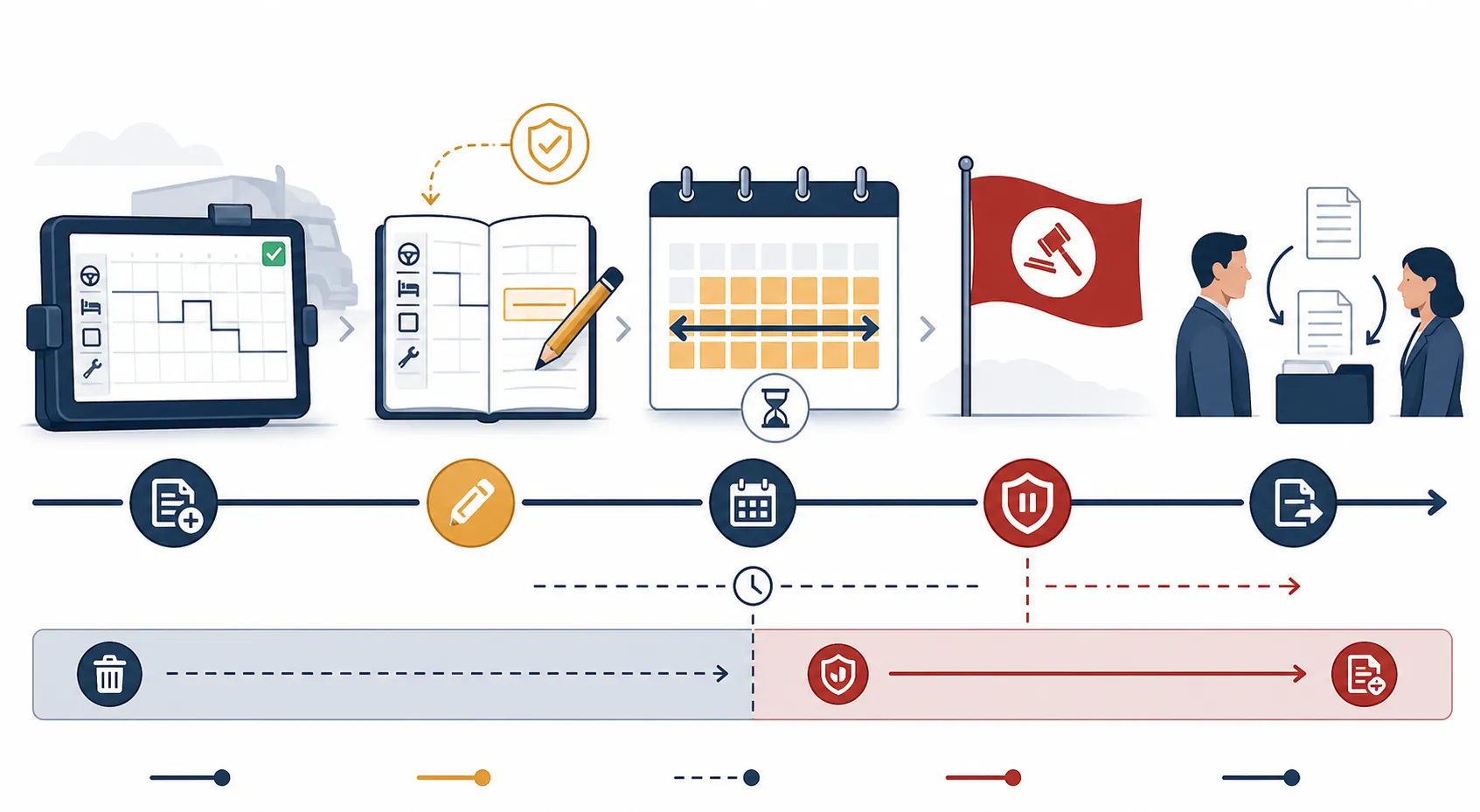
The useful discovery sequence follows the record rather than the lawsuit pleading:
- The ELD captures hours-of-service information and source data used to generate a record of duty status.
- The driver reviews and certifies the RODS.
- Any later edit is associated with an annotation, while the original information remains preserved and traceable.
- The carrier retains the RODS and supporting documents for the ordinary six-month regulatory period.
- If a litigation preservation duty arises before that period expires, routine disposition must yield to preservation of relevant information.
- In federal litigation, a party can request production under FRCP 34, including an appropriate form for producing electronically stored information.
Edits do not replace the source record
Section 395.30 is important because an edited display is not necessarily the complete discoverable record. The regulation protects original hours-of-service information and source data streams against alteration or erasure. It also addresses driver certification and requires edits to remain associated with annotations rather than silently overwriting the original information.[2]
A production request limited to a final PDF or screen image can therefore miss material that the regulatory system preserves. Where edits are relevant, the request should identify the native or exportable ELD data, original entries, edit history, annotations, driver certifications, and information showing whether proposed edits were accepted or rejected. The requested form should be technically usable without demanding data that never existed.
The six-month period and the preservation trigger
Section 395.8(k)(1) directs a motor carrier to retain each driver’s RODS and supporting documents for six months from the date of receipt.[1] It is a routine-retention rule. It neither defines when civil litigation is reasonably anticipated nor decides whether a party breached a discovery obligation.
A preservation demand can provide a clear notice point, particularly when it identifies the crash, driver, vehicle, relevant date range, ELD records, edit history, supporting documents, and systems or custodians likely to hold the data. Service of a letter, however, is not the exclusive way a preservation duty can arise. Rule 37(e) refers to ESI that should have been preserved in the anticipation or conduct of litigation; its wording does not make receipt of a formal preservation letter a prerequisite.[5]
The defensible timeline therefore records at least four dates: when the underlying RODS was received, when the six-month period would ordinarily end, when litigation was reasonably anticipated, and when a hold or other preservation instruction was implemented. The event that matters may precede the first formal production request.
Consider a hypothetical sequence. A carrier receives a driver’s RODS shortly after a collision and would ordinarily retain it for six months. If no preservation duty arises before that period expires, disposal under the routine schedule may comply with section 395.8. If litigation becomes reasonably anticipated during that period, the relevant ESI may need to be preserved beyond the regulatory minimum. The legal analysis turns on evidence of that timing, not on an assumption that every post-accident deletion was improper.
Production under Rule 34
FRCP 34 permits a party to request documents and electronically stored information within another party’s possession, custody, or control. The request must describe the requested items or categories with reasonable particularity and may specify the form in which ESI is to be produced.[4] For ELD material, the form matters because a flattened report may not disclose source fields, annotations, or edit relationships.
A Rule 45 subpoena may be relevant when responsive information is held by a nonparty, including a service provider, subject to the rule’s scope, procedural protections, and the holder’s actual possession or control. A Rule 30(b)(6) deposition can address an organization’s logging systems, retention configuration, preservation steps, export process, and interpretation of produced fields. Neither mechanism creates records that were never generated or expands a nonparty’s technical ability to retrieve expired data.
FMCSA access is not a 48-hour civil-discovery rule
Under 49 CFR 390.29, records required by the Federal Motor Carrier Safety Regulations must be made available for inspection at the motor carrier’s principal place of business within the prescribed period after an FMCSA demand. If the records are maintained elsewhere, the rule allows 48 hours to produce them at the principal place of business or another location specified by the agency, excluding Saturdays, Sundays, and federal holidays.[3]
That is an agency-inspection obligation. It does not require a litigant to answer a Rule 34 request within 48 hours, shorten the applicable civil-discovery response period, or determine whether the requested material is within the permissible scope of discovery.
What Rule 37(e) requires before ESI sanctions
Rule 37(e) applies when electronically stored information that should have been preserved in anticipation or conduct of litigation is lost because a party failed to take reasonable preservation steps and the information cannot be restored or replaced through additional discovery.[5] Each element matters. Proof that an ELD record is unavailable does not, standing alone, establish the rule’s preservation premise, failure-of-reasonable-steps requirement, or inability to replace the evidence.
If routine deletion occurred after the six-month period but before a litigation preservation duty arose, compliance with the retention schedule may explain the loss. If deletion occurred after that duty arose, the inquiry continues: what reasonable steps were taken, whether another export or recipient can restore or replace the information, and what consequences followed from the loss.

Prejudice-based measures under Rule 37(e)(1)
When the threshold requirements are met and the loss prejudices another party, Rule 37(e)(1) permits measures no greater than necessary to cure the prejudice.[5] The focus is remedial. The court must assess the effect of the missing information and select a proportionate response rather than treating any lost log as automatic proof against the party responsible for preserving it.
Intent-to-deprive measures under Rule 37(e)(2)
The more severe measures in Rule 37(e)(2) require a finding that the party acted with intent to deprive another party of the information’s use in the litigation. Only with that finding may a court presume the lost information was unfavorable, instruct the jury that it may or must make that presumption, or dismiss the action or enter a default judgment.[5]
Negligent loss, a missed hold, or the bare fact that information is unavailable does not itself establish intent to deprive. Nor does a violation of an FMCSA retention provision automatically supply the findings required by Rule 37(e)(2). The regulatory breach, preservation failure, prejudice analysis, and intent finding remain distinct questions.
Scope limits of this obligations record
Truck litigation may also involve inspection reports, maintenance records, driver-qualification materials, dispatch communications, telematics, and other evidence. Those categories are not assigned retention periods here because each period must be tied to its own verified regulatory provision. The six-month period in section 395.8(k)(1) should not be copied onto unrelated records, and secondary-source claims about shorter supporting-document periods or rapid vendor overwrite schedules should not displace the controlling text.
The obligations table supplies the narrow answer. FMCSA regulations determine what driver-log records must exist, how original ELD information and edits are handled, and how long RODS and supporting documents remain subject to ordinary retention. The Federal Rules determine how relevant ESI is requested in federal litigation and what findings are necessary if it is lost. Six months is the decisive routine-retention clock, but a missing log alone does not establish sanctionable spoliation—and it does not establish intent to deprive.
References
- 49 CFR § 395.8 — Driver’s record of duty status, Electronic Code of Federal Regulations
- 49 CFR § 395.30 — ELD record submissions, edits, annotations, and data retention, Electronic Code of Federal Regulations
- 49 CFR § 390.29 — Location of records or documents, Electronic Code of Federal Regulations
- Rule 34. Producing Documents, Electronically Stored Information, and Tangible Things, or Entering onto Land, for Inspection and Other Purposes, Legal Information Institute, Cornell Law School
- Rule 37. Failure to Make Disclosures or to Cooperate in Discovery; Sanctions, Legal Information Institute, Cornell Law School
- Electronic Logging Devices, Federal Motor Carrier Safety Administration
- Summary of Hours of Service Regulations, Federal Motor Carrier Safety Administration
Operationalizing workflow
No workflow has been explicitly linked to this obligation yet. See Workflows generally.
Illustrative cases
No illustrative case is currently tracked for this obligation. See Risk Digest for documented incidents generally.
← Back to RegulationReport a correction or tip
Spotted an outdated figure, a misstated fact, or a ruling this regulation entry should reflect? Public comments are disabled for this content given the professional cost of a misreported case outcome, penalty amount, or rule text — use the structured correction channel instead.
Report a correction or tip for this record →