
Trump's Endangered Species Harm Rule Faces Court Challenges
- Authority
- U.S. Fish and Wildlife Service; NOAA Fisheries
- Rule type
- regulation
- Jurisdiction scope
- US federal
- Effective date
- Sep 14, 2026
- Source text
- Read primary rule text ↗
Removes habitat modification from the ESA 'harm' definition once effective; Section 7 and direct-take duties remain.
Status snapshot — last verified August 2, 2026, 00:00 UTC. Category slug: regulation-ethics. Legal-background review posture: docket/status record only; not legal advice. Court dockets, agency records, and any pending emergency motions should be checked again before filing, closing, permitting, or board-level risk advice.
The legal implications of the Trump administration’s endangered species rule are date-bound. The July 14, 2026 final rule, Federal Register document 2026-14195 at 91 FR 43300, rescinds the Endangered Species Act “harm” definition from 50 CFR 17.3 and 50 CFR 222.102, supplies no replacement definition, and is scheduled to take effect September 14, 2026. The Services also state that the rule applies prospectively and will not require re-evaluation of prior permits or incidental-take statements. [1]
| Issue | Current record |
|---|---|
| Rule text at issue | Rescission of the ESA “harm” definition from 50 CFR 17.3 and 222.102, with no replacement definition. [1] |
| Effective date | September 14, 2026, using the Federal Register date rather than inconsistent secondary-date summaries. [1] |
| Litigation status | At least four federal complaints challenge the rule in W.D. Wash., N.D. Cal., and D.S.C.; available trackers and reporting do not align perfectly, so the safer count is “at least four.” [2][3] |
| Immediate procedural risk | Preliminary-injunction or stay practice is the first practical battlefront because the rule is not yet effective but is already challenged. |
| What remains operative unless a court says otherwise | The ESA is not erased: Section 7 consultation, critical habitat practice, and direct-take prohibitions remain part of the legal landscape even if the rescission takes effect. |
What the July 14 rule actually changes
The rule does one central thing: it removes the regulatory definition of “harm” that had made habitat modification legally consequential under the ESA’s Section 9 “take” prohibition. If the rescission takes effect and survives review, habitat modification drops out of the Section 9 take calculus as “harm” under those regulations. That is a significant change for development, energy, timber, agriculture, mining, transportation, and public-infrastructure projects whose risk analysis has historically included habitat effects as a possible route to take liability.
The limiting point matters just as much. The final rule does not repeal Section 7 consultation for federal agency actions, does not abolish critical habitat, and does not create a safe harbor for direct take. A private actor, agency, or applicant still has to ask whether another ESA duty applies. A federal permit still may trigger consultation. A project still may intersect critical habitat. Conduct that directly kills or injures protected wildlife remains legally exposed through the remaining take framework.
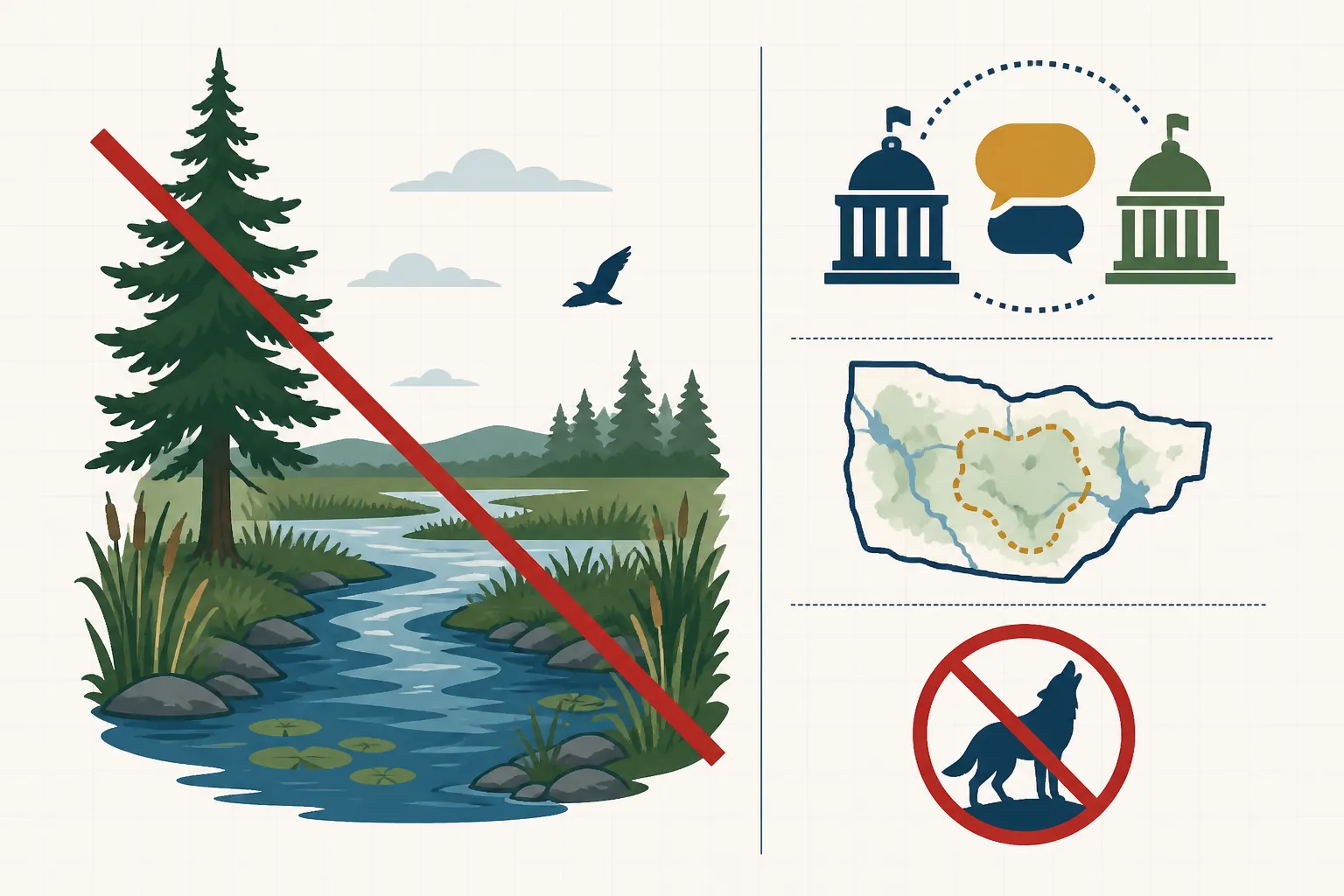
The Services’ prospective-only language also narrows the operational disruption. The final rule says previously issued permits and incidental-take statements are not reopened for re-evaluation because of the rescission. [1] That does not resolve future project risk; it does keep the July 2026 rule from automatically becoming a backward-looking audit of prior ESA approvals.
The administrative record was not quiet. The final rule states that approximately 358,000 public comments were submitted by the May 19, 2025 close of the comment period. [1] The volume does not decide the Administrative Procedure Act question, but it makes the adequacy of the Services’ explanation a live litigation issue rather than a decorative footnote.
The docketed challenges
The lawsuit count should not be inflated casually. Harvard’s tracker, the National Agricultural Law Center summary, and public reporting do not present the same docket picture in exactly the same way; the National Wildlife Federation case filed July 17, 2026 changes the count beyond the first July 14 filings. The record supported here is at least four challenges, not “all challenges everywhere.” [2][3]
| Case | Court | Docket number | Status note |
|---|---|---|---|
| Swinomish Indian Tribal Cmty. v. NMFS | W.D. Wash. | No. 2:26-cv-0247 | Tribal challenge included in the reported post-rule litigation set. [2][3] |
| Envtl. Prot. Info. Ctr. v. NMFS | N.D. Cal. | No. 3:26-cv-07176 | Environmental-group challenge identified in tracker and claims summaries. [2][3] |
| Ctr. for Biological Diversity v. Burgum | W.D. Wash. | No. 2:26-cv-02474 | Challenge involving conservation plaintiffs, including groups identified in public-interest litigation reporting. [2][4] |
| Nat’l Wildlife Fed’n v. USFWS | D.S.C. | No. 2:26-cv-02897 | Filed July 17, 2026, and the reason the count should be stated as at least four. [2] |
The plaintiff side includes conservation organizations and tribal governments. Public-interest reporting identifies plaintiffs and aligned groups including the Center for Biological Diversity, Sierra Club, Conservation Law Foundation, WildEarth Guardians, Oregon Wild, and the Swinomish and Squaxin Island Tribes. [4] The rulemaking record also includes supportive comments from industry-side stakeholders including the American Petroleum Institute and Associated General Contractors, which is relevant to the administrative record but not proof that the rule will survive review. [1]
Why the injunction calendar comes first
Until September 14, 2026, the rescission is scheduled but not yet operative. That leaves a short window in which plaintiffs can seek a temporary restraining order, preliminary injunction, administrative stay, or other timing relief before regulated parties and agencies have to change how they advise on future Section 9 “harm” exposure.
The practical consequences split cleanly. If no court blocks the rule before the effective date, counsel advising on future conduct will have to account for the absence of the regulatory “harm” definition while still checking Section 7, critical habitat, and direct-take issues. If a court enjoins or vacates the rescission, the pre-rescission harm regime remains the operative point of reference. If a court narrows relief by plaintiff, geography, agency, or claim, the real work becomes reading the order rather than repeating that the Trump rule was “blocked” or “allowed.”
As of this verification date, the cited materials did not identify a final court order staying or vacating the July 2026 rule. That is a status statement, not a prediction. The first meaningful update may be a motion filing, a briefing schedule, a consolidation or transfer order, or a temporary stay entered before full preliminary-injunction briefing.
The statutory argument: Sweet Home after Loper Bright
The legal center of the case is not simply that a new administration changed policy. The sharper challenge is that the Services rescinded a long-standing, Supreme Court-upheld interpretation by treating the contrary view associated with Justice Scalia’s dissent in Babbitt v. Sweet Home Chapter of Communities for a Great Oregon as the best reading after Loper Bright. Stanford Law’s explainer frames the dispute around that Sweet Home/Loper Bright tension: the prior “harm” rule had already survived Supreme Court review, while Loper Bright changed judicial deference doctrine rather than amending the ESA. [5]
That is why the Administrative Procedure Act claim has unusual bite. The plaintiffs are not merely saying the Services chose the wrong policy balance. They argue the agencies acted arbitrarily and capriciously under 5 U.S.C. § 706(2)(A) by declaring the old definition unlawful on a pure statutory-interpretation theory after decades of reliance and after Sweet Home had upheld the inclusion of habitat modification within “harm.” [2][5]
For defendants, the post-Loper Bright move is likely to be framed as ordinary agency correction: if the statute has one best meaning and the prior regulation exceeds it, the agencies may say they are not free to keep enforcing an unlawful interpretation. For plaintiffs, the same move looks like an agency using the end of Chevron deference to relitigate a Supreme Court loss through rulemaking. The reviewing courts will have to decide whether Loper Bright supplies room for that move, and what weight Sweet Home still carries when the regulation being rescinded is the one the Court upheld.
The NEPA categorical-exclusion claim
The complaints also attack the Services’ NEPA treatment. The pleaded theory is that the agencies improperly relied on a categorical exclusion under 43 CFR 46.210(i) and failed to account for extraordinary circumstances under 43 CFR 46.215(g), rather than preparing an environmental impact statement. [2] That argument depends on a concrete premise: removing the habitat-modification component of “harm” can change project-level incentives and agency analysis even if the rule is styled as interpretive.
The categorical-exclusion issue may matter at the injunction stage because it gives plaintiffs a second route to likelihood of success and irreparable-harm arguments. It also gives defendants a narrower response: the agencies can argue that a definitional rescission is not itself a ground-disturbing action and that future project approvals remain subject to their own ESA and NEPA processes. The record supplied here supports the existence of the claim, not any conclusion about how a judge will weigh it.
What this is not
This is not a general repeal of endangered species law. It is not, today, an operative removal of habitat-related liability; that depends on the effective date and any court order entered before then. It is also not merely a press-release dispute. The rule is published, the effective date is fixed in the Federal Register, and multiple complaints are already docketed.
Adjacent ESA activity should stay in the background. Harvard’s ESA tracker separately notes other Endangered Species Act regulatory developments, including a March 30, 2026 Northern District of California vacatur involving Section 7 regulations and November 2025 proposed rules. [3] Those matters may affect the broader ESA operating environment, but they are not the July 2026 “harm” rescission and should not be blended into the status of this rule.
Decision points to watch
- Emergency or preliminary-injunction motions before September 14, 2026. This is the first place the legal implications become operational.
- Any consolidation, transfer, or coordination order across W.D. Wash., N.D. Cal., and D.S.C. A consolidated merits path would change briefing strategy and timing.
- The exact scope of any interim relief. A nationwide injunction, plaintiff-specific order, agency-specific order, or claims-limited stay would produce different advice.
- How courts frame Sweet Home. If the cases become a fight over stare decisis rather than ordinary agency discretion, the rescission faces a different kind of review.
- How courts handle the NEPA categorical-exclusion theory. That claim could affect both preliminary relief and the remedy if plaintiffs win.
- Pre-publication source control. CRS Legal Sidebar LSB11421 should be checked directly before publication or filing use; it is not cited here because direct access was not available in the reviewed materials.
The bounded judgment is straightforward: the July 2026 “harm” rescission is a live federal-court dispute, not a settled change in ESA practice. Its near-term consequences depend first on injunction and consolidation decisions, and its merits consequences depend on whether courts accept the administration’s post-Loper Bright reading despite Sweet Home.
References
- Rescinding the Definition of “Harm” Under the Endangered Species Act (Final Rule, 2026-14195, 91 FR 43300) — Federal Register, July 14, 2026.
- Services Rescind ESA “Harm” Definition, Environmental Groups File Suit — National Agricultural Law Center.
- Endangered Species Act Regulations — Environmental and Energy Law Program (Harvard Law School) timeline tracker — Environmental and Energy Law Program, Harvard Law School.
- Lawsuit Seeks to Protect America’s Wildlife from Trump Administration — Earthjustice.
- Endangered Species Act’s Harm Rule Explained: What the Change Means for Wildlife — Stanford Law School, July 23, 2026.
Operationalizing workflow
No workflow has been explicitly linked to this obligation yet. See Workflows generally.
Illustrative cases
No illustrative case is currently tracked for this obligation. See Risk Digest for documented incidents generally.
← Back to RegulationReport a correction or tip
Spotted an outdated figure, a misstated fact, or a ruling this regulation entry should reflect? Public comments are disabled for this content given the professional cost of a misreported case outcome, penalty amount, or rule text — use the structured correction channel instead.
Report a correction or tip for this record →