
Trump Immigration Policy Reversal Overwhelms Federal Courts
- Authority
- U.S. District Court for the Western District of Texas
- Rule type
- regulation
- Jurisdiction scope
- US federal
- Effective date
- Jan 20, 2025
- Source text
- Read primary rule text ↗
Monitor docket capacity and procedural volatility in high-volume immigration habeas districts; verify venue, custody facts, and appellate posture before filing.
This analysis treats the Trump immigration policy reversal legal impact as a federal-court capacity problem before it treats it as an immigration-policy argument. It is a regulation-and-ethics risk assessment for practitioners who may not handle removal defense every day but do need to know when a policy change is no longer confined to agency guidance, press statements, or campaign commitments. It is not legal advice. Its source frame is the public federal-court filing data and litigation reporting identified in the references.
The first hard measure is the docket. Through Q1 2026, more than 18,000 habeas corpus petitions challenging noncitizen detention had been filed in the first 18 months of Trump’s second term, exceeding the combined total from the prior three administrations, according to TRAC’s reporting on immigration litigation filings.[1] Immigration civil filings reached 9,911 in March 2026, up 1,278% from March 2021, and habeas lawsuits increased 85-fold from March 2025 to March 2026.[1]
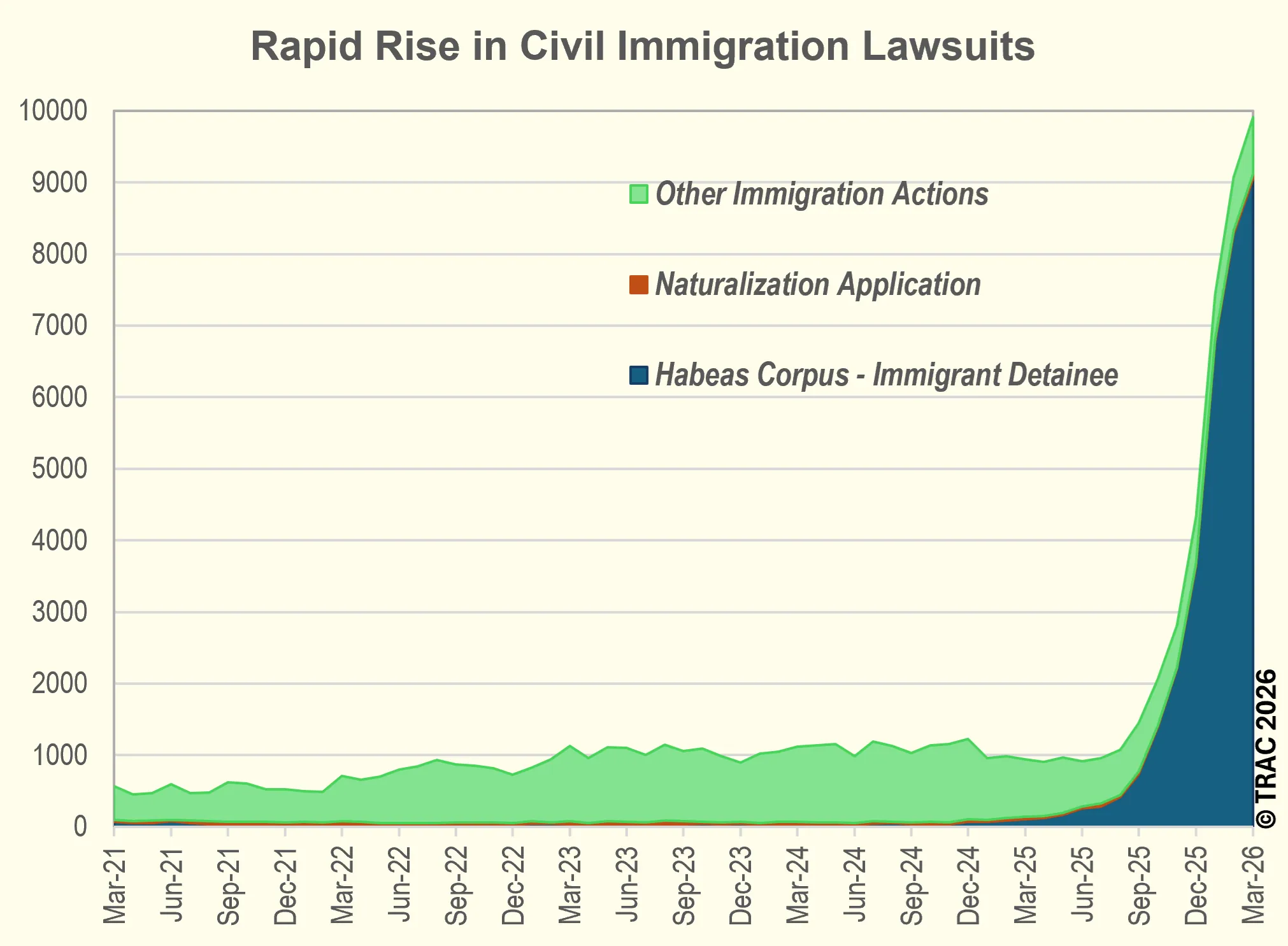
Those numbers do not prove that every petition is distinct, meritorious, or procedurally identical. Habeas filings can include petitions brought under different statutory theories, successive filings, emergency requests, transfer disputes, and cases whose practical posture changes before the court reaches the merits. But as a caseload measure, the figure is difficult to soften. Each petition still arrives as an intake event. Someone opens it, assigns it, screens it, sets deadlines, reviews emergency relief, and decides what to do when detention location, removal timing, or government position shifts faster than the civil docket can comfortably absorb.
The Policy Input Became a Filing Surge
The policy mechanics matter here only because they explain why so many cases reached federal court so quickly. The administration moved away from Biden-era enforcement posture through mandatory detention positions, expanded no-bond treatment, and broader use of expedited removal authorities. ICE’s detained population rose from roughly 39,000 in January 2025 to roughly 70,000 in January 2026, according to Migration Policy Institute’s account of the first year of Trump 2.0 immigration policy.[2]
The New York City Bar Association’s review of the administration’s 2025–26 immigration-law changes describes the reversal in more doctrinal terms: expanded expedited removal, narrower access to ordinary process, and enforcement choices that altered the timing and posture of removal-related disputes.[3] For federal-court workload, the important point is simpler. More people were detained, more of them faced no-bond or accelerated procedures, and more lawyers had to choose habeas as the available federal-court vehicle before the underlying immigration process could run its ordinary course.
That sequence changes what a filing means. In slower litigation, a habeas petition may be one step in a developed record. In this environment, it can be the emergency pleading filed before transfer, before removal, before a bond hearing, or before counsel knows whether the government will maintain the same legal position next week. The docket absorbs that uncertainty as motion practice.
Where the Flood Landed
The national total is the headline, but the federal courts do not experience national totals. They experience division-level intake, chambers queues, magistrate-judge referrals, clerk’s-office triage, and local rules that were not designed around a sudden immigration habeas wave. At least ten federal judicial districts were carrying acute pressure from the surge, with the Western District of Texas standing out sharply in the available reporting.[4]
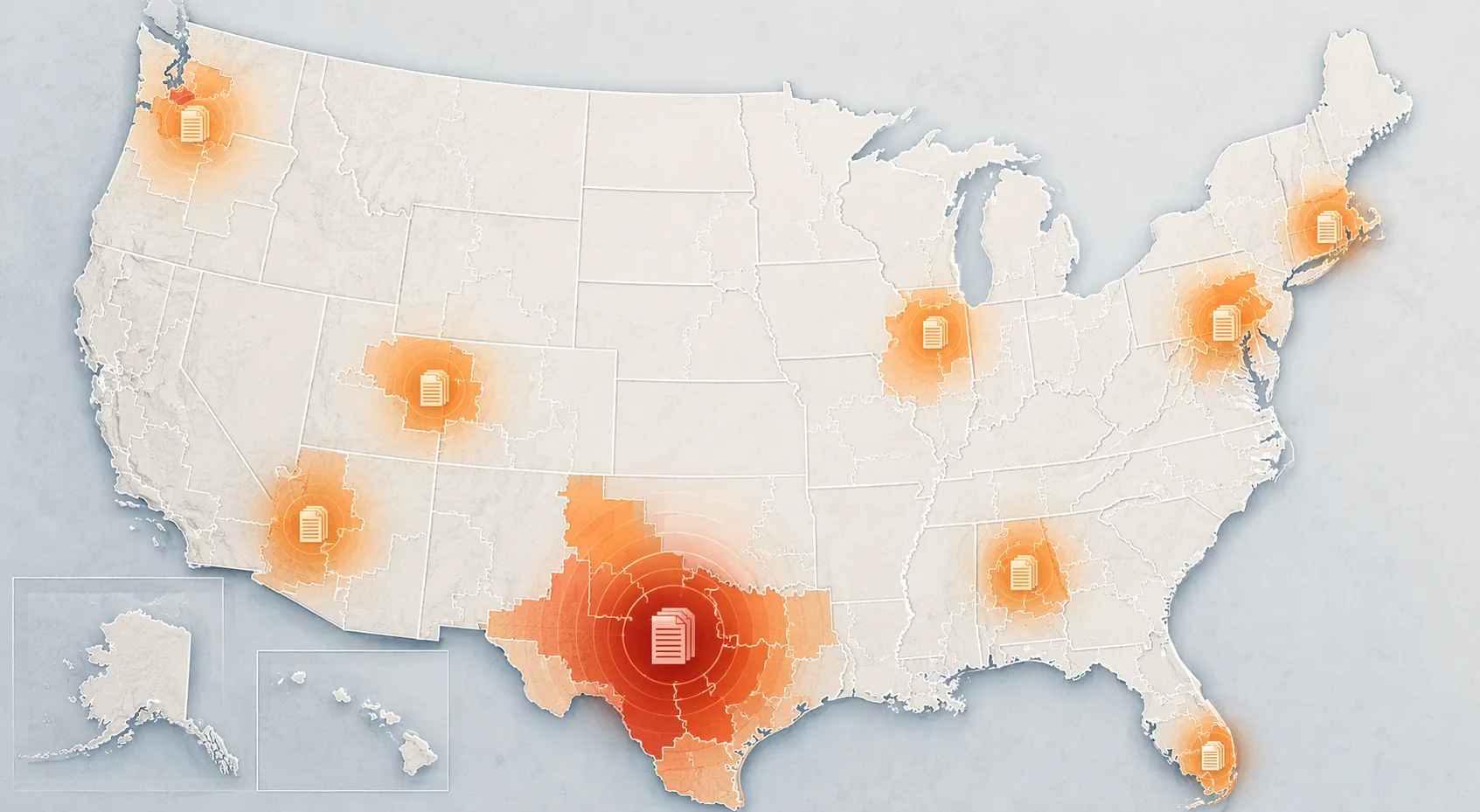
The San Antonio division of the Western District of Texas received 3,448 habeas filings in six months, from October 2025 through March 2026.[4] That is the number that should make litigators pause. It is not a talking point about national policy. It is a local-court operating condition.
| Measure | Reported Figure | Why It Matters for Litigation Risk |
|---|---|---|
| Habeas petitions challenging noncitizen detention | 18,000+ through Q1 2026 | Shows the scale of federal-court intake created by detention litigation |
| Immigration civil filings | 9,911 in March 2026 | Indicates that the surge is broader than a single case category |
| Increase since March 2021 | 1,278% | Signals a structural docket change rather than a routine monthly fluctuation |
| Year-over-year habeas increase | 85x from March 2025 to March 2026 | Explains why ordinary scheduling assumptions may fail |
| Western District of Texas, San Antonio division | 3,448 habeas filings in six months | Places the capacity problem at the division level where filings are processed |
A division receiving thousands of similar-but-not-identical emergency detention challenges does not merely work harder. It changes the risk profile of every case in that lane. Standard response times compress. Boilerplate government positions attract judicial skepticism. Counsel cannot assume that a petition will be reviewed in a quiet procedural sequence. Transfer, removal, and venue facts may become just as important as the statutory argument.
Judicial Pushback Was Broad, but Not Final
The strongest judicial-response number is the district-judge split reported by Migration Policy Institute: 308 district judges rejected the administration’s mandatory detention policy, while 14 upheld it.[4] For anyone tracking trial-court behavior, that is not a marginal pattern. It shows broad district-court resistance to the government’s no-bond and mandatory-detention theories.
It should not be mistaken for settled law. The 5th Circuit upheld mandatory detention in February 2026, creating appellate uncertainty in a region that includes one of the most burdened districts.[4] A district-court ratio of 308 to 14 may describe the immediate trial-court response, but it does not erase circuit-level risk, and it does not tell counsel what will happen after appeal, transfer, or a changed detention posture.
That distinction matters in practice. A lawyer filing in a district where judges have repeatedly rejected the government’s theory may still face a circuit rule that narrows relief, a government request for a stay, or a venue fight that moves the petition into less favorable terrain. Conversely, a petitioner in a difficult circuit may still obtain case-specific relief if the record shows procedural irregularity, imminent removal, or agency conduct that creates a separate due-process problem.
Goodwin and the No-Bond Theory
Judge Robert Chambers Goodwin’s opinion became a useful pressure point because it did not just disagree with the government. As reported by Migration Policy Institute, the opinion was openly incredulous toward the government’s no-bond theory.[4] That judicial reaction is important less for its rhetoric than for what it reveals about workload conditions. When a government position is repeated across a large set of petitions, judges begin seeing it not as a one-off litigation argument but as a systemwide administrative claim being tested through individual habeas files.
That is where policy becomes case administration. A single statutory position may require hundreds of separate orders. A single detention theory may generate emergency hearings in multiple districts. A single change in bond access may cause counsel to file before the ordinary administrative record is complete. The judge is still deciding one case, but the chambers queue reflects the policy.
Contempt as a Docket Signal
Judge Elizabeth Provinzino’s contempt ruling against ICE, described by the Vera Institute, belongs in this analysis for the same reason.[5] Contempt is not ordinary immigration-litigation background noise. It appears when case administration has crossed from delay or disagreement into direct judicial control over agency compliance.
The Minnesota hearing where an ICE lawyer reportedly told the judge to “hold me in contempt” captures the same institutional strain.[5] The point is not that one hearing defines national policy. It is that overloaded detention litigation can push ordinary procedural interactions into open confrontation: who has the person, who can produce them, who has authority to stop removal, and what happens if the court’s order and the agency’s operational plan collide.
What Changes for Practitioners
The practical lesson is not that habeas always works. The better lesson is that immigration-adjacent federal litigation in affected districts now has to be planned around capacity and procedural volatility. A petition may be legally sound and still lose time to reassignment, local congestion, transfer confusion, emergency-response bottlenecks, or appellate intervention.
- Docket congestion: counsel should assume that chambers and clerk’s offices in high-volume districts are processing repeated emergency filings, not isolated detention disputes.
- Bond access constraints: no-bond positions can make habeas timing more urgent, especially when administrative remedies do not move fast enough to prevent continued detention.
- Expedited timelines: expanded expedited removal can force counsel to seek relief before the factual record is stable.
- Transfer risk: a detainee’s physical movement can complicate venue, custodian identification, service, and the court’s practical ability to grant relief.
- Appeal risk: district-court skepticism toward mandatory detention does not eliminate circuit-level uncertainty, particularly after the 5th Circuit’s February 2026 ruling.
For law-firm risk managers, the problem is also staffing. These cases reward speed, but speed without venue discipline can waste the only useful window. Intake teams need enough information to identify the district of confinement, the immediate custodian, removal timing, bond posture, prior filings, and whether a transfer is pending or already underway. Missing one of those facts can turn a plausible emergency filing into a jurisdictional fight.
For lawyers outside immigration practice, the spillover risk is subtler. A federal district carrying thousands of emergency habeas petitions may have less scheduling elasticity for adjacent civil matters. The effect will not be uniform across all judges or all case types, and the available materials do not support a precise delay estimate for non-immigration cases. But a litigation plan that assumes normal motion timing in a heavily affected division is making an unstated capacity bet.
The 18,000-Petition Number Has Limits
The headline figure should be used carefully. TRAC’s 18,000-plus habeas count is a caseload indicator, not a merits determination.[1] It does not mean 18,000 detainees obtained relief, 18,000 separate legal questions were presented, or 18,000 government actions were unlawful. It means the federal courts received more than 18,000 habeas petitions in this category during the measured period, and that volume alone has operational consequences.
The same caution applies to broader deportation and self-deportation claims surrounding the policy reversal. The research record available here does not provide a DHS-verified breakdown that would let those claims be used as firm measures of legal impact. For this article’s purpose, the more reliable indicators are court-facing: filing counts, detention population growth, district-level concentration, judicial rulings, and reported compliance conflicts.
That narrower frame is also more useful. A practitioner does not need a complete political account of immigration enforcement to understand that a district receiving thousands of habeas petitions in six months is operating under altered conditions. The legal impact is visible in the queue.
Litigation Strategy Now Starts With the Court’s Capacity
The most consequential legal impact of the Trump immigration policy reversal, as of Q3 2026, is not a clean doctrinal turn. It is the conversion of detention policy into thousands of individual federal cases, concentrated in districts that must still process each petition through ordinary judicial machinery.
That makes venue, timing, custody facts, and appellate posture primary risk factors rather than secondary procedural details. In overloaded districts, the question is not only whether the detention theory is vulnerable. It is whether the court can reach the issue before removal, transfer, mootness, a stay, or a circuit rule changes the case.
Any immigration-adjacent federal litigation strategy in the affected districts should therefore be built around docket capacity and procedural volatility from the beginning. The merits still matter, but they are no longer the only clock running.
References
- Surge in Immigration Lawsuits Hits Record High in 2026, TRAC Reports.
- Unleashing Power in New Ways: Immigration in the First Year of Trump 2.0, Migration Policy Institute.
- The Trump Administration's 2025-26 Changes to Immigration Law, New York City Bar Association.
- The Trump Administration's Immigration Policies Encounter Resistance in the Courts, Migration Policy Institute.
- Weaponizing the System: One Year of Trump's Attacks on Due Process, Vera Institute.
Operationalizing workflow
No workflow has been explicitly linked to this obligation yet. See Workflows generally.
Illustrative cases
No illustrative case is currently tracked for this obligation. See Risk Digest for documented incidents generally.
← Back to RegulationReport a correction or tip
Spotted an outdated figure, a misstated fact, or a ruling this regulation entry should reflect? Public comments are disabled for this content given the professional cost of a misreported case outcome, penalty amount, or rule text — use the structured correction channel instead.
Report a correction or tip for this record →