
Appeals court blocks Trump mail ballot restrictions in 23 states
- Authority
- 1st Circuit Court of Appeals
- Rule type
- standing order
- Jurisdiction scope
- US federal
- Source text
- Read primary rule text ↗
As of July 29, 2026, the mail-ballot restrictions fight has no single national compliance answer. There is a split. In the 23 states and the District of Columbia covered by Judge Talwani’s injunction, upheld by the 1st Circuit, EO 14399 is blocked for now. In the remaining states, the D.C. Circuit has refused to enter comparable relief, leaving the order’s mail-ballot and voter-list machinery exposed to enforcement unless another court changes the result.[1][2]
This article was last verified on July 29, 2026. It is a compliance-risk map, not legal advice. Election officials and counsel still need to read the controlling order for their own jurisdiction, because the operative line is not partisan preference or general election policy. It is whether a particular office sits inside the enjoined jurisdictions, outside them, or in a category that may be changed by the Supreme Court’s pending emergency docket.
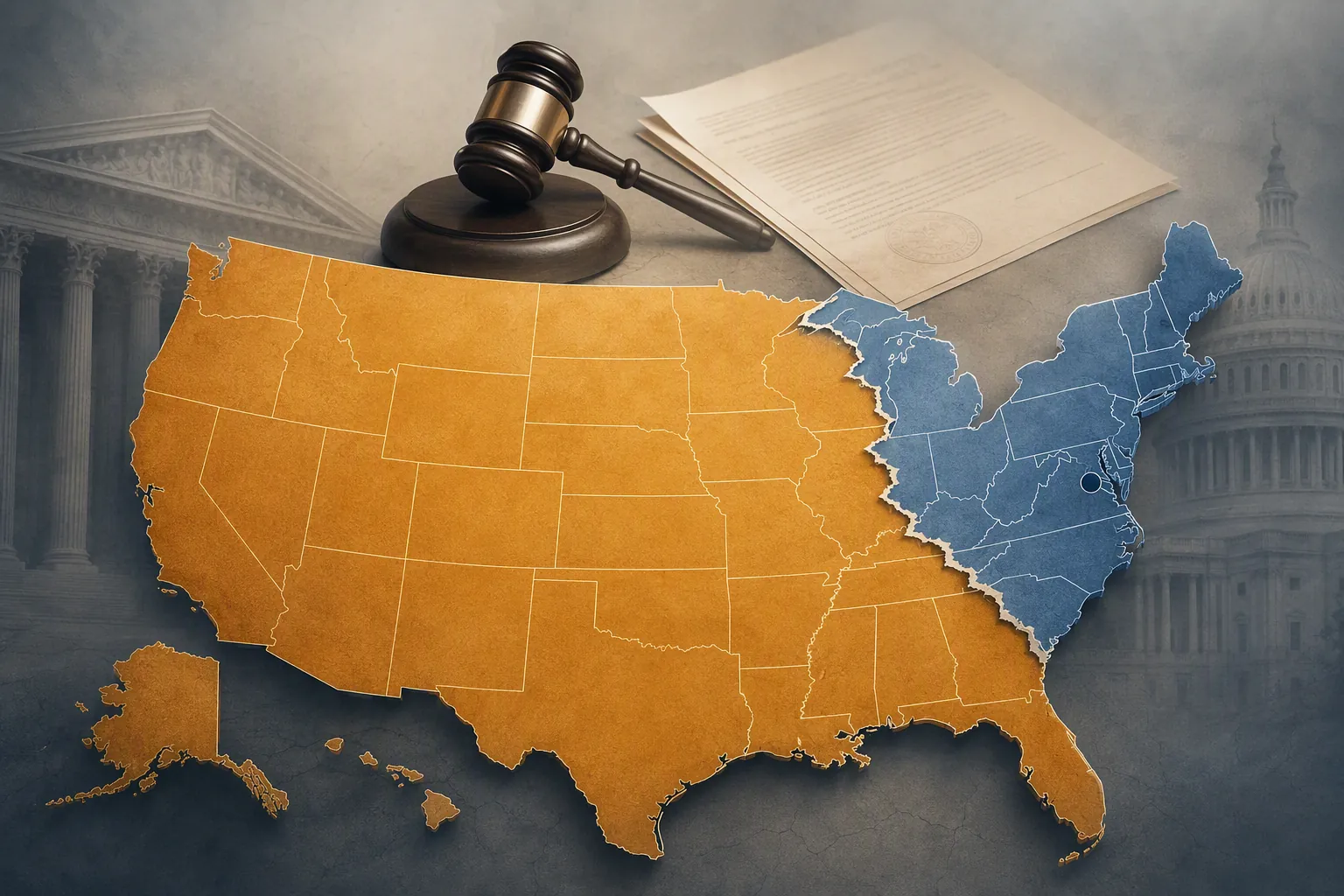
| Jurisdictional position on July 29, 2026 | Current operating posture | Main compliance pressure |
|---|---|---|
| 23 states plus D.C. covered by the Talwani/1st Circuit injunction | EO 14399 is blocked for now | Avoid implementing duties the injunction bars, while preserving records in case the Supreme Court narrows or vacates relief |
| Remaining states after the D.C. Circuit refusal | EO 14399 remains live unless separately blocked | Prepare for USPS ballot-delivery limits, citizenship-list verification demands, and possible criminal-liability claims |
| All jurisdictions | Supreme Court application 26A124 remains pending | Maintain plans for at least three outcomes before the September citizenship-list deadline |
The Split That Matters to a Clerk’s Office
The 1st Circuit ruling matters because it preserves an injunction against EO 14399 in 23 states plus D.C. The D.C. Circuit ruling matters because it declined to block the order elsewhere. Those two rulings do not merely create different litigation narratives. They create opposite operating environments for election administrators roughly 99 days before the 2026 midterms.[1][2]
Inside the injunction zone, the immediate task is restraint: officials should not treat EO 14399 as a freestanding command to change mail-ballot processing, reject ballots based on new federal list checks, or alter procedures in ways the injunction forbids. Outside that zone, the immediate task is triage: identify which parts of the order can be implemented, which require state-law changes, which depend on federal data systems, and which are constrained by the order’s own savings clause.
The savings clause is not decorative. EO 14399 repeatedly frames implementation as required only “to the extent feasible and consistent with applicable law.” That language does not erase the order, but it does complicate any assumption that every federal instruction can be dropped intact into a state election calendar, a county canvassing manual, or a USPS delivery workflow.[3]
For compliance teams, the live domains are narrow enough to name: USPS handling of mail ballots, federal citizenship-list verification, and criminal-liability exposure for officials who issue or count ballots under procedures later challenged by the federal government. The hard part is that none of those domains waits politely for appellate finality.
USPS Ballot Delivery Is the First Operational Fault Line
EO 14399 directs federal action affecting mail ballots, and the Postal Service posture turns that instruction into an immediate logistics problem. Postmaster General David Steiner testified in Congress in June 2026 that USPS would refuse to deliver ballots in non-compliant states. A USPS proposed rule was published June 2, the comment period has closed, and the final rule was due July 29, 2026, the current verification date for this article.[1][2]
That is not a theoretical conflict for a local office preparing absentee packets. If a state is inside the injunction zone, an administrator may be told by court order not to implement EO-based restrictions. If a neighboring state is outside that zone, its administrators may be planning around a federal rule that could affect whether USPS accepts, transports, or delivers certain ballots. The calendar does not care that the two offices are both trying to administer the same federal midterm election.
The practical questions are ordinary and unforgiving: when ballot envelopes go to print, what instruction is placed on them; when outbound ballots enter the mail stream, what acceptance standard applies; when late-arriving ballots are reviewed, whether the delay came from voter action, state procedure, or federal postal refusal. Those questions are not answered by calling the order pro-integrity or anti-mail-voting. They are answered by the controlling injunction, the postal rule actually in force, and the state’s own election statutes.
The September 4 List Deadline Is Already Inside the Planning Window
The second pressure point is citizenship-list verification. EO 14399 sets a 60-day deadline for compiling citizenship-related lists, placing the relevant deadline on September 4, 2026. That means data requests, technical specifications, matching protocols, and objection procedures would need to begin well before early September if the order remains enforceable in a jurisdiction.[3]
The order points toward federal citizenship data, including SAVE-related verification. The record described in the available materials supports a careful, limited conclusion: SAVE is underinclusive and error-prone for election-administration purposes. It does not support a clean national error percentage, and this article does not supply one.[4]
That distinction matters. An underinclusive database can omit eligible citizens. An error-prone matching process can generate false flags. Neither fact, standing alone, proves how many voters would be affected in a particular county. But both facts are enough to require documented review procedures before any office uses a federal list as a gatekeeping device for ballot issuance or ballot counting.
The judicial environment around voter data is also relevant, though not conclusive. Seventeen federal courts have denied Department of Justice demands for state voter data. That pattern does not decide the Supreme Court application, and it does not immunize any jurisdiction outside the injunction zone. It does show that courts have not been treating federal voter-data demands as routine administrative housekeeping.[1][4]
Criminal Exposure Changes the Tone of Every Ambiguous Instruction
The third domain is criminal liability. EO 14399 invokes potential prosecution under 18 U.S.C. § 241, the conspiracy-against-rights statute, and 18 U.S.C. § 611, the federal prohibition on voting by noncitizens, in connection with election officials who issue ballots to voters not appearing on federal eligibility lists.[3][4]
That is where the compliance problem becomes especially unfair to local officials. A registrar may have a state-law duty to process a voter’s application, a federal injunction limiting reliance on the executive order, a postal rule affecting delivery, and a federal executive document implying criminal consequences if the voter is not found on a database that the available materials describe as incomplete. The person who has to make the first-line decision is usually not a cabinet secretary or appellate advocate. It is a local official operating under a calendar.
None of that means prosecution is likely in any given case. The research materials do not establish frequency, charging standards, or a completed enforcement pattern. The risk is narrower and more immediate: when criminal statutes are named in an executive order, lawyers advising election offices must preserve the decision trail. Who checked the voter record, which data source was used, what mismatch process existed, who approved the ballot decision, and what state-law authority controlled the action all become compliance facts.
What Changes Inside the Injunction Zone
For the 23 covered states and D.C., the operative fact is that the Talwani injunction remains in place after the 1st Circuit ruling. Election offices in those jurisdictions should treat the blocked provisions as blocked unless their own counsel identifies a narrower local command, a separate order, or a later Supreme Court ruling changing the analysis.[1]
- Mail-ballot operations should not be redesigned solely to comply with EO 14399 provisions covered by the injunction.
- Citizenship-list matching should not be converted into a ballot-issuance condition merely because the executive order directs federal list compilation.
- Any communications with USPS should identify the jurisdiction’s injunction status and request written confirmation of how postal acceptance and delivery rules will be applied.
- Counsel should preserve internal memoranda explaining why the office followed the injunction rather than the executive order.
The danger inside the injunction zone is not only overcompliance. It is inconsistent compliance. If one county changes ballot envelopes, voter notices, or database-screening practices while another county in the same enjoined state does not, the state may create equal-treatment problems that were avoidable even before the Supreme Court acts.
What Remains Live Outside the Injunction Zone
Outside the 23 enjoined states and D.C., the D.C. Circuit’s refusal to block EO 14399 leaves election officials in a different position. The order may be enforceable, but the word “may” is doing real work. The savings clause, state-law conflicts, federal agency implementation, and the pending Supreme Court application all affect what can actually be done before ballots move.[2][3]
| Workstream | Question for non-enjoined states | Why it cannot wait |
|---|---|---|
| USPS ballot handling | Will USPS accept and deliver ballots if state procedures do not match the federal rule? | Outbound ballot schedules and voter notices are prepared before Election Day disputes arise |
| Citizenship-list verification | Which federal list will be used, what fields will be matched, and who reviews mismatches? | The September 4 list deadline requires advance data work |
| Criminal-risk documentation | Who signs off when state law and federal executive instructions point in different directions? | Named criminal statutes make contemporaneous records more important |
| Voter communication | What can be said without overstating federal requirements or understating uncertainty? | Confusing instructions can suppress lawful participation or create challenge evidence |
A state outside the injunction zone should not assume that every EO instruction is self-executing. Nor should it assume that the D.C. Circuit ruling will be the last word. The safer administrative posture is to separate mandatory current steps from conditional steps, then attach each step to a source: executive order, agency rule, state statute, court order, or counsel-approved contingency.
The Supreme Court Application Creates Three Planning Files, Not One Forecast
The Supreme Court emergency application, docketed as 26A124 in Trump v. California, is the event most likely to reorder the map. The response deadline is August 3, 2026, and the available reporting treats a decision within days afterward as possible because of the midterm calendar.[1]
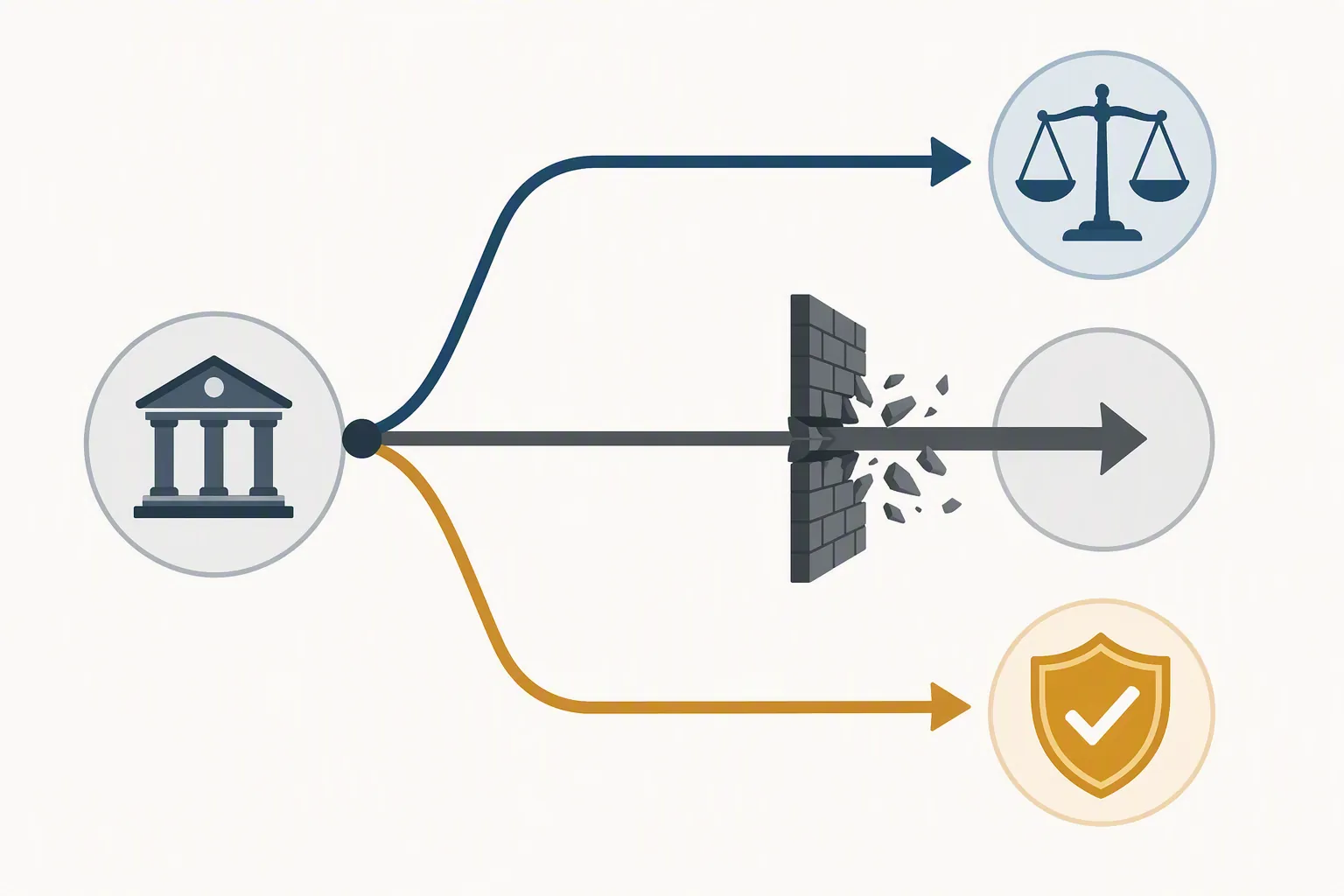
Compliance teams do not need to predict the outcome to prepare for it. They need three files ready enough that a clerk is not rewriting voter instructions from scratch after the Court acts.
| Supreme Court outcome | What it would mean operationally | Immediate preparation |
|---|---|---|
| The Court leaves the split in place | The 23 states plus D.C. continue under the injunction, while the remaining states continue to face live EO obligations | Maintain jurisdiction-specific manuals and written cross-border USPS guidance |
| The Court clears broader enforcement | States currently protected by the injunction may need to implement EO-related processes quickly | Pre-draft conditional notices, data-review workflows, and USPS escalation contacts without activating them prematurely |
| The Court validates the injunction’s logic more broadly | States outside the injunction zone may need to suspend EO implementation or unwind planned changes | Keep reversible implementation steps separate from irreversible ballot design, mailing, and voter-removal decisions |
The third column is the part that tends to disappear in national coverage. A court ruling is not self-implementing in a county office. Someone must update the written procedure, notify vendors, instruct temporary staff, communicate with USPS, answer voter calls, and decide what to do with records already screened under a rule that may no longer apply.
Fraud Claims Do Not Resolve the Administrative Question
Mail-voting debates often move quickly to fraud rates. That is not where a compliance officer can stop. The available materials note that some cited fraud figures rely on databases that are not exhaustive or comprehensive. Those figures may be relevant to policy debate, but they cannot by themselves answer whether a particular official may reject a ballot, delay mailing, or rely on a federal citizenship list in a jurisdiction under injunction.
Baseline voting behavior is also distinct from legal effectiveness. MIT Election Lab’s 2024 report is useful as context for how Americans voted, but adoption of mail voting does not prove that a restriction is lawful, effective, or administratively workable in 2026.[5]
That narrower treatment is intentional. The open question for midterm administrators is not whether mail voting has symbolic value or whether fraud prevention is a legitimate public concern. The open question is what an official must do tomorrow morning without violating a court order, state law, federal agency rule, or criminal statute.
The Working Matrix Before Early September
By early September, the citizenship-list deadline will force choices that cannot be postponed indefinitely. Before then, each election office needs a documented matrix showing its current injunction status, the applicable USPS rule, the citizenship-data source being requested or rejected, the state-law authority for ballot issuance, and the person responsible for approving any deviation from ordinary procedure.
That matrix should also identify which actions are reversible. A staff training memo can be revised. A ballot envelope order may not be easy to recall. A voter notice sent with an overstated eligibility warning can create harm even if a later court order corrects the legal premise. A mismatch record generated from an incomplete database may follow a voter into a challenge process long after the emergency application is resolved.
The current landscape is not one national mail-ballot rule. It is a provisional obligations matrix split between the Talwani/1st Circuit injunction zone and the remaining states, with USPS delivery rules, federal citizenship lists, and possible criminal exposure moving on their own calendars. Responsible officials need plans for all three Supreme Court outcomes because the risk is already active: preparation time, data demands, ballot-delivery rules, and liability concerns do not wait for appellate consensus.
References
- Trump administration asks Supreme Court to clear the way for new mail-in voting restrictions, SCOTUSblog, July 2026
- Federal court panel declines to block Trump's mail ballot order, AP News
- Ensuring Citizenship Verification and Integrity in Federal Elections, The White House, March 2026
- Analyzing the President's Executive Order on Mail Voting, Brennan Center for Justice
- New Report: How We Voted in 2024, MIT Election Lab
Operationalizing workflow
No workflow has been explicitly linked to this obligation yet. See Workflows generally.
Illustrative cases
No illustrative case is currently tracked for this obligation. See Risk Digest for documented incidents generally.
← Back to RegulationReport a correction or tip
Spotted an outdated figure, a misstated fact, or a ruling this regulation entry should reflect? Public comments are disabled for this content given the professional cost of a misreported case outcome, penalty amount, or rule text — use the structured correction channel instead.
Report a correction or tip for this record →