
Trump's Mail-In Voting Order Blocked, Supreme Court to Decide
- Authority
- U.S. Court of Appeals for the 1st Circuit
- Rule type
- standing order
- Jurisdiction scope
- US federal
- Effective date
- Jun 25, 2026
- Source text
- Read primary rule text ↗
Administration must not implement EO 14399 citizenship verification and USPS ballot delivery provisions
The Supreme Court fight over Trump’s blocked 2026 mail-in voting order is now a deadline problem before it is a merits problem. The 1st Circuit left the injunction against Executive Order 14399 in place on July 25. Solicitor General D. John Sauer went to the Supreme Court on July 27. The response deadline is August 3, 2026, with the midterms 99 days away. For counsel advising election officials, federal agencies, campaigns, or vendors, that is the operative calendar.
The order under review does not merely announce a presidential view about mail voting. It directs DHS to compile citizenship-verification information for use by states, directs USPS toward a ballot-delivery gatekeeping role tied to state compliance, and instructs DOJ to prioritize enforcement against election-related offenses. Those are agency commands with implementation consequences, even if the government now characterizes the order as internal executive-branch guidance. [1]
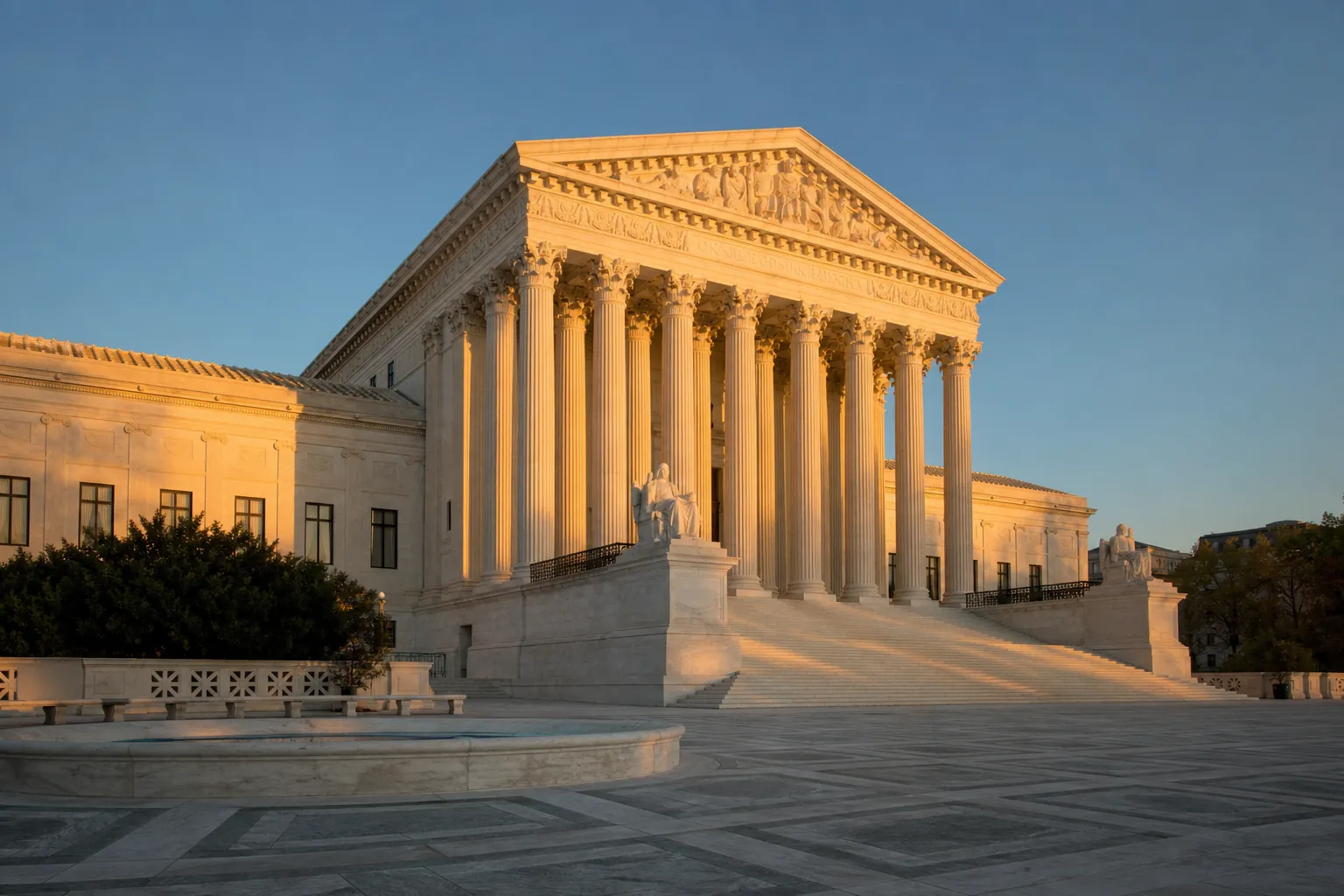
Judge Talwani’s June 25 injunction and the 1st Circuit’s 2-1 July 25 affirmance treated those commands as a separation-of-powers problem. Available reporting quotes the 1st Circuit as saying the order “directs unprecedented levels of involvement by federal officials in how states administer elections” and would “sow confusion and threaten disenfranchisement.” Because the full 1st Circuit text was not independently retrieved for this record, those quotations should be read as attributed to the reporting that quoted the decision, not as a separately verified docket extract. [2]
The commands that made the injunction matter
The constitutional dispute becomes clearer when the order is read as a work instruction. Article I, Section 4 gives states the initial authority to set the “Times, Places and Manner” of congressional elections, subject to alteration by Congress. The challenged order asks federal agencies to occupy pieces of that administrative field without a new congressional statute doing the work.
| EO 14399 function | Agency or actor | Why the lower-court objection attaches |
|---|---|---|
| Compile citizenship-verification information for state election use | DHS | Turns a federal security agency into a supplier of voter-eligibility screening material for state election administration. [1] |
| Restrict or condition mail-ballot delivery based on state compliance status | USPS | Makes the postal system a gatekeeper for whether state ballots move through the mail. [1] |
| Prioritize election-related prosecutions | DOJ | Adds federal enforcement pressure to a state-administered election process. [1] |
That is why the lower-court rulings cannot be reduced to a disagreement over whether stricter mail-ballot controls are wise. The objection was institutional. If the President can instruct agencies to decide which state systems qualify for federal cooperation, the practical control point moves away from state election officials and toward federal administrators who were not given that role by Congress.
The government’s best emergency argument is not that the President personally runs state elections. It is that the order governs how federal agencies organize their own conduct: DHS can prepare information, USPS can coordinate delivery standards, and DOJ can set enforcement priorities. Framed that way, the order looks like intra-branch policy guidance rather than an immediately reviewable takeover of state election machinery.
The weakness in that framing is timing. State officials do not get to wait for final merits review before deciding how to prepare ballots, voter notices, vendor instructions, and litigation positions. The record described primaries already underway. Once federal agencies begin sorting states into compliant and noncompliant categories, state administrators must react even if the government insists that the order has not yet ripened into coercion. [2]
Talwani and the 1st Circuit treated confusion as a constitutional consequence
In emergency election cases, confusion is sometimes treated as an administrative inconvenience. Here it carried constitutional weight. Judge Talwani’s 37-page ruling held that the President lacked authority to direct DHS to compile state citizenship lists or USPS to restrict ballot delivery. The 1st Circuit, by a divided panel, left that injunction in place. [2]
The reported 1st Circuit language matters because it identifies the injury before any individual voter is turned away. The panel did not need a completed non-delivery event to see a risk: federal officials would be inserted into state election administration, states would have to plan around that insertion, and voters could face changed ballot-handling rules close to an election. [2]
That is a harder finding to disturb quietly on an emergency docket than a generic policy disagreement. The Supreme Court can disagree with the injunction. It can conclude the government is likely to prevail or that the equitable balance favors allowing the order to operate pending appeal. But if it does so, it will have to decide how much weight to give lower-court findings that the order changes the election-administration environment now, not later.
The USPS record is where “nonbinding” becomes difficult
The USPS evidence is the most useful practical test of the government’s position. If the order is only an internal planning document, then the postal service should be able to prepare without changing ballot movement. But the reported declaration from Chief Customer Officer Steven Monteith said a “two-tiered system” would be operationally impossible, and Postmaster General Steiner reportedly testified that USPS would refuse ballot delivery to non-compliant states. [3]
That does not prove the President will ultimately lose. It does make the emergency posture less abstract. A postal official does not need a final Supreme Court merits opinion to know whether a sorting center should treat one state’s ballot envelopes differently from another’s. A state election director does not need final merits review to know whether ballot instructions, cure notices, and contingency plans must be rewritten.
This is the point at which federalism becomes a delivery problem. If USPS is asked to distinguish compliant from noncompliant state ballots, the supposed guidance has left the memorandum stage. The operational burden lands on people who must move envelopes, answer voter questions, and defend decisions in court while the constitutional authority question remains unresolved.
What Sauer is asking the Court to stay
The Solicitor General’s emergency application asks the Supreme Court to stay the injunction that prevents the administration from implementing the challenged provisions while litigation continues. In ordinary stay terms, the government must persuade the Court that it is likely enough to prevail, that the injunction causes sufficient harm, and that the equities favor interim relief. The states answer that implementation itself is the harm because election preparation cannot be unwound cleanly after ballots, procedures, and public instructions change. [4]
The D.C. Circuit’s separate ruling lifting a broader nationwide injunction increases the pressure for Supreme Court review. The full text of that ruling was not independently retrieved for this record, so the point should be kept narrow: available reporting describes a separate appellate development that leaves the administration facing different injunction landscapes in different courts. That is enough to make emergency clarification more likely, without treating the D.C. Circuit as having resolved the same issue in the same posture. [5]
For litigators, the emergency posture changes the advice window. The question is not whether a final appellate opinion will eventually announce the outer boundary of presidential authority over federal agencies touching elections. The question is whether federal agencies may start acting under EO 14399 before that boundary is fixed.
- State election officials need to know whether to plan for federal citizenship-list matching and USPS compliance screening.
- USPS counsel need to know whether ballot-delivery procedures can remain uniform while the case proceeds.
- Campaign and party counsel need to know whether state-by-state ballot disputes should be litigated against state officials, federal agencies, or both.
- DOJ and agency counsel need to know whether internal implementation work risks being characterized as enforcement of an enjoined election-administration scheme.
Another shadow-docket test, not just another mail-ballot fight
Ballotpedia counted 38 emergency applications in cases involving the second Trump administration as of July 21, 2026, and only 3 short-fuse emergency appeals in 2026. That makes this application a significant data point for how the Court handles urgent executive-power disputes before merits review, especially when the government asks to act and lower courts have identified immediate operational consequences. [6]
Watson v. Republican National Committee is the nearest recent Supreme Court mail-ballot marker, but it should not be overread. On June 29, 2026, the Court decided Watson 5-4 and upheld Mississippi’s late-arriving ballot grace period. That result shows that the current Court is not mechanically hostile to every mail-ballot accommodation. It does not answer whether the President can direct federal agencies to police state ballot systems without congressional authorization. [7]
The fraud debate is even less central to the injunction question. Brookings has placed the mail-voting fraud rate at 0.000043%, while other fraud-focused compilations count discrete historical instances over longer periods. Those numbers may matter in legislative debate. They do not decide whether Article I, Section 4 permits the President to make DHS and USPS gatekeepers for state election administration. [8]
The Supreme Court’s practical options before August 3
The Court can deny a stay and leave the 1st Circuit injunction in place while the merits litigation proceeds. That would preserve the lower-court view that the challenged provisions should not operate during the election-preparation window. It would not finally resolve the President’s authority, but it would keep DHS and USPS from taking on the disputed gatekeeping roles in the interim.
The Court can grant a stay and allow the challenged provisions to take effect pending appeal. That would accept, at least for emergency purposes, the government’s view that the order is sufficiently internal or sufficiently lawful to proceed before final review. The consequence would be immediate planning pressure on states and operational pressure on USPS.
The Court can also split the difference: allow some agency planning while preserving limits on ballot-delivery restrictions or state-facing enforcement. A partial stay would be administratively harder to read but legally plausible, especially if the Justices distinguish between compiling information and using federal delivery systems to condition ballot movement.
The trackable question is therefore narrow and consequential: whether EO 14399 is treated as ordinary intra-branch guidance that can take effect pending appeal, or as an attempted federal takeover of state election administration that must remain blocked while merits litigation proceeds. By August 3, the relevant risk is not a final answer about mail-in voting fraud. It is whether federal agencies may begin acting as gatekeepers before the constitutional boundary is finally resolved.
References
- Executive Order 14399: Ensuring Citizenship Verification and Integrity in Federal Elections — The White House, March 31, 2026
- Judge Talwani constitutional holding and 1st Circuit 2-1 panel decision coverage — Reuters, ABC News, CNN, National Law Journal, June 25 and July 25, 2026
- USPS declaration and testimony coverage — Votebeat and ABC News, 2026
- Solicitor General Sauer emergency application coverage — CNBC, Democracy Docket, PBS NewsHour, The Guardian, July 27, 2026
- D.C. Circuit separate ruling coverage — ABC News, Votebeat, CNN, 2026
- Emergency applications involving the second Trump administration — Ballotpedia, July 21, 2026
- Watson v. Republican National Committee, No. 24-1260 — Supreme Court of the United States, June 29, 2026
- Mail voting in the US: Data points to very low fraud and significant benefits to voters — Brookings Institution
Operationalizing workflow
No workflow has been explicitly linked to this obligation yet. See Workflows generally.
Illustrative cases
No illustrative case is currently tracked for this obligation. See Risk Digest for documented incidents generally.
← Back to RegulationReport a correction or tip
Spotted an outdated figure, a misstated fact, or a ruling this regulation entry should reflect? Public comments are disabled for this content given the professional cost of a misreported case outcome, penalty amount, or rule text — use the structured correction channel instead.
Report a correction or tip for this record →