
Where Every Trump Nuclear Waste Storage Case Stands
- Authority
- New Mexico and Texas state legislatures
- Rule type
- statute
- Jurisdiction scope
- US state
- Source text
- Read primary rule text ↗
Explicit state consent is required before high-level waste storage can proceed in New Mexico and Texas.
Q3 2026 status map: what is still legally alive
As of August 2, 2026, the legal issues around the Trump nuclear waste storage plan are no longer centered on a pending Supreme Court merits fight over the Nuclear Regulatory Commission’s licensing power. The Supreme Court’s June 18, 2025 decision in NRC v. Texas shut Texas and Fasken out on standing under the Hobbs Act and Atomic Energy Act party-aggrieved framework; it did not decide whether the NRC had statutory authority to license private consolidated interim storage for spent nuclear fuel. The later Fifth Circuit remand dismissals closed the appellate vehicles that had produced the Fifth Circuit merits ruling, and the Supreme Court’s January 12, 2026 denial of certiorari in Beyond Nuclear v. NRC left the D.C. Circuit’s 2024 ruling in place without making a Supreme Court merits holding. [1][2][3][4]
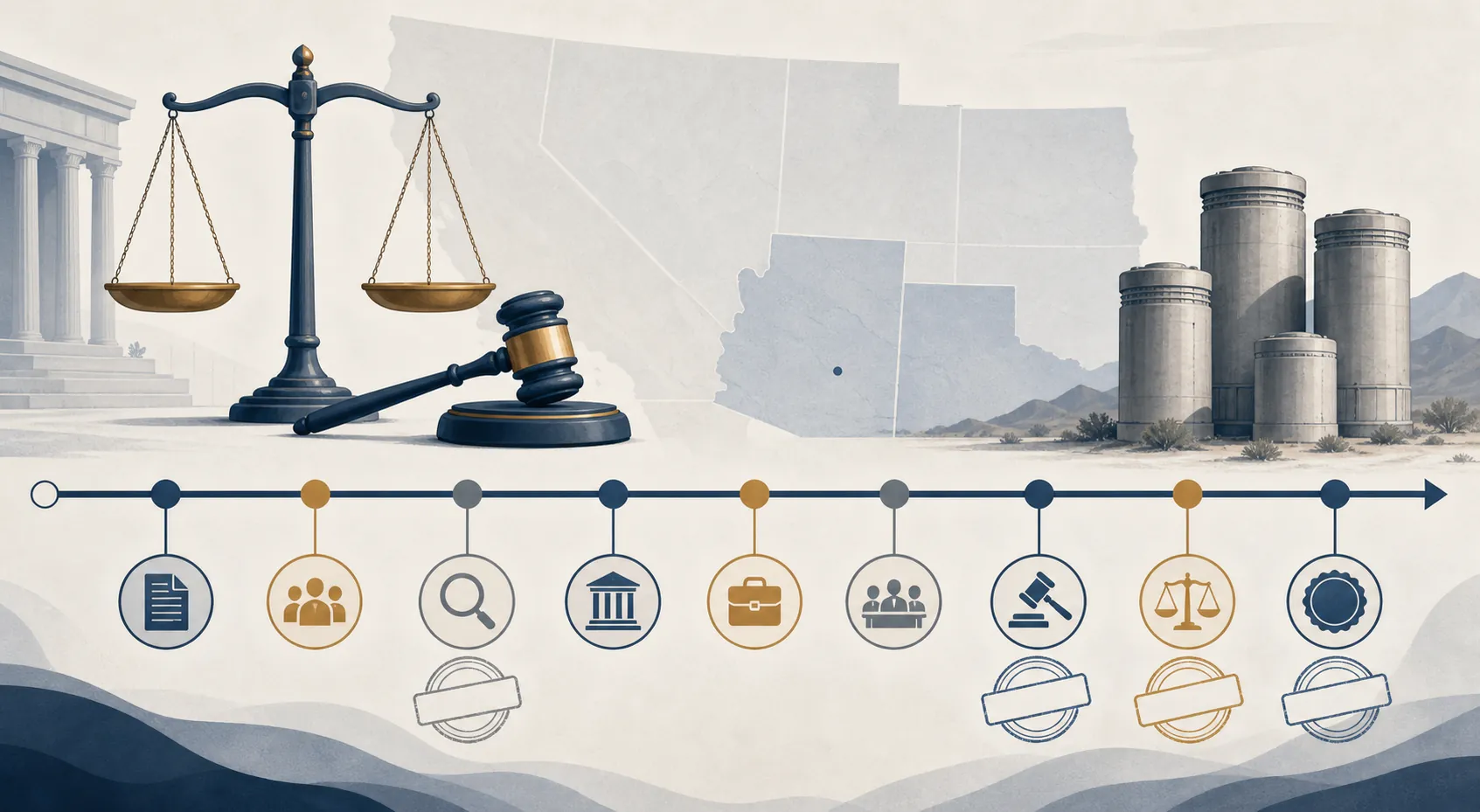
The practical answer is narrower and more useful: the main federal appellate litigation has been exhausted or procedurally closed, while state consent and permitting law remains operative against both proposed consolidated interim storage sites. That is the point at which advice should now begin.
| Matter or barrier | Forum | Key date | Action | Present legal effect as of Q3 2026 | Source |
|---|---|---|---|---|---|
| NRC v. Texas / Texas and Fasken challenge to ISP license | U.S. Supreme Court | June 18, 2025 | The Court held 6-3 that Texas and Fasken were not “parties aggrieved” entitled to judicial review because they were not the license applicant or granted intervenors in the NRC proceeding. | Procedural loss for these challengers. The Court did not reach the merits of whether the NRC has statutory authority to license private consolidated interim storage. | Pillsbury, https://www.pillsburylaw.com/en/news-and-insights/scotus-rules-challenging-nuclear-regulatory-commission-licenses.html [1] |
| Texas/ISP petitions after Supreme Court remand | U.S. Court of Appeals for the Fifth Circuit | September 22, 2025 | The Fifth Circuit dismissed the Texas/ISP petitions on remand. | The remanded appellate vehicle was closed. The dismissal did not supply the merits answer the Supreme Court had avoided. | Spencer Fane, https://www.spencerfane.com/insight/shut-out-of-the-courtroom-when-procedure-trumps-policy-in-nuclear-waste-litigation/ [2] |
| ISP and Holtec-related petitions after Supreme Court remand | U.S. Court of Appeals for the Fifth Circuit | October 20, 2025 | The Fifth Circuit dismissed both ISP and Holtec-related petitions. | The Fifth Circuit docket path was procedurally closed for these petitions. Counsel should not treat the earlier Fifth Circuit merits reasoning as the operative final outcome after remand. | Spencer Fane, https://www.spencerfane.com/insight/shut-out-of-the-courtroom-when-procedure-trumps-policy-in-nuclear-waste-litigation/ [2] |
| Beyond Nuclear v. NRC | U.S. Court of Appeals for the D.C. Circuit | August 27, 2024 | The D.C. Circuit ruling on the NWPA challenge remained the judgment left standing after the Supreme Court later denied certiorari. | The D.C. Circuit result remains in place, but it is not a Supreme Court merits endorsement of NRC authority. | ANS Nuclear Newswire, https://www.ans.org/news/2025-11-13/article-7537/beyond-nuclear-brings-interim-storage-case-back-to-supreme-court/ [4] |
| Beyond Nuclear v. NRC, No. 25-540 | U.S. Supreme Court | January 12, 2026 | The Court denied certiorari. | The cert denial ended this Supreme Court route. It did not decide the merits of the NWPA/NRC authority question. | Supreme Court docket, https://www.supremecourt.gov/docket/docketfiles/html/public/25-540.html [3] |
| New Mexico federal complaint over Holtec project | Federal district litigation described in contemporaneous complaint coverage | March 29, 2021 | New Mexico alleged that the NWPA barred DOE from taking possession of spent fuel before a permanent repository was licensed, that “consolidated interim storage facility” was not a federal regulatory category, and that the project would impose unfunded transportation and emergency-response burdens. | Useful as a record of New Mexico’s legal theory and objections. The presently operative obstacle is better described as state consent and permitting law, not this earlier complaint standing alone. | Courthouse News Service, https://www.courthousenews.com/plan-for-waste-illegal-new-mexico-tells-nuclear-regulatory-commission-in-lawsuit/ [6] |
| Holtec HI-STORE / Eddy-Lea Energy Alliance project posture | Project and state-law posture outside a live federal appellate merits ruling | October 2025 | Holtec canceled its agreement for the New Mexico project, citing state and oil-and-gas opposition and New Mexico’s 2023 law barring high-level waste storage without explicit state consent. | The New Mexico project is not merely waiting on a clean federal appellate merits answer. Its site path is blocked in practical terms by state consent and permitting law. | Bulletin of the Atomic Scientists, https://thebulletin.org/2026/05/will-the-trump-administrations-nuclear-campus-plan-break-the-us-nuclear-waste-gridlock/ [5] |
| New Mexico consent/permitting barrier | State law | 2023 | New Mexico enacted a law barring high-level waste storage without explicit state consent. | Blocks the New Mexico consolidated interim storage site regardless of how one characterizes the federal license posture. | Bulletin of the Atomic Scientists, https://thebulletin.org/2026/05/will-the-trump-administrations-nuclear-campus-plan-break-the-us-nuclear-waste-gridlock/ [5] |
| Texas consent/permitting barrier | State law | 2022 | Texas enacted a law prohibiting the state permits needed to break ground on high-level waste storage without explicit state consent. | Blocks the Texas consolidated interim storage site regardless of federal license posture. | Bulletin of the Atomic Scientists, https://thebulletin.org/2026/05/will-the-trump-administrations-nuclear-campus-plan-break-the-us-nuclear-waste-gridlock/ [5] |
| Nuclear Waste Technical Review Board dismissals | Administrative context, not a located court case | July 2025 | The Trump administration dismissed seven of the eight members of the Nuclear Waste Technical Review Board. | No court challenge to these dismissals was found in the materials reviewed for this article. They should not be folded into the litigation docket unless framed as administrative context outside the case map. | ANS Nuclear Newswire, https://www.ans.org/news/2025-07-23/article-7215/trump-expels-all-but-one-member-of-nuclear-waste-oversight-board/ [7] |
The Supreme Court ruling was a standing ruling, not a licensing-authority ruling
The most common misstatement is also the most consequential one: NRC v. Texas did not approve the NRC’s authority to license private interim storage. The Supreme Court resolved who could get into court under the review statute. It did not resolve whether the NRC had the statutory power the challengers disputed. [1]
That distinction matters because the Fifth Circuit had previously reached the authority question in a posture the Supreme Court later found unavailable to Texas and Fasken. The Supreme Court’s answer was that these challengers were not “parties aggrieved” for Hobbs Act review because, under the Court’s reading of the Atomic Energy Act scheme, the relevant “party” is the license applicant or a person admitted as an intervenor in the NRC proceeding. Texas and Fasken were neither. [1]
For a status memo, the right formulation is therefore not “NRC won on authority.” It is: the challengers who produced the Fifth Circuit merits ruling lost their route to judicial review. That is a very different legal sentence. It tells the reader which appellate vehicle died, while preserving the unresolved statutory question.
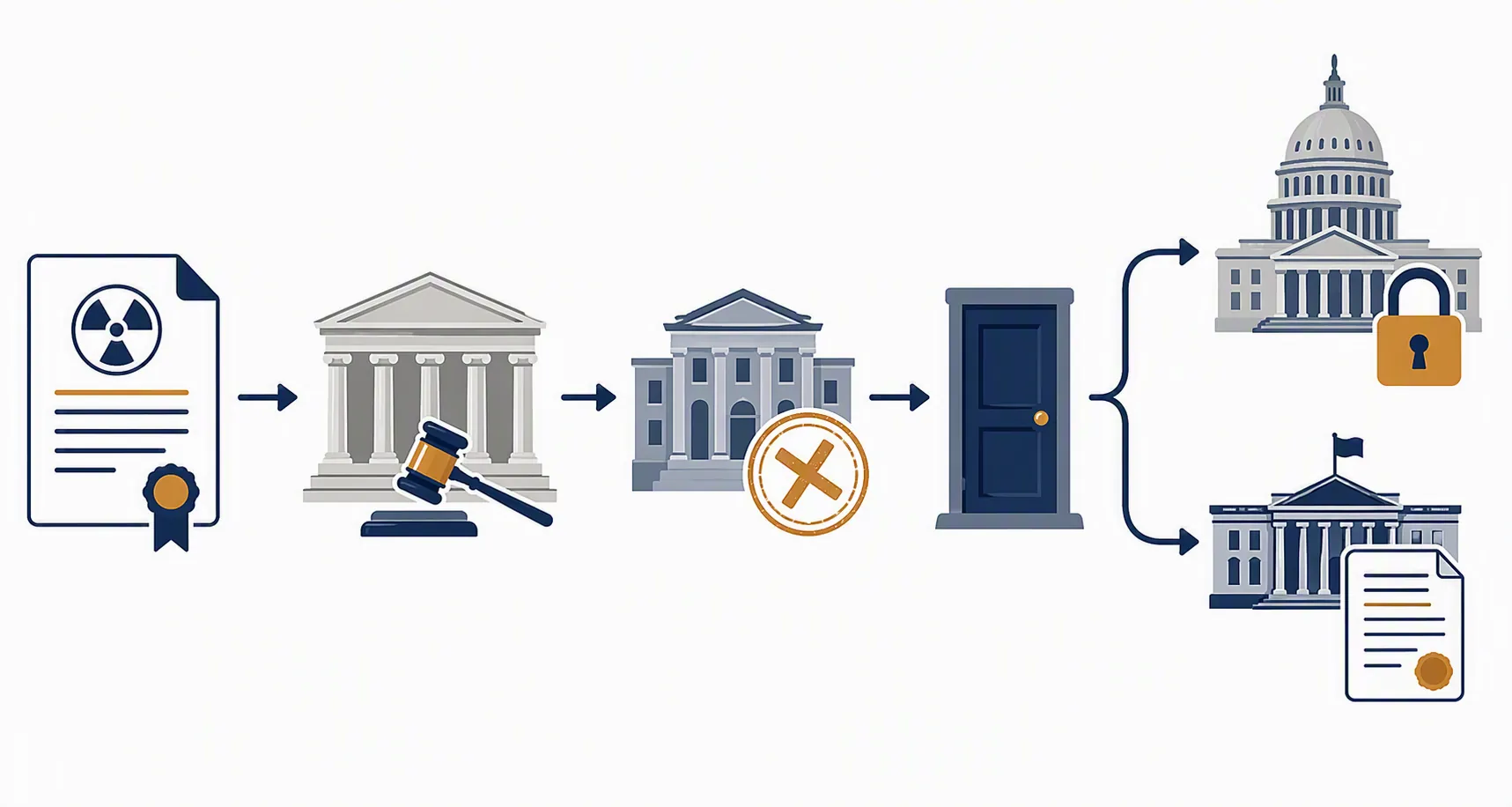
The Fifth Circuit’s remand dismissals in September and October 2025 completed the procedural cleanup. On September 22, 2025, the court dismissed the Texas/ISP petitions; on October 20, 2025, it dismissed both ISP and Holtec-related petitions. Those dismissals close the docket path. They are not a second merits adjudication by the Supreme Court, and they should not be written as one. [2]
What was avoided
The avoided question is the one many policy accounts still want to answer: whether federal law permits the NRC to license privately owned consolidated interim storage facilities for spent nuclear fuel when the Nuclear Waste Policy Act’s permanent-repository structure remains unresolved. The record here supports a narrower statement. The Supreme Court did not answer that question in NRC v. Texas, and the denial of certiorari in Beyond Nuclear did not answer it either. [1][3]
A cert denial leaves the lower-court judgment in place. It does not adopt the lower court’s reasoning as Supreme Court law. That is not pedantry in this docket; it is the difference between advising that a federal statutory theory has been rejected on the merits by the Supreme Court and advising that the available Supreme Court vehicles have closed without such a merits ruling.
Beyond Nuclear closed another federal route, but not the underlying controversy
Beyond Nuclear’s petition put the interim-storage dispute back before the Supreme Court after the D.C. Circuit’s August 27, 2024 ruling. The Supreme Court docket for No. 25-540 shows certiorari denied on January 12, 2026. [3][4]
That denial is procedurally simple and substantively easy to overread. The D.C. Circuit judgment stands. The Supreme Court did not use the case to say that the NRC’s licensing theory is correct, nor did it use the case to say that the challengers’ NWPA theory is correct. The result is finality for that vehicle, not a clean national merits rule.
The operative blocker is now state consent and permitting law
The practical constraint is not hidden in a footnote. New Mexico’s 2023 law and Texas’s 2022 law prohibit the state permits needed to break ground on high-level waste storage without explicit state consent. Those laws block both consolidated interim storage sites regardless of federal license posture. [5]
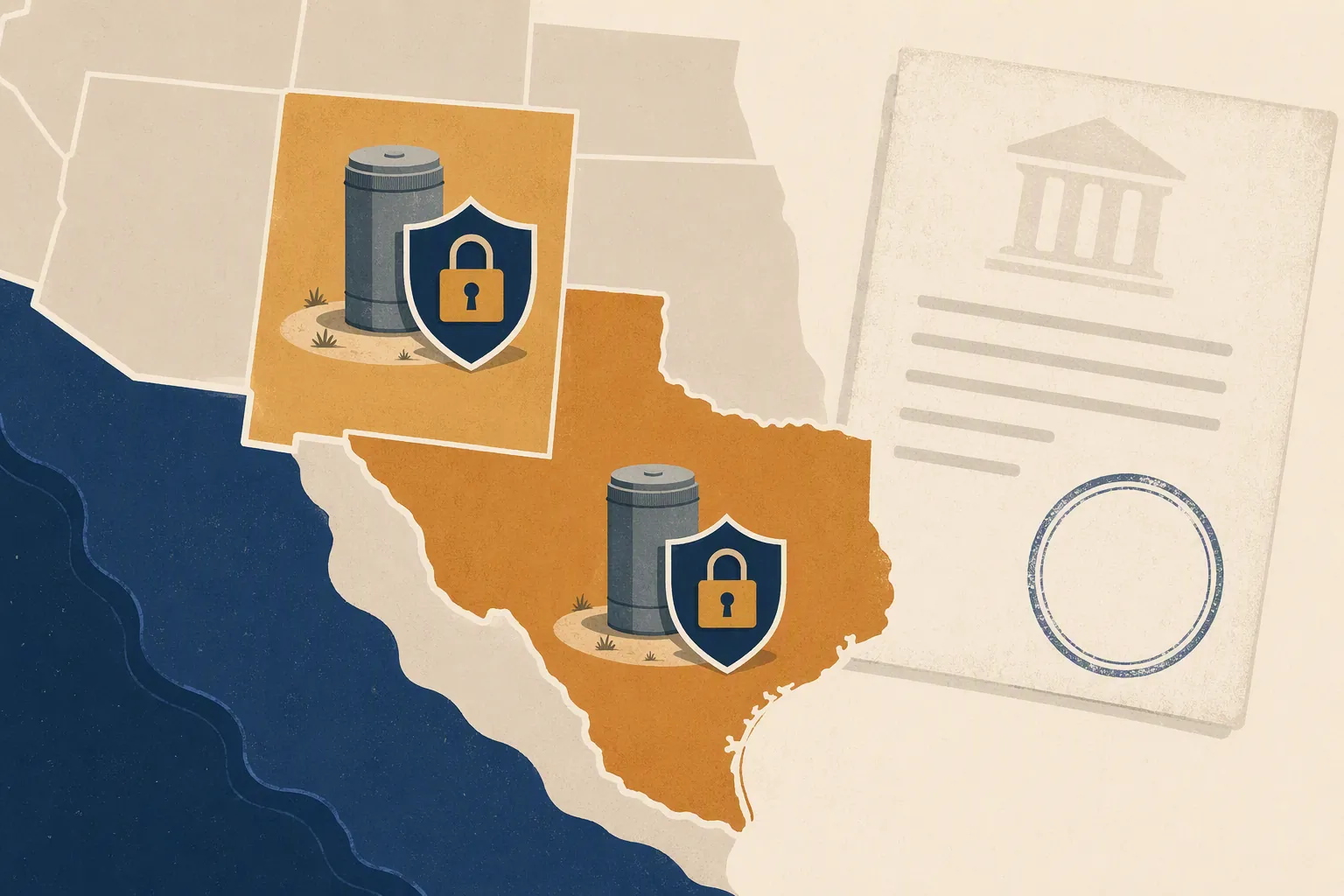
That is why Holtec’s October 2025 cancellation matters more to a present-tense risk analysis than another abstract recap of the NWPA debate. Holtec canceled its Eddy-Lea Energy Alliance agreement for the New Mexico project, citing state and oil-and-gas opposition and New Mexico’s consent law. [5]
A federal license, even one treated as administratively intact, does not pour concrete, secure the state-level permissions needed to build, or create political consent where a state statute requires it. If the client question is “Can the site proceed?” rather than “Can we write an exam answer about NRC authority?”, the state-law answer belongs near the top of the memo.
New Mexico’s position also did not begin with the 2023 statute. In a 2021 federal complaint, the state argued that the NWPA barred DOE from taking possession of spent fuel until a permanent repository was licensed, that the term “consolidated interim storage facility” did not exist in federal regulations, and that the proposed facilities would impose unfunded transportation and emergency-response mandates. [6]
Those earlier theories help explain the state’s posture, but they are not the best current shorthand for the legal obstacle. The current shorthand is simpler: without explicit state consent, state permitting law blocks the sites. A memo that spends three pages on the Fifth Circuit and one sentence on the state statutes is now weighted backwards.
The Gorsuch dissent is a procedural foothold, not a holding
Justice Gorsuch’s dissent in NRC v. Texas is worth preserving, but only in the correct column. He argued that the Atomic Energy Act directs the NRC to admit as parties those “whose interest may be affected,” criticized the agency’s contention-based intervention rules, and suggested that a future litigant might challenge those rules in light of the D.C. Circuit’s 1990 decision having rested on now-disavowed Chevron deference. [8]
That is not a live holding. It does not revive Texas or Fasken, and it does not reopen Beyond Nuclear. It does, however, mark a procedural theory for a future challenger: attack the NRC intervention rules themselves, rather than assume a non-intervenor can arrive later in the court of appeals as a “party aggrieved.”
The distinction is operational. A future litigant looking to preserve review would need to think early, at the NRC proceeding stage, about intervention, contentions, and any direct challenge to the rules governing admission. Waiting for license issuance and then relying on Texas’s path is exactly what NRC v. Texas now makes hazardous.
What not to treat as live litigation
The July 2025 Nuclear Waste Technical Review Board dismissals belong in the administrative-context file, not the case-status file, unless and until a court challenge is located. The reported fact is that the Trump administration dismissed seven of the eight Board members. No court challenge to those dismissals was found in the materials reviewed for this article. [7]
The same caution applies to broader campus-plan reporting, job projections, capital figures, and federal liability estimates. Those facts may matter to appropriations, oversight, and political strategy. They do not change the current litigation posture unless they become tied to a filing, statutory amendment, permit decision, or reviewable agency action.
Where the dispute can still materially advance
The remaining federal forum is Congress. That does not mean the controversy has cooled; it means the most important federal lever is legislative rather than appellate. Congress can alter the statutory framework for consent, interim storage, repository sequencing, federal possession, or preemption. The courts, on the record now available, have mostly closed the existing appellate vehicles without producing the clean merits answer many summaries imply.
At the state level, the legal blockers are already present. New Mexico and Texas have consent and permitting statutes that prevent the two consolidated interim storage sites from moving forward without explicit state consent. Holtec’s canceled New Mexico agreement shows how that barrier operates in practice, not just in theory. [5]
So the defensible Q3 2026 status answer is limited but clear: federal appellate litigation over the Trump nuclear waste storage plan has largely been exhausted or procedurally closed without a Supreme Court merits answer on NRC licensing authority; state consent and permitting law remains the practical blocker; and Congress is the remaining federal forum where the dispute can materially advance.
References
- SCOTUS Rules on Who Can Challenge Nuclear Regulatory Commission Licenses, Pillsbury Winthrop Shaw Pittman, June 26, 2025
- Shut Out of the Courtroom: When Procedure Trumps Policy in Nuclear Waste Litigation, Spencer Fane, January 26, 2026
- Beyond Nuclear v. NRC, No. 25-540, Supreme Court of the United States
- Beyond Nuclear brings interim storage case back to Supreme Court, ANS Nuclear Newswire, November 13, 2025
- Will the Trump administration’s nuclear campus plan break the US nuclear waste gridlock?, Bulletin of the Atomic Scientists, May 6, 2026
- Plan for waste illegal, New Mexico tells Nuclear Regulatory Commission in lawsuit, Courthouse News Service, March 29, 2021
- Trump expels all but one member of nuclear waste oversight board, ANS Nuclear Newswire, July 23, 2025
- A Merits Non-Dodge?, The Regulatory Review, August 7, 2025
Operationalizing workflow
No workflow has been explicitly linked to this obligation yet. See Workflows generally.
Illustrative cases
No illustrative case is currently tracked for this obligation. See Risk Digest for documented incidents generally.
← Back to RegulationReport a correction or tip
Spotted an outdated figure, a misstated fact, or a ruling this regulation entry should reflect? Public comments are disabled for this content given the professional cost of a misreported case outcome, penalty amount, or rule text — use the structured correction channel instead.
Report a correction or tip for this record →