
Trump 2025 Public Charge Rule: Green Card Timeline and Impact
- Effective date
- Sep 18, 2026
As of July 24, 2026, the practical answer for green card cases affected by the 2025–2026 public charge changes is not that every case has moved into one new system. The first question is whether the case is a USCIS adjustment filing or a consular case, and the second is whether the relevant Form I-485 is filed before or on or after September 18, 2026. The DHS final rule has been published, but it is not yet effective; when it becomes effective, it will replace the 2022 regulatory definitions with a broader discretionary framework and leave the client-facing benefit list to later agency guidance.
That filing-date line matters because the final rule was published on July 20, 2026, with an effective date of September 18, 2026.[1] USCIS describes the action as a rescission of the 2022 public charge regulation, but the operative question for pending and near-term filings is narrower: which rule governs the application that is actually postmarked, submitted, or presented for adjudication?[2]
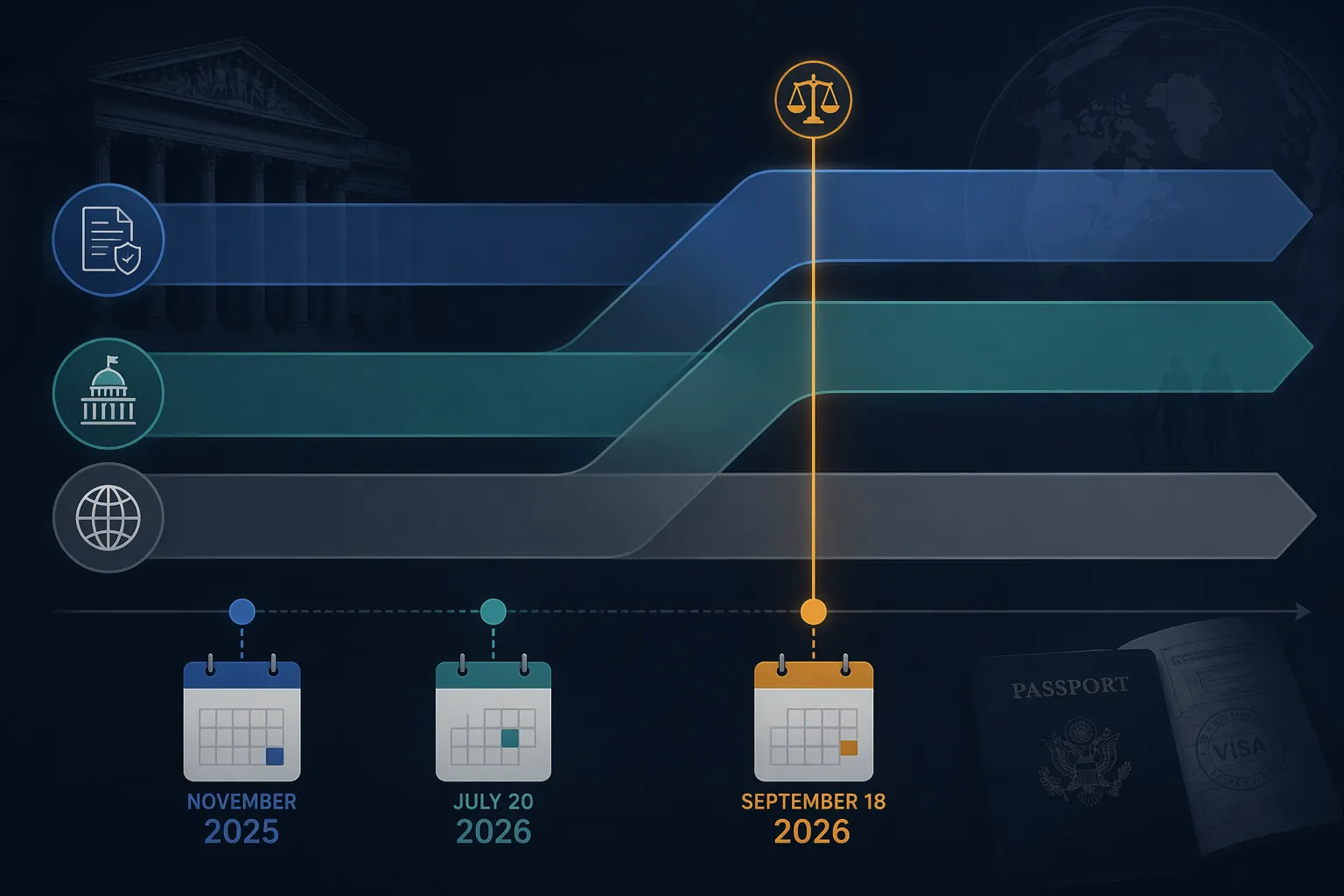
The dates that divide the green card cases
The cleanest way to read the 2025–2026 public charge sequence is as a set of filing and adjudication thresholds, not as a single political switch. The 2022 rule remains relevant because it still governs adjustment filings submitted before the new effective date. The November 2025 proposal matters because it began the DHS rulemaking track. The July 2026 final rule matters because it supplies the new legal framework. September 18 matters because it is the date on which the USCIS lane changes for new adjustment filings.
| Date | Event | Why it matters for case screening |
|---|---|---|
| 2022 | DHS public charge regulation in effect under the Biden administration | This is the governing USCIS adjustment framework for applications filed before the September 18, 2026 cutoff.[2] |
| November 19, 2025 | DHS notice of proposed rulemaking published at 90 FR 52207 | This begins the DHS rulemaking path that leads to the 2026 final rule.[1] |
| November 2025 | DOS consular public charge standard changed by cable | This affects consular processing separately from USCIS adjustment filings.[3][4] |
| January 21, 2026 | DOS immigrant visa suspension for nationals of 75 countries | This is a consular-processing restriction, not a Form I-485 rule.[5] |
| July 20, 2026 | DHS final rule published | The rule is legally significant on publication, but it is not yet the effective standard for all filings.[1] |
| September 18, 2026 | DHS final rule effective date | New adjustment filings on or after this date move into the new DHS discretionary framework, with revised form requirements and later guidance issues.[1][3] |
The table also shows why shorthand references to a “Trump public charge rule” can mislead. A client inside the United States preparing an I-485 package is not in the same procedural position as a family member waiting for a consular interview abroad. A September filing is not the same as an October filing. A pending challenge to a DOS action is not an injunction against USCIS adjudication.
Three regimes, not one
For counseling, the case map now has three lanes. The lanes overlap in time, but not in application type.
| Regime | Who is in it | Practical consequence |
|---|---|---|
| 2022 DHS rule | Adjustment applicants whose Form I-485 is postmarked or submitted before September 18, 2026 | The rescinded definitions still matter for these filings because the new rule is not effective for them.[3] |
| New DHS discretionary framework | Adjustment applicants filing Form I-485 on or after September 18, 2026 | Adjudicators will apply the new framework, revised forms are expected, and benefit-treatment details depend on unpublished sub-regulatory guidance.[3][4] |
| DOS consular standard | Immigrant visa applicants processing outside the United States | The consular standard changed on a separate track in November 2025 and is tied to a separate 75-country visa suspension challenged in federal court.[5] |
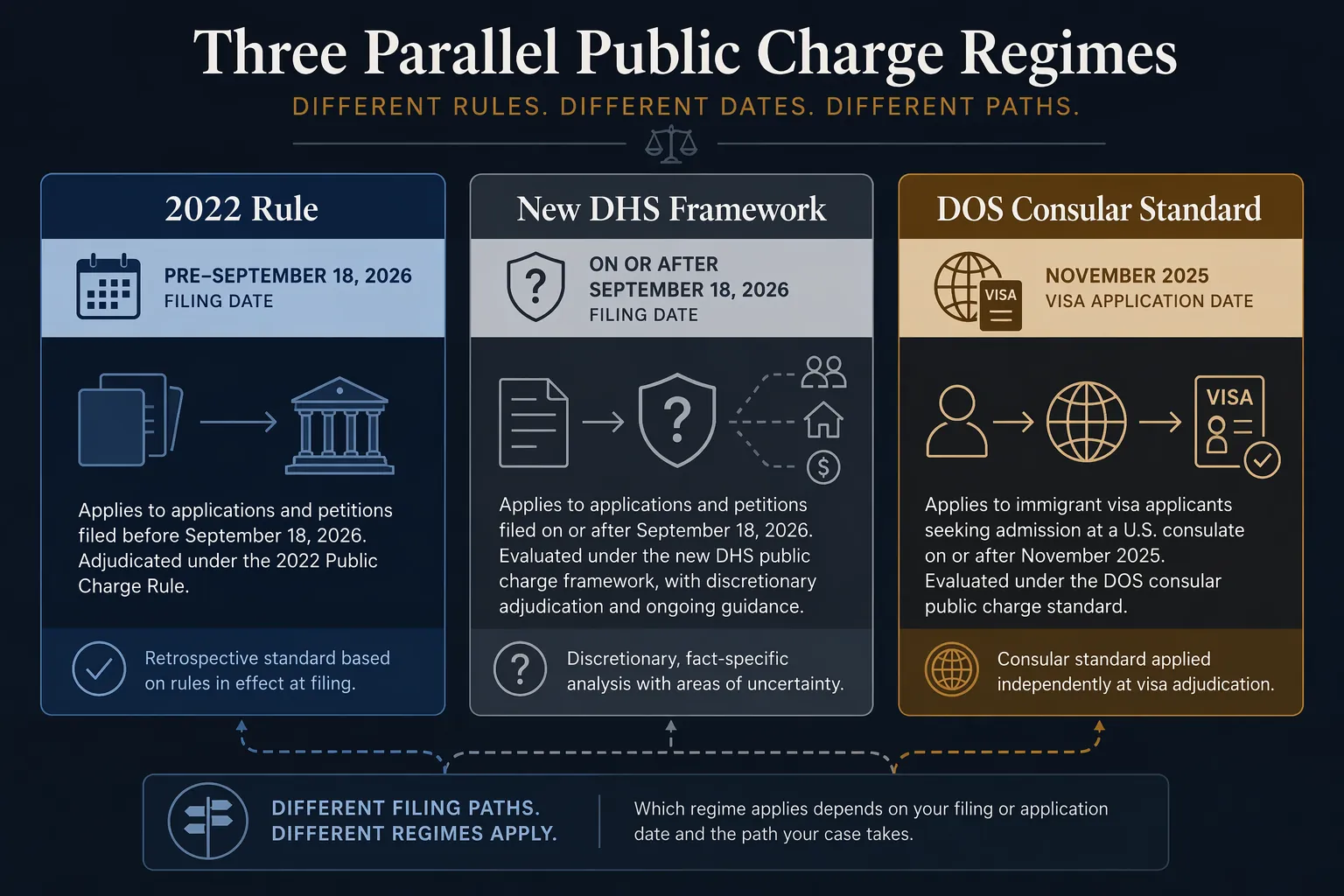
This is the point at which client counseling becomes uncomfortable. The final rule is real. The effective date is real. But the operational list that families, employers, and benefits counselors want to see is not yet public. A practitioner can say which lane the case appears to occupy. The practitioner cannot responsibly pretend that the July final rule itself answers every benefits-risk question.
What changes for Form I-485 filings on September 18
For adjustment of status, the operative mechanics are filing-date mechanics. Practitioner alerts describe the cutoff as applying to Form I-485 applications postmarked or submitted before September 18, 2026, versus those filed on or after that date.[3] That means a case mailed before the cutoff and a case assembled before the cutoff are not necessarily the same case if the postmark or electronic submission occurs later.
For filings on or after September 18, revised forms are expected to be required.[3] That is not a cosmetic point. If USCIS changes the Form I-485 edition and public charge questions, a package using an old edition after the effective date may create a rejection or refiling problem. The consequence is procedural before it is substantive: a missed form-effective-date rule can move a client from one timing posture into another.
The same date also matters for benefits received after September 18. Available practitioner and community updates state that benefit receipt after the effective date may be weighed under the new framework.[3][4] That phrasing should stay as narrow as the source support allows. It does not mean every benefit will count. It means post-effective-date receipt may become part of the discretionary public charge assessment once DHS supplies the missing operational guidance.
Public charge bonds get their own timing problem. Alerts identify a tightening under which receipt of any means-tested benefit after September 18 would breach a public charge bond.[3][6] That is a material consequence for the smaller set of cases involving a bond, and it should not be blurred into the broader question of whether a benefit makes an applicant inadmissible in the first place.
A practical intake sequence
The intake sequence for an adjustment case should be bluntly chronological before it becomes substantive:
- Confirm whether the applicant is filing Form I-485 with USCIS or processing for an immigrant visa abroad.
- For Form I-485, identify the expected postmark or electronic submission date, not merely the date the package was prepared.
- If the filing will occur before September 18, screen under the 2022 rule while preserving proof of timely filing.
- If the filing will occur on or after September 18, plan for revised forms and a broader discretionary public charge review.
- Ask separately whether a public charge bond is involved, because post-September 18 means-tested benefit receipt has a distinct bond-breach consequence.
- When discussing benefit use, disclose that the controlling sub-regulatory benefit guidance has not yet been published.
That sequence may feel mechanical, but public charge mistakes often start with an imprecise date. A client who says “we filed in September” has not supplied enough information. The legal cutoff is not the month; it is the filing posture relative to September 18.
Why the final rule does not close the benefits question
The July 2026 final rule rescinds the 2022 public charge definitions and replaces them with a framework that gives adjudicators broader discretion.[1][2] The difficult part is what the final rule does not do: it does not publish a complete, operative list of which benefits will count in the new analysis. Available updates state that this practical detail is expected through sub-regulatory guidance rather than the regulation itself.[3][4]
That matters for two reasons. First, sub-regulatory guidance can arrive after the final rule and can be revised more easily than a regulation. Second, it will not go through the same notice-and-comment process that produced the final rule. For lawyers and legal-ops teams, the gap is not academic. It is the difference between telling a client “this benefit is excluded under the current rule” and telling the client “the agency has not yet published the operative guidance for filings after the effective date.”
The statutory factors remain part of the analysis. INA 212(a)(4)(B) directs consideration of age, health, family status, assets, resources, financial status, education, and skills, and public charge analysis has not become a single-factor benefits test.[2][7] USCIS and practitioner summaries also continue to identify humanitarian exemptions and the naturalization context as outside the ordinary green card public charge inquiry.[2][7] Those points are useful guardrails, but they do not supply the missing post-September 18 benefits list.
This is also where the 2022 rule should not take up more space than it deserves. The old rule matters because it governs pre-effective-date filings and because the new rule rescinds its definitions. It does not answer what DHS will tell adjudicators to do after September 18.
Consular processing moved on a separate track
Only after the USCIS adjustment timeline is sorted should the DOS piece enter the analysis. A person outside the United States applying for an immigrant visa is not filing Form I-485, and the September 18 DHS form mechanics do not control the consular interview. DOS changed its consular public charge standard by cable in November 2025, before the DHS final rule became effective.[3][4]
The consular track then became more complicated on January 21, 2026, when DOS imposed an immigrant visa suspension affecting nationals of 75 countries, without notice-and-comment rulemaking.[5] That suspension belongs in the public charge conversation only for consular cases. It should not be described as a USCIS adjustment-of-status bar.
The pending challenge is CLINIC v. Rubio, filed on February 2, 2026, in the Southern District of New York under case number 1:26-cv-00858.[5] The available NILC update states that the case is on cross-motions for partial summary judgment; based on the available update, there is no published ruling or injunction as of July 24, 2026.[5] Without an injunction, the visa suspension remains an operative consular-processing problem, not merely a background litigation issue.
This distinction changes the advice. For an adjustment applicant, the key questions are I-485 timing, form edition, benefits guidance, and any bond issue. For a consular applicant, the key questions include the DOS standard, nationality-based suspension coverage, interview posture, and the status of CLINIC v. Rubio. Calling both “public charge” does not make them the same adjudicatory path.
What can be said safely before September 18
For cases that can be filed before September 18, the practical task is to preserve the filing record. The postmark or electronic submission date should be documented. If a filing is rejected for a form, fee, signature, or delivery problem, the client may lose the timing position counsel thought had been secured. The rule map is only useful if the filing proof is clean.
For cases that will be filed on or after September 18, advice should separate known changes from unresolved details. Known: the 2022 regulatory definitions are being rescinded, the new DHS framework is broader and discretionary, revised I-485 materials are expected, post-effective-date benefits may be weighed, and the bond-breach rule tightens for means-tested benefit receipt after that date.[1][3][4][6] Unresolved: the exact benefit list and the way USCIS will operationalize it in adjudicator guidance.
For consular cases, the September 18 USCIS filing cutoff should not be allowed to crowd out the DOS facts. The November 2025 cable and January 2026 suspension may be more important to the client’s actual path than the DHS form-effective-date rule.[5] A family waiting abroad can be harmed by advice that assumes every public charge question runs through USCIS.
The legally significant event has already happened: DHS published a final rule rescinding the 2022 framework. The operationally complete event has not happened yet: DHS has not published the sub-regulatory guidance that will tell practitioners exactly which benefits count in the new system. Before advising on green card timing or benefits risk, the case has to be sorted by filing date and application type, and the guidance gap has to be disclosed rather than smoothed over.
References
- Public Charge Ground of Inadmissibility, Federal Register, July 20, 2026.
- U.S. Citizenship and Immigration Services Rescinds 2022 Public Charge Regulation, USCIS.
- United States: DHS Replaces Public Charge Regulation with Policy Guidance and Broad Discretion for Adjudicators, Fragomen, July 16, 2026.
- Public Charge: Latest, ILRC, July 16, 2026.
- CLINIC v. Rubio, NILC, April 22, 2026.
- Public Charge: What Advocates Need to Know About the November 2025 Proposed Rule, NILC.
- New Public Charge Rule: Green Card Applicants, Ilabaca Law.
Operationalizing workflow
No workflow has been explicitly linked to this obligation yet. See Workflows generally.
Illustrative cases
No illustrative case is currently tracked for this obligation. See Risk Digest for documented incidents generally.
← Back to RegulationReport a correction or tip
Spotted an outdated figure, a misstated fact, or a ruling this regulation entry should reflect? Public comments are disabled for this content given the professional cost of a misreported case outcome, penalty amount, or rule text — use the structured correction channel instead.
Report a correction or tip for this record →