
The Section 123 Statutory Roadmap for the Trump-Saudi Nuclear Deal
- Authority
- U.S. Congress
- Rule type
- statute
- Jurisdiction scope
- US federal
- Source text
- Read primary rule text ↗
Standard non-exempt 123 agreement enters into force after 90 continuous-session days unless Congress passes joint resolution of disapproval and overrides veto.
As of July 24, 2026, the legal question around the Trump-Saudi nuclear deal starts with a narrow filing fact: the U.S.-Saudi civilian nuclear cooperation agreement was signed on July 22, is expected to be transmitted to Congress, and the full agreement text is not yet public. Public reporting describes a proposed Section 123 agreement that appears to be moving on the standard non-exempt route under the Atomic Energy Act rather than the exempt route requiring affirmative congressional approval.[1][2]
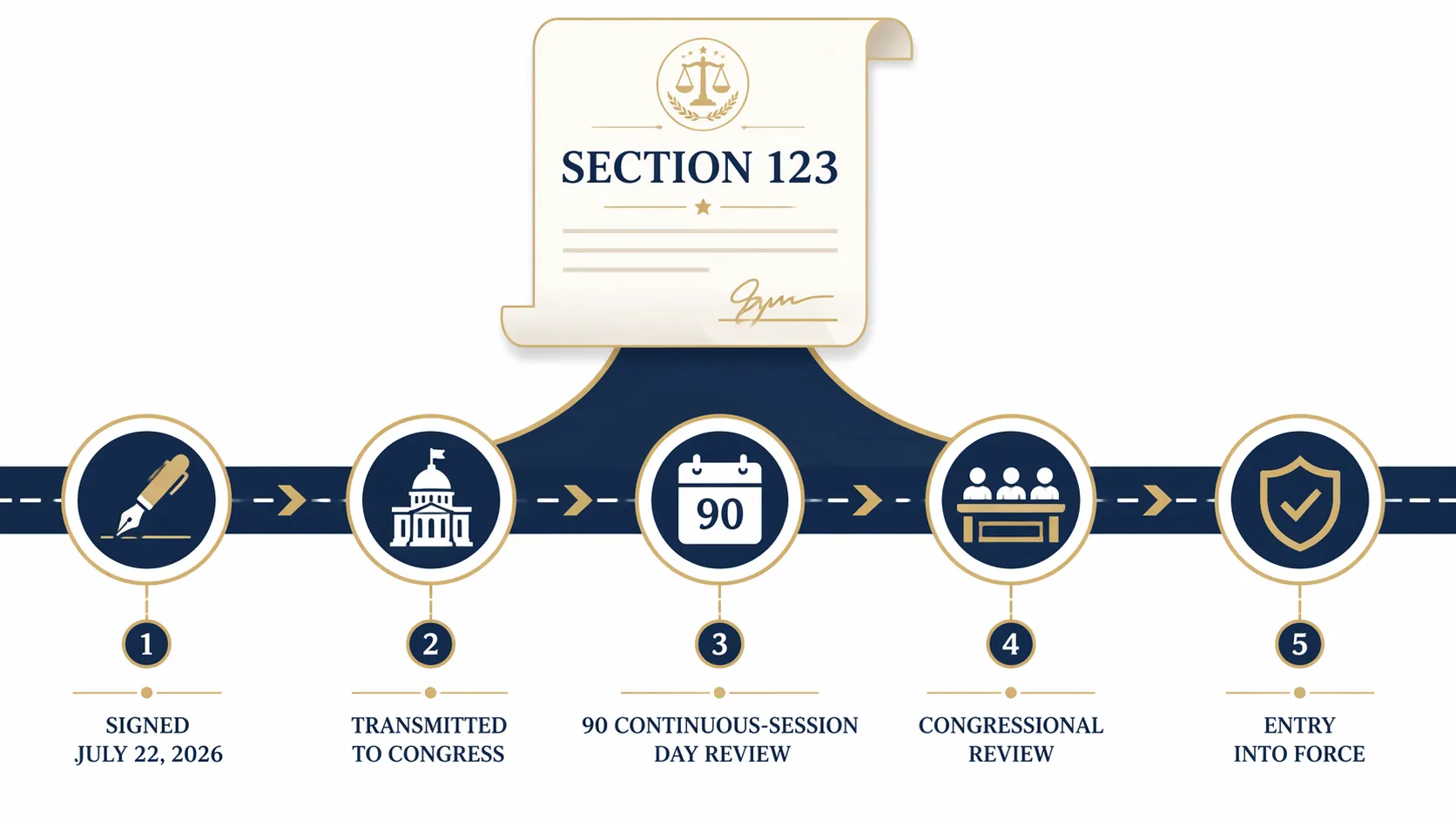
That sequence matters because “approval” is the wrong verb if it suggests Congress must vote yes before the agreement can take effect. For a standard non-exempt Section 123 agreement, the statutory default is entry into force after a 90-continuous-session-day congressional review period unless Congress enacts a joint resolution of disapproval. The distinction is not semantic. It determines who must assemble votes, when the clock starts, and whether a presidential veto becomes the practical center of the fight.[3]
The Atomic Energy Act does not ask Congress to bless the deal in the ordinary case
Section 123 of the Atomic Energy Act is the gateway for significant U.S. civilian nuclear cooperation with another country. The statute requires an agreement for cooperation and sets nonproliferation criteria that must be addressed before U.S.-origin nuclear material, equipment, or technology can move under that relationship. The Arms Control Association summarizes the statutory framework as nine nonproliferation criteria, including safeguards, peaceful-use commitments, restrictions on retransfers, controls on enrichment and reprocessing of covered material, physical security, prior approval for certain storage, and U.S. rights if the partner detonates a nuclear explosive device or terminates safeguards.[4]
Those criteria are not the same thing as the “gold standard” often used in policy debates. A gold-standard agreement, such as the 2009 U.S.-UAE model discussed in the Saudi context, includes a partner’s formal renunciation of enrichment and reprocessing. Section 123’s baseline requirements are more limited: they give the United States consent rights and control conditions over covered cooperation, but they do not by themselves require every partner to renounce all enrichment and reprocessing activity as a national policy matter.[1][4]
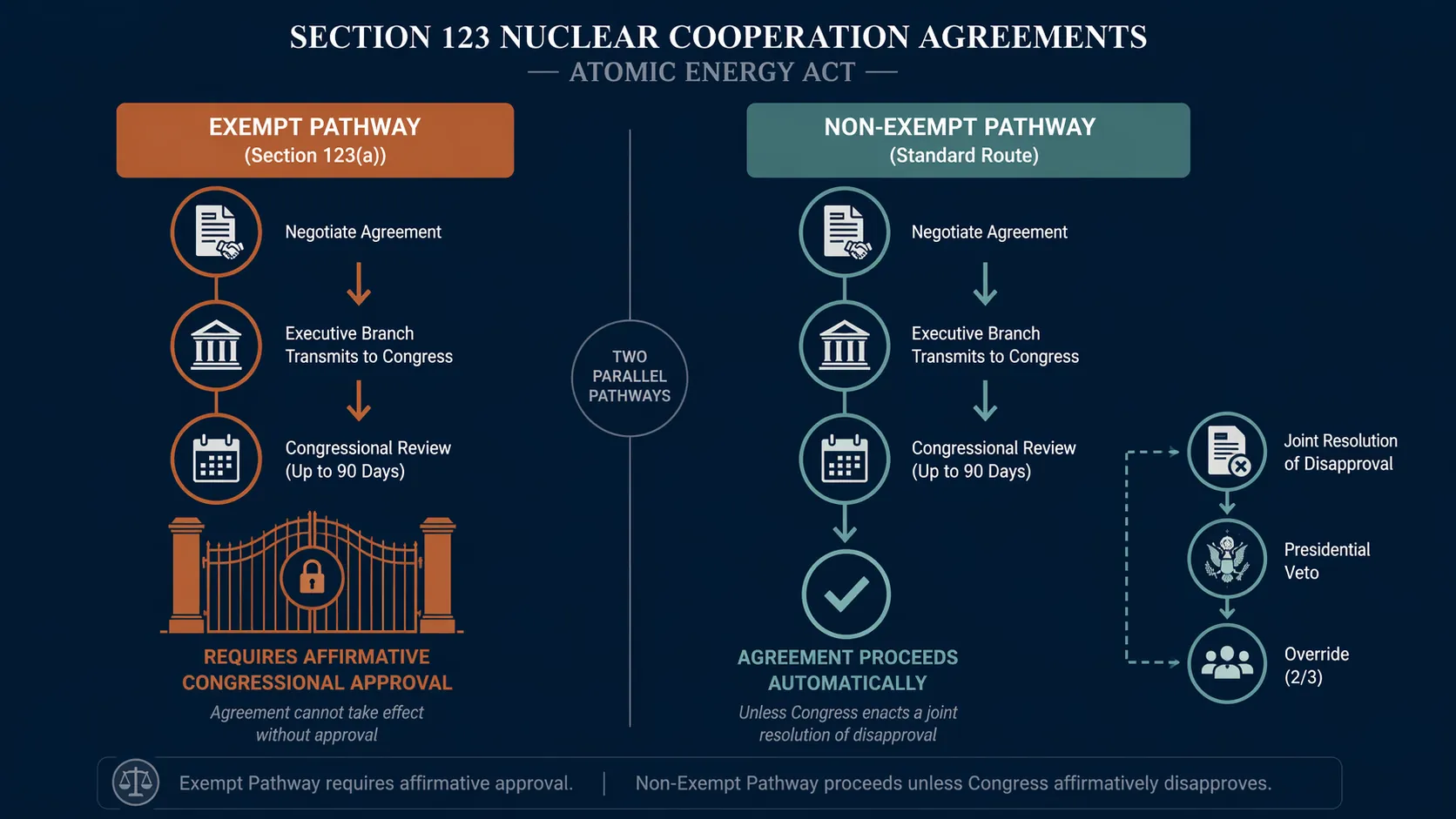
The statute then divides proposed agreements into two legally different tracks. A standard, non-exempt agreement is submitted for congressional review and may enter into force unless Congress blocks it. An exempt agreement is one in which the President exempts the agreement from one or more statutory criteria; that route requires affirmative congressional approval before it can enter into force. No in-force 123 agreement has ever been adopted under the presidential exemption authority.[4][5]
| Pathway | Congressional posture | Legal consequence |
|---|---|---|
| Standard non-exempt Section 123 agreement | Congress reviews; opponents must enact a joint resolution of disapproval | Agreement may enter into force after the 90-continuous-session-day period unless disapproved |
| Exempt Section 123 agreement | Congress must affirmatively approve | Agreement does not enter into force without the required approval |
On the materials available now, the Saudi agreement should be analyzed as the first row, not the second. If the administration later transmits an agreement with an exemption from a Section 123 criterion, that would change the vote posture. But absent that transmission package, the better working assumption is the ordinary non-exempt mechanism: review, possible disapproval, and default entry into force.
The clock starts with transmission, not signing
The July 22 signature is legally important, but it is not the same event as statutory submission to Congress. Public reporting says the agreement will be transmitted to Congress for review; as of July 24, the publicly available materials do not establish that the 90-continuous-session-day clock has formally begun.[1]
When the package is transmitted, Congress is not merely receiving a diplomatic text. The Section 123 process includes the proposed agreement and associated executive-branch determinations and nonproliferation analysis, including a Nuclear Proliferation Assessment Statement. Those materials are the record against which committees and staff will test whether the agreement satisfies the Atomic Energy Act criteria and whether any separate statutory restrictions have been addressed.[3][5]
The “90 days” also should not be read as 90 ordinary calendar days. The statute uses continuous-session days, a congressional counting device that can be affected by adjournments and the congressional calendar. That is why counsel tracking the deal should watch the formal transmission date and the congressional session calendar before advising on the outside date for possible entry into force.[3][5]
Congress’s formal blocking tool is disapproval, subject to presidential veto
For a non-exempt agreement, Congress’s formal blocking mechanism is a joint resolution of disapproval. That makes the legal posture asymmetric. Supporters of the agreement do not need to pass a new statute approving it. Opponents must move legislation through both chambers and present it to the President.[3][5]
In a deal signed and publicly defended by President Trump’s administration, a disapproval resolution that reached the White House should be expected to face a veto. That moves the practical threshold from simple passage in both chambers to the votes needed to override a veto. The result is that congressional “review” can be very real without being equivalent to an up-or-down approval requirement.
Congress is not limited forever to that single instrument. It can legislate separately, attach conditions to appropriations, or affect later export licensing through targeted statutory restrictions. CRS has tracked appropriations riders addressing Saudi nuclear cooperation, including conditions tied to Saudi renunciation of enrichment and reprocessing and adherence to the IAEA Additional Protocol, along with later waiver authority.[5] But those tools should not be collapsed into the Section 123 review vote itself. The statutory review mechanism is disapproval; later implementation may raise additional licensing, funding, and compliance questions.
Why the reported Saudi terms are policy-significant even if not automatically unlawful
The reported Saudi terms raise serious nonproliferation questions because they appear to depart from safeguards that many members of Congress and nonproliferation specialists had treated as essential for Saudi Arabia. Reuters reported that the agreement lacks the gold-standard safeguards associated with the U.S.-UAE agreement.[1] The New York Times reported that the arrangement does not include a formal Saudi prohibition on enrichment and reprocessing and includes a two-year study concerning enrichment.[2]
That absence does not, standing alone, prove a Section 123 violation. The Atomic Energy Act criteria require specified controls over U.S.-origin materials, equipment, and cooperation; they do not necessarily require Saudi Arabia to make a blanket national renunciation of all enrichment and reprocessing. A congressional staff memorandum can therefore say both things at once: the absence of a gold-standard pledge is a major policy concession, and it is not automatically the same as failure to satisfy Section 123.
The same distinction applies to the IAEA Additional Protocol. The Additional Protocol is a strengthened safeguards instrument that gives the IAEA broader tools than a basic comprehensive safeguards agreement. It has become a common benchmark in nonproliferation policy. But the reported Saudi package substitutes a Bilateral Safeguards Agreement, and Arms Control Today reported that this bilateral arrangement would cover only “proliferation sensitive” sites.[6]
That narrower reported safeguard is important because it affects inspection reach and precedent. It is not the same as saying the Atomic Energy Act text expressly requires the Additional Protocol in every 123 agreement. The legal question is whether the transmitted package satisfies Section 123 and any other applicable statutory conditions. The policy question is whether Congress should accept a Saudi-specific arrangement that lacks the Additional Protocol and a formal enrichment-and-reprocessing renunciation.
Just Security’s pre-transmission analysis framed the congressional inquiry around that separation: members should evaluate the statutory nonproliferation criteria, the history of Saudi commitments, and the effect of any waiver or safeguard substitution rather than treating a diplomatic announcement as the end of the legal review.[7] That is the right level of skepticism. The agreement can be legally structured to pass through Section 123 while still presenting a safeguards profile that Congress may judge too weak for Saudi Arabia.
The two-year enrichment study is a hinge, not a conclusion
The reported two-year enrichment study deserves more precision than the word “authorization” gives it. Brookings had previously outlined a possible way forward that included a time-limited study of enrichment issues rather than immediate Saudi enrichment.[8] The New York Times account of the July 2026 deal similarly describes a two-year study in the absence of a formal enrichment-and-reprocessing prohibition.[2]
Until the agreement text is public, the legal effect of that study provision cannot be pinned down. It may operate as a deferral mechanism that leaves future enrichment activity subject to separate consent, negotiation, or licensing controls. It may also create diplomatic momentum toward a later enrichment pathway. Those are different legal consequences. The transmitted text, any side instruments, and the executive branch’s nonproliferation assessment will matter more than characterizations in public messaging.
The Section 1264 waiver sits beside the 123 process
The Saudi deal also intersects with Section 1264 of the FY2020 National Defense Authorization Act, a separate statutory provision that had conditioned certain nuclear cooperation steps on Saudi nonproliferation commitments, including enrichment-and-reprocessing renunciation and Additional Protocol adherence, unless waived. CRS identifies that waiver authority as part of the Saudi nuclear cooperation legal landscape.[5]
The Arms Control Association reported that the administration submitted a Section 1264 waiver report on November 24, 2025, and described it as the first use of that waiver. The administration’s waiver report argued that the deal would “prevent strategic competition from seizing an opportunity.”[9] That sentence is worth quoting because it states the administration’s case in the register Congress is likely to hear: if the United States does not structure cooperation, another supplier may.
But the waiver should not be made to do more legal work than it does. It does not transform the Saudi agreement into an exempt Section 123 agreement, and it does not erase the 90-continuous-session-day review mechanism. It addresses a separate statutory obstacle to cooperation with Saudi Arabia. Congress can treat the waiver as a serious signal about the administration’s willingness to accept weaker Saudi commitments, but the Section 123 pathway remains its own mechanism.
The Abraham Accords condition is outside the Atomic Energy Act unless later made enforceable
President Trump’s July 23 statement that Saudi Arabia must recognize Israel or normalize relations as a condition for the nuclear deal changes the political setting, but not the Section 123 statute. BBC and PBS reported the Truth Social condition and the White House press secretary’s confirmation of it.[10][11] That is an executive-branch condition as publicly stated. It is not one of the nine Section 123 nonproliferation criteria, and no cited Atomic Energy Act provision makes Abraham Accords participation a prerequisite for a 123 agreement.[4]
The timing also matters. Atlantic Council analysis around the agreement described the nuclear deal as having been de-linked from Saudi normalization with Israel before Trump’s public condition.[12] The President may now be trying to reattach normalization as a political precondition. But unless that condition is written into the agreement, an implementing instrument, an export-license condition, an appropriations restriction, or some other binding legal mechanism, it does not rewrite the Atomic Energy Act review path.
That does not make the condition irrelevant. It may affect whether the administration transmits the agreement, how Saudi Arabia responds, whether Congress views the package as stable, and whether later implementation proceeds. It may also become legally relevant if the administration incorporates it into an enforceable commitment or if Congress enacts a condition tying nuclear cooperation to normalization. As of July 24, however, the publicly reported condition sits outside the statutory Section 123 criteria.
What counsel should track next
The next legally significant event is not another social-media statement. It is transmission. The documents to watch are the agreement text, the Nuclear Proliferation Assessment Statement, any Bilateral Safeguards Agreement or side arrangement made available to Congress, the President’s determinations, and any explanation of how the administration treats enrichment, reprocessing, and the Additional Protocol.
Once transmitted, the central congressional question will be whether opponents can enact a joint resolution of disapproval within the statutory review period and, realistically, whether they can overcome a veto. If they cannot, the agreement may enter into force without an affirmative approval vote. Separate congressional tools may still affect funding, licensing, and implementation, but they should be analyzed as separate tools.
On the present record, the bounded legal judgment is straightforward: the Trump-Saudi agreement appears to be proceeding through the standard non-exempt Section 123 pathway; Congress’s formal blocking tool is a joint resolution of disapproval subject to veto politics; the reported absence of gold-standard safeguards is consequential policy terrain rather than an automatic statutory defect; and the Abraham Accords condition is not an Atomic Energy Act requirement unless it is later incorporated into a binding legal condition.
References
- Trump to seek Congress approval for Saudi Arabia nuclear energy pact that lacks safeguards — Reuters, July 21, 2026
- How the Trump Administration's Nuclear Deal With Saudi Arabia May Work — The New York Times, July 22, 2026
- Civil Nuclear Cooperation Through 123 Agreements: A Primer — Lawfare
- The U.S. Atomic Energy Act Section 123 At a Glance — Arms Control Association
- Prospects for U.S.-Saudi Nuclear Energy Cooperation — CRS Report IF10799, September 23, 2024
- U.S.-Saudi Deal Said to Loosen Nonproliferation Vows — Arms Control Today, March 2026
- How Congress Should Judge a Saudi Nuclear Cooperation Agreement — Just Security, February 12, 2026
- A way forward on a US-Saudi civil nuclear agreement — Brookings Institution, April 12, 2024
- Is Trump Jeopardizing Nonproliferation Efforts to Get A Nuclear Cooperation Deal with Saudi Arabia? — Arms Control Association, February 19, 2026
- Saudis must recognise Israel for nuclear deal, says Trump — BBC, July 23, 2026
- Trump adds new condition to Saudi nuclear deal, says kingdom must normalize relations with Israel — PBS News, July 23, 2026
- Experts react: Reading between the lines of the new US-Saudi nuclear agreement — Atlantic Council, July 2026
Operationalizing workflow
No workflow has been explicitly linked to this obligation yet. See Workflows generally.
Illustrative cases
No illustrative case is currently tracked for this obligation. See Risk Digest for documented incidents generally.
← Back to RegulationReport a correction or tip
Spotted an outdated figure, a misstated fact, or a ruling this regulation entry should reflect? Public comments are disabled for this content given the professional cost of a misreported case outcome, penalty amount, or rule text — use the structured correction channel instead.
Report a correction or tip for this record →