
How the Supreme Court split on birthright citizenship in Trump v. Barbara
- Authority
- U.S. Supreme Court
- Rule type
- Supreme Court opinion
- Jurisdiction scope
- US federal
- Effective date
- Jun 30, 2026
- Source text
- Read primary rule text ↗
Fourteenth Amendment protects birthright citizenship for persons born in U.S. territory under territorial jurisdiction
Any useful analysis of Trump v. Barbara has to start with the split, not the headline. The Court affirmed the District of New Hampshire’s class-wide injunction against Executive Order 14160 by a 6-3 judgment. But the Fourteenth Amendment holding carried only five votes: Chief Justice Roberts, joined by Justices Sotomayor, Kagan, Barrett, and Jackson. Justice Kavanaugh supplied the sixth vote for the judgment on statutory grounds only, concluding that the order violated 8 U.S.C. §1401(a), while Justices Thomas, Alito, and Gorsuch dissented. [1]
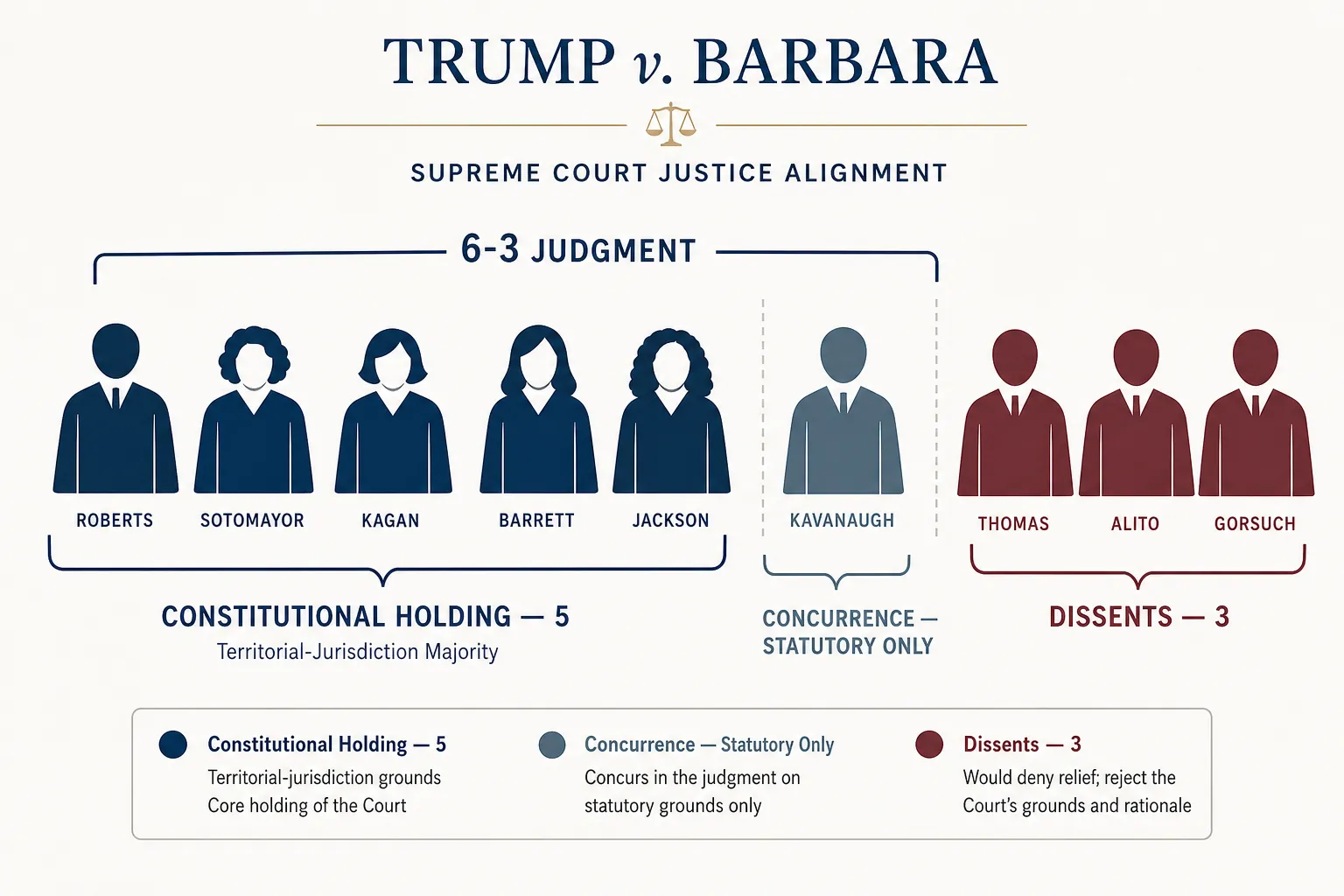
That distinction is not academic housekeeping. For most present counseling, a child born in the United States and covered by the Court’s territorial-jurisdiction analysis remains constitutionally protected under the Citizenship Clause. But a lawyer who describes Barbara as a 6-3 constitutional ruling is giving away the most important risk fact in the record: one justice in the judgment expressly refused to constitutionalize the result.
The vote split that controls the risk analysis
| Position | Justices | Immediate effect | Future litigation use |
|---|---|---|---|
| Constitutional majority | Roberts, Sotomayor, Kagan, Barrett, Jackson | The Citizenship Clause protects birthright citizenship under territorial-jurisdiction and jus soli principles. [1] | Binding constitutional holding for lower courts, unless and until the Court revisits it. |
| Statutory-only concurrence | Kavanaugh | Executive Order 14160 fails under 8 U.S.C. §1401(a), so the injunction is affirmed. [1] | Congress is invited to amend the statute, creating a possible new vehicle for constitutional litigation. |
| Dissents | Thomas, Alito, Gorsuch | The order would not be invalidated on the majority’s terms. [1] | Thomas supplies the broad constitutional challenge; Gorsuch supplies a narrower as-applied signal. |
The procedural posture matters because Barbara arrived after the Court had already limited universal injunction practice in Trump v. CASA. Executive Order 14160 was issued on January 20, 2025; after CASA on June 27, 2025, the Barbara plaintiffs proceeded through a Rule 23(b)(2) class action in the District of New Hampshire, where Judge Joseph Laplante certified the class and entered class-wide relief. The Court later granted certiorari before judgment, heard argument on April 1, 2026, and decided the case on June 30, 2026. [2][3]
That posture is why the judgment is not just a merits ruling about citizenship. It is also a confirmation that, after CASA, properly certified class relief can still carry national consequences when the class definition and Rule 23 record do the work that a universal injunction no longer can.
Roberts’s majority opinion: territorial jurisdiction does the work
Chief Justice Roberts’s opinion treats “subject to the jurisdiction thereof” as a territorial-jurisdiction phrase, not as a domicile screen. In the majority’s account, the Citizenship Clause incorporated the common-law jus soli rule: birth within sovereign territory generally confers citizenship, subject to historically recognized exceptions. The opinion reads United States v. Wong Kim Ark as confirming that rule rather than as a narrow decision about the child of lawfully domiciled parents. [1]
The government’s central move was to recast jurisdiction as a more demanding allegiance-or-domicile requirement. Roberts rejected that theory as “revisionist” and unsupported by “scant evidence,” a phrase that will do real work in district-court briefs if the executive branch or private intervenors attempt to relitigate the same theory under a different caption. [1]
The opinion is also notable for the way it handles changed immigration conditions. At oral argument, Roberts put the point to Solicitor General Sauer in a line that now reads like the boundary marker for the case: “It’s a new world. It’s the same Constitution.” [4] That is not a free-floating aphorism. It explains why the majority was unwilling to let contemporary enforcement concerns alter the constitutional meaning of a citizenship guarantee.
For practitioners, the strongest present advice rests here. If the client’s question is whether Barbara currently protects birthright citizenship for children born in the United States under the majority’s territorial-jurisdiction rule, the answer is yes. The harder questions begin when the facts or the legal vehicle move away from the executive order the Court actually reviewed.
Kavanaugh’s concurrence is the statutory opening
Justice Kavanaugh’s concurrence is the loose screw in an otherwise clear merits defeat for the government. He agreed that Executive Order 14160 could not survive because Congress has enacted §1401(a), which grants citizenship to persons born in the United States and subject to its jurisdiction. On that basis, he joined the judgment affirming the injunction. [1]
But he did not join Roberts’s Fourteenth Amendment holding. More than that, his concurrence expressly stated that Congress could “amend §1401(a) or otherwise enact new legislation establishing exceptions to birthright citizenship.” [1] That sentence is now the invitation every legislative drafter and constitutional challenger will quote first.
The practical consequence is straightforward. A new statute would not be the same case. The Roberts five would still control the constitutional holding from Barbara, but Kavanaugh’s vote would be newly contested because his concurrence resolved only the conflict between the executive order and the statute then on the books. If Congress changes the statute, the statutory ground disappears and the constitutional question returns without the same six-justice alignment.
That is why the legislative track deserves separate attention. For a fuller treatment of that pathway, see Can Congress end birthright citizenship after Trump v. Barbara? The short version for this decision analysis is that Kavanaugh did not merely leave a gap; he identified the institution that could try to walk through it.
The dissents point in different directions
Justice Thomas’s dissent is the broadest future-litigation template. In the Cornell LII version of the slip opinion, his dissent runs 91 pages and argues that the Citizenship Clause was directed to formerly enslaved persons and persons with the requisite domicile-based allegiance, not to every child born within U.S. territory. [1] The importance of that dissent is not its length by itself. It is that it gives future challengers a developed theory for asking the Court to narrow Wong Kim Ark or distinguish it from the facts presented by undocumented-parent cases.
Justice Alito’s dissent matters principally as part of the three-justice bloc that would not affirm on the majority’s terms. The present risk does not turn on a separate Alito pathway so much as on whether a future case can add Kavanaugh to some version of the Thomas position, or can persuade one member of the Roberts majority to move.
Justice Gorsuch’s solo dissent deserves narrower but more immediate attention. He wrote that he “harbor[ed] doubts” about applying the order to children of undocumented parents who “have long chosen to make this Nation their permanent home.” [1] That is not a vote for the Roberts holding. It is an as-applied warning: even a justice who rejected the majority’s route saw possible problems with using the executive order against a subset of families with deep U.S. ties.
For litigators, Gorsuch’s dissent changes the pleading map. A future plaintiff need not frame every challenge as a facial attack on Congress’s or the executive’s power to define citizenship categories. A narrower complaint could allege that, whatever the government’s authority at the margins, applying a restriction to a child whose parents have long treated the United States as their permanent home crosses a separate constitutional line. The dissent does not guarantee success for that theory. It makes the theory visible.
What counsel can safely say on July 27, 2026
Immigration counsel can tell most affected clients that Executive Order 14160 has been enjoined and that five justices held the Fourteenth Amendment protects birthright citizenship under territorial-jurisdiction principles. In-house teams can treat ordinary citizenship-status documentation, benefits eligibility, and onboarding processes as governed by Barbara unless a new statute or new fact pattern changes the legal premise. Litigators should be more careful: Barbara forecloses the executive order theory the Court rejected, but it does not foreclose every conceivable statutory or as-applied dispute.
Three monitoring obligations follow from the opinion alignment.
- Rehearing: Wikipedia reports that Trump announced a rehearing petition on July 8, 2026, but as of July 27, 2026, the materials reviewed here do not independently confirm that a petition was filed by the late-July deadline. Rehearing remains a low-probability event; the research materials identify 1965 as the last time the Court granted rehearing in this posture. [5]
- Legislation: Wikipedia reports that Rep. McGuire introduced the Birthright Citizenship Clarification Act on July 10, 2026, and that Sen. Moreno introduced the Harry Reid Immigration Stabilization Act on July 15, 2026. The bill text was not independently reviewed for this article, so the dates should be verified against primary congressional records before they are used in a filing or client alert. [5]
- As-applied litigation: Gorsuch’s dissent gives both sides a concrete line to plead around. Plaintiffs will emphasize long-term U.S. residence and permanent-home facts; the government will try to keep any future restriction framed at the category level rather than the family-history level. [1]
The rehearing issue should not drive day-to-day advice unless a petition is actually filed and the Court takes the extraordinary step of calling for a response or granting further review. The legislative issue is more serious because it activates Kavanaugh’s concurrence. The as-applied issue is quieter, but it may be the one that shapes the next complaint most directly.
So the restrained bottom line is this: birthright citizenship remains protected for most current counseling purposes under a five-justice constitutional holding, and Executive Order 14160 is not enforceable against the certified class. But Barbara is not a closed historical explainer. The constitutional margin is thin, the statutory concurrence is an invitation, and the Gorsuch dissent gives future litigants a fact-specific route back into court.
References
- Trump v. Barbara, Cornell Legal Information Institute.
- Trump v. Barbara, SCOTUSblog.
- Barbara v. Donald J. Trump, ACLU.
- Supreme Court strikes down Trump’s order ending birthright citizenship, SCOTUSblog, June 30, 2026.
- Trump v. Barbara, Wikipedia.
Operationalizing workflow
No workflow has been explicitly linked to this obligation yet. See Workflows generally.
Illustrative cases
No illustrative case is currently tracked for this obligation. See Risk Digest for documented incidents generally.
← Back to RegulationReport a correction or tip
Spotted an outdated figure, a misstated fact, or a ruling this regulation entry should reflect? Public comments are disabled for this content given the professional cost of a misreported case outcome, penalty amount, or rule text — use the structured correction channel instead.
Report a correction or tip for this record →