
What Legal Requirements Gate a Turkey F-35 Sale?
- Authority
- U.S. Congress
- Rule type
- statute
- Jurisdiction scope
- US federal
- Effective date
- Jul 22, 2026
- Source text
- Read primary rule text ↗
Joint State/Defense certification that Turkey no longer possesses the S-400, credible assurances against reacquisition, and no other Russian systems risking F-35; resolve CAATSA sanctions and §216 review; notify Congress under AECA §36.
As of Q3 2026, the legal answer to a State Department Turkey F-35 sale is still gated, not merely pending. The current record supports a narrow conclusion: the Department may discuss policy options, but an actual transfer remains blocked unless several statutory conditions are satisfied, certified, waived, reviewed, or notified. The reported July 22, 2026 State Department letter is important because it gives a dated compliance status: as reported, Turkey “has not yet met these conditions.” The letter itself is not publicly posted, so that wording should be treated as reported text and checked against the Kathimerini original; secondary accounts from Fox News, Turkish Minute, and The Times of Israel corroborate the report, but they do not replace the governing statutes or a public primary copy of the letter.[1]

The useful question is therefore not whether Washington is warmer or colder toward Ankara. It is which legal gate has moved. On the materials available, none has.
The Current Gate Inventory
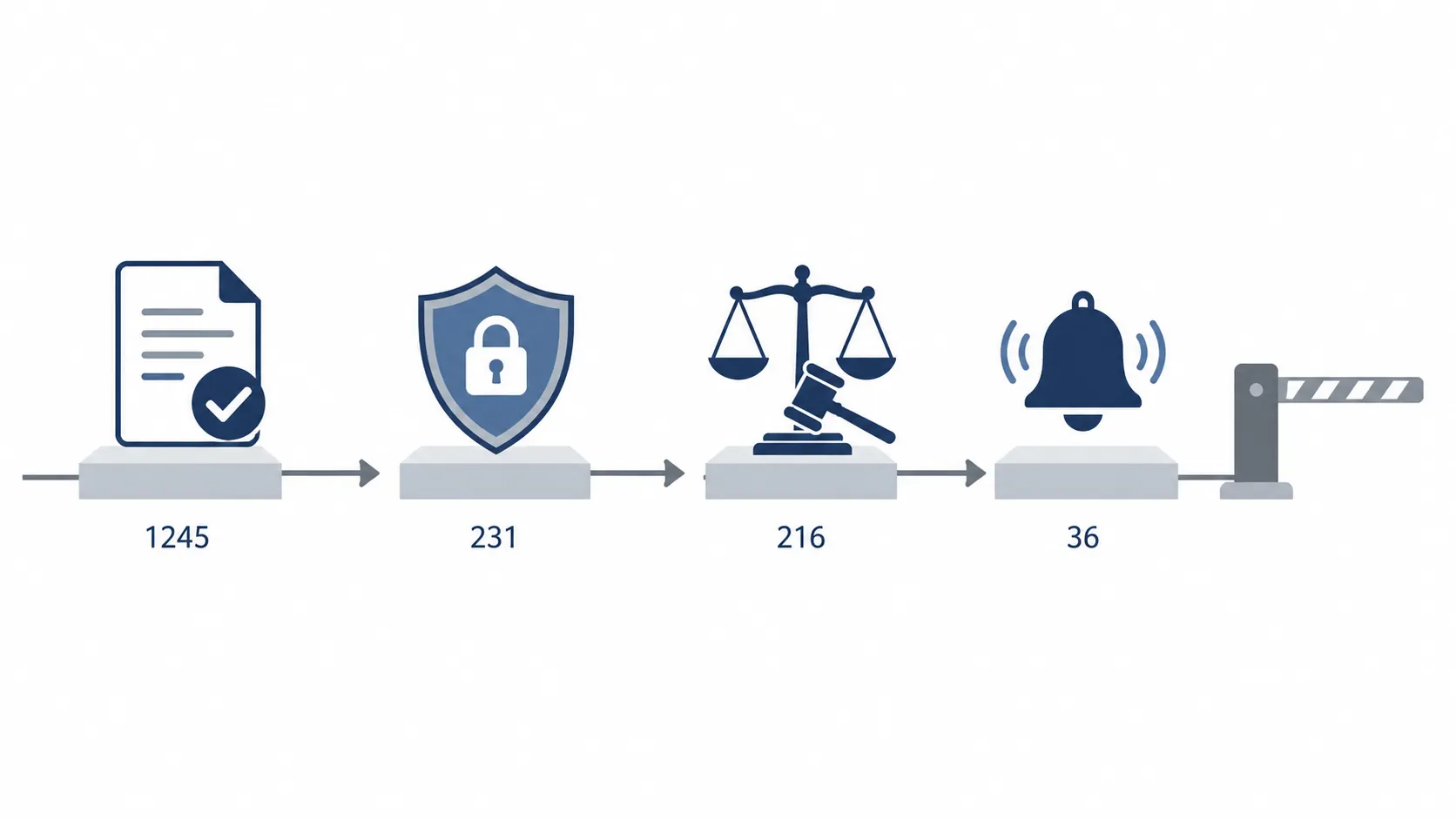
For briefing purposes, the chain is short enough to track in one place, but the steps should not be collapsed into one “State Department approval” label. They do different work.
| Gate | Legal function | Current status on available record | What would have to happen |
|---|---|---|---|
| FY2020 NDAA §1245 | Bars F-35 transfer to Turkey unless a joint State/Defense certification is made | Not met, according to the July 22, 2026 State Department letter as reported | Certification that Turkey no longer possesses the S-400, has credible assurances against reacquisition, and does not possess other Russian systems that risk compromising the F-35 |
| CAATSA §231 and related sanctions framework | Addresses sanctions imposed for significant transactions with Russia’s defense or intelligence sectors | Unresolved on the available record | Sanctions path must be resolved through the statutory mechanisms Congress provided, including any applicable waiver or termination conditions |
| CAATSA §216 | Requires congressional review for certain actions that would significantly alter sanctions policy | Still downstream of any sanctions-resolution step | Relevant sanctions action must be submitted for the required congressional review process |
| AECA §36 | Requires congressional notification for an eventual Foreign Military Sale | Not the present factual bottleneck | An FMS case would have to be notified to Congress if the earlier gates were cleared |
That sequence matters. A congressional notification under the Arms Export Control Act cannot cure a missing §1245 certification. A sanctions waiver, if available and properly used, would not itself establish that Turkey no longer possesses the S-400. A diplomatic statement that the parties are discussing defense cooperation is not a certification, a sanctions termination, or an AECA notice.
The §1245 Certification Is the First Hard Block
Section 1245 of the FY2020 National Defense Authorization Act is the most immediate transfer bar. As summarized by the Congressional Research Service, the statute prohibits transfer of F-35 aircraft or related intellectual property to Turkey unless the Secretary of State and Secretary of Defense jointly certify three conditions to Congress.[2]
- Turkey no longer possesses the S-400 air and missile defense system.
- Turkey has provided credible assurances that it will not reacquire the S-400.
- Turkey does not possess any other system acquired from the Russian Federation that could risk compromising the F-35.
Each element is factual and cumulative. “No longer possesses” is not the same as “does not operate,” “stores elsewhere,” or “agrees to discuss disposal,” unless the certifying officials are prepared to treat the facts as satisfying the statutory words. “Credible assurances” against reacquisition add a forward-looking condition; they are not automatically supplied by removal of existing equipment. The third element is broader than the S-400 itself because it asks whether any other Russian-origin system could risk compromising the F-35.
The reported State Department letter goes directly to this gate. It reportedly states that Turkey has not yet met the conditions for rejoining the program or receiving F-35s, which means the §1245 certification path is not presently open on the reported facts.[1]
What Counsel Should Not Conflate
The §1245 analysis should stay separate from broader judgments about whether Turkey is strategically important, whether bilateral relations have improved, or whether a future administration might favor a sale. Those may matter politically, but they do not answer the statutory certification question. The certification is a legal act by identified officials to Congress, not a general expression that the Executive Branch is comfortable with the transaction.
CAATSA Is a Separate Sanctions Gate
CAATSA operates on a different axis. Section 231 targets persons that knowingly engage in significant transactions with Russia’s defense or intelligence sectors, and Turkey’s Presidency of Defense Industries, commonly referenced as SSB, was sanctioned under that framework after the S-400 acquisition.[3]
That means a clean §1245 story would still not be the whole file. A sale path would also have to account for the existing CAATSA sanctions status. The relevant question is not simply whether the State Department supports the sale, but whether the sanctions posture has been lawfully resolved through the mechanisms Congress allowed.
The research record here supports only the narrower conclusion: the CAATSA issue is unresolved on the available facts. It does not support saying that sanctions have been terminated, waived, or otherwise cleared. Nor does it support treating a possible future waiver as if it had already been invoked.
Waivable Is Not Cleared
For risk analysis, “sanctioned but waivable” and “not sanctioned” are different states. A waiver authority, where applicable, is a legal route with conditions; it is not proof that those conditions have been met. A termination route likewise requires the statutory standard to be satisfied. Until the government actually uses a valid mechanism and completes any required congressional process, the sanctions gate remains part of the transaction file.
CAATSA §216 Adds Congressional Review to Certain Sanctions Changes
CAATSA §216 is not the same thing as the original §231 sanctions trigger. It is a congressional review provision for certain actions that would significantly alter U.S. sanctions policy toward Russia-related sanctions. In practical terms, it can make sanctions relief procedurally visible to Congress before a defense sale ever reaches the ordinary FMS notification stage.[4]
That review function is easy to understate because it is not the headline condition. But for a lawyer preparing a transaction-status note, it matters where §216 sits: after a contemplated sanctions-policy action, before anyone should describe the sanctions issue as resolved for sale-clearance purposes.
The available record does not identify a completed §216 review process for sanctions relief connected to a Turkey F-35 sale. Without that, the file should not be described as having cleared the CAATSA layer.
AECA §36 Comes Later, but It Still Matters
The Arms Export Control Act is the ordinary notification framework for major Foreign Military Sales. Section 36 requires the Executive Branch to notify Congress of covered sales before issuance of a letter of offer, subject to the statute’s thresholds and procedures.[5]
For the Turkey F-35 question, AECA §36 is important but downstream. It is the gate that would matter if the Executive Branch had a legally viable sale to notify. It is not, on the present record, the condition preventing the first move. The current bottlenecks are the §1245 certification and CAATSA sanctions-resolution path.
A precise briefing should therefore avoid saying that Congress merely “could object” to a sale. Congress is already embedded at several points: as recipient of the §1245 certification, as reviewer under CAATSA §216 for covered sanctions actions, and as recipient of any AECA §36 FMS notification. Those are different congressional roles with different legal consequences.
A Cleaner Way to State the Legal Position
The safest formulation is record-based and conditional:
A U.S. F-35 sale or transfer to Turkey is currently gated by FY2020 NDAA §1245, CAATSA sanctions and review requirements, and AECA §36 notification. The §1245 transfer bar would require a joint State/Defense certification that Turkey no longer possesses the S-400, has provided credible assurances against reacquiring it, and does not possess other Russian systems that could risk compromising the F-35. Separately, the existing CAATSA sanctions posture involving Turkey’s SSB would have to be lawfully resolved, including any required congressional review. If those gates were cleared, an eventual Foreign Military Sale would still require AECA §36 notification. According to the July 22, 2026 State Department letter as reported, Turkey has not yet met the conditions.[1][2][3][4][5]
That statement leaves room for future facts without manufacturing them. It does not treat the reported letter as primary text, convert possible waiver authority into completed relief, or make AECA notification do work that belongs to §1245 or CAATSA.
Status as of Q3 2026
On the available record, no present legal sale path is open. The reported State Department position is that Turkey has not yet met the conditions. The §1245 certification has not been identified as made. The CAATSA sanctions issue has not been shown to be terminated, waived, or cleared through the required process. The AECA §36 notice remains a later requirement for an eventual FMS, not evidence that the earlier gates have moved.
References
- Reported July 22, 2026 State Department letter on Turkey and F-35 conditions, Kathimerini, July 2026, link
- Turkey and the F-35: Background and Issues for Congress, Congressional Research Service, link
- Countering America’s Adversaries Through Sanctions Act, U.S. Congress, link
- CAATSA Section 216 Congressional Review of Sanctions Actions, U.S. Congress, link
- Arms Export Control Act Section 36, Legal Information Institute, link
Operationalizing workflow
No workflow has been explicitly linked to this obligation yet. See Workflows generally.
Illustrative cases
No illustrative case is currently tracked for this obligation. See Risk Digest for documented incidents generally.
← Back to RegulationReport a correction or tip
Spotted an outdated figure, a misstated fact, or a ruling this regulation entry should reflect? Public comments are disabled for this content given the professional cost of a misreported case outcome, penalty amount, or rule text — use the structured correction channel instead.
Report a correction or tip for this record →