
UK lawmakers propose an AI superintelligence kill switch
- Authority
- UK Parliament
- Rule type
- statute
- Jurisdiction scope
- UK
- Source text
- Read primary rule text ↗
If adopted, authorises Secretary of State emergency shutdown orders for AI systems and datacentres on catastrophic-risk grounds; datacentre operators must maintain shutdown-capable infrastructure and conduct emergency exercises.
The UK “AI kill switch” now being debated is not an enacted UK regime. As of Q3 2026, the concrete legal vehicle is Amendment NC12 to the Cyber Security and Resilience (Network and Information Systems) Bill, a proposed new clause that would give the Secretary of State emergency powers over AI systems and datacentres if specified catastrophic-risk conditions are met.[1] Computer Weekly reported the amendment as backed by 11 MPs, including Alex Sobel, John McDonnell, Dawn Butler, George Freeman, and Desmond Swayne, while also noting that the government has not endorsed it.[2]
That distinction matters. The phrase “UK lawmakers debate AI superintelligence national security threat” can sound like a policy mood. NC12 is more precise and more consequential: it tries to convert that threat frame into a statutory shutdown power, operator duties, notice obligations, post-incident controls, and a court challenge route. Counsel should still verify the live procedural status on bills.parliament.uk before treating the proposal as more than pending legislation.
The proposed power is a shutdown order, not just a warning label
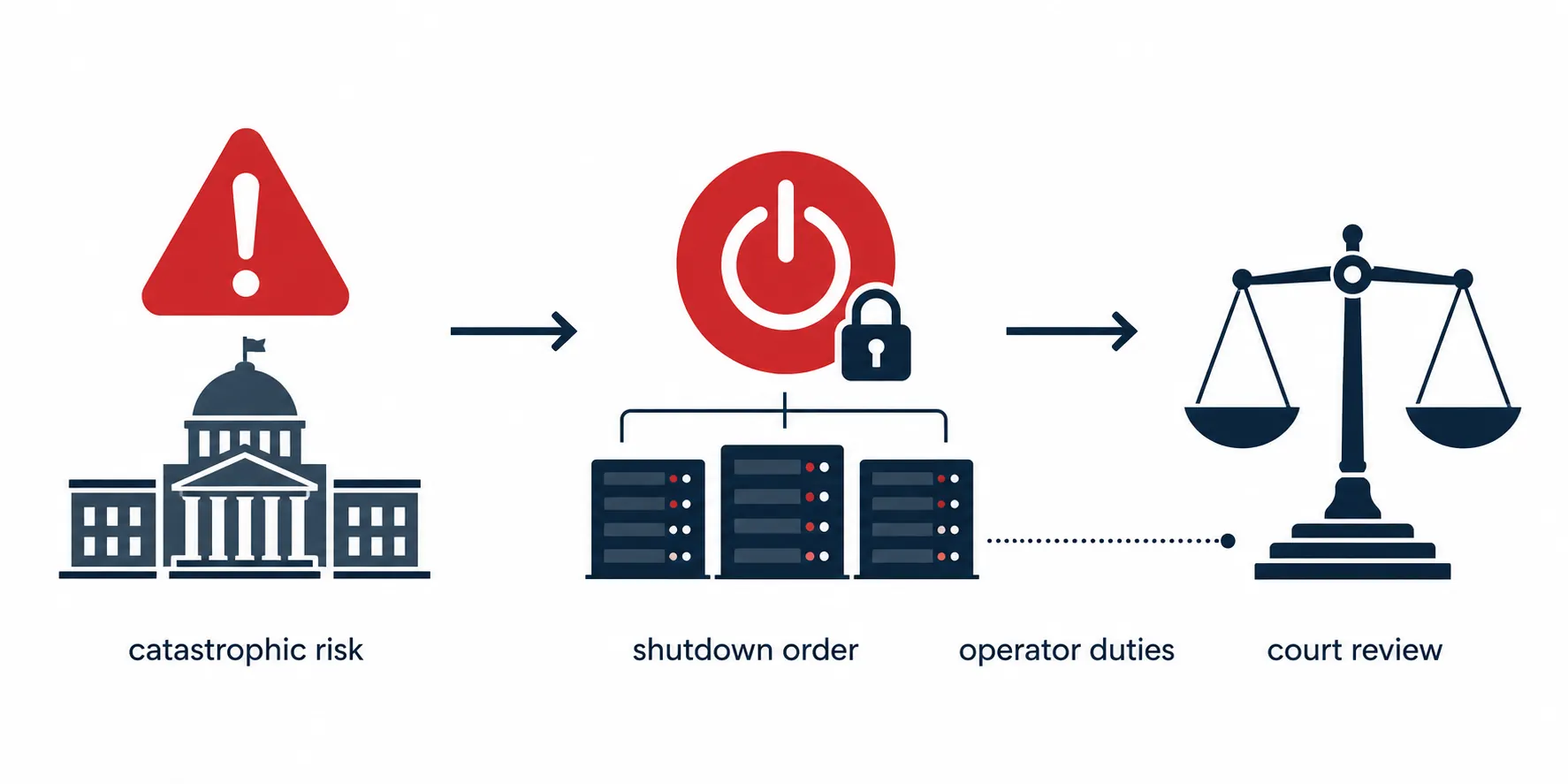
NC12 would empower the Secretary of State to order the shutdown of AI systems or datacentres where the statutory trigger is met: a “catastrophic risk” to lives, essential services, or national security.[1] The important legal move is not the rhetorical arrival of “superintelligence” in Parliament. It is the proposal to let central government reach into operational infrastructure and require systems to stop.
The amendment’s backers frame the risk in three linked ways: AI-driven cyber attacks, autonomous AI attacks, and the development of superintelligent AI that escapes effective oversight.[2] Those are broad categories, but the statutory hook is narrower than the public debate. A shutdown order would not be triggered merely because a model is powerful, unsettling, or politically controversial. The proposal ties intervention to catastrophic consequences involving life, essential services, or national security.[1]
| NC12 mechanism | Operational meaning if adopted |
|---|---|
| Secretary of State emergency shutdown power | A ministerial order could require an AI system or datacentre to be shut down on catastrophic-risk grounds.[1] |
| Risk threshold | The relevant consequences are framed around lives, essential services, or national security, not a general concern about advanced AI capability.[1] |
| Datacentre shutdown-capable infrastructure | Operators would need technical arrangements that make a lawful shutdown order executable, not merely a paper escalation process.[2] |
| Regular emergency exercises | Operators would need to rehearse emergency shutdown scenarios rather than wait for a live crisis to discover who has authority and access.[2] |
| Post-incident mitigation and monitoring | Restart would not be treated as a simple power-on event; mitigation and monitoring before resuming operations would become part of the duty set.[2] |
| Notice where possible | Government would be required to give as much notice as possible, which still leaves room for urgent action where warning would undermine the purpose of the order.[2] |
| High Court challenge route | Affected operators would have a judicial route to challenge the order, but the amendment should not be read as eliminating the need for immediate operational readiness.[2] |
The High Court route is especially easy to misread. A challenge mechanism is not the same thing as an assurance that operations can continue while every legal point is argued. If NC12 were adopted, counsel would need to know what evidence supports compliance, who can receive the order, who can authorize the technical action, and how the company preserves a record for any later challenge.
What datacentre operators would actually have to build around
For datacentre operators, the hardest part of NC12 is not the label “kill switch.” It is the proposal that they maintain shutdown-capable technical infrastructure and conduct regular emergency exercises.[2] That reaches beyond a policy document. It implies mapped dependencies, named decision-makers, escalation paths, authenticated government-contact channels, customer-impact procedures, evidence logs, and a tested sequence for reducing or stopping service without improvising in the middle of a national-security event.
A managed service provider would face a different version of the same problem. It may not own the entire stack, but it may control orchestration, access management, monitoring, or customer communications. If a statutory order applies to infrastructure that supports multiple tenants, the provider’s contracts, runbooks, and technical controls would need to answer a practical question before the emergency: what can be isolated, what must be shut down, and who bears the consequence of delay?
The proposed duty to conduct emergency exercises is also more than an annual tabletop with a slide deck. A useful exercise would test whether the organization can distinguish a genuine lawful order from fraud, whether senior leadership can be reached out of hours, whether technical staff understand the permitted scope, and whether downstream customers can be notified without disclosing sensitive national-security information. None of that is glamorous AI policy. It is the part that determines whether a statutory power can be used without producing a second crisis.
The post-incident provisions would matter just as much. Computer Weekly’s account of NC12 describes post-incident mitigation and monitoring before operations resume.[2] That means restart would become a controlled legal and technical act. The operator would need a record of what changed, which risk has been mitigated, what monitoring is in place, and who approved resumption. In a contested case, those records would likely be the difference between a credible compliance file and an after-the-fact narrative.
Counsel tracking the proposal should resist the temptation to treat existing incident-response plans as automatically sufficient. Cyber-resilience plans often assume the organization is responding to an attacker, regulator, customer outage, or law-enforcement request. NC12 would add another category: a state-directed shutdown on catastrophic-risk grounds. That category needs a different authority chain because the company may not be the actor deciding whether the risk exists.
Why the superintelligence frame is in the bill debate at all
The amendment did not appear in a vacuum. Its supporters are arguing that AI-related cyber and national-security risks are moving faster than the UK’s current point-of-use, sector-by-sector approach can comfortably absorb. Computer Weekly reported ControlAI chief executive Andrea Miotti as saying the powers would cover “super-intelligent AI, AI that can autonomously compromise national security,” and that “The UK is not truly sovereign on AI if it can't pull the plug when AI national security threats happen on its soil.”[2]
That sovereignty claim is the cleanest explanation for why the amendment targets datacentres as well as AI systems. If the feared system runs on domestic infrastructure, a purely voluntary safety relationship with the developer may be too slow or too indirect for the kind of emergency the amendment imagines. A shutdown order aimed at the infrastructure layer gives the state a different lever.
The Telegraph framed the proposal as a demand for “last-resort” powers for the Technology Secretary to defend against catastrophe.[3] That framing should not be overread as government adoption. It is useful because it shows how the supporters want the measure understood: not as everyday licensing of AI models, but as an emergency power reserved for extreme infrastructure-risk scenarios.
The House of Lords PNQ on artificial intelligence and national-security implications supplies the surrounding anxiety. Peers discussed the White House restricting foreign-national access to Anthropic’s Mythos 5 and Fable 5, the UK AI Security Institute’s pre-release access to both models, and the government’s £1.6 billion sovereign-AI investment.[4] That exchange is not NC12, and it does not create operator duties. It does explain why model access, sovereign capability, and loss of oversight are now appearing in the same parliamentary conversation.
This is also where precision matters most. Parliamentary debate may contain alarming claims about autonomous cyber capability, but those claims should be treated as debate assertions unless independently verified. The safer legal reading is that lawmakers are trying to legislate for a category of catastrophic-risk emergency before there is consensus on exactly how often such an emergency will arise.
The US echo: similar instinct, different vehicle
The UK proposal now sits alongside a US development with the same broad instinct. Politico reported that a bipartisan House AI Kill Switch Act was unveiled in July 2026, giving the Department of Homeland Security shutdown authority, and that the bill arrived days after an OpenAI Hugging Face model-evaluation security incident raised alarms.[5]
That comparison is useful for counsel because it suggests a transatlantic pattern: lawmakers are beginning to ask who can order an emergency stop when AI infrastructure is treated as a national-security risk. It is not useful if it collapses the two proposals into one regime. The UK amendment is attached to the Cyber Security and Resilience (NIS) Bill and focuses on Secretary of State powers, catastrophic-risk triggers, and datacentre-operator duties.[1][2] The US proposal, as reported, would locate authority in DHS.[5]
The shared direction is more important than any superficial slogan. Emergency AI shutdown authority is being drafted as an infrastructure power, not merely a model-governance aspiration. For legal teams already tracking export controls, model-access restrictions, systemic-risk obligations, and national-security reviews, the practical question is whether shutdown readiness becomes another expected control in high-risk AI infrastructure.
How to track NC12 without treating it as enforceable today
The immediate work is not to announce that the UK has created an AI kill-switch regime. It has not, on the materials available here. The immediate work is to keep a clean status file and map what would change if the amendment, or a later version of it, survives the legislative process.
- Check the amendment record and bill stage on bills.parliament.uk before relying on any secondary account of whether NC12 was voted on, withdrawn, amended, or carried.
- Separate government position from backbench or cross-party proposal. The amendment’s significance is not the same thing as endorsement.
- Identify whether the business is a datacentre operator, managed service provider, customer, developer, or infrastructure supplier; the practical exposure will differ.
- Review whether existing incident-response, business-continuity, and cyber-resilience plans contain a state-directed shutdown scenario.
- Test whether contracts permit emergency suspension, customer notification, evidence preservation, and controlled restart after a government order.
- Track the UK proposal against the US AI Kill Switch Act as a legislative signal, not as proof that either jurisdiction has settled the final model.
For a wider view of the UK’s enforceable AI and cyber obligations, this proposal should be read alongside the current map of UK AI regulation after the tech department breakup. For the predecessor record on Parliament’s national-security framing, see UK lawmakers declare AI a national security threat. Those materials help keep the status line straight: policy concern, proposed amendment, enacted duty, and operational compliance are not interchangeable stages.
As of Q3 2026, NC12 is best treated as a pending, government-unendorsed direction-of-travel signal. If adopted, it would matter because it would turn AI-superintelligence and national-security concern into concrete shutdown and readiness obligations. Until then, it belongs in the legislative tracker, not in the compliance manual as an enforceable UK kill-switch regime.
References
- Amendment NC12 to the Cyber Security and Resilience (NIS) Bill, bills.parliament.uk
- MPs propose kill switch to shut down rogue AI systems, Computer Weekly, 18 May 2026
- MPs demand AI kill switch to defend against catastrophe, The Telegraph, 16 May 2026
- Artificial Intelligence: National Security Implications, Hansard Lords, 16 Jun 2026
- House AI kill switch bill unveiled as OpenAI hack raises alarms, Politico, 23 Jul 2026
Operationalizing workflow
No workflow has been explicitly linked to this obligation yet. See Workflows generally.
Illustrative cases
No illustrative case is currently tracked for this obligation. See Risk Digest for documented incidents generally.
← Back to RegulationReport a correction or tip
Spotted an outdated figure, a misstated fact, or a ruling this regulation entry should reflect? Public comments are disabled for this content given the professional cost of a misreported case outcome, penalty amount, or rule text — use the structured correction channel instead.
Report a correction or tip for this record →