
What Legal Instrument Is the Ukraine Ceasefire Framework?
- Authority
- Hague Regulations (1907)
- Rule type
- regulation
- Jurisdiction scope
- International (Russia-Ukraine)
- Source text
- Read primary rule text ↗
Do not assume law-of-armed-conflict or occupation duties lapse without a binding ceasefire, armistice, or peace treaty.
Status first: there is no single instrument to enforce
As last verified on August 3, 2026, there is no comprehensive Ukraine ceasefire or peace treaty in force that can be treated as the settled “Trump–Zelenskyy–Putin framework.” The legal answer therefore starts one step earlier than the political language: there is a moving record of leaked drafts, reported revisions, counterproposals, and ad hoc arrangements. Each item has to be classified on its own terms.
That classification matters because a ceasefire, an armistice, and a peace treaty do different legal work. A ceasefire suspends hostilities without ending the international armed conflict. An armistice may end the war or bring hostilities to a more durable legal close without settling the underlying dispute. A peace treaty is the instrument that can terminate the state of war and attempt to settle the postwar legal relationship. Lawfare’s analysis of a Russia–Ukraine ceasefire treats that distinction as the central legal hinge, building on law-of-truce analysis from the Lieber Institute [1][2].
This record is written for classification and obligations tracking, not for legal advice. Legal-background review: Mara Ellison, J.D., limited to source traceability, instrument classification, and law-of-armed-conflict issue spotting. It is filed in the site’s Regulation & Ethics format and uses the same verification discipline reflected in the site’s AI-hallucinated brief sanctions record.
The classification test
The practical legal framework analysis is not whether officials call a document historic, binding, or peace-making. The useful questions are narrower: who agreed, to what text, on what date, with what entry-into-force rule, and with what consequence for breach.
| Instrument | What it does | What it does not do by itself | Current record status |
|---|---|---|---|
| Ceasefire | Suspends hostilities, either generally or for a defined purpose and period. | Does not terminate the international armed conflict or erase occupation-law duties. | Ad hoc pauses exist in the record; no comprehensive ceasefire is in force as last verified. |
| Armistice | Can bring the war or active hostilities to a legally more durable close. | Does not necessarily settle sovereignty, territorial claims, reparations, security guarantees, or recognition issues. | No concluded armistice is identified in the current record. |
| Peace treaty | Can terminate the state of war and attempt to settle the postwar legal relationship. | Cannot validate terms that international law would treat as invalid merely because they are written into a treaty. | No peace treaty is in force as last verified. |
The table is deliberately spare. It avoids the most common error in commentary on war-termination talks: treating “ceasefire,” “armistice,” and “peace agreement” as interchangeable diplomatic synonyms. They are not interchangeable for a lawyer deciding whether international humanitarian law still governs conduct tomorrow morning, whether occupation duties continue in territory under foreign control, or whether a new strike is a breach or a lawful resumption.
The leaked 28-point draft is evidence, not final law
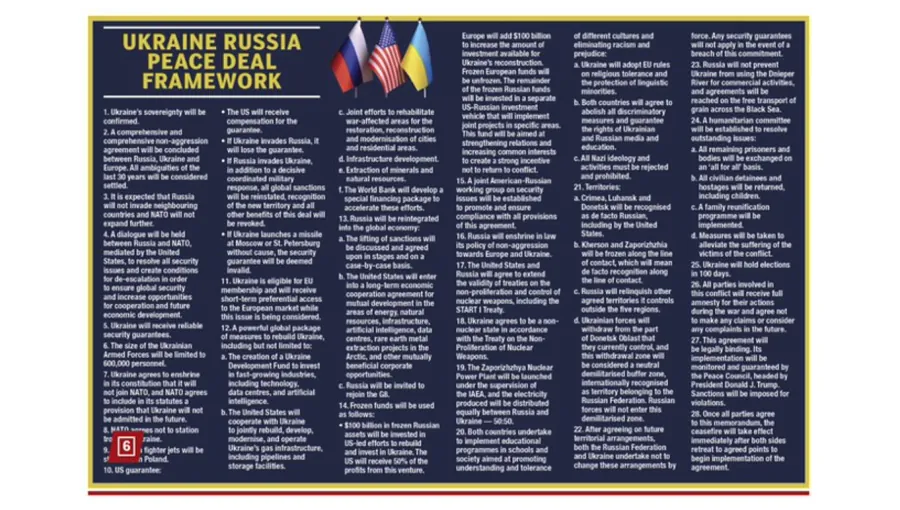
The most concrete text in the public record is the leaked 28-point draft analyzed provision by provision by CSIS on November 24, 2025. CSIS treated it as an unfinished plan, not as an authenticated final agreement; that distinction must stay attached to every conclusion drawn from it [3].
Two provisions are doing most of the legal work in that draft. Provision 27 is described by CSIS as saying that the agreement would be “legally binding.” Provision 28 is described as the ceasefire trigger [3]. Those are important drafting signals, but neither turns a leaked document into an operative ceasefire, armistice, or peace treaty. A draft clause can show what negotiators contemplated. It cannot, without more, prove that Ukraine and Russia entered a binding instrument on those terms.
Provision 27: “legally binding” is not the end of the inquiry
A clause saying an agreement is legally binding is useful. It may help rebut a later claim that the parties intended only a political declaration. But the clause is not self-authenticating. It still leaves the lawyer asking whether the text was adopted, who had authority to bind the parties, whether any conditions precedent were satisfied, whether the instrument entered into force, and what legal forum or mechanism would make breach matter.
This is where political ambiguity may be deliberate rather than accidental. Negotiators sometimes need language that lets talks continue before the parties can accept a final legal classification. That may be useful diplomacy. It is not a substitute for identifying the instrument when rights, sanctions exposure, occupation obligations, or military legal advice turn on the answer.
Provision 28: a ceasefire trigger points to a future legal act
A ceasefire-trigger clause is not the same thing as a ceasefire in force. If the trigger depends on acceptance of the draft, signature of a memorandum, withdrawal steps, guarantees, or some other implementation act, then the operative instrument is the later act, not the leaked draft standing alone. The consequence is simple but often missed: a draft can describe a future ceasefire architecture without itself suspending hostilities.
The public record also includes European counterproposals and reported later versions with fewer points, but those materials do not create a single legal text unless the parties actually adopt one. A lawyer should not merge the most convenient clause from one draft with the most convenient guarantee from another and call the result “the framework.” That produces a synthetic instrument nobody signed.
The May 2026 three-day pause shows the ceiling of an ad hoc ceasefire
The May 9–11, 2026 ceasefire episode is a cleaner example because it was finite, specific, and reported as an agreed pause rather than as a comprehensive settlement. NPR reported on May 9, 2026 that President Trump said Russia and Ukraine had agreed to his request for a three-day ceasefire, alongside a 1,000-for-1,000 prisoner exchange; the same report described competing unilateral ceasefires that had collapsed and Secretary of State Marco Rubio’s characterization of the talks as “stagnated” [4].
That episode supports a narrow conclusion. It shows that the parties could participate in a short, ad hoc suspension of hostilities or related humanitarian arrangement. It does not prove the existence of a comprehensive ceasefire. It does not prove an armistice. It does not terminate the international armed conflict. It also illustrates the enforcement ceiling of many battlefield pauses: once the period ends, or once the arrangement collapses, the legal question shifts to breach, warning, and lawful resumption rather than to postwar settlement.
If it is only a ceasefire, the armed conflict continues
The consequence of classifying an arrangement as a ceasefire is not peace. It is suspension. Lawfare’s account emphasizes that a ceasefire would not, by itself, end the international armed conflict between Russia and Ukraine, and that the law of armed conflict would continue to govern the parties while the conflict remains legally alive [1].
That continuity matters most in occupied territory. Lawfare points to Common Article 2, Geneva Convention IV Article 6(3), and the ICJ’s 2004 Wall advisory opinion for the proposition that occupation-law obligations may continue notwithstanding a suspension of active hostilities, so long as the factual and legal predicates of occupation remain [1]. A halt in firing does not by itself answer who controls the territory, who owes duties to protected persons, or which civilian-administration obligations survive.
For counsel, the practical consequence is that the compliance file should not be closed when a ceasefire is announced. Advice on humanitarian access, detention, civilian protection, property, sanctions-linked conduct, and dealings in occupied territory still has to be checked against the continuing law-of-armed-conflict and occupation-law framework. The relevant change is operational tempo, not the disappearance of the legal regime.
- Do not treat a ceasefire announcement as proof that the international armed conflict has ended.
- Do not assume occupation-law duties lapse because hostilities are paused.
- Do identify the ceasefire’s duration, scope, covered forces, territorial reach, monitoring mechanism, and breach rule.
- Do separate humanitarian exchanges or local pauses from a comprehensive suspension of hostilities.
If an armistice emerges, the question changes but does not disappear
An armistice would be more legally consequential than a short ceasefire. It would suggest that the parties are not merely pausing fire for a window of hours or days, but are using a law-of-truce instrument to bring the war or active hostilities to a more durable legal close. The Lieber Institute’s war-termination analysis is useful here because it treats truce instruments as part of a distinct body of war-termination law, not merely as political communiqués [2].
Even then, an armistice is not a complete peace settlement unless its terms do that work. It may stop the war without resolving recognition, sovereignty, territorial title, reparations, security guarantees, prisoner return, accountability, or future alliance questions. It may create a demarcation line without settling the status of the land on either side of it. It may regulate military conduct while leaving the underlying dispute for later instruments.
That is why the label “armistice” would not relieve the need to read the operative clauses. The question would shift from “has fighting paused?” to “what legal state did the parties intend to create after the pause?” A durable no-fire arrangement with monitoring, demarcation, withdrawal, and denunciation clauses may function very differently from a temporary humanitarian ceasefire, even if both reduce shooting on the ground.
What only a peace treaty can try to settle
A peace treaty is the instrument that can terminate the state of war and attempt to set the postwar legal relationship. It can address recognition, borders, security arrangements, reparations, guarantees, withdrawal sequencing, claims settlement, and dispute-resolution machinery. Those are not mere implementation details if the legal question is whether the war has ended.
But treaty form is not a solvent for every validity problem. EJIL: Talk! has separately framed the question of a Russia–Ukraine peace treaty in a “grey zone,” including the validity issues that may arise when a settlement touches red lines in international law [5]. The point for classification is narrower: if a concluded peace treaty appears, it should be analyzed as a treaty; until then, a draft peace plan should not be given the legal effects of one.
The distinction also affects private and institutional risk analysis. A board memo that says “the peace framework is binding” without identifying the dated text and legal form is not just imprecise. It may misstate whether sanctions programs remain in place, whether occupation-related restrictions continue to apply, whether force majeure and war-risk clauses have been triggered or ended, and whether counterparties are relying on a political promise rather than an enforceable instrument.
Resumption, breach, and the Hague Regulations problem
War-termination law also matters when the guns start again. Lawfare’s analysis identifies Hague Regulations Article 36 and Article 40 as the operative rules for suspension and resumption: where an armistice has no fixed duration, hostilities may be resumed only with warning in accordance with the terms of the armistice; a serious violation by one party can give the other the right to denounce it and, in urgent cases, recommence hostilities immediately [1].
That rule structure is easy to flatten in public commentary. “The ceasefire collapsed” may be an adequate headline. It is not adequate legal analysis. The adviser needs to know whether the instrument had a fixed end date, whether the alleged violation was material or serious, whether the text required notice, whether monitoring findings existed, and whether renewed hostilities were treated as resumption under the instrument or as an independent breach.
The May three-day episode shows why this matters. If a pause is short and expires by its own terms, the legal issue is different from a durable armistice broken by a serious violation. If unilateral pauses are announced and then collapse, the issue may be less about treaty breach than about whether any mutual instrument ever governed the conduct in the first place. Classification controls the breach analysis.
Do the Vienna Convention rules apply?
The Vienna Convention on the Law of Treaties should not be dropped into the analysis as if every ceasefire or armistice were automatically a treaty in the ordinary sense. Lawfare, relying in part on the Lieber Institute’s law-of-truce framing, argues that VCLT rules are unlikely to apply by default to ceasefires or armistices [1][2]. That is a commentator position, not a magic phrase that ends the debate.
The safer formulation is conditional. If the parties conclude a peace treaty, treaty-law questions will be central. If they conclude a truce instrument, ceasefire, or armistice, treaty-law concepts may still be argued by analogy or by reference to the instrument’s form, but one should first ask what body of law governs that instrument. The document’s title is relevant. Its parties, form, content, intended legal effect, and governing clauses are more important.
How to read the moving framework without overstating it

The public record is not one neat document. It is a sequence. The working method should match that sequence.
- Name the instrument being analyzed: leaked draft, counterproposal, reported revision, ad hoc ceasefire, prisoner-exchange arrangement, memorandum, armistice, or treaty.
- Attach the date and source: a November 2025 leaked draft is not the same legal object as a May 2026 three-day pause.
- Separate adoption from effect: a text may be negotiated, initialed, signed, ratified, triggered, implemented, breached, or expired at different moments.
- Read the operative hinge: entry into force, ceasefire trigger, monitoring, denunciation, breach, warning, dispute resolution, and survival clauses.
- Preserve continuing obligations: unless the legal basis for ending the armed conflict or occupation duties is identified, do not assume those duties have vanished.
That method is less tidy than calling the whole package a peace framework, but it is the only method that does not transfer uncertainty to the next reader. On the present record, enforceability cannot be derived from political branding. It must be classified instrument by instrument. Until a comprehensive ceasefire, armistice, or peace treaty is actually in force, obligations under the law of armed conflict and occupation law cannot be assumed away.
References
- All’s Well That Ends Well? Legal Complications of a Russia-Ukraine Ceasefire — Lawfare
- Ukraine Symposium – War Termination: Legal Implications for International Security — Lieber Institute, July 21, 2025
- The Unfinished Plan for Peace in Ukraine: Provision by Provision — CSIS, November 24, 2025
- Trump says Russia and Ukraine have agreed to his request for a 3-day ceasefire — NPR, May 9, 2026
- Red lines in a grey zone: the validity of a Russia-Ukraine peace treaty under international law — EJIL: Talk!, July 13, 2026
Operationalizing workflow
No workflow has been explicitly linked to this obligation yet. See Workflows generally.
Illustrative cases
No illustrative case is currently tracked for this obligation. See Risk Digest for documented incidents generally.
← Back to RegulationReport a correction or tip
Spotted an outdated figure, a misstated fact, or a ruling this regulation entry should reflect? Public comments are disabled for this content given the professional cost of a misreported case outcome, penalty amount, or rule text — use the structured correction channel instead.
Report a correction or tip for this record →