
Compliance Roadmap for the US Ban on Chinese Humanoid Robots
- Authority
- Federal Communications Commission
- Rule type
- regulation
- Jurisdiction scope
- US federal
- Effective date
- Jul 28, 2026
- Source text
- Read primary rule text ↗
Separately address FCC authorization, Section 1260H procurement bans, and supply-chain component audits.
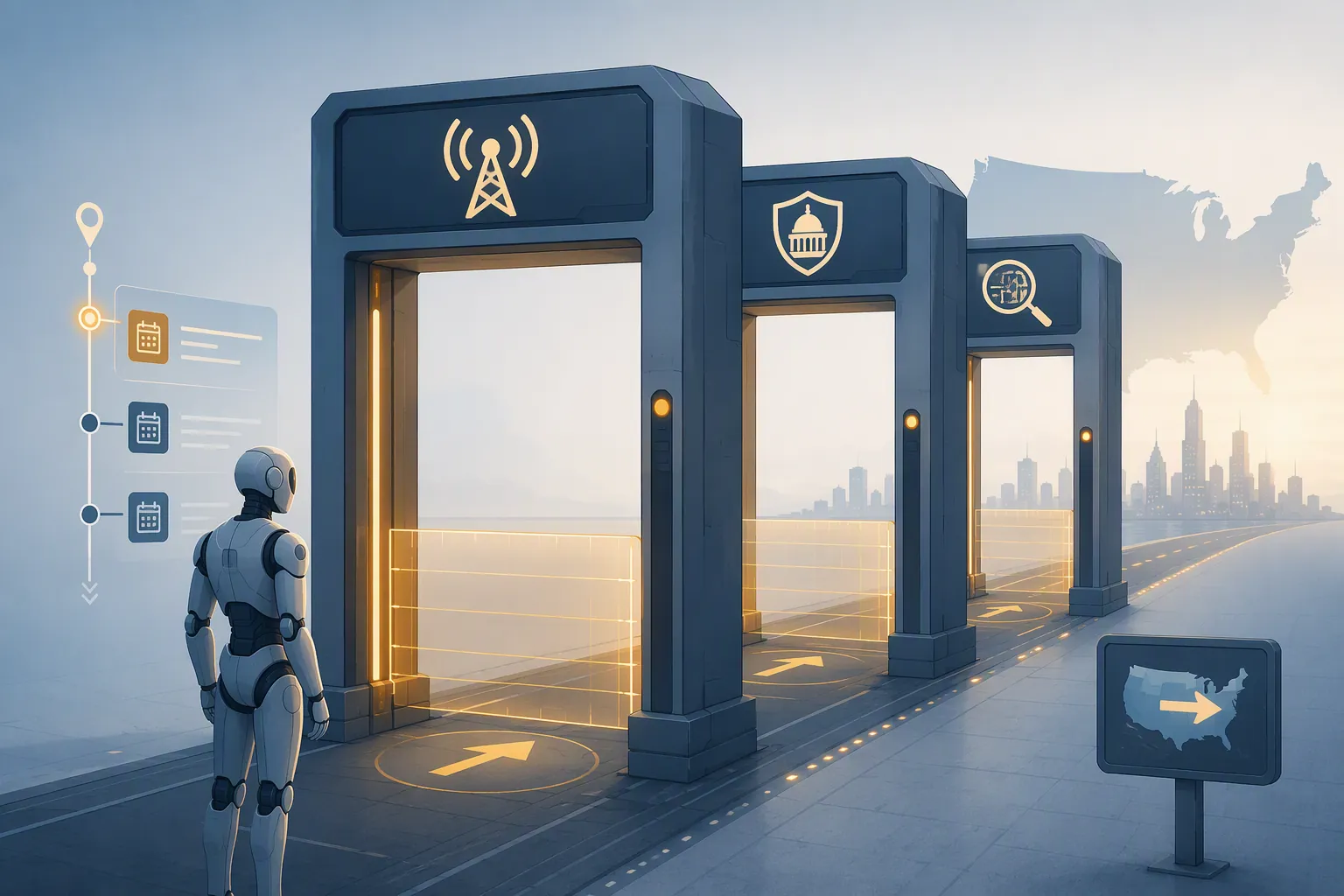
Current as of July 30, 2026, and not legal advice: the useful starting point for the legal implications of the US ban on Chinese humanoid robots is that there is no single robot ban to operationalize. There is an FCC authorization gate, a Section 1260H procurement restriction, and a supply-chain screening problem that reaches into components and software before anyone has bought a finished humanoid robot.
That distinction matters because each regime sends work to a different owner. Imports and equipment authorizations sit with regulatory and product teams. Federal-contract eligibility sits with government-contracting counsel. Component exposure belongs in vendor onboarding, engineering bills of materials, contract flow-downs, and restricted-party screening. Treating the headline as a border issue is how a company misses the clause in a DoD contract or the LiDAR supplier buried three tiers below the integrator.
The operative timeline is already staggered
The date sequence is the compliance map. Unitree appeared on the DoD Section 1260H Chinese Military Companies list on June 8, 2026, in a list identifying 188 entities operating in the United States under Section 1260H.[1] Section 805 of the FY24 NDAA then made the direct-procurement ban effective on June 30, 2026, with the indirect procurement restriction scheduled for June 30, 2027.[2] The FCC action followed on July 28, 2026, when foreign-produced advanced robotic devices were added to the Covered List under the Secure Networks Act framework.[3]
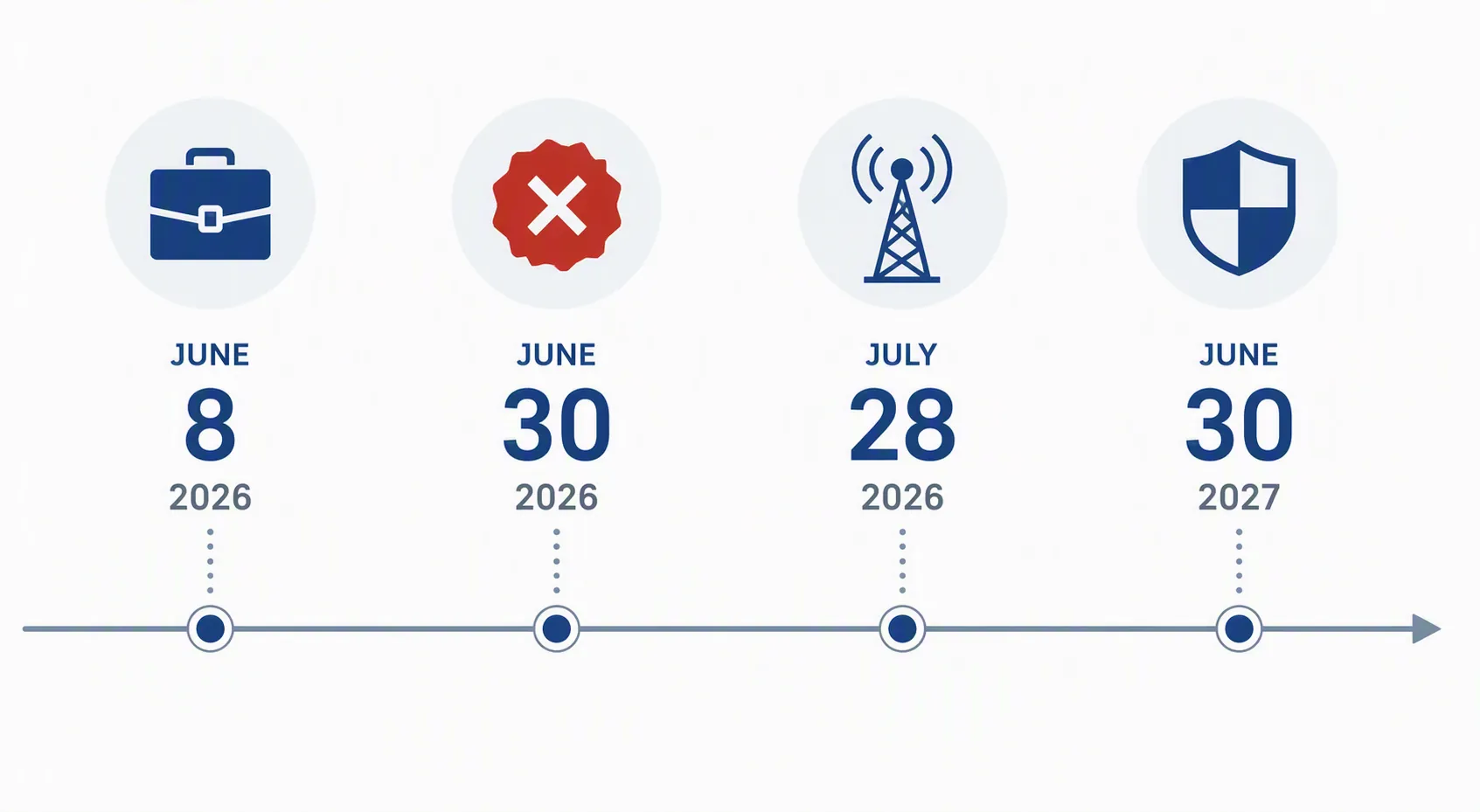
| Date | Regime | What changed | Primary internal owner |
|---|---|---|---|
| June 8, 2026 | Section 1260H | Unitree was included on the DoD Chinese Military Companies list. | Government contracts, restricted-party screening |
| June 30, 2026 | Section 805 direct procurement | DoD direct purchases from listed entities became restricted. | Federal sales, bids, contract review |
| July 28, 2026 | FCC Covered List | Foreign-produced advanced robotic devices became subject to a forward-looking authorization restriction. | Product regulatory, import, distribution |
| June 30, 2027 | Section 805 indirect procurement | DoD contracts are scheduled to be restricted where goods or services include goods or services produced or developed by listed entities. | Supply chain, engineering, subcontract management |
Commercial urgency is real, but it should not dictate the legal analysis. News coverage has tied the policy move to a robotics market in which Chinese companies reportedly held 87% of global humanoid robot shipments and shipped more than 15,000 units in 2025.[4] Those figures explain why business teams are paying attention. They do not answer whether a particular US deployment, reseller arrangement, or DoD subcontract is permissible.
Regime one: the FCC Covered List is an authorization gate, not a universal seizure order
The FCC Covered List is the most visible July 28 event. The FCC list identifies communications equipment and services that are considered to pose an unacceptable risk to national security or the security and safety of US persons, and the July 2026 entry added foreign-produced advanced robotic devices within that framework.[3] The accompanying National Security Determination established the role of a Department of War conditional-approval pathway for covered robotic devices.[5]
For a company trying to decide what to do on Monday morning, the first cut is whether it is seeking a new authorization for a foreign-produced advanced robotic device or dealing with units already deployed in the United States. Based on the public materials available as of July 30, 2026, the FCC action operates as a forward-looking authorization gate. Existing models already in US deployment appear to sit outside the immediate new-authorization restriction, but that is not the same as saying they are free of all legal risk.
The distinction is especially important for companies that are not importers of record. A warehouse operator using an already-deployed robot may not have the same FCC question as a distributor planning to bring in a new model. But the same warehouse operator may still have procurement-covenant, data-security, customer-contract, or federal-flow-down questions if the robot, its sensors, or its software stack traces back to a listed entity.
Conditional approval should be treated as a possible path, not a safe harbor that already has robotics precedent. The National Security Determination points toward an administrative model rather than a flat categorical wall.[5] Still, as of the July 28 action, no robotics-specific conditional approvals had been published in the available public materials. A robotics applicant should expect questions that are harder than a paper certification: component provenance, firmware control, remote-access restrictions, update channels, telemetry, cloud dependencies, vulnerability management, and where sensor data can be accessed.
That evidentiary burden follows from the product itself. A humanoid or quadruped robot is not only a radio module attached to a chassis. It may be a mobile sensor platform with cameras, LiDAR, microphones, navigation software, wireless connectivity, and autonomous decision functions. A conditional-approval package that cannot tie those functions to auditable controls is likely to produce the kind of Friday-afternoon answer no business sponsor wants: the deal is not ready for approval because no one can prove what the device does after it is turned on.
Regime two: Section 1260H is where the procurement work starts
Section 1260H is not an FCC rule. It is a DoD identification regime for Chinese military companies operating in the United States, and its practical bite comes through procurement restrictions and contract clauses. The June 8, 2026 DoD list included Unitree among 188 identified entities.[1] A WilmerHale analysis of the June update described the Pentagon as adding 65 new entities and highlighted the Section 805 phase-in: direct procurement first, indirect procurement later.[2]
The direct ban is the easier part to route. If a company sells to DoD, bids on DoD work, or supports a prime contractor, it should not be casually proposing a listed company’s robot, maintenance service, software subscription, or support package into that work after the effective date. That review belongs in bid/no-bid, proposal intake, supplier approval, and contract review, not after award.
The indirect ban is the part more likely to be mishandled. Section 805’s later phase is scheduled to restrict DoD from contracting for goods or services that include goods or services produced or developed by a listed entity.[2] That language is the reason a US-made robot, a domestic warehouse automation system, or an apparently ordinary networking bundle may need review even when no one is buying a Unitree robot.
The implementing DFARS rules for the indirect-procurement restriction had not been published in public materials available as of July 30, 2026. That leaves real uncertainty around the phrase “produced or developed by.” It may be interpreted through agency guidance, contract clauses, certification language, or future exclusions. Until then, counsel should resist two equally bad shortcuts: assuming every trace component is automatically disqualifying, or assuming only finished goods count.
| Company posture | FCC question | Section 1260H question | Near-term action |
|---|---|---|---|
| Importer or distributor of new foreign-produced humanoid or quadruped robots | Does the product require conditional approval before authorization? | Is the manufacturer or a key supplier listed? | Pause launch gating until product regulatory and listed-entity review are complete. |
| US company deploying robots already in the United States | Is a new authorization, modification, or model involved? | Do customer contracts or federal flow-downs restrict listed-entity goods or services? | Separate existing-use analysis from future purchase and support renewal analysis. |
| US integrator building a domestic robot platform | Are covered communications or robotic-device authorizations implicated? | Do components, firmware, libraries, or services come from listed entities? | Map BOM, software BOM, and critical subcontractors before certifying eligibility. |
| Federal contractor or DoD subcontractor | Does the equipment being delivered require authorization? | Can the company certify compliance with direct and upcoming indirect restrictions? | Update screening, representations, subcontract flow-downs, and exception escalation. |
Regime three: the component audit may matter more than the finished robot
The supply-chain problem is the one least likely to appear in a headline and most likely to create a certification failure. At least four Section 1260H-listed entities are relevant to robotics supply chains in the public materials: Robosense for LiDAR sensors, BYD for battery cells or packs, BOE for displays and sensors, and TP-Link for networking modules.[1][6] None of those examples requires the buyer to purchase a finished Chinese humanoid robot.
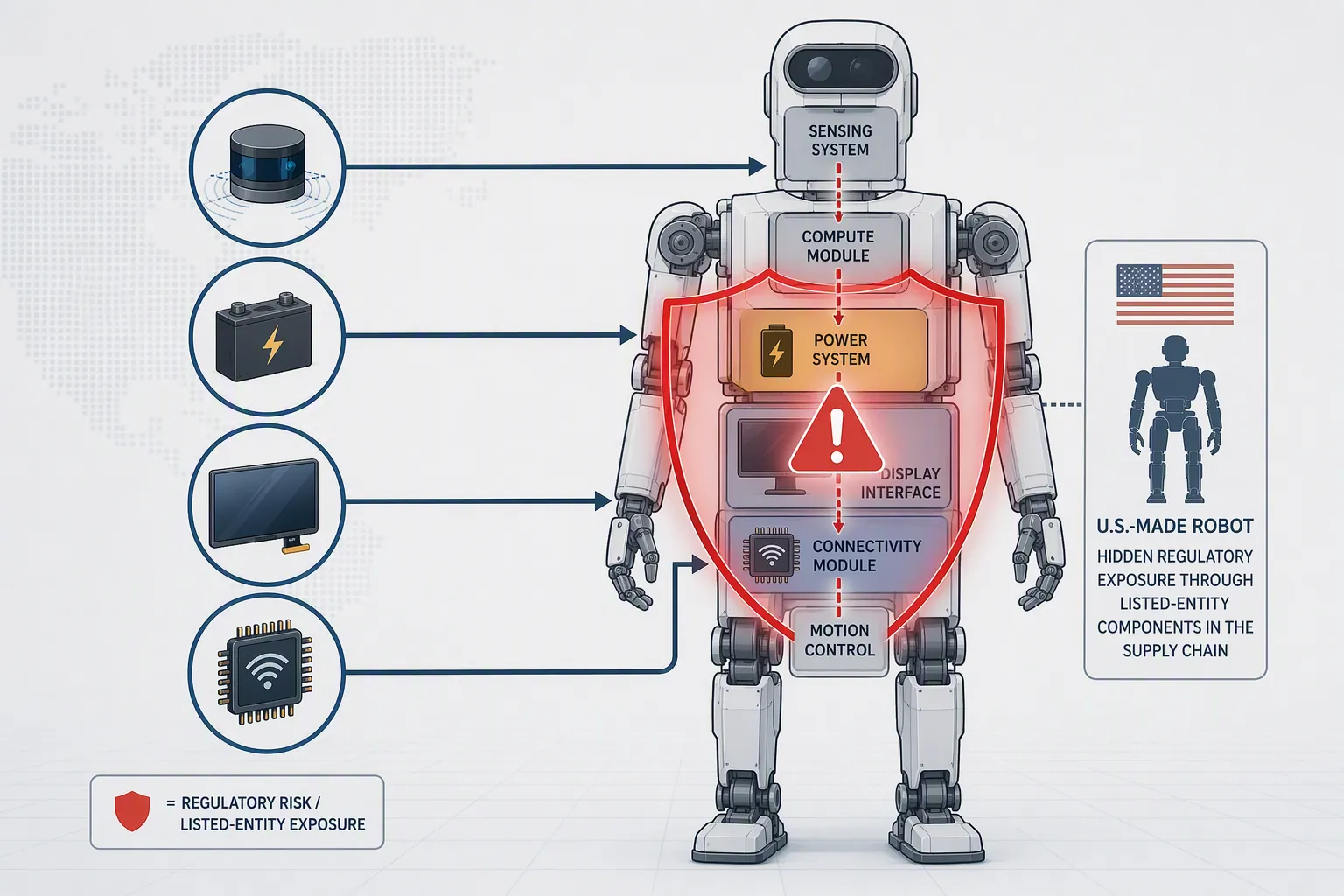
A domestic integrator can therefore have exposure through a LiDAR unit, battery pack, display panel, connectivity module, embedded firmware, or software library. A reseller can inherit exposure through a supplier’s configuration choices. A prime contractor can receive a representation from a subcontractor that sounds complete but covers only OFAC sanctions or the BIS Entity List, not Section 1260H.
That last point is not a drafting nicety. Dentons has flagged that Section 1260H expansion interacts with export-control obligations, including the EAR military-end-use rule at 15 CFR 744.21, which independently restricts transfers of items subject to the EAR to Section 1260H entities.[6] A company that is not a federal contractor may still need to ask whether it is exporting, reexporting, or transferring items subject to the EAR to a listed party.
Ordinary restricted-party screening may not catch this. Many screening programs were built around the OFAC SDN List, the BIS Entity List, and denied-party datasets that procurement teams already know. Section 1260H is a different list. If the vendor-screening tool, intake questionnaire, or ERP block does not ingest it, a supplier can pass the company’s current screen and still create a 1260H issue.
What to pull before the next procurement meeting
The first useful audit is not a grand geopolitical risk assessment. It is a records exercise that names products, suppliers, listed entities, contract obligations, and approval status. Holland & Knight’s July 2026 guidance describes a compliance framework for Section 1260H that includes supply-chain audit methodology and flow-down certification language.[7] In practice, the legal team needs enough documentation to make a defensible call when a business unit asks whether a robot order, subcontract, renewal, or customer deployment can proceed.
- Product inventory: identify humanoid, quadruped, mobile robotic, sensing, networking, and automation products imported, distributed, sold, leased, deployed, or supported in the United States.
- BOM and software BOM: request component-level and software-library disclosures for LiDAR, batteries, displays, cameras, wireless modules, cloud services, firmware, update servers, and navigation software.
- Listed-party coverage: confirm that the screening platform includes the DoD Section 1260H list, not only OFAC and BIS lists.
- Federal-contract mapping: identify DoD contracts, DoD subcontracts, task orders, reseller channels, and customer terms that require compliance representations or flow-downs.
- Authorization status: separate products already deployed in the United States from new models, modified models, future imports, and products that may need conditional approval.
- Exception process: create an escalation path for listed-entity hits, incomplete supplier answers, firmware opacity, or refusal to provide component provenance.
The questionnaire should be specific enough that silence means something. Asking whether a supplier “complies with all applicable law” is not the same as asking whether any good, service, component, firmware, software library, cloud service, or support function is produced or developed by an entity on the DoD Section 1260H list. A supplier that cannot answer may still be commercially useful, but it is not ready for a clean federal-contract certification.
Existing deployments are not one legal category
One of the fastest ways to give bad advice after the July 28 announcement is to say that existing deployments are either “banned” or “safe.” The available materials support a narrower conclusion: the FCC action appears forward-looking for new authorizations of covered foreign-produced advanced robotic devices, while Section 1260H and EAR issues can still attach through procurement, components, support, and transfers.
An existing robot on a commercial warehouse floor may raise no immediate FCC authorization action if there is no new import, authorization, or covered modification. The same robot could become a problem if the company later sells services to a DoD customer, renews support from a listed entity, imports replacement units, relies on a listed networking module in a federal deliverable, or exports controlled software or components to a listed party.
The cleanest internal note therefore separates four questions: whether the product can be newly authorized; whether the company can buy directly from a listed entity for DoD work; whether the company can certify that its deliverables do not include goods or services produced or developed by a listed entity when the indirect ban takes effect; and whether any EAR-controlled transfer involves a listed entity. Combining those questions into one “robot ban” answer leaves too much unreviewed.
Open issues that should stay open
There are places where the correct compliance answer is not yet available. The most important is the unpublished DFARS implementation for the indirect Section 805 restriction. Until the government publishes the clause structure and interpretive guidance, companies will not know exactly how DoD will read “include goods or services produced or developed by” in the robotics context.
The second is the robotics conditional-approval record. The FCC and National Security Determination materials create a pathway, but the public materials did not include robotics-specific conditional approvals as of July 28, 2026.[5] It is reasonable to study adjacent approval frameworks, but it is not reasonable to tell a robotics applicant that prior approvals for other device categories prove the same burden will apply.
The third is proposed legislation. The GUARD Act had been introduced as H.R. 9129, with sponsors describing it as legislation to ban dangerous Chinese robots, but it had not been enacted as of July 30, 2026.[8] It belongs in monitoring notes and board briefings as a possible future development, not in the same column as the FCC Covered List action or the Section 805 deadlines.
A practical priority order
The companies most exposed now are not only the ones importing conspicuously Chinese humanoid robots. They are also federal contractors with incomplete supplier visibility, US integrators using listed-entity components, distributors preparing new model launches, and buyers whose screening tools do not include the Section 1260H list.
- Update restricted-party screening to include Section 1260H and test whether known listed entities are actually caught by the tool.
- Identify direct purchases, support contracts, reseller arrangements, and renewals involving Unitree or other listed entities.
- Map component and software exposure for LiDAR, batteries, displays, sensors, networking modules, firmware, software libraries, and cloud services.
- Review DoD contracts and subcontracts for current representations, future flow-downs, and clauses that may need amendment when the indirect restriction takes effect.
- For future imports or launches of foreign-produced advanced robotic devices, decide early whether a conditional-approval strategy is needed and whether the evidence package can support it.
Waiting for a customs seizure, a customer objection, or the final DFARS rule is a poor control point. By then, the company may already have represented compliance, accepted a flow-down, shipped a configured system, or built a product around a component it cannot replace quickly. The immediate work is narrower and more useful: screen the right lists, map the listed-entity content, preserve uncertainty where the rules are not yet final, and make future robot imports pass through an approval strategy before the purchase order is released.
References
- Entities Identified as Chinese Military Companies Operating in the United States in Accordance with Section 1260H, Department of Defense, June 8, 2026, link
- Pentagon Adds 65 New Entities to the 1260H List of Chinese Military Companies, WilmerHale, June 11, 2026, link
- List of Equipment and Services Covered By Section 2 of The Secure Networks Act, FCC, July 28, 2026, link
- Trump administration to ban new Chinese robots, inverters in protecting US AI buildout, Reuters, July 28, 2026, link
- FCC National Security Determination, FCC, July 28, 2026, link
- DoD Expands Section 1260H Chinese Military Companies List, Dentons, June 18, 2026, link
- Department of War Updates Section 1260H, Holland & Knight, July 2026, link
- Moolenaar, Obernolte, McClellan Introduce Legislation to Ban Dangerous Chinese Robots, House Select Committee on the CCP, link
Operationalizing workflow
No workflow has been explicitly linked to this obligation yet. See Workflows generally.
Illustrative cases
No illustrative case is currently tracked for this obligation. See Risk Digest for documented incidents generally.
← Back to RegulationReport a correction or tip
Spotted an outdated figure, a misstated fact, or a ruling this regulation entry should reflect? Public comments are disabled for this content given the professional cost of a misreported case outcome, penalty amount, or rule text — use the structured correction channel instead.
Report a correction or tip for this record →