
US-Israel Military AI Merger Creates New International Law Risks
- Authority
- U.S. Congress
- Rule type
- statute
- Jurisdiction scope
- US federal
- Source text
- Read primary rule text ↗
Mandates data fusion and network integration between US and Israeli military AI targeting systems
As of July 24, 2026, the legal question around US-Israel military integration is still tied to unsettled legislation, not an enacted mandate. The House passed H.R. 8800 with Section 219 on July 22, while the Senate’s motion to proceed on S. 4784 failed 50-46 on July 14; final NDAA language remains subject to negotiation.[1]
That status matters. The legal risk is not that a completed statute has already fused US and Israeli military AI systems. The risk is that Congress is considering language that would push data fusion, network integration, and defense-technology cooperation into a statutory framework before the corresponding vetting, suspension, audit, and human-review rules are comparably explicit.
Section 219 is described in legislative tracking as creating an Executive Agent structure for a US-Israel Defense Technology Cooperation Initiative and requiring work on “data fusion” and “network integration” across covered defense-technology areas.[1] Separate reporting on the provision has identified artificial intelligence, autonomous systems, command-and-control, cybersecurity, directed energy, hypersonics, and other advanced domains as part of the cooperation frame.[2] The important legal move is not the label attached to the technology. It is the creation of a pipeline.
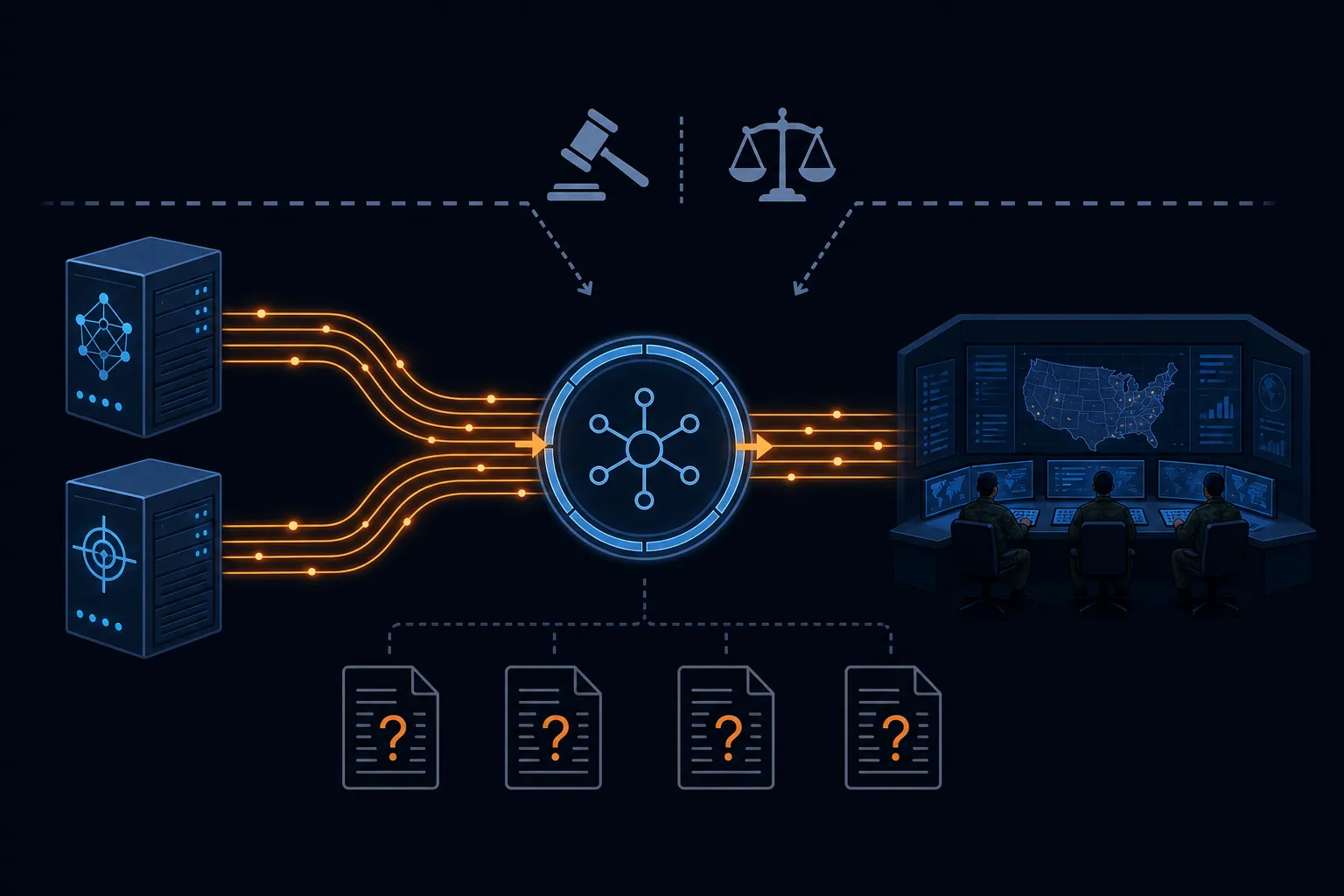
Put beside the companion intelligence-sharing concern, the question becomes less about defense innovation and more about which legal gate is being rewired. If Israeli intelligence outputs produced by AI-assisted targeting systems can enter integrated US systems, the ordinary compliance analysis changes. The output may not arrive as a classic unit-assistance package, a weapons transfer, or a discrete procurement deliverable. It may arrive as data, model-enabled prioritization, a fused operational picture, or an interoperable feed.
The pipeline is the legal event
A useful compliance file would not start with a broad claim that military AI is dangerous. It would start with a workflow: an Israeli system generates or enriches intelligence; that intelligence enters an integrated US-managed or US-supported network; US personnel, agencies, or contractors help maintain, interpret, secure, procure, or operationalize that network; a later targeting decision is challenged under international humanitarian law.
Each step changes the record. A foreign intelligence output that once might have been treated as information received from a partner can become part of a shared technical environment. The US actor may not be selecting the target, but the system may still be contributing to target discovery, prioritization, confidence scoring, geolocation, dissemination, or command review. That is where professional responsibility becomes uncomfortable: the farther downstream the US role sits, the easier it is to describe it as technical support; the more integrated the system becomes, the harder it is to say the support is legally remote.
The minimum risk map looks like this:
| Pipeline point | Why counsel would care |
|---|---|
| Israeli AI-derived intelligence output is generated | The source methodology may affect whether a person or object has been lawfully identified as a military target. |
| Output enters a fused or interoperable US-linked network | The transfer may not resemble traditional assistance that clearly triggers existing vetting practices. |
| US personnel or contractors maintain, secure, procure, or rely on the system | Their role may create records showing knowledge, foreseeability, or operational contribution. |
| A strike or detention decision is later challenged | Distinction, proportionality, and feasible-precautions duties become the legal yardstick. |
| Congressional language limits suspension or review | Domestic compliance teams may lose a practical control point even if underlying legal duties remain. |
This is why the AI-targeting materials matter. Lavender and Gospel are not relevant because their names sound ominous. They matter because public reporting and legal analysis describe systems whose outputs sit close to the legal line between intelligence support and target selection.
Why Lavender and Gospel are legally sensitive outputs
Human Rights Watch’s September 2024 Q&A described Lavender as using positive-unlabeled machine learning to help generate lists of suspected Hamas and Palestinian Islamic Jihad members in Gaza. HRW concluded that the system, as described in available reporting, was “not an adequate tool for identifying lawful military targets.”[3] That is a serious claim, but it should be read with precision. HRW was not independently publishing Lavender’s source code or a full technical audit. It was assessing reported methodology and use against targeting-law requirements.
Michael N. Schmitt’s Lieber Institute analysis supplies the legal framework more cleanly than most public commentary. He evaluates Lavender and Gospel through the law of armed conflict duties of distinction, proportionality, and precautions, while also emphasizing that legality depends on how the systems are used, what data they process, what confidence levels are attached, and what human review actually occurs.[4]
Gospel is generally discussed as a system associated with identifying objects or structures as potential targets, while Lavender is discussed as identifying people suspected of militant affiliation.[3][4] The legal difference is not cosmetic. A person-based list raises the question whether the listed individual is a lawful military objective at the time of attack. An object-based recommendation raises the question whether the structure, vehicle, tunnel segment, or facility meets the military-objective test. Both can also feed proportionality analysis if civilian harm is expected.
+972 Magazine’s reporting, discussed in Schmitt’s analysis, alleged that human approval of Lavender-generated targets could take as little as 20 seconds. Schmitt called that allegation “exceptionally troubling” if accurate.[4] The caveat is not optional. Public reporting does not establish the full internal operation of the system, every review practice, or every strike-specific record. But the allegation is exactly the kind of fact that would matter in litigation or an internal government review, because a nominal human-in-the-loop step does not answer whether the human had time, information, authority, and training to exercise legal judgment.
A human reviewer who only confirms that a machine-generated name appears in the right interface is not performing the same function as a commander or legal adviser assessing military necessity, civilian status uncertainty, expected incidental harm, and feasible alternatives. The law does not require humans to reject machine assistance as such. It does require that target selection remain tied to legally relevant facts.
This becomes more acute when the system output travels. Inside one military’s chain of command, the legal file may contain classified targeting standards, intelligence confidence assessments, collateral-damage estimates, and review logs. In a fused bilateral system, the receiving US-side actor may see only a processed output, not the evidentiary trail needed to test whether the target was lawfully identified. If Congress mandates integration without mandating auditability, the missing record becomes a design feature rather than an accident.
The Leahy problem is not solved by calling the transfer data
The domestic-law interface starts with the Leahy Laws, which restrict certain US assistance to foreign security-force units when there is credible information that the unit committed a gross violation of human rights. Charles O. Blaha, a former State Department official, has described Israel as subject to a distinctive Israel Leahy Vetting Forum process and wrote that the process had never produced a list of ineligible Israeli units.[5]
That history matters because Section 219’s integration model does not look like the easiest Leahy case. The simplest Leahy file asks whether a named foreign unit is receiving a covered form of assistance. A data-fusion mandate asks whether intelligence outputs, targeting-system interoperability, shared engineering work, or network access should be treated as assistance to a foreign security force, assistance from a foreign partner, a joint capability, a procurement activity, or something else.
The legal concern is not that every exchange of intelligence automatically violates the Leahy Laws. It is that integration can displace the moment when vetting would otherwise occur. If the operative act is no longer “provide training or equipment to Unit X,” but “connect this data stream to a shared operational architecture,” the compliance team needs a different control: source-system review, unit-linkage documentation, suspension authority, audit logs, and a way to quarantine outputs linked to credibly implicated units or practices.
The companion intelligence-sharing concern sharpens the issue. HRW’s June 2026 analysis warned that the congressional proposal could deepen US complicity by restricting the ability to suspend intelligence sharing on human-rights grounds.[6] If that reading holds in final language, the statute would not merely encourage cooperation. It would remove or narrow one of the practical levers agencies use when partner conduct creates legal exposure.
One way to test the provision is to ask what document a contracting officer, program counsel, or judge advocate would want before approving a connection between a US system and an Israeli AI-derived targeting feed. A legally mature file would not stop at cybersecurity accreditation or export-control review. It would identify the source system, the originating units, the categories of targets, the human-review standard, the civilian-harm estimation process, the retention of audit logs, and the suspension trigger if credible violation information emerges.
Section 219, as summarized in the available legislative tracking, foregrounds the integration mandate. The unresolved question is whether the final statute will also foreground those control points.[1]
Customary IHL supplies the standard even when the software is new
The targeting-law duties most relevant here are not exotic AI rules. They are the familiar customary international humanitarian law rules of distinction, proportionality, and feasible precautions. Schmitt’s analysis applies those law-of-armed-conflict principles to Lavender and Gospel, and that is the right starting point.[4]
Distinction asks whether the system helps identify lawful military objectives and combatants or fighters, rather than civilians and civilian objects. For a person-based system like Lavender, the hard question is whether data signals used to infer militant affiliation are legally probative enough for targeting. Membership, function, direct participation, uncertainty, and temporality cannot be reduced to a generic “suspicion” label without losing the legal analysis.
Proportionality asks whether expected incidental civilian harm would be excessive in relation to the concrete and direct military advantage anticipated. An AI-generated name or object recommendation does not answer that question. It may help identify a target candidate, but the proportionality judgment depends on expected civilian presence, weapon effects, timing, location, available alternatives, and the value of the military objective in the circumstances.
Feasible precautions ask what attackers could practicably do to verify the target and reduce civilian harm. This is where the alleged 20-second review window, if accurate, becomes legally salient.[4] Speed is not unlawful by itself. Some targets are time-sensitive. But if the human review step is too thin to test the machine output or consider civilian-risk information, the precautionary function may be more formal than real.
For US personnel and contractors, the problem is not limited to the strike cell. A contractor maintaining the data environment, an agency office approving an integration plan, or a uniformed officer relying on a fused operational display may not have target-release authority. Still, their records may show that they helped make the output usable. In an after-action inquiry, the questions will be practical: what did the US-side actor know about the system’s limitations, what warnings were available, what controls were built, and whether anyone retained authority to stop the feed.
Domestic criminal statutes are part of the risk map, not a prediction
The War Crimes Act, 18 U.S.C. § 2441, and the Torture Act are binding US statutes. They are not policy preferences. They also should not be invoked casually as though every data-sharing decision creates criminal exposure. The better compliance question is narrower: could a US person’s role in maintaining or enabling an integrated targeting pipeline later be characterized as participation in, aiding, or facilitating conduct that satisfies the elements of an offense?
That question would turn on facts the public record does not yet establish: the specific conduct, the relevant mental state, the nature of the underlying violation, the US actor’s knowledge, and the causal significance of the assistance. A statutory integration mandate does not erase those elements. It may, however, produce a paper trail showing that risks were identified before the pipeline was built.
Common Article 1 and the Genocide Convention complicity debate should be handled with the same discipline. HRW’s June 2026 warning frames the NDAA proposal as a potential deepening of US complicity.[6] That is a legal and policy warning, not a final adjudication. The scope of third-state duties to ensure respect for the Geneva Conventions, and the application of complicity concepts to intelligence sharing and arms support in this context, remain contested in important respects and have not been definitively resolved by a court for Section 219’s proposed architecture.
The absence of a definitive ruling does not make the risk imaginary. It means counsel should resist two shortcuts at once: treating complicity as already proven, and treating unresolved doctrine as a safe harbor. The relevant operational fact is that Congress may be creating mandatory channels through which AI-derived intelligence connected to unresolved IHL concerns becomes easier for US systems to ingest and harder for agencies to suspend.
AUKUS shows that integration can be drafted with guardrails
The comparison to AUKUS Pillar II is useful only if kept modest. Quincy Institute’s “Cooperation without Oversight” contrasts the proposed US-Israel framework with AUKUS Pillar II, which it describes as sharing advanced capabilities such as AI and quantum technologies among treaty allies subject to guardrails including Biological Weapons Convention signatory status and Leahy-compliance framing.[7] The point is not that AUKUS is a perfect compliance model. The point is that advanced-defense integration does not have to be drafted as pure acceleration.
Source posture matters here. Quincy, HRW, A New Policy, and The Intercept all approach Israel policy from identifiable critical positions; legislative proponents and defense-policy advocates frame the same cooperation in strategic and deterrence terms.[1][2][6][7] A legal-risk analysis does not need to adopt every advocacy conclusion to notice the drafting gap. If a statute names the technical integration objective with specificity but leaves human-rights vetting, suspension, and audit controls to implication, the compliance burden moves to the agencies and contractors who must operationalize it.
What would be missing from the record
The hardest part of this issue is not imagining a catastrophic misuse of AI. It is identifying the ordinary memo that no one writes. A program office approves an interface. A contractor scopes a data connector. A liaison cell expands access to a feed. A cybersecurity team validates a shared environment. None of those acts is a strike decision, but each may help make a targeting output operational.
For a defensible record, the approving office would need answers to questions that are currently not obvious from the proposed mandate:
- Which Israeli systems can send outputs into US-linked networks, and are Lavender- or Gospel-type outputs included?
- What source units, data sources, and targeting categories are associated with those outputs?
- What Leahy-style review applies when the transfer is a data feed rather than conventional assistance?
- Who can suspend, quarantine, or downgrade access when credible information raises IHL or human-rights concerns?
- What audit logs preserve the path from foreign system output to US-side use?
- What human-review standard applies before an AI-derived output contributes to a targeting decision?
Those are not anti-integration questions. They are the questions that determine whether integration can survive later review. A system can be interoperable and still be legally under-documented. In fact, the more seamless the interface, the more important it becomes to preserve friction at the legal decision points.
The risk for defense contractors is especially concrete. A contractor may be asked to build or maintain architecture without seeing the full intelligence basis for the outputs moving through it. Standard procurement clauses may address cybersecurity, export controls, data rights, and classification; they may not answer whether the contractor is supporting a pipeline tied to targeting practices that HRW and IHL experts have flagged as legally sensitive.[3][4][6] That gap belongs in bid review, subcontractor flow-downs, representations, change-order procedures, and escalation channels.
Uniformed personnel face a different version of the same problem. If a fused display incorporates partner-generated AI outputs, the officer using that display needs to know what the output means and what it does not mean. A confidence score is not a legal conclusion. A target category is not a proportionality analysis. A partner-vetted label is not necessarily a US-vetted record.
The compliance consequence if Section 219 survives
If Congress preserves Section 219’s data-fusion model without explicit vetting, suspension, audit, and human-review safeguards, the result is not merely a diplomatic controversy. It becomes a compliance problem for US agencies, uniformed personnel, and defense contractors whose systems may help operationalize targeting outputs already linked to unresolved international humanitarian law concerns.
The narrowest defensible conclusion is also the most practical one: a statutory mandate to integrate AI-relevant defense systems should carry a statutory record of how the United States will preserve distinction, proportionality, feasible precautions, Leahy-style vetting, and suspension authority when partner-generated targeting intelligence enters US-linked networks. Without that record, the legal risk will not sit safely in the abstract. It will attach to the people who approve the interface, maintain the system, rely on the output, and later have to explain what legal judgment remained in the chain.
References
- Section 224 NDAA, A New Policy.
- US-Israel 224 AI defense budget, The Intercept, June 8, 2026.
- Questions and Answers: Israeli Military’s Use of Digital Tools in Gaza, Human Rights Watch, September 10, 2024.
- The Gospel, Lavender, and the Law of Armed Conflict, Lieber Institute, West Point.
- Israel and the Leahy Law, Just Security.
- Congressional Proposal Could Deepen US Complicity, Human Rights Watch, June 16, 2026.
- Cooperation without Oversight: The United States-Israel Defense Technology Cooperation Initiative, Quincy Institute.
Operationalizing workflow
No workflow has been explicitly linked to this obligation yet. See Workflows generally.
Illustrative cases
No illustrative case is currently tracked for this obligation. See Risk Digest for documented incidents generally.
← Back to RegulationReport a correction or tip
Spotted an outdated figure, a misstated fact, or a ruling this regulation entry should reflect? Public comments are disabled for this content given the professional cost of a misreported case outcome, penalty amount, or rule text — use the structured correction channel instead.
Report a correction or tip for this record →