
What the USCIS Sept. 18, 2026 Green Card Rule Changes Mean
- Authority
- USCIS/DHS
- Rule type
- regulation
- Jurisdiction scope
- US federal
- Effective date
- Sep 18, 2026
- Source text
- Read primary rule text ↗
Use 09/18/26 Form I-485 for post-cutoff filings; new totality-of-circumstances public charge standard applies; pre-cutoff filings remain under 2022 rule.
Verification record
Last verified: Aug. 26, 2026, UTC. This is a Regulation & Ethics obligations record for the Sept. 18, 2026 USCIS green card rule changes. It is not legal advice, and it does not evaluate the wisdom of the public charge policy. It tracks which rule governs which filing, which form edition USCIS says it will accept, and where the primary sources say so.
- Federal Register final rule: Public Charge Ground of Inadmissibility, 91 FR 45324, Doc. 2026-14539, published July 20, 2026, effective Sept. 18, 2026. [1]
- USCIS Form I-485 alert: USCIS to Publish New Edition of Form I-485; Older Editions Will Be Rejected Starting Sept. 18, Aug. 19, 2026. [2]
- USCIS public charge guidance alert: USCIS Issues Guidance on Making Public Charge Inadmissibility Determination, Aug. 18, 2026. [3]
- USCIS Policy Manual update page: USCIS Policy Manual — Updates, Policy Alert, Vol. 8, Part G, effective Sept. 18, 2026. [4]
Scope note: this record is about public charge inadmissibility and Form I-485 adjustment filing mechanics. It should not be merged with separate September 2026 coverage of F, J, or I nonimmigrant admission-period rules.

The Sept. 18 compliance table
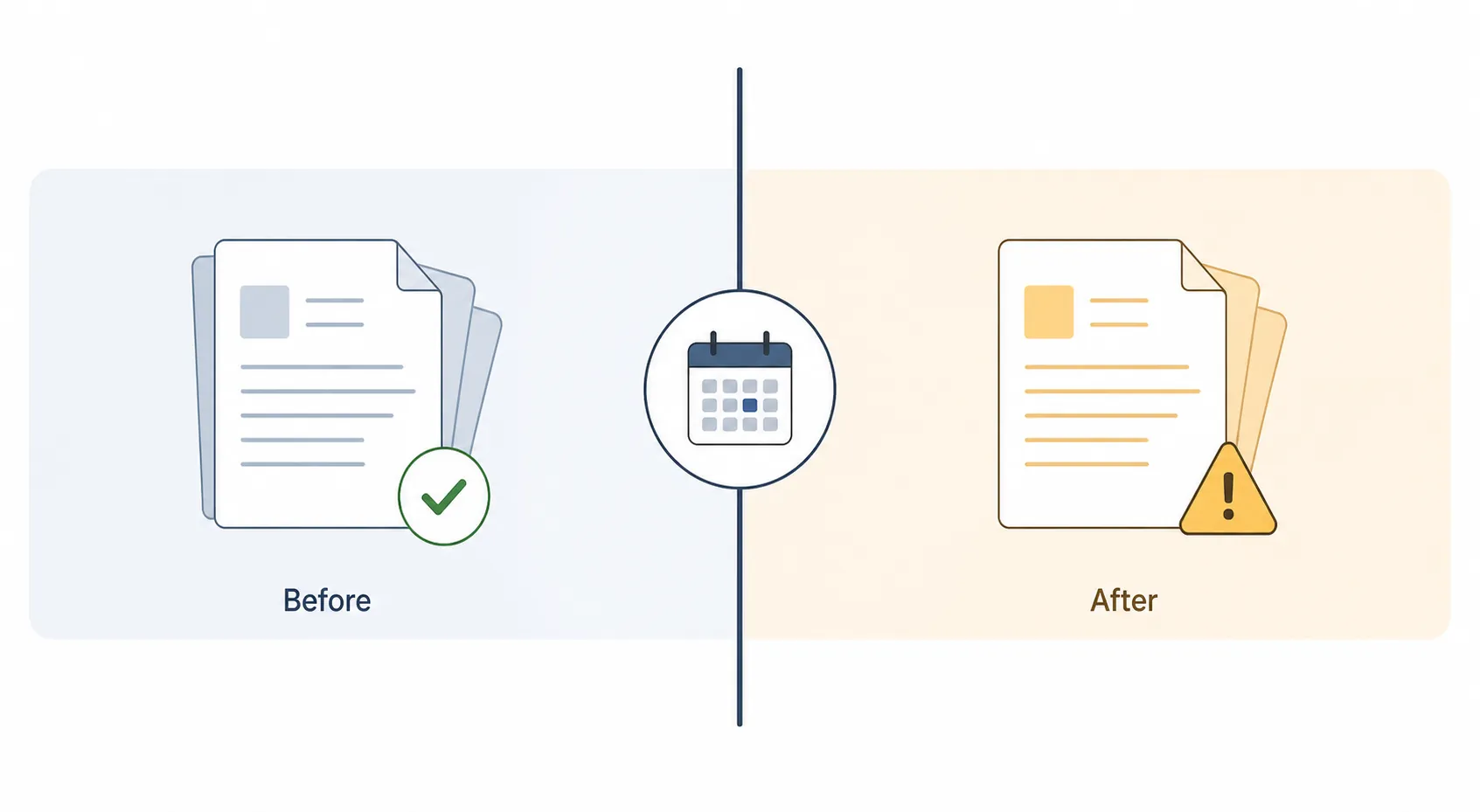
The date matters twice. On Sept. 18, 2026, the substantive public charge standard changes for covered adjustment filings, and USCIS also switches Form I-485 editions with no grace period. A filing that clears one surface can still fail the other.
| Compliance surface | Cutoff | What changes | Filing consequence |
|---|---|---|---|
| Public charge standard for adjustment of status | Form I-485 postmarked or electronically submitted on or after Sept. 18, 2026 | The 2022 regulatory framework no longer governs those filings; DHS rescinds 8 CFR 212.20–212.23 and moves to a statute-plus-guidance, totality-of-circumstances determination. [1] | Covered filings submitted on or after the cutoff must be assessed under the new public charge framework. |
| Form I-485 edition | Form I-485 postmarked or electronically submitted on or after Sept. 18, 2026 | USCIS will accept only the 09/18/26 edition and will reject the 01/20/25 edition, with no grace period. [2] | Wrong edition means rejection, not a request to cure. |
| Pending and pre-cutoff adjustment filings | Pending on Sept. 18, 2026, or postmarked/electronically submitted before Sept. 18, 2026 | The final rule applies prospectively; pre-cutoff adjustment filings remain under the 2022 rule. [1] | Do not triage these as though the new public charge standard already governs them. |
| Public charge bonds | Bond submitted on or after Sept. 18, 2026 | A post-cutoff public charge bond is breached by receipt of any means-tested public benefit before death, permanent departure, or naturalization; pre-cutoff bonds remain under the 2022 standard. [1] | Bond exposure changes on the same effective date, but it is a separate compliance question from the I-485 edition. |
The hard rejection risk is the I-485 edition
The easiest mistake to prevent is also the least forgiving one. USCIS says it will reject the 01/20/25 edition of Form I-485 if it is postmarked or electronically submitted on or after Sept. 18, 2026. The only accepted edition for those filings is the 09/18/26 edition. USCIS also states there is no grace period. [2]
That is not a discretionary public charge judgment. It is an intake rule. A packet prepared under the old edition and mailed too late does not first reach the merits of the public charge analysis; it risks coming back because the edition is wrong.
For a law office, the practical line is not when the form was drafted, signed, printed, or placed in an internal queue. The source language is postmark or electronic submission. A package assembled before the cutoff but postmarked on or after Sept. 18 falls on the post-cutoff side of the edition rule. [2]
Which public charge rule governs a filing
The public charge final rule is prospective. It applies to applications for admission made on or after Sept. 18, 2026, and to adjustment applications postmarked or electronically submitted on or after that date. Adjustment applications pending before the cutoff, and applications submitted before the cutoff, remain governed by the 2022 public charge rule. [1]
That prospective structure is where many compressed summaries become risky. “After Sept. 18, the rule is harsher” is too blunt for filing triage. A pending Form I-485 does not become a post-cutoff filing merely because an officer adjudicates it after the effective date. The governing question is the filing date rule in the final rule, not the later date when a case happens to be reviewed.
| Filing status | Public charge framework | Form edition issue |
|---|---|---|
| I-485 pending before Sept. 18, 2026 | 2022 public charge rule remains controlling. [1] | No new edition rejection issue for that already-filed application. |
| I-485 postmarked before Sept. 18, 2026 | 2022 public charge rule remains controlling. [1] | The Sept. 18 mandatory-edition rule is not triggered by a pre-cutoff postmark. |
| I-485 electronically submitted before Sept. 18, 2026 | 2022 public charge rule remains controlling. [1] | The Sept. 18 mandatory-edition rule is not triggered by a pre-cutoff electronic submission. |
| I-485 postmarked or electronically submitted on or after Sept. 18, 2026 | New discretionary totality-of-circumstances public charge framework applies. [1][3][4] | Only the 09/18/26 Form I-485 edition is accepted; the 01/20/25 edition is rejected. [2] |
What the new public charge standard asks USCIS to weigh
The final rule rescinds the 2022 public charge regulations at 8 CFR 212.20 through 212.23 and amends the public charge bond provisions at 8 CFR 103.6(c)(1). In their place, USCIS guidance directs officers to make public charge inadmissibility determinations case by case under the statutory framework. [1][3][4]

The five statutory factors are age; health; family status; assets, resources, and financial status; and education and skills. USCIS says the determination is made in the totality of the circumstances, which means the factors are weighed together rather than converted into a single automatic pass-fail item. [3][4]
That matters because discretion is not the same thing as a denial formula. A post-cutoff filing enters a broader risk environment, but the cited USCIS materials do not support treating any one listed fact as automatically outcome-determinative. The agency’s own benefits discussion is a useful example: benefit receipt may be considered under the applicable rule, but receipt alone does not decide the public charge determination. [3][4]
Where Form I-864 is required by statute or regulation, the affidavit of support requirement continues. The rescission of the 2022 public charge regulation does not erase that separate support-document obligation. [1]
Benefit receipt turns on timing, not just category
USCIS separates benefits received before the cutoff from benefits received on or after the cutoff. For benefits received before Sept. 18, 2026, USCIS says it will consider only public cash assistance for income maintenance and long-term institutionalization at government expense, consistent with the 2022 rule. For benefits received on or after Sept. 18, 2026, USCIS guidance opens review to any and all means-tested public benefits, while still stating that receipt alone is not outcome-determinative. [3][4]
| Benefit timing | USCIS treatment described in the guidance | What not to infer |
|---|---|---|
| Before Sept. 18, 2026 | Only public cash assistance for income maintenance and long-term institutionalization at government expense are considered. [3][4] | Do not relabel every pre-cutoff benefit as newly relevant. |
| On or after Sept. 18, 2026 | Any and all means-tested public benefits may be reviewed in the totality of the circumstances. [3][4] | Do not treat receipt alone as an automatic denial. |
Exemptions, bonds, and implementation details
The final rule does not remove statutory public charge exemptions. The exempt groups identified in the rule include refugees, asylees, VAWA self-petitioners, T and U visa holders, special immigrant juveniles, and Cuban Adjustment Act filers. [1]
The bond change is narrower than the I-485 edition change but still date-sensitive. For a public charge bond submitted on or after Sept. 18, 2026, the rule provides that the bond is breached if the alien receives any means-tested public benefit before death, permanent departure, or naturalization. Bonds submitted before the cutoff remain subject to the 2022 standard. [1]
There is also a paperwork implementation note. The Federal Register discussion states that the revised Form I-485 information collection still requires OMB approval before the effective date. That does not soften the USCIS no-grace-period alert; it is a separate implementation dependency to re-check close to filing. [1][2]
The comments and transfer-payment estimate belong in context
The final rule’s executive summary says DHS received 8,846 total comments on the notice of proposed rulemaking, with a majority opposed. A later response section in the same Federal Register document refers to 5,882 comments received during the 30-day NPRM period. The cleaner way to cite the larger number is as the total-comment figure attributed to the executive summary, while noting the internal document discrepancy rather than smoothing it away. [1]
DHS estimates the rule will reduce federal and state transfer payments by roughly $13.05 billion annually, consisting of about $7.71 billion in federal payments and $5.34 billion in state payments. The estimate is tied to an affected population of 1,265,993 individuals and 35,294 households at a 10.3% midpoint disenrollment rate. [1]
Those estimates are not filing instructions. They do, however, show that DHS expects the rule to affect behavior and benefits participation at scale. For a specific adjustment case, the immediate operational questions remain narrower: which side of Sept. 18 the filing falls on, whether the correct I-485 edition is used, and how the post-cutoff public charge factors are documented if the new framework applies.
The filing-status test
- If the Form I-485 was pending before Sept. 18, 2026, or was postmarked or electronically submitted before Sept. 18, 2026, the 2022 public charge framework remains controlling. [1]
- If the Form I-485 is postmarked or electronically submitted on or after Sept. 18, 2026, counsel must account for the new discretionary totality-of-circumstances public charge framework and must use the 09/18/26 Form I-485 edition; USCIS says it will reject the 01/20/25 edition with no grace period. [1][2][3][4]
References
- Public Charge Ground of Inadmissibility — Federal Register — July 20, 2026
- USCIS to Publish New Edition of Form I-485; Older Editions Will Be Rejected Starting Sept. 18 — USCIS — Aug. 19, 2026
- USCIS Issues Guidance on Making Public Charge Inadmissibility Determination — USCIS — Aug. 18, 2026
- USCIS Policy Manual — Updates — USCIS — effective Sept. 18, 2026
Operationalizing workflow
No workflow has been explicitly linked to this obligation yet. See Workflows generally.
Illustrative cases
No illustrative case is currently tracked for this obligation. See Risk Digest for documented incidents generally.
← Back to RegulationReport a correction or tip
Spotted an outdated figure, a misstated fact, or a ruling this regulation entry should reflect? Public comments are disabled for this content given the professional cost of a misreported case outcome, penalty amount, or rule text — use the structured correction channel instead.
Report a correction or tip for this record →