
What USCIS's Removal of Asylum Interviews Means for Applicants
- Authority
- USCIS
- Rule type
- regulation
- Jurisdiction scope
- US federal
- Effective date
- Jul 28, 2026
- Source text
- Read primary rule text ↗
Prepare comprehensive written I-589 record as interview may be omitted
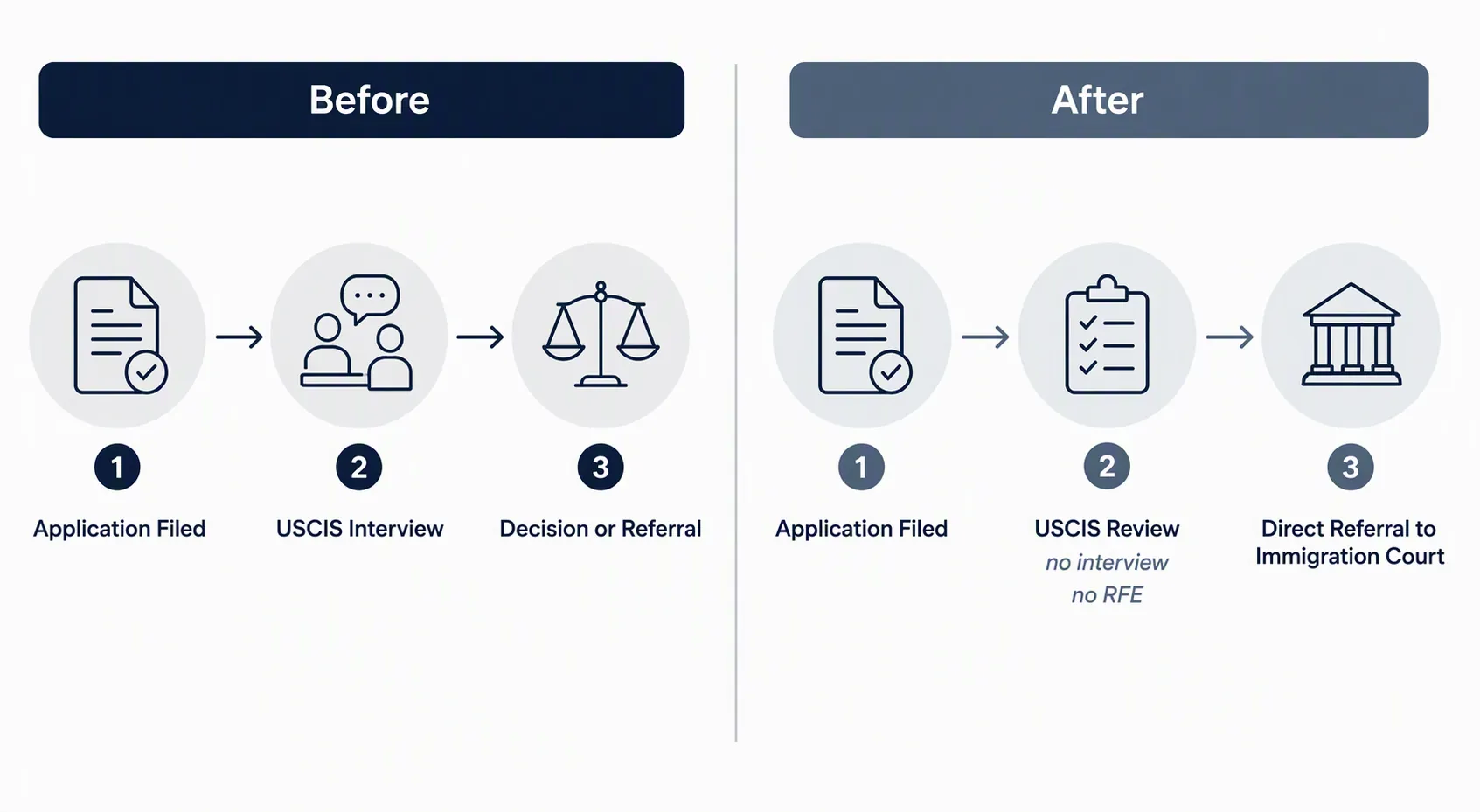
On July 28, 2026, USCIS published an interim final rule that changes a deceptively practical part of affirmative asylum practice: the agency may now refer certain Form I-589 cases to immigration court without first interviewing the applicant and without issuing a Request for Evidence. The rule applies not only to future filings, but also to pending cases that have not yet been scheduled for an initial interview.[1]
For applicants and their lawyers, the most important sentence is not the agency’s efficiency rationale. It is the revised warning USCIS says will appear in the Form I-589 instructions: the application “may be the only opportunity to meet his or her burden.”[1] That sentence turns a filing package into something closer to a first merits record. If USCIS removes the interview from the affirmative process, the old assumption that a client will later sit with an asylum officer and explain missing chronology, trauma-related gaps, translation errors, deadline exceptions, or corroboration problems becomes unsafe.

This is not legal advice, and one day after publication it is not a prediction about how every asylum office will use the new authority. No implementation guidance, litigation pattern, or judicial stay exists yet. The ethics question is narrower and more immediate: once counsel knows the interview may not happen, can the same intake checklist, filing memo, engagement letter, and client update practices still satisfy the duties of competence, diligence, and communication?
What USCIS Changed
The interim final rule, titled “Affirmative Asylum Referrals Without Interview,” amends the affirmative asylum process so that USCIS may refer cases directly to immigration court in defined circumstances instead of conducting the usual non-adversarial interview first.[1] USCIS described the change publicly as a way to address workload and refer cases that the agency views as unsuitable for interview-based adjudication.[2]
The agency estimates that 444,724 pending cases, or 31% of an approximately 1.43 million-case affirmative asylum backlog, may be affected. It also estimates that about 132,167 future annual applicants could fall within the new referral authority.[1] Those figures do not tell counsel which individual client will be referred, but they do tell counsel that this is not a marginal administrative adjustment affecting a few outlier files.
| Before the rule | After the rule |
|---|---|
| Form I-589 filed; applicant ordinarily expected an asylum-office interview before referral. | Form I-589 filed; USCIS may review the written record and refer without interview in covered categories. |
| The interview often functioned as the place to explain deadline exceptions, clarify inconsistencies, and add oral testimony. | The written application may have to carry those explanations before any live testimony occurs. |
| A referral sent the case to immigration court after the affirmative interview process. | A referral may send the case to immigration court without the applicant first speaking to an asylum officer. |
The rule does not eliminate asylum. It does not eliminate immigration-court review. A referred applicant may still present the claim de novo before an immigration judge. But the procedural setting changes in a way that matters for lawyering. The USCIS asylum interview is non-adversarial; immigration court is adversarial, with DHS counsel present.[3] Treating de novo review as a complete cure ignores what applicants lose when the first live opportunity to explain the case moves from an asylum office to a contested removal proceeding.
The Old Backstop Was Never Just Paperwork
A written asylum application has always mattered. The change is that the interview could previously absorb some human messiness before the case moved into court. A client who filed late might explain changed or extraordinary circumstances. A client whose statement used approximate dates might clarify them. A client whose declaration was skeletal because the intake was rushed, the interpreter was weak, or the trauma narrative emerged slowly might still have had a structured chance to speak to an asylum officer before referral.
The Federal Register history makes that point harder to dismiss. In the 1994 rulemaking, the government had considered making affirmative asylum interviews discretionary, then stepped back and concluded that streamlining goals could be met without changing the interview rule.[1] That history does not freeze the agency’s authority in place. It does show that interviews were not always treated as a harmless scheduling step. They were part of the substantive design of the affirmative process.
The current rule removes that assumption for covered cases. A lawyer who continues to draft the I-589 as if the interview will repair omissions is no longer making a mere tactical choice. The lawyer is choosing to let the first tribunal-ready record be thinner than the lawyer knows it may need to be.
Who Is Most Exposed
The rule’s practical risk is not evenly distributed. It is sharpest where the written record is likely to be incomplete, internally strained, or dependent on explanation. The Federal Register’s one-year filing deadline discussion is a useful example. DHS reports that, historically, about 77% of untimely-filed asylum referrals were based on the one-year filing deadline even after an interview. That point supports the agency’s view that interviews often did not change the outcome for that group. But the remaining approximately 23% matters professionally: those were the cases in which an interview may have helped surface or test changed or extraordinary circumstances.[1]
Another group requires different attention: pending one-year filing deadline cases filed 10 or more years after last entry. DHS estimates that approximately 129,525 such pending cases exist and states that this group often uses the affirmative asylum process as a pathway into removal proceedings for cancellation of removal.[1] Counsel should not translate that observation into an assumption about any individual client’s purpose or eligibility. But it does signal that very late-filed cases are likely to be among the files USCIS reviews closely for direct referral.
A third exposure category is harder to quantify because DHS says estimates are “not available” for applicants who are not eligible on the merits.[1] That absence is not comforting. It means counsel cannot rely on a published denominator to identify the scale of merits-based referral risk. Weak nexus analysis, unclear protected-ground evidence, country-conditions gaps, or thin corroboration may now reach immigration court before the applicant ever gives oral testimony to USCIS.
The court side of the transfer is not a clean acceleration device. Immigration courts already face a backlog reported at about 3.57 million cases for Q2 FY2026.[1][4] Direct referral may move a file out of the asylum office, but it does not necessarily move the person toward quick adjudication. It changes the forum, the procedural posture, and the professional responsibility problem.
Diligence Now Starts Earlier
Model Rule 1.3 is where the filing workflow changes most visibly. Diligence in this setting is not simply filing before the deadline and waiting for the interview notice. If the written I-589 may be the only pre-referral opportunity to meet the burden, then counsel has to decide what must be investigated, translated, corroborated, and explained before submission.
That does not mean every application must become a trial brief. It does mean that known vulnerability points should not be parked for later without a documented reason. A late filing needs its changed-or-extraordinary-circumstances theory identified in the written record when possible. A prior inconsistent statement needs a client-reviewed explanation. Missing police, medical, family, party-membership, religious, or identity documents need either corroboration or an account of why corroboration is unavailable. Discretionary equities should not be left entirely oral if USCIS can refer before asking a single question.
The RFE point is especially important. Practical analyses of the rule have emphasized that USCIS may refer without issuing a Request for Evidence.[5] Counsel therefore cannot treat an RFE as the expected intermediate warning that the file is underdeveloped. If the case has a deadline problem, a statutory bar concern, a discretionary issue, or a merits gap, the time to create a record of counsel’s investigation is at filing, not after the agency signals discomfort.
A defensible diligence file should show more than a completed form. It should show what the lawyer asked, what the client could answer, what documents were requested, what documents were unavailable, what translation issues were resolved, and what advice was given about the consequences of filing a thin record. That documentation protects the client first. It also protects the lawyer who may later be judged by a disciplinary reviewer reading a cold file after the interview never occurred.
Communication Means Telling Pending Clients That Silence Has Changed
Model Rule 1.4 requires more than updating a template paragraph for new clients. The rule applies retroactively to pending cases that have not yet been scheduled for an initial interview.[1] Those clients may have been told, explicitly or by implication, that the next meaningful step would be an asylum-office interview. Some may have delayed supplementing declarations or gathering records because everyone expected a later chance to explain.
Those clients need a direct communication that the procedural meaning of waiting has changed. Silence from USCIS no longer preserves the same expected future opportunity to testify before referral. A pending applicant who believes “I will explain it at the interview” may now be relying on a step the agency can bypass.
The communication should be practical rather than alarmist. Clients need to know whether their case has been scheduled for an initial interview, whether the file contains known one-year-deadline issues, whether the written declaration explains the central facts, whether supporting evidence is still outstanding, and whether a supplement should be prepared. They also need to understand the difference between USCIS referral and final denial: referral moves the case to immigration court, where the claim may be heard de novo, but in an adversarial setting.
For counsel, the record of communication matters. A case-management note saying “rule update sent” may not be enough if the client’s file plainly depends on oral explanation. The better record identifies the client-specific issue, the advice given, the documents or declaration supplement requested, the deadline for response, and any limitations on what counsel can do before USCIS acts.
Competence Requires Category-Specific Filing Judgment
Model Rule 1.1 does not require every immigration lawyer to predict unpublished implementation guidance. It does require counsel to understand the referral categories well enough to prepare the I-589 record for the risk USCIS has announced. Practical summaries of the rule identify four broad referral paths: cases involving a bar to applying, cases involving a bar to granting asylum, cases viewed as not eligible on the merits, and cases where USCIS may deny as a matter of discretion before reaching eligibility.[5]
- Bar to apply: the filing should address the one-year deadline and any changed or extraordinary circumstances when the issue is present.
- Bar to grant: the filing should identify facts that could trigger statutory bars and document counsel’s inquiry into them.
- Merits eligibility: the filing should connect the harm, protected ground, government action or inability to protect, and country evidence with enough clarity that the claim is intelligible without oral testimony.
- Discretion-first denial: the filing should not leave positive equities, family ties, rehabilitation, vulnerability, or humanitarian considerations entirely outside the written record when discretion is foreseeable.
Competence here is not a demand for perfection. Asylum records are often built under pressure, with frightened clients, incomplete documents, unstable housing, limited interpretation access, and facts that emerge gradually. The ethical failure is not that a record lacks every possible exhibit. The failure is proceeding as if the old interview structure still exists after the lawyer knows the agency may refer without using it.
A competent filing process after this rule should include an intake question for each referral category, a documented one-year-deadline analysis, a consistency review across the I-589, declaration, prior immigration filings, and known government records, and a client-facing explanation of what cannot be fixed later if USCIS refers immediately. Firms handling volume asylum work should also revisit who is authorized to decide that a case is “ready to file.” That decision now carries more evidentiary weight than it did when the interview was treated as the next substantive checkpoint.
What Not to Overread
The rule is new. The affected pending-case estimate is based on December 2025 data, and actual referral patterns will depend on implementation choices USCIS has not yet published.[1] It is too early to say how often asylum offices will use direct referral, how consistently categories will be applied, or what litigation will do to the rule.
It is also easy to dilute the professional-responsibility point by turning immediately to every adjacent policy issue. Employment authorization rules, the annual asylum fee, and the political debate over asylum processing all affect the same population in important ways. They do not answer the narrower question confronting counsel today: whether the file being submitted, or the file already pending, can stand as the applicant’s only pre-referral burden-carrying record.
The First Ethics Checkpoint Is Now the I-589 File
Applicants referred without interview still retain de novo review before an immigration judge. That matters. It keeps the rule from being a final adjudication on the papers alone. But it does not erase the lost asylum-office interview, the lost chance to clarify facts in a non-adversarial setting, or the possibility that a weak written record will shape the posture of the case before DHS counsel ever appears.
The immediate ethical response is therefore concrete: stronger pre-filing diligence, direct communication with pending and new clients, and category-specific documentation in the I-589 record. Until implementation guidance narrows the field, competent representation depends on treating the written asylum file as potentially decisive from the moment of filing.
References
- Affirmative Asylum Referrals Without Interview, Federal Register, July 28, 2026.
- USCIS News Release, U.S. Citizenship and Immigration Services, July 27, 2026.
- #AfghanEvac Explainer, #AfghanEvac.
- LA Times asylum backlog reporting, Los Angeles Times, July 27, 2026.
- Gozel Law blog analysis, Gozel Law.
Operationalizing workflow
No workflow has been explicitly linked to this obligation yet. See Workflows generally.
Illustrative cases
No illustrative case is currently tracked for this obligation. See Risk Digest for documented incidents generally.
← Back to RegulationReport a correction or tip
Spotted an outdated figure, a misstated fact, or a ruling this regulation entry should reflect? Public comments are disabled for this content given the professional cost of a misreported case outcome, penalty amount, or rule text — use the structured correction channel instead.
Report a correction or tip for this record →