
USDA meat processing exemptions for farmers and ranchers
- Authority
- USDA Food Safety and Inspection Service (FSIS)
- Rule type
- regulation
- Jurisdiction scope
- US federal
- Effective date
- May 28, 2026
- Source text
- Read primary rule text ↗
Custom-exempt meat is owner-use only with no resale; retail-exempt sales are limited to the processor's own storefront and one same-owner store; inspected slaughter is still required.
For a farmer or rancher, the first question is not whether a processor calls a job “exempt.” It is who will buy the meat and where the sale will occur. The two relevant paths lead to very different destinations:
| Path | Who owns the animal or meat? | Where can the meat go? |
|---|---|---|
| Custom-exempt | The customer owns the live animal before slaughter and receives the meat for personal use. | The product cannot be resold. |
| Retail-exempt | The processing establishment sells meat through its own retail operation. | Its own storefront, one additional store under the same ownership, and the limited uncooked, unprocessed HRI channel described below. |
That comparison is the decision frame. Custom-exempt processing is fundamentally an owner-use arrangement. Retail-exempt processing is a narrowly bounded processor-retail arrangement. Neither route is a general permission for a producer to process meat and sell it wherever customers happen to be.

Custom-exempt processing follows the owner, not the marketplace
Under the custom-exempt path, the person receiving the meat must own the live animal before it is slaughtered. The resulting product is for that owner’s personal use, and it cannot be resold. The arrangement can therefore fit a customer who buys an animal, sends it to a custom processor, and takes home the meat. It does not fit a farmer who wants to send privately owned livestock to a processor, collect packaged cuts, and then offer those cuts at a farmstand or farmers market. The owner-use condition is what controls the transaction, not the fact that the animal came from the farmer’s own herd. [1]
This is where casual processor language can create an expensive misunderstanding. “Custom” may describe the processing order, but it does not turn the resulting meat into inventory for resale. A producer planning retail sales needs to identify the buyer before signing the processing contract: is the buyer the animal owner receiving meat for personal use, or is the producer retaining meat to sell to unrelated customers? Those are different transactions.
Custom-exempt also does not mean that the plant is outside all inspection or statutory oversight. The Niche Meat Processor Assistance Network summary describes periodic, risk-based FSIS or state inspection of custom-exempt plants and identifies compliance obligations under the Federal Meat Inspection Act, the Poultry Products Inspection Act, and the Humane Methods of Slaughter Act. The exact state requirements still need to be confirmed for the operation and location in question.[1]
Retail-exempt processing is a processor’s retail route
Retail-exempt processing addresses a different business model. The processing establishment may sell its products through its own retail storefront and through one additional store, provided that store is under the same ownership. The route can also include sales to hotels, restaurants, and institutions, but the described HRI channel is limited to uncooked, unprocessed product. The exemption therefore attaches to a defined retail operation and its permitted outlets; it is not a transferable label that a farmer can apply to any later sale. [2]
That ownership detail matters. A processor’s own storefront is not the same thing as a farmer’s farmstand. A second store under the same ownership is not the same thing as an independent retailer buying product for resale. And a restaurant or institution receiving permitted product is not a blanket authorization for every kind of prepared or further-processed item.
The Oregon State University guide specifically describes the farmers-market restriction in this framework, but it is an Oregon-specific, undated guide, and the relevant sentence is truncated in the supplied version. That makes the farmers-market point useful as a warning about the proposed sales model, not a substitute for checking the governing rule in every state. A producer should not treat the guide as nationwide legal clearance. [2]
The practical test is straightforward: if the farmer owns the meat and plans to move it through a farmstand, farmers market, or another retailer, the processor’s retail-exempt status does not automatically make that sale permissible. Ask instead who owns the processing establishment, who owns any second store, and which entity is making the sale to the final customer.
The slaughter inspection happens upstream
A retail exemption does not remove the need for inspected slaughter. The Oregon guide describes retail-exempt establishments as processing meat from federally or state-inspected slaughter. In other words, the exemption concerns the qualifying processing and retail activity; it does not mean that slaughter inspection disappears at the beginning of the chain. [2]
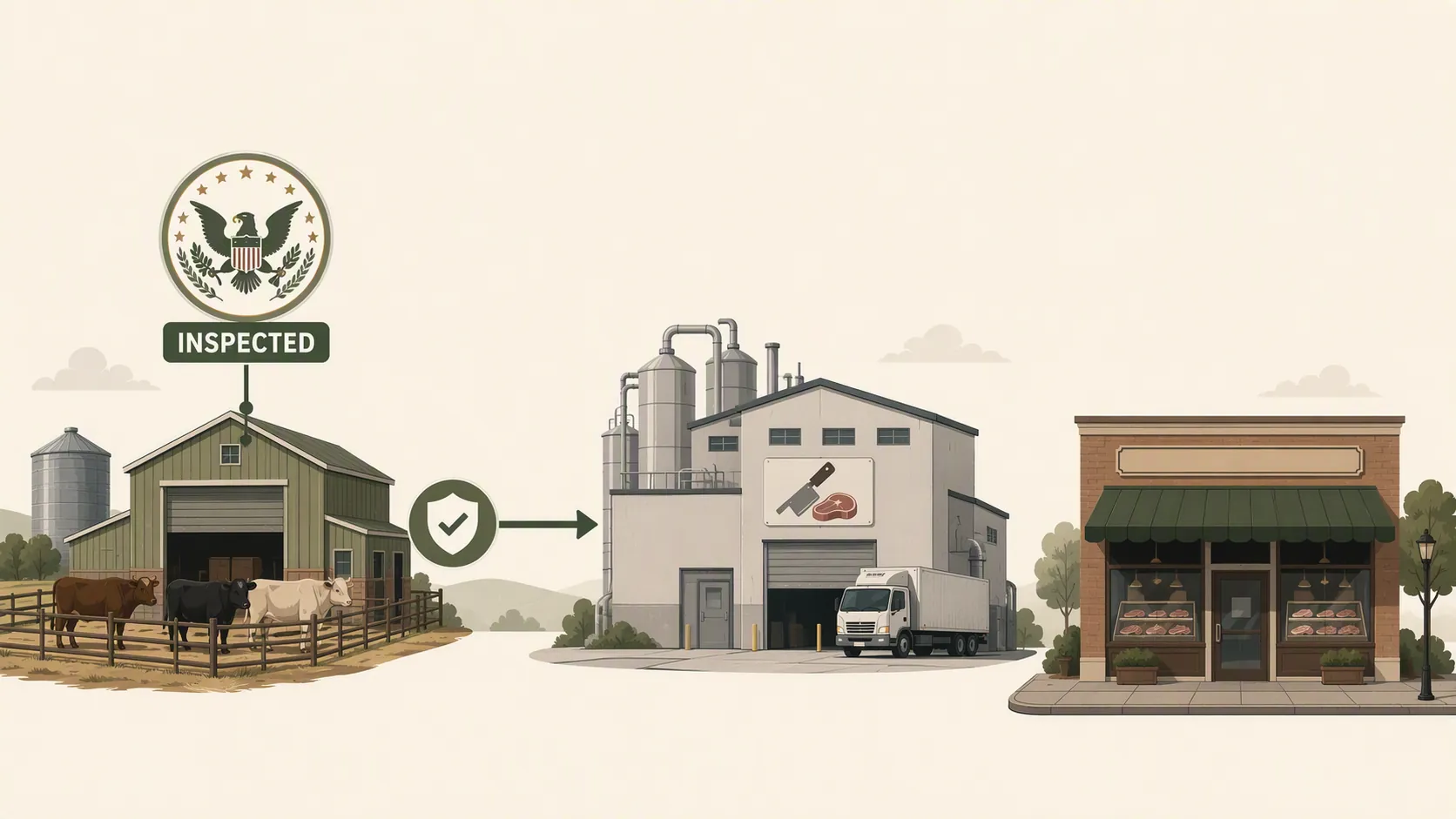
That creates a checkpoint before the processor’s work is even evaluated. The producer needs to know where slaughter will occur, whether that slaughter is federally or state inspected, and how the carcass will move to the processing establishment. A processor that can perform retail-exempt cutting or packaging cannot cure an upstream slaughter arrangement that does not meet the applicable inspection requirement.
What the 2026 dollar adjustment changes—and what it does not
The FSIS notice effective May 28, 2026, adjusted the retail-exemption dollar limitations for sales to hotels, restaurants, and institutions using the 2025 Consumer Price Index. The adjustment increased the meat ceiling by $6,000 and the poultry ceiling by $1,300. [3]
Those figures update a threshold; they do not expand the permitted sales locations, convert a custom arrangement into a retail one, or answer whether a particular farmers-market transaction is allowed. They also should not be treated as a resolution of the separate 2023 retail-exemption proposal. The status of that proposal is not established by the materials available here.
Four traps to test before signing with a processor
- A customer order is not the same as a retail inventory plan. If the customer owns the live animal before slaughter and takes the meat for personal use, the custom path may describe the arrangement. If the farmer keeps the meat to sell, the no-resale boundary is the immediate problem.
- A processor’s exemption does not automatically follow the farmer’s product. Meat processed through a retail-exempt establishment cannot simply be redirected to the farmer’s farmstand or farmers-market table because the farmer supplied the animal.
- A same-owner store is not an independent retailer. The retail route described in the research materials allows the processor’s own storefront and one additional store under the same ownership. Selling to another retailer requires a separate analysis and is not covered by that description.
- Processing inspection is not slaughter inspection. Confirm the inspection status of the slaughter facility before relying on a retail-exempt processing plan. The downstream exemption does not replace the upstream requirement.
Map the transaction before you map the equipment
Before paying a deposit or committing animals to a processing date, write down five things:
- Who owns the live animal immediately before slaughter?
- Who will own the meat after processing?
- Which establishment will slaughter and which will process?
- Who will make the sale to the customer, restaurant, institution, or retailer?
- Where will the sale occur: the processor’s storefront, a same-owner second store, a farmstand, a farmers market, or another location?
Then ask the processor to identify the exemption being used and the specific sale boundary it believes applies. Confirm the slaughter inspection status separately. Finally, verify the state-specific requirements with the relevant state authority before acting. This is a compliance decision, not individualized legal advice, and the available Oregon guide cannot answer every state’s rules.
References
Operationalizing workflow
No workflow has been explicitly linked to this obligation yet. See Workflows generally.
Illustrative cases
No illustrative case is currently tracked for this obligation. See Risk Digest for documented incidents generally.
← Back to RegulationReport a correction or tip
Spotted an outdated figure, a misstated fact, or a ruling this regulation entry should reflect? Public comments are disabled for this content given the professional cost of a misreported case outcome, penalty amount, or rule text — use the structured correction channel instead.
Report a correction or tip for this record →