
Tracking Legal Changes to Vaccine Mandates After the 2025 Measles Outbreak
- Authority
- State legislatures and governors
- Rule type
- Statute
- Jurisdiction scope
- US state
- Source text
- Read primary rule text ↗
Last verified for this article: July 24, 2026. This tracker is for legal-information and issue-spotting purposes only; it is not legal advice and should not substitute for jurisdiction-specific review of statutes, agency guidance, court dockets, and local implementation records.
The legal implications of the 2025 measles outbreak for vaccine mandates are no longer captured by a national yes-or-no answer. Counsel now has to distinguish enacted statutes from executive orders, announced plans from effective rules, and public-health recommendations from state-law obligations. That sorting matters because kindergarten MMR coverage fell from 95.2% in 2019-2020 to 92.5% in 2024-2025, leaving about 286,000 kindergartners at risk; CDC data also show 14 states with exemption rates above 5%, including Idaho at 15.4%.[1]

The table below treats each entry as an obligations record. A row does not mean the state action is legally equivalent to another row. Idaho’s enacted statute, West Virginia’s executive order, Florida’s announced phased plan, and Oregon’s statutory backstop sit in different legal categories and should be briefed that way.
Jurisdiction Tracker
| State | Type of action | Mandate direction | Affected setting | Citation or source | Signed or announced date | Effective date | Litigation status | Enforcement outlook |
|---|---|---|---|---|---|---|---|---|
| Idaho | Enacted statute, SB 1210 | Rollback; prohibits schools and businesses from requiring a “medical intervention” as a condition of enrollment or employment | Schools and businesses | Politico report on SB 1210[2] | Signed April 2025 | Not specified in the provided source material | No specific pending challenge identified in the provided source material | Strongest rollback posture in this source set because the action is statutory, but counsel still needs the enrolled bill, effective-date clause, and any implementing guidance before advising on a concrete policy |
| West Virginia | Executive order | Rollback; permits religious or personal exemptions from a prior medical-exemption-only school policy | School immunization requirements | KFF review of recent changes to school vaccine requirements[3] | January 2025 | Not specified in the provided source material | Litigation ongoing; legislature rejected codifying legislation | Unstable. The executive order may affect agency practice, but its durability is materially weaker than a statute because codification failed and litigation remains pending |
| Florida | Announced phased plan | Rollback; plan would remove school vaccine mandates and make Florida a no-mandate state if implemented as described | School immunization requirements | Pharmacy Times report on Florida Surgeon General announcement[4] | September 2025 | Plan includes a 90-day delay and phased implementation; specific enforceable dates require record-level confirmation | Legal challenge reported in the provided source material | Unstable. Treat as announced policy direction unless and until the operative legal instruments, effective dates, and litigation posture are verified |
| Oregon | Enacted statute, SB 1598 | Backstop; preserves vaccine coverage by locking in federal agency definitions as of June 30, 2025 and allowing state public health officer recommendations | State vaccine coverage and immunization policy references | CIDRAP report on state vaccine policy[5] | Passed March 2026 | Not specified in the provided source material | No Oregon-specific challenge identified in the provided source material | Comparatively stable as a statutory backstop, though implementation depends on state agency administration and any subsequent amendments |
| Colorado | Enacted statute, SB 32 | Backstop; delinks state immunization coverage from shifting federal ACIP determinations | State vaccine coverage and immunization policy references | CIDRAP report on state vaccine policy[5] | Reported in March 2026 source material | Not specified in the provided source material | No Colorado-specific challenge identified in the provided source material | Statutory backstop posture. Counsel should verify the bill text and effective-date provision before treating coverage as fixed for a particular policy |
| Washington | Enacted statute, HB 2242 | Backstop; delinks state immunization coverage from shifting federal ACIP determinations | State vaccine coverage and immunization policy references | CIDRAP report on state vaccine policy[5] | Reported in March 2026 source material | Not specified in the provided source material | No Washington-specific challenge identified in the provided source material | Statutory backstop posture. The key question for counsel is how the state incorporates federal recommendations after the effective date |
| California | Existing statutory-policy posture | Preservation; remains a medical-exemption-only state for school vaccine exemptions | School immunization requirements | KFF review identifying remaining medical-exemption-only states[3] | Not a 2025-2026 rollback record in the provided source material | Existing posture; date not specified in the provided source material | No California-specific challenge identified in the provided source material | Preserved mandate posture in this tracker. Do not classify as a new backstop statute unless a separate enacted record is verified |
| Connecticut | Existing statutory-policy posture | Preservation; remains a medical-exemption-only state for school vaccine exemptions | School immunization requirements | KFF review identifying remaining medical-exemption-only states[3] | Not a 2025-2026 rollback record in the provided source material | Existing posture; date not specified in the provided source material | No Connecticut-specific challenge identified in the provided source material | Preserved mandate posture in this tracker. Verify current agency guidance before advising a school client on exemption processing |
| Maine | Existing statutory-policy posture | Preservation; remains a medical-exemption-only state for school vaccine exemptions | School immunization requirements | KFF review identifying remaining medical-exemption-only states[3] | Not a 2025-2026 rollback record in the provided source material | Existing posture; date not specified in the provided source material | No Maine-specific challenge identified in the provided source material | Preserved mandate posture in this tracker. Treat as a current baseline, not as a new 2025-2026 enactment |
| New York | Existing statutory-policy posture | Preservation; remains a medical-exemption-only state for school vaccine exemptions | School immunization requirements | KFF review identifying remaining medical-exemption-only states[3] | Not a 2025-2026 rollback record in the provided source material | Existing posture; date not specified in the provided source material | No New York-specific challenge identified in the provided source material | Preserved mandate posture in this tracker. Counsel should still verify local school implementation and any pending state-court activity |
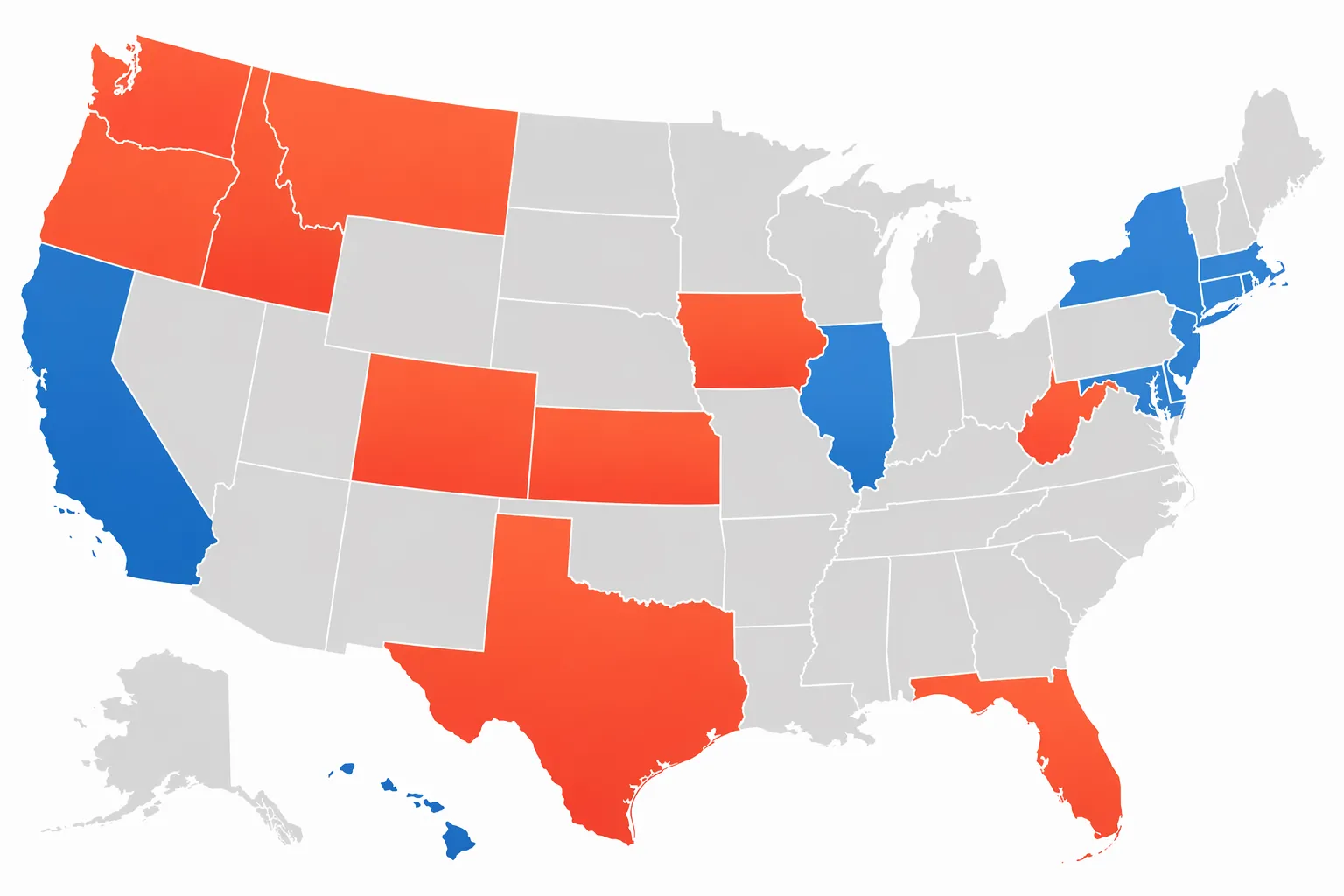
The table counts ten jurisdictional records, but only some are rollbacks. Idaho, West Virginia, and Florida point toward mandate weakening; Oregon, Colorado, and Washington point toward statutory insulation from federal recommendation volatility; California, Connecticut, Maine, and New York remain important because they preserve the medical-exemption-only model rather than following the new rollback pattern.[2][3][4][5]
How To Read The Legal Posture
For a multi-state memo, the first dividing line is not pro-vaccine versus anti-mandate. It is whether the source changes enforceable law today. A statute generally deserves more reliance than an executive order. An executive order deserves more caution when the legislature refuses to codify it. An announcement deserves still more caution when implementation is delayed, phased, or already challenged.
That is why Idaho and West Virginia should not be summarized in the same sentence. Idaho’s SB 1210 is described as a first-in-the-nation statutory ban on schools and businesses requiring a medical intervention as a condition of enrollment or employment.[2] West Virginia’s January 2025 move is an executive order that altered a century-old medical-exemption-only posture, but the state House rejected codifying legislation and litigation is ongoing.[3] A client may care about both, but the reliance analysis is different.
Florida requires a separate label again. The reported September 2025 plan would remove school vaccine mandates after a 90-day delay and through phased implementation, which is not the same as an already-effective statutory repeal.[4] If a school, employer, or health system is asking whether it may change a policy now, counsel should ask for the operative instrument, the phase that applies to the setting, and the current docket status before treating the announced plan as enforceable.
Effective Dates Are Not Administrative Detail
In vaccine-mandate work, an effective date can decide whether a student is excluded, whether an employee accommodation process remains intact, or whether a hospital policy is still defensible. The source set here does not provide every effective-date clause. That absence is not harmless; it is a verification task. A tracker that cannot distinguish “signed,” “announced,” “passed,” and “effective” will overstate the law.
- For an enacted bill, verify the enrolled version, governor action, effective-date clause, codification location, and agency guidance.
- For an executive order, verify the order text, statutory authority, agency implementation, expiration or rescission terms, and any legislative response.
- For an announced plan, verify whether a rulemaking, statute, order, or agency directive actually exists.
- For pending litigation, verify whether a preliminary injunction, stay, settlement, or merits ruling changes enforcement.
Federal Recommendations Still Matter, But They Do Not Rewrite State Law
Federal vaccine recommendations can move state systems indirectly. The March 2026 CIDRAP source describes state responses to ACIP-related volatility, including Oregon SB 1598, Colorado SB 32, and Washington HB 2242, each aimed at preventing state vaccine coverage from rising or falling automatically with federal recommendation changes.[5] That is a practical warning for counsel: a federal recommendation change may affect insurance coverage, agency references, and political pressure, but it does not by itself repeal a state school-entry requirement.
Oregon’s SB 1598 is the cleanest example in this source set. It locks in vaccine coverage based on federal agency definitions as of June 30, 2025, and lets the state public health officer recommend covered vaccines independently.[5] That is not a rollback. It is a legal backstop designed to keep state coverage rules from becoming hostage to later federal recommendation changes.
The federal-state distinction is also where briefing language can get sloppy. “CDC changed its recommendation” is not the same as “the state mandate changed.” “ACIP is under challenge” is not the same as “a school may stop enforcing state immunization requirements.” The safer formulation is narrower: federal developments may affect incorporated references and agency practice, and some states have responded by decoupling their own rules.
The Measles Context Explains The Pressure
The public-health backdrop is not just atmosphere. The CDC’s MMR coverage decline and exemption data explain why school-entry rules are receiving renewed legal scrutiny.[1] A Stanford JAMA model summarized by CIDRAP projected that a 15% decline in vaccination could produce 1 million measles cases over 25 years.[6] That projection is a model, not a count of actual cases and not proof that any specific state law caused a specific outbreak, but it shows why small shifts in coverage assumptions are not merely theoretical.
The legal movement is also organized. The Medical Freedom Act Coalition is described as a 19-state coordinated strategy for anti-mandate legislation.[7] That fact should not be converted into a claim that all 19 states enacted the same rule, or that each has the same litigation risk. It does explain why counsel should expect similar bill language, exemption language, or “medical intervention” framing to appear across jurisdictions.
Workplace lawyers have a separate operational problem. CDC HAN-00522, issued in March 2025, addressed measles exposure management, and employment counsel analyzing workplace policies treated prevention, prophylaxis, and exposure response as live operational questions.[8] That advisory context does not create a private employer mandate, but it affects how hospitals, schools, and employers evaluate exclusion, leave, accommodation, and exposure-response protocols.
What Counsel Can Safely Say Today
A defensible ten-minute answer should be modest. Idaho has a sourced statutory rollback record. West Virginia has a sourced executive-order rollback record with uncertain durability and ongoing litigation. Florida has a sourced announced rollback plan with delayed, phased implementation and a legal challenge. Oregon, Colorado, and Washington have sourced statutory backstop records responding to federal recommendation instability. California, Connecticut, Maine, and New York remain sourced medical-exemption-only states.[2][3][4][5]
What counsel should not safely say from this source set is just as important. Do not say every highlighted state has repealed mandates. Do not say federal ACIP changes automatically alter state school-entry rules. Do not say an announced plan is effective law. Do not say pending litigation is irrelevant unless the docket confirms no injunction, stay, or operative order affects enforcement.
Post-2025 vaccine-mandate law is now a state-by-state obligations problem. Any reliable answer depends on record-level verification, effective-date tracking, and litigation updates.
References
- Measles Cases and Outbreaks, CDC.
- States loosen vaccine rules — even as measles outbreak rages, Politico.
- A Look at Recent Changes to State Vaccine Requirements for School Children, KFF.
- Measles Outbreak Update: Florida Surgeon General Announces Plan to Remove Vaccine Mandates in Schools, Pharmacy Times.
- The State of US Vaccine Policy — Mar 5, 2026, CIDRAP, Mar. 5, 2026.
- ‘Precipice of disaster’: Measles may be endemic in 25 years if vaccine uptake stays low: Model, CIDRAP.
- Legal Underpinnings of the Great Vaccine Debate of 2025, PMC.
- Measles in 2025: Prevention, Prophylaxis, and Workplace Policies, Ogletree Deakins.
Operationalizing workflow
No workflow has been explicitly linked to this obligation yet. See Workflows generally.
Illustrative cases
No illustrative case is currently tracked for this obligation. See Risk Digest for documented incidents generally.
← Back to RegulationReport a correction or tip
Spotted an outdated figure, a misstated fact, or a ruling this regulation entry should reflect? Public comments are disabled for this content given the professional cost of a misreported case outcome, penalty amount, or rule text — use the structured correction channel instead.
Report a correction or tip for this record →